

News
Exclusive analysis articles with the latest market updates, and real-time news feeds.

China’s Spodumene Imports Rise 7% MoM in September, with Australia, Nigeria and Zimbabwe the Top Three Sources
According to compiled Chinese customs data, China imported 970,100 physical tonnes of spodumene in September 2026, up approximately 7.0% from 906,600 tonnes in August. Based on the classification and assumed grades, moisture content and conversion factors used in this analysis, September imports represented approximately 81,300 tonnes of lithium carbonate equivalent (LCE). By origin, imports from Australia, Nigeria and Zimbabwe increased significantly. Australia remained the largest supplier, with shipments to China reaching 446,200 tonnes, up approximately 36.7% month on month and accounting for around 46.0% of total imports. Nigeria became the second-largest supplier at 189,800 tonnes, up approximately 40.1%, while imports from Zimbabwe rose approximately 83.0% to 136,500 tonnes. Imports from South Africa fell approximately 49.6% to 112,400 tonnes, whereas imports from Brazil increased approximately 30.9% to 81,200 tonnes. Smaller volumes came from Burundi, Rwanda and Mozambique, at approximately 1,800 tonnes, 1,300 tonnes and 1,000 tonnes, respectively, with limited shipments from Zambia and Somalia. No imports from Mali or Canada appeared in the September dataset. Overall, China’s spodumene imports continued to grow in September, with the composition shifting toward concentrate. Under the classification used in this analysis, concentrate imports reached approximately 688,800 tonnes, accounting for 71.0% of total physical imports, compared with 60.7% in August. Raw ore imports stood at approximately 281,300 tonnes. Increased concentrate imports from Australia, Zimbabwe and Nigeria offset lower imports from Mali and Canada, providing the main support for growth in China’s imported lithium resource supply during the month.
Oct 20, 2026 19:03 (GMT+8)
[SMM Analysis] Hoa Phat’s record HRC sales reshape Vietnam’s self-sufficiency and China’s export flows
Hoa Phat sold 5.47 Mt of hot-rolled coil in January to September, up 59% and about a third of Vietnam’s consumption, with 24.6% of third-quarter sales exported. Vietnam’s HRC demand of about 17.3 Mt this year still exceeds local output of about 10.8 Mt by 6.5 Mt, and new capacity arrives mainly after 2027. Anti-dumping duties have pushed mainstream Chinese coil out of Vietnam; Chinese mills now face Vietnamese coil in ASEAN and other third markets.
Oct 20, 2026 14:36 (GMT+8)
China's Rare Earth Magnet Exports Hit Record in September, Driven by Backlog Release and Regulatory Easing【SMM Analysis】
China’s September rare earth magnet exports hit a record 6,165 tonnes (+23% MoM), driven by clearance of July–August port backlogs, not new demand. US-China talks unblocked shipments, while EU “green channel” talks lifted Q4 forecast to ~5,700 tonnes/month. Large producers recovered fastest; small mills remain constrained.
Oct 20, 2026 16:06 (GMT+8)
Latest News
![Titanium product divergence continues, weak market pattern highlighted [SMM Titanium Weekly Review]](https://imgqn.smm.cn/usercenter/hSSxt20251217171722.jpeg)
Titanium product divergence continues, weak market pattern highlighted [SMM Titanium Weekly Review]
Oct 23, 2026 14:40 (GMT+8)
![Sulphuric Acid Continues Post-Holiday Rise, Regional Changes Further Diverge [SMM Sulphuric Acid Weekly Review]](https://imgqn.smm.cn/usercenter/NPpAM20251217171723.jpeg)
Sulphuric Acid Continues Post-Holiday Rise, Regional Changes Further Diverge [SMM Sulphuric Acid Weekly Review]
Oct 23, 2026 13:31 (GMT+8)

Apple commits up to US$100 million to US titanium supplier
Oct 21, 2026 18:16 (GMT+8)
African mining: Power costs test local mineral-processing ambitions
[SMM Flash] African countries' plan to expand domestic mineral processing faces a shortage of affordable, reliable electricity. A Guinea government adviser at Africa Mining Week said the country would need 5,000–10,000 MW to support its industrialisation ambitions, compared with about 1,000 MW currently generated. Those figures describe a stated requirement, not capacity already built.
Power is one of several conditions investors identified alongside secure mineral feedstock, stable policy, financing and buyers. The reporting helps explain why proposed refineries and smelters may take longer to develop than policy announcements suggest.
Oct 20, 2026 15:22 (GMT+8)
Japan Launches Anti-Dumping Probe on Chinese Titanium Dioxide Pigments Impacting Exports
【SMM Titanium Flash】On October 16th, Japan's Ministry of Finance and Ministry of Economy, Trade and Industry announced that they had initiated an anti-dumping investigation into products such as pigments made from Chinese-produced rutile titanium dioxide. These materials are used in automotive and architectural coatings, among others. Japan claims that the low import prices may have caused damage to domestic industries. The investigation is expected to be completed within one year in principle, and the Japan Titanium Dioxide Industry Association submitted an application for the imposition of anti-dumping duties on August 7th. As the investigation progresses, Chinese exports of titanium dioxide to Japan may face trade remedy pressure, and relevant enterprises need to pay attention to the progress of subsequent rulings.
Oct 20, 2026 14:53 (GMT+8)
Titanium exports continue to diverge,with titanium dioxide exports turning from decline to increase, boosting the market
【SMM Titanium Flash】According to statistics from the General Administration of Customs, China's total imports of titanium concentrate in September 2026 amounted to 388,000 tons, marking a 33% decrease compared to the previous month. From January to September, the total imports of titanium concentrate reached 4.243 million tons, representing a cumulative year-on-year increase of 12.3%. Exports of titanium sponge in September amounted to 817 tons, marking a 15.4% increase compared to the previous month. From January to September, cumulative exports of titanium sponge reached 5,948 tons, representing a cumulative year-on-year increase of 12.8%. In September, a total of 176,000 tons of titanium dioxide were exported, representing a 22% increase compared to the previous month. From January to September 2026, the cumulative exports of titanium dioxide amounted to 1.533 million tons, marking a cumulative year-on-year increase of 13.8%.
Oct 20, 2026 13:16 (GMT+8)
Weak bullish support; titanium market expected to continue trend in the short term [SMM Titanium Spot Express]
[SMM Titanium Spot Express: Positive Support Lacks Momentum, Titanium Market Expected to Continue Trend in the Short Term] The phased improvement in titanium market demand failed to sustain, as end-user purchasing, pushing for lower prices, and wait-and-see sentiment continued to weigh on the market. In the short term, the titanium market is likely to remain in the doldrums.
Oct 19, 2026 17:22 (GMT+8)
Titanium Market Weekly in the Doldrums, Industry Chain Divergence Continues [SMM Titanium Weekly Review]
[SMM Titanium Weekly Review: Titanium Market Consolidates on a Weak Note This Week, Industry Chain Divergence Persists] The titanium market overall consolidated on a weak note this week. Titanium concentrates were in ample supply, with domestic growth combined with high imported inventory, low-priced cargoes weighing on the market, and downstream buyers pushing for lower prices, leaving ore prices under pressure. Titanium dioxide held steady, with improved orders in September driving production resumptions, but the "October peak season" failed to materialize, as new orders were few and transactions weak, with limited support from raw materials. Titanium slag consolidated on a weak note, with losses persisting, operating rates at low levels, downstream just-in-time procurement, and supply contraction finding a floor but unable to rise. Titanium sponge remained in the doldrums, with new capacity releases combined with production resumptions after maintenance creating significant supply pressure, while downstream buyers pushed for lower prices and transactions were thin. Titanium products showed a cold-hot divergence, with the civilian segment sluggish amid fierce price competition, while aerospace and military orders were full but provided limited boost. Overall, end-use demand has not fully recovered, with short-term divergence and a weak consolidation expected, and attention on post-holiday restocking and low-end capacity rationalization.
Oct 16, 2026 17:38 (GMT+8)
Nigeria's Ondo State Inks $362M Deal for West Africa's First Integrated Titanium Plant
【SMM Titanium Flash】On October 12th, the government of Ondo State, Nigeria, signed an agreement worth $362 million with PyVee Limited to build a titanium processing plant in the Ilaje Local Government Area, implemented through a public-private partnership model. Positioned as the first fully integrated titanium value chain processing plant in West Africa, the project will be advanced in two phases: the first phase involves an investment of approximately $12 million to build a commercial pilot plant, which is expected to be operational about 21 months after signing; the second phase involves the construction of a full-scale titanium processing complex. The state government participates by exchanging land for equity, and the project is expected to generate an annual economic value of over 300 billion naira for Ondo State. With the implementation of the project, Nigeria's participation in the global titanium processing industry is expected to increase.
Oct 16, 2026 15:56 (GMT+8)
Moma’s Q3 ilmenite output rebounds, but Kenmare cuts annual forecast
[SMM Titanium Flash] Kenmare Resources reported on 15 October that its Moma mine in Mozambique produced 233,600 tonnes of ilmenite in the third quarter, up 12% year on year and 59% from the second quarter. Finished-product shipments totalled 242,900 tonnes. Despite the rebound, Kenmare lowered its 2026 ilmenite production forecast to 710,000–750,000 tonnes from about 800,000 tonnes, citing continuing commissioning difficulties at Wet Concentrator Plant A.
Kenmare also expects full-year shipments of about 1.05 million tonnes, below its previous guidance of more than 1.1 million tonnes. Finished-product stocks rose to 284,200 tonnes at the end of September as production outpaced shipments. The company said titanium-feedstock prices remained pressured by surplus supply, particularly in China, and expects its average received ilmenite price to fall in the fourth quarter. Those shipment and price figures are forecasts, not completed results.
Oct 16, 2026 14:49 (GMT+8)
![Monthly pricing regions saw a decline at the start of the month; after the holiday, sulphuric acid prices were raised in many areas, and expectations are for relative stability this month [SMM Sulphuric Acid Weekly Review]](https://imgqn.smm.cn/usercenter/qbMSp20251217171722.jpeg)
Monthly pricing regions saw a decline at the start of the month; after the holiday, sulphuric acid prices were raised in many areas, and expectations are for relative stability this month [SMM Sulphuric Acid Weekly Review]
Oct 16, 2026 14:05 (GMT+8)

Ondo signs agreement for proposed Nigerian processing plant
Oct 15, 2026 14:49 (GMT+8)

Rio Tinto’s Q3 slag output falls 17%
Oct 14, 2026 15:20 (GMT+8)
US Energy and EXIM chiefs set for Elk Creek visit
[SMM Titanium & Niobium Flash] NioCorp announced that US Energy Secretary Chris Wright, Export-Import Bank chairman John Jovanovic, Nebraska Governor Jim Pillen and federal lawmakers are scheduled to visit the Elk Creek critical-minerals site on 14 October. The group is expected to tour mine-portal construction and receive briefings on the planned niobium, titanium, scandium and rare-earth products. NioCorp said EXIM is still reviewing its application for potential project debt financing.
The visit places a senior federal and financing delegation at a project intended to reduce US import dependence, but it is not an approval of funding or a final investment decision. NioCorp began a roughly US$44.6 million portal programme in February; that is pre-construction for underground access, while full mine construction and commercial output remain conditional on sufficient financing. Any policy or financing outcome should be reported only after the officials’ visit and a formal decision.
Oct 13, 2026 18:27 (GMT+8)
Titanium market lacks clear rebound support in the short term, and the market may remain stable going forward [SMM Titanium Spot Report]
[SMM Titanium Spot Express: Titanium Market Lacks Clear Rebound Support in the Short Term, and the Market Is Likely to Remain Stable] The rebound in sulphuric acid provides cost support, but titanium concentrates are under pressure, new orders fell short of expectations, and order growth may be overdrawn. The titanium dioxide market is likely to remain stable in the short term.
Oct 13, 2026 18:02 (GMT+8)
Kenmare confirms non-binding approach for Mozambique mine owner
[SMM Titanium Flash] Kenmare Resources confirmed on 6 October that International Resources Holdings had submitted a non-binding proposal for a possible cash offer for all Kenmare shares. Discussions are continuing, but no price or firm offer has been announced. Under Irish takeover rules, IRH must state a firm intention to bid or withdraw by 17 November unless the deadline is extended.
Kenmare operates Mozambique’s Moma mine, which produces titanium minerals including ilmenite and rutile. A change of ownership could affect future financing and development, but no acquisition has been agreed. Kenmare’s statement reported no change to Moma’s production plans.
Oct 13, 2026 00:14 (GMT+8)
Pre-holiday Stockpiling Drives Demand Recovery; Post-holiday New Orders See Limited Growth [SMM Titanium Spot Report]
[SMM Titanium Spot Express: Pre-holiday stockpiling drives demand recovery, limited growth in new orders after the holiday] The titanium dioxide market remained stable overall today. Titanium concentrates stayed weak while sulphuric acid rebounded slightly, creating divergent cost pressures. Producers focused on delivering existing orders, but domestic demand growth was limited, and the market is expected to consolidate in the short term.
Oct 09, 2026 17:37 (GMT+8)
UK proposes five-year duties on Chinese rutile TiO₂
[SMM Titanium Flash] The UK Trade Remedies Authority has published an initial recommendation for a five-year mixed anti-dumping duty on Chinese rutile titanium dioxide. Proposed rates are 48.29%, with a minimum of £0.665/kg for cooperating exporters, and 63.66%, with a £0.876/kg minimum for other exporters. The TRA found dumping and an imminent threat of injury; May 2026 imports were more than 299% of their May 2025 volume.
No duty has yet been imposed. Interested parties may comment until 26 October, after which the TRA will make a final recommendation to the Secretary of State. If adopted, the measure could support UK pigment producers facing rapidly rising Chinese imports, while raising sourcing costs or prompting supplier shifts for paint, plastics and paper manufacturers. The exact market effect depends on the minister’s decision and final scope.
Oct 08, 2026 21:03 (GMT+8)
Titanium Market Caught in A Stalemate After the Holiday, Downside Risks Linger
The titanium market remained under pressure but stable after the holiday, with weak domestic demand causing the September peak season to fall short of expectations and market confidence to be subdued. Policies and export orders provided modest support, but exports remained constrained by barriers. In the short term, the titanium market is consolidating in a stalemate, and the outlook depends on orders and the pace of destocking in mid-to-late October.
Oct 08, 2026 15:23 (GMT+8)
[SMM Titanium Macro Analysis] Titanium Market in Stalemate After Double Festivals, Short-Term Exports Become Key Observation Point
[SMM Titanium Macro Analysis: Titanium Market in Stalemate After the Double Holiday, Short-Term Exports Become Key Observation Point] During the National Day holiday, the titanium industry chain was under pressure overall. On the first trading day after the holiday, prices remained temporarily stable with no significant fluctuations. Upstream titanium concentrate supply was ample, titanium sponge continued to see inventory buildup, and quotations for all titanium dioxide product categories were stable. However, domestic end-use demand was weak, the September peak season fell short of expectations, and the market remained cautious about the October peak season. Some producers even took orders at low prices, undermining market confidence. Nevertheless, the suspension of anti-dumping measures on titanium dioxide by Europe and Asia, mortgage interest subsidy policies, and export orders brought some positive factors. However, the recovery in domestic demand remained sluggish, and anti-dumping measures in multiple overseas regions continued to constrain exports. In the short term, the titanium market is likely to maintain a fluctuating and stagnant trend, with downstream orders and the pace of destocking in mid-to-late October likely to determine the subsequent direction.
Oct 08, 2026 15:12 (GMT+8)
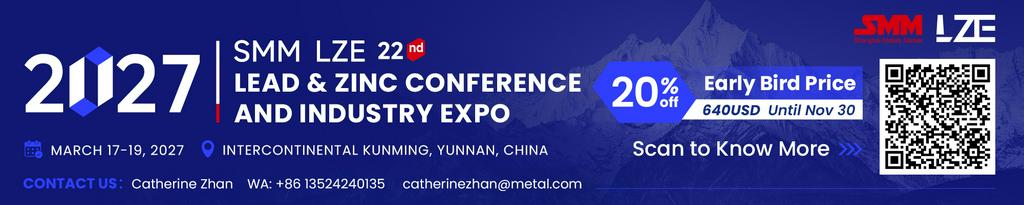
Early Bird Bookings Now Open for 2027 SMM LZE (22nd) Lead & Zinc Conference and Industry Expo in Yunnan next March
——From Conference to Expo · Doubled Scale · Full Upgrade—— [What This Article Brings You] ① Exhibition Introduction ② How to Register ③ First Batch of Exhibitors ④ Conference Agenda I. Doubled Scale, Full Upgrade! In 2026, lead and zinc face sharp volatility—elevated lead prices, scarce high-purity lead, record high LME low-grade lead stocks, lead-acid battery relocation from China to overseas, deeply negative zinc concentrate TCs, tight high-quality imported zinc ore, open export window for zinc ingots, and overseas zinc smelter buildout. The LZE covers market outlook, price forecast, equipment technology, recycling, and downstream applications—driving green transformation and win-win growth. What sets the 2027 (22nd) LZE apart from earlier events is its transformative upgrade: moving from a pure industry conference to a seamlessly combined conference and industry expo — deliver a larger-scale gathering, an expanded industry showcase and far-reaching involvement across the entire lead and zinc value chain. From industry trend analysis to in-depth industry chain exchanges, from upstream and downstream supply-demand matching to concentrated enterprise showcases, from a single industry conference to the further integration of "conference + industry expo"——in 2027, SMM LZE enters the "expo" era! The conference will embrace its 22nd edition with a larger scale, a richer industry lineup, and broader upstream and downstream participation! Scan the QR Code Below to Register as A Visitor for Free 1. Conference Scale Delegation: 6,000+ (up 71.4% from the previous edition) Companies: 2,000+ (up 100% from the previous edition) Exhibitors: 120+ (up 50% from the previous edition) Supply-demand matchmaking: 300+ (up 50% from the previous edition) Dedicated Forums: 7 (1 more than the previous edition) 2. Participant Groups 20% - Miners 23% - Smelters 22% - Processing enterprises 10% - Traders 5% - Lead-zinc end-user procurement 15% - Third-party equipment, technology, auxiliary materials, media, etc. 3% - Government, associations, university research institutions 2% - Financial and futures firms 3. Job Title Breakdown 4. Conference Highlights Price trends, consumption outlook, and policy interpretation Global dialogue on the lead-zinc industry and go-global strategies One-on-One Business Meetings Exploring Breakthrough Paths in Mining & Metallurgy Technology and Resource Recycling Showcase of Cutting-Edge Equipment and Consumables II. Four Identities, One Lead-Zinc Exhibition Whether you are here for market insights, procurement, showcasing or brand exposure, you will find a participation option that suits you. 1. Professional Visitors (Explore the exhibition for business opportunities and connect with the upstream and downstream of the industry) [Visitor Benefits] Exhibition Area Ticket On-site Check-in Gifts SMM Exclusive Lead-Zinc Industry Distribution Map Lead-Zinc Industry Visitor Exchange Group Group Benefits Tickets for Some Forums …… 2. Conference Delegates (Gain insights into new trends and discuss the lead-zinc market) [Delegate Benefits] Exhibition Area Ticket On-site Check-in Gifts SMM Exclusive Lead-Zinc Industry Distribution Map Lead-Zinc Industry Visitor & Conference Exchange Group Ticket for All Forums of the Conference Executive Dinner Voucher Lunch and Dinner Vouchers During the Conference Enterprise Directory Expert Reports 1-on-1 Supply-Demand Matching Post-Conference Field Trip Activities …… 3. Exhibitor (Step onto the industry stage and showcase your strengths) [18㎡ Custom Booth] [Benefits] Design & construction of all materials for the 18㎡ booth, tables, chairs, sofa & reception desk, TV, 5 conference passes, X-banner stand*1, conference booklet color page*1, LOGO display, multi-platform online exposure and promotion, supply-demand 1-on-1 matchmaking, long-term cooperation support from SMM, etc. [9㎡ Premium Booth] [Benefits] Design & construction of all materials for the 9㎡ booth, printed backdrop wall & reception desk & tables and chairs, TV, 3 conference passes, X-banner stand*1 or conference booklet color page*1, LOGO display, multi-platform online exposure and promotion, supply-demand 1-on-1 matchmaking, long-term cooperation support from SMM, etc. [6㎡ Standard Booth] [Benefits] Design & construction of all materials for the 6㎡ booth, one long table & two chairs, 2 X-banner stands with different content, 2 conference passes, multi-platform online exposure and promotion, supply-demand 1-on-1 matchmaking, long-term cooperation support from SMM, etc.
Oct 22, 2026 09:59 (GMT+8)

2027 Global Aluminum Supply-Demand Outlook: High Margins Drive Expansion, Shifting the Market from Tight to Loose
Oct 21, 2026 09:41 (GMT+8)

Chinese $6Billion Battery Investment in Morocco Reshapes EU Lithium Demand Amid Tariff Shifts
Oct 20, 2026 17:02 (GMT+8)

N-Type vs. P-Type Solar PV Modules: What Sets Them Apart, and Why Is N-Type Gaining Ground in the Global Market?
Oct 21, 2026 09:45 (GMT+8)
China’s Spodumene Imports Rise 7% MoM in September, with Australia, Nigeria and Zimbabwe the Top Three Sources
Oct 20, 2026 19:03 (GMT+8)
![[SMM Analysis] Hoa Phat’s record HRC sales reshape Vietnam’s self-sufficiency and China’s export flows](https://imgqn.smm.cn/usercenter/MhPNV20251217171716.jpg)
[SMM Analysis] Hoa Phat’s record HRC sales reshape Vietnam’s self-sufficiency and China’s export flows
Oct 20, 2026 14:36 (GMT+8)
China's Rare Earth Magnet Exports Hit Record in September, Driven by Backlog Release and Regulatory Easing【SMM Analysis】
Oct 20, 2026 16:06 (GMT+8)
Latest News
Titanium product divergence continues, weak market pattern highlighted [SMM Titanium Weekly Review]
Oct 23, 2026 14:40 (GMT+8)
Sulphuric Acid Continues Post-Holiday Rise, Regional Changes Further Diverge [SMM Sulphuric Acid Weekly Review]
Oct 23, 2026 13:31 (GMT+8)
Apple commits up to US$100 million to US titanium supplier
Oct 21, 2026 18:16 (GMT+8)
African mining: Power costs test local mineral-processing ambitions
Oct 20, 2026 15:22 (GMT+8)
Japan Launches Anti-Dumping Probe on Chinese Titanium Dioxide Pigments Impacting Exports
Oct 20, 2026 14:53 (GMT+8)
Titanium exports continue to diverge,with titanium dioxide exports turning from decline to increase, boosting the market
Oct 20, 2026 13:16 (GMT+8)
Weak bullish support; titanium market expected to continue trend in the short term [SMM Titanium Spot Express]
Oct 19, 2026 17:22 (GMT+8)
Titanium Market Weekly in the Doldrums, Industry Chain Divergence Continues [SMM Titanium Weekly Review]
Oct 16, 2026 17:38 (GMT+8)
Nigeria's Ondo State Inks $362M Deal for West Africa's First Integrated Titanium Plant
Oct 16, 2026 15:56 (GMT+8)
Moma’s Q3 ilmenite output rebounds, but Kenmare cuts annual forecast
Oct 16, 2026 14:49 (GMT+8)
Monthly pricing regions saw a decline at the start of the month; after the holiday, sulphuric acid prices were raised in many areas, and expectations are for relative stability this month [SMM Sulphuric Acid Weekly Review]
Oct 16, 2026 14:05 (GMT+8)
Ondo signs agreement for proposed Nigerian processing plant
Oct 15, 2026 14:49 (GMT+8)
Rio Tinto’s Q3 slag output falls 17%
Oct 14, 2026 15:20 (GMT+8)
US Energy and EXIM chiefs set for Elk Creek visit
Oct 13, 2026 18:27 (GMT+8)
Titanium market lacks clear rebound support in the short term, and the market may remain stable going forward [SMM Titanium Spot Report]
Oct 13, 2026 18:02 (GMT+8)
Kenmare confirms non-binding approach for Mozambique mine owner
Oct 13, 2026 00:14 (GMT+8)
Pre-holiday Stockpiling Drives Demand Recovery; Post-holiday New Orders See Limited Growth [SMM Titanium Spot Report]
Oct 09, 2026 17:37 (GMT+8)
UK proposes five-year duties on Chinese rutile TiO₂
Oct 08, 2026 21:03 (GMT+8)
Titanium Market Caught in A Stalemate After the Holiday, Downside Risks Linger
Oct 08, 2026 15:23 (GMT+8)
[SMM Titanium Macro Analysis] Titanium Market in Stalemate After Double Festivals, Short-Term Exports Become Key Observation Point
Oct 08, 2026 15:12 (GMT+8)