In mid-July, South Korea’s Ministry of Climate, Energy and Environment announced a proposed revision to bring ferrous and non-ferrous scrap, previously exempt from reporting, under the country’s waste export declaration system. The proposal is open for public consultation from July 16 to August 5 and is scheduled to take effect on January 1, 2027, after regulatory and legal reviews.
Since South Korea introduced its waste import and export declaration system in 2008, ferrous and non-ferrous scrap has generally remained exempt. Under the proposed rules, exporters would be required to submit documents including material composition analyses and export contracts, allowing regulators to track the actual movement of valuable secondary resources more closely.
The revision is mainly intended to curb misdeclaration. South Korean authorities have identified cases in which high-value materials, including electronic waste and copper scrap, were declared as ordinary ferrous scrap before being exported. One example cited was an August 2024 case involving copper scrap misdeclared as ferrous scrap and smuggled to China.
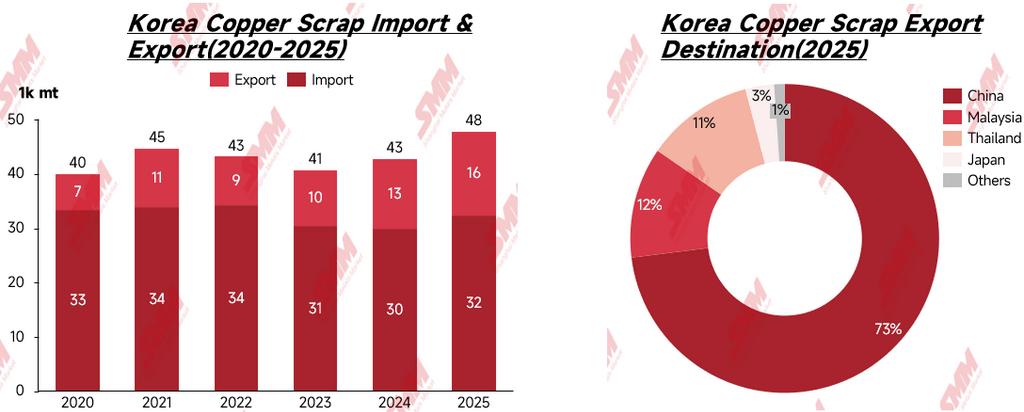
South Korea is an important copper scrap supplier in Asia. In 2025, the country exported approximately 154,700 mt of copper scrap. China received around 112,900 mt, accounting for 72.99% of the total, while Malaysia and Thailand imported approximately 17,900 mt and 17,400 mt, representing 11.59% and 11.28%, respectively. Together, the three markets accounted for 95.86% of South Korea’s copper scrap exports.
However, the proposed policy is neither an export ban nor an export quota. It would only require cargoes that were previously exempt to complete formal declaration procedures. Companies with clearly documented cargo origins, grades, compositions and contracts should, in principle, still be able to export normally.
As a result, South Korean copper scrap exports may not decline sharply after the policy takes effect. The immediate impact is more likely to come from additional administrative procedures, testing and documentation costs, as well as potentially longer export lead times. Mixed-metal scrap, dismantled materials, electronic waste and other complex cargoes with unclear classifications are expected to face greater scrutiny than Millberry, No. 1 copper scrap and other clearly defined high-grade materials.
For South Korea’s domestic market, tighter declarations could improve transparency and reduce the outflow of valuable materials under incorrect tariff classifications. If some non-compliant exports are restricted, more scrap could remain within the domestic market and become available to local copper rod plants, brass producers, secondary smelters and other processors.
For buyers in China and Southeast Asia, South Korean copper scrap is unlikely to disappear from the international market in the near term. In Malaysia, for example, much of the material imported from South Korea is reportedly high-grade Millberry supplied to Korean and Japanese copper foil plants operating locally. These trade flows have relatively clear cargo specifications and end uses, and are therefore expected to face limited disruption from the new declaration requirements.
Overall, the proposed revision is aimed at strengthening oversight of cross-border flows of valuable secondary resources rather than directly restricting copper scrap exports. Before the rules take effect in 2027, exporters are likely to adjust their classification, testing and documentation procedures.
Whether Asian copper scrap trade flows change significantly will depend on the final declaration requirements, approval timelines and enforcement standards. If the policy mainly targets misdeclaration and illegal exports, its impact on compliant trade should remain limited. However, if inspections and documentation requirements become significantly stricter, buyers in China and Southeast Asia may need to source more material from Japan, the US and other markets.