

News
Exclusive analysis articles with the latest market updates, and real-time news feeds.
China’s Spodumene Imports Rise 7% MoM in September, with Australia, Nigeria and Zimbabwe the Top Three Sources
According to compiled Chinese customs data, China imported 970,100 physical tonnes of spodumene in September 2026, up approximately 7.0% from 906,600 tonnes in August. Based on the classification and assumed grades, moisture content and conversion factors used in this analysis, September imports represented approximately 81,300 tonnes of lithium carbonate equivalent (LCE). By origin, imports from Australia, Nigeria and Zimbabwe increased significantly. Australia remained the largest supplier, with shipments to China reaching 446,200 tonnes, up approximately 36.7% month on month and accounting for around 46.0% of total imports. Nigeria became the second-largest supplier at 189,800 tonnes, up approximately 40.1%, while imports from Zimbabwe rose approximately 83.0% to 136,500 tonnes. Imports from South Africa fell approximately 49.6% to 112,400 tonnes, whereas imports from Brazil increased approximately 30.9% to 81,200 tonnes. Smaller volumes came from Burundi, Rwanda and Mozambique, at approximately 1,800 tonnes, 1,300 tonnes and 1,000 tonnes, respectively, with limited shipments from Zambia and Somalia. No imports from Mali or Canada appeared in the September dataset. Overall, China’s spodumene imports continued to grow in September, with the composition shifting toward concentrate. Under the classification used in this analysis, concentrate imports reached approximately 688,800 tonnes, accounting for 71.0% of total physical imports, compared with 60.7% in August. Raw ore imports stood at approximately 281,300 tonnes. Increased concentrate imports from Australia, Zimbabwe and Nigeria offset lower imports from Mali and Canada, providing the main support for growth in China’s imported lithium resource supply during the month.
Oct 20, 2026 19:03 (GMT+8)
[SMM Analysis] Hoa Phat’s record HRC sales reshape Vietnam’s self-sufficiency and China’s export flows
Hoa Phat sold 5.47 Mt of hot-rolled coil in January to September, up 59% and about a third of Vietnam’s consumption, with 24.6% of third-quarter sales exported. Vietnam’s HRC demand of about 17.3 Mt this year still exceeds local output of about 10.8 Mt by 6.5 Mt, and new capacity arrives mainly after 2027. Anti-dumping duties have pushed mainstream Chinese coil out of Vietnam; Chinese mills now face Vietnamese coil in ASEAN and other third markets.
Oct 20, 2026 14:36 (GMT+8)
China's Rare Earth Magnet Exports Hit Record in September, Driven by Backlog Release and Regulatory Easing【SMM Analysis】
China’s September rare earth magnet exports hit a record 6,165 tonnes (+23% MoM), driven by clearance of July–August port backlogs, not new demand. US-China talks unblocked shipments, while EU “green channel” talks lifted Q4 forecast to ~5,700 tonnes/month. Large producers recovered fastest; small mills remain constrained.
Oct 20, 2026 16:06 (GMT+8)
Latest News
![[Fortescue holds full-year guidance; September-quarter shipments at 46.8 Mt]](https://imgqn.smm.cn/usercenter/QMaot20251217171719.jpg)
[Fortescue holds full-year guidance; September-quarter shipments at 46.8 Mt]
5 hours ago
![[JSW Steel Posts Record Crude Steel Output and Sales; Net Profit Up 225.5%]](https://imgqn.smm.cn/usercenter/VgxkU20251217171719.jpg)
[JSW Steel Posts Record Crude Steel Output and Sales; Net Profit Up 225.5%]
5 hours ago
![[Global crude steel output at 142.4 Mt in September, down 0.2% y/y]](https://imgqn.smm.cn/usercenter/FFFrV20251217171719.jpg)
[Global crude steel output at 142.4 Mt in September, down 0.2% y/y]
5 hours ago
[Global crude steel output from 70 countries falls 0.2% YoY to 142.4 Mt in September 2026]
Crude steel production across the 70 countries reporting to the World Steel Association (worldsteel) totalled 142.4 million tonnes (Mt) in September 2026, down 0.2% from September 2025. By region, Africa produced 2.2 Mt, up 10.6% YoY; Asia and Oceania 104.0 Mt, up 0.7%; the EU (27) 10.1 Mt, down 5.0%; Europe, Other 3.6 Mt, down 1.4%; the Middle East 3.6 Mt, down 20.4%; North America 9.3 Mt, up 3.4%; Russia & other CIS + Ukraine 6.1 Mt, down 1.9%; South America 3.5 Mt, up 0.2%. Over January-September 2026, the 70 countries produced 1,367.5 Mt, down 0.7% YoY. The 70 countries accounted for approximately 98% of total world crude steel production in 2025.
Among the top 10 steel-producing countries, China produced 73.6 Mt in September, up 0.1% YoY; India 13.9 Mt, up 1.9%; the United States is estimated to have produced 7.2 Mt, up 4.3%; Japan 6.3 Mt, down 0.6%; Russia is estimated to have produced 5.5 Mt, up 6.2%; South Korea 5.2 Mt, up 3.6%; Türkiye 3.2 Mt, up 0.8%; Germany 2.6 Mt, down 13.0%; Brazil 2.8 Mt, down 0.8%; Viet Nam 2.6 Mt, up 29.1%. [SMM Iron Ore]
5 hours ago
MMi Daily Iron Ore Report (October 23)
Iron ore futures were firmer today. The DCE most-traded I2701 contract settled at 675 yuan/mt, up 0.90% from the previous session. Qingdao port spot prices rose about 4 yuan/mt on average. Trader activity was moderate and mills bought on an as-needed basis. Spot trading was moderate.
Oct 23, 2026 18:24 (GMT+8)
[SMM Iron Ore] Port stocks dip on lower arrivals; contract talks keep iron ore range-bound
Oct 23, 2026 18:14 (GMT+8)
[India's Steel Ministry to Hold Open House on Steel Import Issues on Oct 28]
India's Ministry of Steel said in a statement issued on Oct 23 that it will hold an Open House on Oct 28 to discuss issues related to the import of steel. The meeting will be held at the Steel Room, 3rd Floor, GPOA-3, Netaji Nagar, New Delhi, starting at 11:00 am, with specific time slots to be indicated via e-mail. Walk-ins will not be possible due to logistic challenges and only one representative per organisation is permitted to ensure wider participation.
Companies or associations with issues related to SIMS, SARAL SIMS and QCO Exemption for steel imports must send their requests by e-mail by 12:00 noon on Oct 26 to obtain confirmed time slots. The e-mail must state the type of industry and product, such as auto, aerospace, telecom or defence, describe the issue in no more than 50 words, and provide the participant's name, designation, mobile number and e-mail. The ministry made clear that third-party representation is not allowed.
SIMS, SARAL SIMS and QCO Exemption are regulatory frameworks introduced and updated by the Ministry of Steel to monitor and streamline iron and steel imports and reduce compliance burdens for small and export-oriented enterprises. SARAL SIMS simplifies mandatory registration under SIMS for small consignments of iron and steel imported by MSMEs and other small importers, as well as imports under Advance Authorization, SEZ and EOU routes for export purposes. A QCO requires all domestic and foreign steel producers to obtain a valid Bureau of Indian Standards (BIS) licence and display the ISI mark to prove their products meet designated Indian Standards.
Meanwhile, India's core sector industries grew 7.9% YoY in September, a 30-month high, with steel production up 4.9% and cement output up 10.3%. [SMM Iron Ore]
Oct 23, 2026 17:07 (GMT+8)
[Fortescue warns it may cut Pilbara iron ore output if talks with China's buying agency remain unresolved]
Fortescue (ASX:FMG) has warned it may be forced to scale back Pilbara operations and miss sales targets if contract negotiations with China Mineral Resources Group (CMRG) are not concluded by the end of 2026. The warning follows orders from China's central procurement agency for domestic steel mills to halt purchases of a low-grade Fortescue iron ore product during pricing disputes.
"We will look at every single opportunity to stockpile and utilise working capital, but there will be a point where there is just no more room to put our ore," said Dino Otranto, CEO of Fortescue Metals and Operations. The miner plans to stockpile 4-5 Mt of ore this month while maintaining its FY2027 target of 197-207 Mt at a cash cost of US$20.50-21.00/t.
The share price fell 2% to $14.57 after the announcement. Iron ore shipments in the September quarter were 46.8 Mt, down 6% YoY. Unit production costs rose to US$21.98/t in the quarter, driven by higher diesel prices stemming from Middle East conflicts. [SMM Iron Ore]
Oct 23, 2026 17:07 (GMT+8)
[Canada industry minister gives Cleveland-Cliffs 15 days to reverse Stelco layoffs or face court]
Canada's Industry Minister Mélanie Joly has given Ohio-based Cleveland-Cliffs 15 days to reverse layoffs at its Hamilton-based Stelco operations before turning to the courts. In a demand letter sent to the company on Thursday, obtained by Radio-Canada, Joly said the company is violating its commitments under the Investment Canada Act. If Cleveland-Cliffs fails to comply, the minister may, pursuant to Section 40 of the act, apply to a superior court, seeking monetary penalties against the company and potentially an order to divest from Stelco.
Cleveland-Cliffs said late last month that it plans to lay off as many as 500 workers as it idles certain steel production at Stelco. The federal government said the company's 2024 purchase of Stelco included commitments to employ at least the same number of unionized employees and the vast majority of non-unionized employees as in 2024 through 2029. The company said the layoffs are needed to "ensure the survival" of the company as U.S. steel tariffs squeeze its sales; Joly dismissed that reasoning, saying "no act of God or change in market conditions can relieve Cleveland-Cliffs of the commitments it made to Canada. Those commitments are not optional."
Joly had previously issued an ultimatum for the company to present a plan to avoid the layoffs. Paul Simon, president and general counsel at Stelco Inc., wrote to Joly earlier this month that the representation that Stelco's planned layoffs cause it to breach its undertakings is "false." Conservative MP Ned Kuruc called on the government to take the company to court now. Cleveland-Cliffs CEO Lourenco Goncalves said on Monday that the third quarter was Stelco's strongest since the acquisition, adding that "the Canadian hot-rolled market has improved substantially." In 2009, Industry Canada sued Stelco's previous owner, U.S. Steel, over job protection; the matter was settled out of court in 2011. [SMM Iron Ore]
Oct 23, 2026 17:07 (GMT+8)
[SMM Iron Ore Weekly Brief] Hot Metal Turns Up and Ports Draw Down, but Iron Ore's Rebound Does Not Hold
Demand delivered its first turning point in six periods and a fourth straight fall in arrivals drove the first port drawdown of this cycle. Yet mills remain in loss, miner quarterlies show supply has not truly contracted, and the week's rally was given back in full.
Oct 23, 2026 16:51 (GMT+8)
![[SMM Analysis] Anglo American Q3 iron ore output down 4%, sales up 9%; Kumba lump share of sales rises to 69.6%](https://imgqn.smm.cn/usercenter/MhPNV20251217171716.jpg)
[SMM Analysis] Anglo American Q3 iron ore output down 4%, sales up 9%; Kumba lump share of sales rises to 69.6%
Oct 23, 2026 14:05 (GMT+8)
![[SMM Analysis] Fortescue Q1 FY27 iron ore shipments fall 5.8% YoY to 46.8 Mt; lump share rises to 8.1%](https://imgqn.smm.cn/usercenter/rKOND20251217171716.jpg)
[SMM Analysis] Fortescue Q1 FY27 iron ore shipments fall 5.8% YoY to 46.8 Mt; lump share rises to 8.1%
Oct 23, 2026 14:03 (GMT+8)
![[Canada Sets Up $9 Billion Fund, Over $5 Billion for Ontario Steel Mills Hit by U.S. Tariffs]](https://imgqn.smm.cn/usercenter/hyiDc20251217171715.jpg)
[Canada Sets Up $9 Billion Fund, Over $5 Billion for Ontario Steel Mills Hit by U.S. Tariffs]
Oct 23, 2026 10:11 (GMT+8)
[Anglo American's Q3 iron ore output falls 4% y/y to 13.8 Mt]
Anglo American reported a 4% y/y decline in premium iron ore production to 13.8 million tonnes in the third quarter of 2026, down 10% QoQ. The company said the fall was mainly due to a planned production cut at its South African Kumba operation, only partly offset by higher output at the Brazilian Minas-Rio complex. By unit, Kumba production dropped 19% y/y to 7.5 million tonnes, reflecting planned shutdowns at the Sishen processing plant to tie in the new UHDMS project and a shortage of feedstock at the Kolomela mine; Kumba sales rose 9% y/y to 15.75 million tonnes on drawdown of stockpiles. Minas-Rio concentrate output rose 24% y/y to 6.3 million tonnes on higher equipment availability following last year's pipeline inspections, with export sales from the asset up 21% to 6.05 million tonnes. The average realised price for premium ore in Q3 fell 11% y/y to $82/t FOB, with Kumba products sold at $86/t and Minas-Rio at $77/t; Minas-Rio prices were supported by the high iron content (~67%), partly offset by the rerouting of logistics flows away from the conflict zone in the Middle East. The company confirmed its 2026 production guidance of 55–59 million tonnes (31–33 Mt at Kumba and 24–26 Mt at Minas-Rio), and meeting full-year sales targets will depend on stable operation of third-party rail and port infrastructure. [SMM Iron Ore]
Oct 23, 2026 10:11 (GMT+8)
[ MinRes Q1 FY27 attributable iron ore shipments hit a record 7.9 Mt; Onslow Iron ships 9.2 Mt ]
Mineral Resources (MinRes) reported record attributable iron ore shipments of 7.9 Mt for the September 2026 quarter (Q1 FY27). Onslow Iron shipped 9.2 Mt wmt on a 100% basis, with September exports of 3.49 Mt wmt a monthly record. The company maintained FY27 production and cost guidance across all divisions, including 20.0–21.7 Mt wmt for Onslow Iron and 10.0–11.0 Mt wmt for the Pilbara Hub. It said FOB costs should stay within guidance after a temporary rise in diesel costs in September. [SMM Iron Ore]
Oct 23, 2026 09:59 (GMT+8)
[SMM Iron Ore] Imported iron ore margin narrows to 1.03 yuan/mt as port prices slump
Oct 23, 2026 09:42 (GMT+8)
MMi Daily Iron Ore Report (October 22)
Iron ore futures were weaker today. The DCE most-traded contract settled at 669 yuan/mt, down 1.83% from the previous session. Qingdao port spot prices fell by around 9–15 yuan/mt on average. Traders were reluctant to offer, while mill inquiries were reasonable.
Oct 22, 2026 18:11 (GMT+8)
[SMM Iron Ore] SMM 10-Port Inventory Data
SMM's 10-port total inventory was 104.65 Mt on Oct 22, down 0.49 Mt from the previous period. Lump, concentrate and pellets built; fines destocked notably.
Oct 22, 2026 18:03 (GMT+8)
[Fortescue Q1 iron ore shipments fall 6% to 46.8 Mt]
Fortescue reported iron ore shipments of 46.8 Mt for the first quarter of FY27 (quarter ended 30 September 2026), including 2.5 Mt from Iron Bridge, down 6% year on year. Iron ore sales were 42.9 Mt, below shipments, reflecting ongoing negotiations with China Mineral Resources Group (CMRG); product inventory rose during the quarter and further inventory build is expected in October.
On costs and prices, hematite C1 unit cost was US$21.98/wmt, up from US$18.17/wmt a year earlier. Hematite realised price was US$79.79/dmt and Iron Bridge Concentrate revenue was US$111.09/dmt. As of 30 September 2026, the company held US$3.2 billion in cash and US$2.8 billion in net debt after the FY26 dividend and capital expenditure.
Operationally, the company said it carried out its biggest-ever shutdown across port operations during the quarter, replacing the tippler cell in Train Unloader 1 and major components on its reclaimer and shiploader. It also reported a first Ore Reserve at Blacksmith of 196 Mt at an average grade of 58% iron; Dino Otranto, CEO of Fortescue Metals and Operations, said Blacksmith will play an important role in maintaining production as existing mines mature. In addition, the Green Metal Project at Christmas Creek produced first hot metal and turbine components for the Nullagine Wind Project arrived. On safety, the company reported a Leading Safety Index (LSI) of 142 and a Total Recordable Injury Frequency Rate (TRIFR) of 1.4.
FY27 guidance for shipments, C1 unit cost and capital expenditure remains unchanged but is subject to the outcome of the CMRG negotiations; operations could be affected if a resolution is not reached by the end of the calendar year. [SMM Iron Ore]
Oct 22, 2026 17:52 (GMT+8)
[Fortescue Q3 iron ore shipments down 6% YoY to 46.8 Mt, FY27 guidance maintained]
Fortescue (ASX: FMG) reported September-quarter iron ore shipments of 46.8 Mt, down 6% YoY, including 2.5 Mt from its Iron Bridge magnetite project. The company attributed part of the shortfall to its largest-ever scheduled port maintenance shutdown, which involved replacing tippler cells at Train Unloader 1 and major upgrades to reclaimers and shiploaders at its Pilbara port infrastructure.
Sales recognised in the quarter totalled 42.9 Mt, below shipments, as the company declined to finalise transactions with China Mineral Resources Group (CMRG) on terms it considers unacceptable. Fortescue maintained its FY27 shipment guidance of 197-207 Mt, but said the guidance remains contingent on resolution of the CMRG pricing negotiations before the end of the calendar year. It warned that unsold stock is expected to grow by a further 4-5 Mt in October alone and that it may be forced to adjust production levels if no deal is reached by year-end.
Hematite C1 cash costs rose 21% YoY to US$21.98/wmt, above the company's FY27 guidance range of US$20.50-21.75/wmt, driven by higher diesel prices (about US$1.40/t), broader supply chain inflation and lower throughput during the port shutdown. Average realised hematite prices fell 10% YoY to US$79.79/dmt, equal to 82% of the 62% benchmark index. Net debt rose to US$2.8 billion from US$0.9 billion at 30 June, while cash reserves fell to US$3.2 billion. Fortescue also reported a maiden ore reserve of 196 Mt at 58.0% Fe for its Blacksmith project. [SMM Iron Ore]
Oct 22, 2026 17:52 (GMT+8)
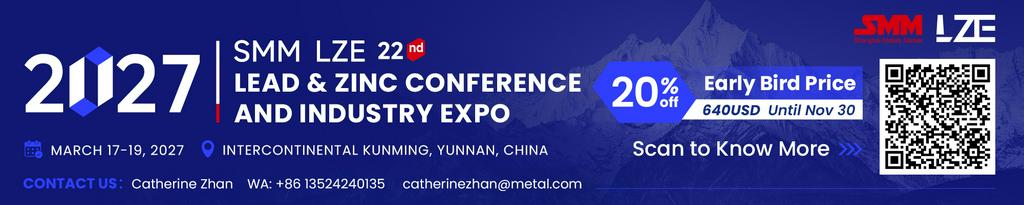
Early Bird Bookings Now Open for 2027 SMM LZE (22nd) Lead & Zinc Conference and Industry Expo in Yunnan next March
——From Conference to Expo · Doubled Scale · Full Upgrade—— [What This Article Brings You] ① Exhibition Introduction ② How to Register ③ First Batch of Exhibitors ④ Conference Agenda I. Doubled Scale, Full Upgrade! In 2026, lead and zinc face sharp volatility—elevated lead prices, scarce high-purity lead, record high LME low-grade lead stocks, lead-acid battery relocation from China to overseas, deeply negative zinc concentrate TCs, tight high-quality imported zinc ore, open export window for zinc ingots, and overseas zinc smelter buildout. The LZE covers market outlook, price forecast, equipment technology, recycling, and downstream applications—driving green transformation and win-win growth. What sets the 2027 (22nd) LZE apart from earlier events is its transformative upgrade: moving from a pure industry conference to a seamlessly combined conference and industry expo — deliver a larger-scale gathering, an expanded industry showcase and far-reaching involvement across the entire lead and zinc value chain. From industry trend analysis to in-depth industry chain exchanges, from upstream and downstream supply-demand matching to concentrated enterprise showcases, from a single industry conference to the further integration of "conference + industry expo"——in 2027, SMM LZE enters the "expo" era! The conference will embrace its 22nd edition with a larger scale, a richer industry lineup, and broader upstream and downstream participation! Scan the QR Code Below to Register as A Visitor for Free 1. Conference Scale Delegation: 6,000+ (up 71.4% from the previous edition) Companies: 2,000+ (up 100% from the previous edition) Exhibitors: 120+ (up 50% from the previous edition) Supply-demand matchmaking: 300+ (up 50% from the previous edition) Dedicated Forums: 7 (1 more than the previous edition) 2. Participant Groups 20% - Miners 23% - Smelters 22% - Processing enterprises 10% - Traders 5% - Lead-zinc end-user procurement 15% - Third-party equipment, technology, auxiliary materials, media, etc. 3% - Government, associations, university research institutions 2% - Financial and futures firms 3. Job Title Breakdown 4. Conference Highlights Price trends, consumption outlook, and policy interpretation Global dialogue on the lead-zinc industry and go-global strategies One-on-One Business Meetings Exploring Breakthrough Paths in Mining & Metallurgy Technology and Resource Recycling Showcase of Cutting-Edge Equipment and Consumables II. Four Identities, One Lead-Zinc Exhibition Whether you are here for market insights, procurement, showcasing or brand exposure, you will find a participation option that suits you. 1. Professional Visitors (Explore the exhibition for business opportunities and connect with the upstream and downstream of the industry) [Visitor Benefits] Exhibition Area Ticket On-site Check-in Gifts SMM Exclusive Lead-Zinc Industry Distribution Map Lead-Zinc Industry Visitor Exchange Group Group Benefits Tickets for Some Forums …… 2. Conference Delegates (Gain insights into new trends and discuss the lead-zinc market) [Delegate Benefits] Exhibition Area Ticket On-site Check-in Gifts SMM Exclusive Lead-Zinc Industry Distribution Map Lead-Zinc Industry Visitor & Conference Exchange Group Ticket for All Forums of the Conference Executive Dinner Voucher Lunch and Dinner Vouchers During the Conference Enterprise Directory Expert Reports 1-on-1 Supply-Demand Matching Post-Conference Field Trip Activities …… 3. Exhibitor (Step onto the industry stage and showcase your strengths) [18㎡ Custom Booth] [Benefits] Design & construction of all materials for the 18㎡ booth, tables, chairs, sofa & reception desk, TV, 5 conference passes, X-banner stand*1, conference booklet color page*1, LOGO display, multi-platform online exposure and promotion, supply-demand 1-on-1 matchmaking, long-term cooperation support from SMM, etc. [9㎡ Premium Booth] [Benefits] Design & construction of all materials for the 9㎡ booth, printed backdrop wall & reception desk & tables and chairs, TV, 3 conference passes, X-banner stand*1 or conference booklet color page*1, LOGO display, multi-platform online exposure and promotion, supply-demand 1-on-1 matchmaking, long-term cooperation support from SMM, etc. [6㎡ Standard Booth] [Benefits] Design & construction of all materials for the 6㎡ booth, one long table & two chairs, 2 X-banner stands with different content, 2 conference passes, multi-platform online exposure and promotion, supply-demand 1-on-1 matchmaking, long-term cooperation support from SMM, etc.
Oct 22, 2026 09:59 (GMT+8)

2027 Global Aluminum Supply-Demand Outlook: High Margins Drive Expansion, Shifting the Market from Tight to Loose
Oct 21, 2026 09:41 (GMT+8)

Chinese $6Billion Battery Investment in Morocco Reshapes EU Lithium Demand Amid Tariff Shifts
Oct 20, 2026 17:02 (GMT+8)

N-Type vs. P-Type Solar PV Modules: What Sets Them Apart, and Why Is N-Type Gaining Ground in the Global Market?
Oct 21, 2026 09:45 (GMT+8)
China’s Spodumene Imports Rise 7% MoM in September, with Australia, Nigeria and Zimbabwe the Top Three Sources
Oct 20, 2026 19:03 (GMT+8)
[SMM Analysis] Hoa Phat’s record HRC sales reshape Vietnam’s self-sufficiency and China’s export flows
Oct 20, 2026 14:36 (GMT+8)
China's Rare Earth Magnet Exports Hit Record in September, Driven by Backlog Release and Regulatory Easing【SMM Analysis】
Oct 20, 2026 16:06 (GMT+8)
Latest News
[Fortescue holds full-year guidance; September-quarter shipments at 46.8 Mt]
5 hours ago
[JSW Steel Posts Record Crude Steel Output and Sales; Net Profit Up 225.5%]
5 hours ago
[Global crude steel output at 142.4 Mt in September, down 0.2% y/y]
5 hours ago
[Global crude steel output from 70 countries falls 0.2% YoY to 142.4 Mt in September 2026]
5 hours ago
MMi Daily Iron Ore Report (October 23)
Oct 23, 2026 18:24 (GMT+8)
[SMM Iron Ore] Port stocks dip on lower arrivals; contract talks keep iron ore range-bound
Oct 23, 2026 18:14 (GMT+8)
[India's Steel Ministry to Hold Open House on Steel Import Issues on Oct 28]
Oct 23, 2026 17:07 (GMT+8)
[Fortescue warns it may cut Pilbara iron ore output if talks with China's buying agency remain unresolved]
Oct 23, 2026 17:07 (GMT+8)
[Canada industry minister gives Cleveland-Cliffs 15 days to reverse Stelco layoffs or face court]
Oct 23, 2026 17:07 (GMT+8)
[SMM Iron Ore Weekly Brief] Hot Metal Turns Up and Ports Draw Down, but Iron Ore's Rebound Does Not Hold
Oct 23, 2026 16:51 (GMT+8)
[SMM Analysis] Anglo American Q3 iron ore output down 4%, sales up 9%; Kumba lump share of sales rises to 69.6%
Oct 23, 2026 14:05 (GMT+8)
[SMM Analysis] Fortescue Q1 FY27 iron ore shipments fall 5.8% YoY to 46.8 Mt; lump share rises to 8.1%
Oct 23, 2026 14:03 (GMT+8)
[Canada Sets Up $9 Billion Fund, Over $5 Billion for Ontario Steel Mills Hit by U.S. Tariffs]
Oct 23, 2026 10:11 (GMT+8)
[Anglo American's Q3 iron ore output falls 4% y/y to 13.8 Mt]
Oct 23, 2026 10:11 (GMT+8)
[ MinRes Q1 FY27 attributable iron ore shipments hit a record 7.9 Mt; Onslow Iron ships 9.2 Mt ]
Oct 23, 2026 09:59 (GMT+8)
[SMM Iron Ore] Imported iron ore margin narrows to 1.03 yuan/mt as port prices slump
Oct 23, 2026 09:42 (GMT+8)
MMi Daily Iron Ore Report (October 22)
Oct 22, 2026 18:11 (GMT+8)
[SMM Iron Ore] SMM 10-Port Inventory Data
Oct 22, 2026 18:03 (GMT+8)
[Fortescue Q1 iron ore shipments fall 6% to 46.8 Mt]
Oct 22, 2026 17:52 (GMT+8)
[Fortescue Q3 iron ore shipments down 6% YoY to 46.8 Mt, FY27 guidance maintained]
Oct 22, 2026 17:52 (GMT+8)