

News
Exclusive analysis articles with the latest market updates, and real-time news feeds.
China’s Spodumene Imports Rise 7% MoM in September, with Australia, Nigeria and Zimbabwe the Top Three Sources
According to compiled Chinese customs data, China imported 970,100 physical tonnes of spodumene in September 2026, up approximately 7.0% from 906,600 tonnes in August. Based on the classification and assumed grades, moisture content and conversion factors used in this analysis, September imports represented approximately 81,300 tonnes of lithium carbonate equivalent (LCE). By origin, imports from Australia, Nigeria and Zimbabwe increased significantly. Australia remained the largest supplier, with shipments to China reaching 446,200 tonnes, up approximately 36.7% month on month and accounting for around 46.0% of total imports. Nigeria became the second-largest supplier at 189,800 tonnes, up approximately 40.1%, while imports from Zimbabwe rose approximately 83.0% to 136,500 tonnes. Imports from South Africa fell approximately 49.6% to 112,400 tonnes, whereas imports from Brazil increased approximately 30.9% to 81,200 tonnes. Smaller volumes came from Burundi, Rwanda and Mozambique, at approximately 1,800 tonnes, 1,300 tonnes and 1,000 tonnes, respectively, with limited shipments from Zambia and Somalia. No imports from Mali or Canada appeared in the September dataset. Overall, China’s spodumene imports continued to grow in September, with the composition shifting toward concentrate. Under the classification used in this analysis, concentrate imports reached approximately 688,800 tonnes, accounting for 71.0% of total physical imports, compared with 60.7% in August. Raw ore imports stood at approximately 281,300 tonnes. Increased concentrate imports from Australia, Zimbabwe and Nigeria offset lower imports from Mali and Canada, providing the main support for growth in China’s imported lithium resource supply during the month.
Oct 20, 2026 19:03 (GMT+8)
[SMM Analysis] Hoa Phat’s record HRC sales reshape Vietnam’s self-sufficiency and China’s export flows
Hoa Phat sold 5.47 Mt of hot-rolled coil in January to September, up 59% and about a third of Vietnam’s consumption, with 24.6% of third-quarter sales exported. Vietnam’s HRC demand of about 17.3 Mt this year still exceeds local output of about 10.8 Mt by 6.5 Mt, and new capacity arrives mainly after 2027. Anti-dumping duties have pushed mainstream Chinese coil out of Vietnam; Chinese mills now face Vietnamese coil in ASEAN and other third markets.
Oct 20, 2026 14:36 (GMT+8)
China's Rare Earth Magnet Exports Hit Record in September, Driven by Backlog Release and Regulatory Easing【SMM Analysis】
China’s September rare earth magnet exports hit a record 6,165 tonnes (+23% MoM), driven by clearance of July–August port backlogs, not new demand. US-China talks unblocked shipments, while EU “green channel” talks lifted Q4 forecast to ~5,700 tonnes/month. Large producers recovered fastest; small mills remain constrained.
Oct 20, 2026 16:06 (GMT+8)
Latest News
![[Europe terminates the definitive anti-dumping and countervailing duties imposed on solar glass originating in China]](https://imgqn.smm.cn/usercenter/wBAsG20251217171742.jpg)
[Europe terminates the definitive anti-dumping and countervailing duties imposed on solar glass originating in China]
Oct 23, 2026 16:27 (GMT+8)
![[SMM PV Newsletter] LONGi and TÜV Rheinland Jointly Release the PV Fire Safety White Paper](https://imgqn.smm.cn/usercenter/PkttC20251217171742.jpg)
[SMM PV Newsletter] LONGi and TÜV Rheinland Jointly Release the PV Fire Safety White Paper
Oct 23, 2026 11:45 (GMT+8)
![[SMM PV Flash] Two Selected! Maxtian Energy EVO Series Products Included in Zhejiang Provincial List](https://imgqn.smm.cn/usercenter/Lttjf20251217171742.jpg)
[SMM PV Flash] Two Selected! Maxtian Energy EVO Series Products Included in Zhejiang Provincial List
Oct 23, 2026 11:44 (GMT+8)
[SMM PV News] Targeting Central and Eastern Europe, Kehua Digital Energy Helps Commission Romania's Energy Storage Project!
Recently, the 60MW/120MWh cell energy storage project in Romania, for which Kehua Digital Energy provided the energy storage solution, officially entered operation. This is another benchmark project delivered by Kehua Digital Energy in the Central and Eastern European energy storage market, further validating the company's comprehensive capabilities in deepening its presence in the European new energy market and building a localized service system.
Oct 23, 2026 11:44 (GMT+8)
[SMM PV News] Qinghai Implements Local Standard for Green Electricity Traceability
According to Xinhua News Agency, a reporter learned from State Grid Qinghai Electric Power Company that after a three-month verification period, Qinghai Province officially implemented the special local standard "Green Electricity Traceability Method for Power-Consuming Enterprises" on October 22, marking a new breakthrough in the quantitative management and control of green electricity consumption and the construction of a full-process traceability system in Qinghai.
As an important clean energy industry base in China, Qinghai ranks among the top in the country in terms of the proportion of installed clean energy capacity and the share of green electricity generation. With the rapid rise of green computing and green manufacturing industries, power-consuming enterprises have an increasingly growing demand for green electricity consumption accounting and traceability certification. To solve the challenges of green electricity traceability and enhance the credibility of green electricity consumption, State Grid Qinghai Electric Power Company initiated preliminary research on the standard in 2024, and, in collaboration with Qinghai University and other research institutions, formed a standard drafting team to advance the research and formulation of the standard.
Based on the actual conditions of Qinghai's clean energy industry, the drafting team carried out data collection on typical regional power grid operations and surveys of electricity load characteristics, gathered key parameters such as output curves, grid-connected electricity volumes, and transmission and distribution paths of green electricity projects including PV and wind power, reviewed practical experience and data foundations in green electricity trading, traceability platform operations, and green computing evaluation in Qinghai, established a green electricity flow data model, and gradually built a full-chain, full-coverage green electricity traceability technology system.
To date, leveraging the results of green electricity traceability, Qinghai has established "carbon accounts" for 992 enterprises across the province, effectively supporting the issuance of "carbon account" loans and promoting precise green financial services for low-carbon enterprises.
Oct 23, 2026 11:43 (GMT+8)
[SMM PV Flash] Lodestone Lists on NZX, Raising NZ$75 Million to Expand Solar Portfolio
Lodestone Energy announced its NZX Main Board debut on October 22, 2026, under the ticker LOD, following an IPO that raised NZ$75 million. Proceeds will support new solar farms and expansion of its electricity customer base. The company operates five solar farms, with another under construction in Hawke’s Bay, combining project development and operations with direct electricity sales. Existing shareholders retained their holdings through the IPO, with those shares subject to post-listing escrow arrangements.
Oct 23, 2026 09:15 (GMT+8)
[SMM PV Flash] Encavis Signs Spanish Hybrid Solar and Wind PPA to Supply 60 GWh Annually
Encavis announced on October 21, 2026, that it had signed its first hybrid solar and wind power purchase agreement in Spain with Visalia. The three-and-a-half-year contract provides for annual deliveries of 60 GWh from two solar parks and three wind farms in its 199 MW Aragon portfolio near Zaragoza. According to Encavis, the complementary generation profiles will provide a more balanced supply across different times of day and seasons, supporting Visalia’s renewable electricity procurement and supply diversification.
Oct 23, 2026 09:14 (GMT+8)
[SMM PV Flash] European Energy Signs 30-Year Traditional Owner Agreements for Australian Solar and Storage Projects
European Energy announced on October 21, 2026, that it had signed 30-year cultural heritage management and benefit-sharing agreements with Queensland’s FNBGGGTB First Nations group. The agreements cover the Bullyard, Upper Calliope and Tyrone solar and battery projects, building on an exclusivity agreement signed in 2024. They establish procedures to identify and protect culturally significant sites and artefacts during development, alongside long-term funding for social, cultural and environmental initiatives selected by Traditional Owners.
Oct 23, 2026 09:14 (GMT+8)
PV Frame Makers Maintain Stable Operations; Aluminum Prices to Consolidate Amid Mixed Macro Signals [SMM Analysis]
Oct 22, 2026 18:32 (GMT+8)
Macro front bearish factors regain dominance; market focuses on month-end Fed rate meeting [SMM Precious Metals Macro Analysis]
Precious metals rebounded slightly before pulling back this week: Warsh's dovish remarks once pushed gold prices close to $4,200, but the escalation in the Middle East drove Brent crude oil above $111, shifting the market's main narrative to "energy inflation → December rate hike." Coupled with Meta's earnings beating expectations and boosting risk appetite, gold prices plunged on Thursday, with silver falling over 3%. Accelerated central bank gold purchases provided bottom support. Attention now turns to the October 27-28 policy meeting and the situation in the Middle East.
Oct 22, 2026 16:24 (GMT+8)
![PV Upstream Multi-Segment Stalemate Holds Steady, Module Prices Continue to Decline [SMM Weekly Review]](https://imgqn.smm.cn/usercenter/vbcyk20251217171723.jpeg)
PV Upstream Multi-Segment Stalemate Holds Steady, Module Prices Continue to Decline [SMM Weekly Review]
Oct 22, 2026 15:31 (GMT+8)
![October Glass Prices Stabilize; November Expected to See Significant Price Hikes from Enterprises [SMM Analysis]](https://imgqn.smm.cn/usercenter/WUJtg20251217171743.jpg)
October Glass Prices Stabilize; November Expected to See Significant Price Hikes from Enterprises [SMM Analysis]
Oct 22, 2026 14:56 (GMT+8)
![[SMM PV News] Jiangsu 300 MW PV project announced!](https://imgqn.smm.cn/usercenter/Jzkij20251217171737.jpg)
[SMM PV News] Jiangsu 300 MW PV project announced!
Oct 22, 2026 13:27 (GMT+8)
[SMM PV Flash] Trinasolar Invited to Attend the 2026 Sustainable Global Leaders Conference
On October 20, the 2026 Sustainable Global Leaders Conference was successfully held in Shanghai. Centered on the theme "Building a Resilient Future Together," the conference brought together more than 300 guests from political, business, and academic circles worldwide to engage in in-depth exchanges on frontier topics such as global governance, technological innovation, and industrial upgrading. Trinasolar was invited to attend the event. Wu Xiao, Vice President of the company and head of Group ESG Management and Risk Control Management, participated in the panel discussion themed "Advancing High-Quality Development with Eastern Strength," where he shared Trinasolar's cutting-edge explorations and practical experience on topics including energy system transformation in the AI era, collaborative innovation in computing-power and electricity integration, and industrial risk governance.
Oct 22, 2026 13:25 (GMT+8)
[SMM PV Flash] LONGi Selected for "Top 50 Outstanding Manufacturing Enterprises Going Global" List
On October 17, 2026, the 2026 Enterprise Go Global Exchange Conference and Global Promotion Conference, hosted by the Center for China and Globalization (CCG) and co-organized by the China Association of International Trade, the China Society for World Trade Organization Studies, and the United Nations Conference on Trade and Development (UNCTAD), was held in Beijing.
Oct 22, 2026 13:25 (GMT+8)
[SMM PV Flash] Sineng Electric and SANY Hydrogen successfully complete empirical testing of hydrogen production power supply
Recently, Sineng Electric Co., Ltd. (hereinafter referred to as "Sineng Electric") and Sany Hydrogen Energy Co., Ltd. (hereinafter referred to as "Sany Hydrogen") jointly conducted an empirical test of hydrogen production power supply and achieved complete success.
As the energy hub of the system, the performance of the hydrogen production power supply directly determines the operating efficiency and stability of the entire system. In this joint test, the two parties worked closely together across the upstream and downstream of the industry chain: Sany Hydrogen provided the test platform, and Sineng Electric provided the hydrogen production power supply product, completing the empirical test under real load conditions with an electrolyzer.
The test data show that Sineng Electric's 5.7 MW hydrogen production power supply demonstrates excellent collaborative capabilities in dynamic response, precise power matching, and power grid adaptability, and its feasibility and stability have been fully verified under long-term real operating conditions. Based on this recognition, the product will also be officially designated as the platform's certified power supply for long-term on-site operation.
Oct 22, 2026 13:24 (GMT+8)
Silver consolidates at lows ahead of US Fed rate meeting; spot trades show weak recovery [SMM Silver Weekly Review]
[SMM Silver Weekly Review: Silver Consolidates at Lows Ahead of Fed Meeting, Spot Trades Show Weak Recovery] This week, silver prices moved sideways in a narrow range of 13,700-14,000 yuan/kg. Macro factors were mixed with no clear direction, and the market consolidated ahead of the Fed meeting next week. In the spot market, as silver prices dipped, end-user rigid demand and invoice demand were released. Suppliers held back from selling and held prices firm, with trading sentiment improving from the prior period, showing a weak recovery. On the inventory side, social inventory destocked by 75 mt, driven by dip-buying and seasonal jewelry demand. In the short term, silver prices are likely to continue consolidating within the range, awaiting the Fed meeting outcome.
Oct 22, 2026 13:15 (GMT+8)
[SMM PV Flash] Italy Awards Funding for 505 MW of Agricultural Rooftop Solar Projects
Italy’s energy services agency (GSE) recently announced the latest round of funding allocations under its Agrisolare scheme, awarding approximately €770 million in grants to 7,409 rooftop solar projects across the agricultural, livestock and agro-industrial sectors, with a combined planned capacity of around 505 MW. The initiative aims to promote solar deployment on agricultural buildings, support the sector’s energy transition and expand distributed PV applications. As the supported projects move forward, they are expected to stimulate demand for agricultural rooftop solar installations, creating further opportunities for solar module and related equipment suppliers.
Oct 22, 2026 09:17 (GMT+8)
[SMM PV Flash] Zambia’s Installed Solar Capacity Surpasses 1 GW Amid Renewable Energy Expansion
According to recent data released by Zambia’s Ministry of Energy, the country’s cumulative installed solar PV capacity surpassed 1 GW, reaching 1,027 MW as of October 2026. The commissioning of several utility-scale solar projects, alongside ongoing electricity market reforms, has accelerated solar deployment as Zambia seeks to reduce its reliance on hydropower and strengthen energy security. The government continues to promote power infrastructure development and attract private investment in renewable energy projects. As additional solar projects progress, Zambia’s PV market could expand further, supporting local demand for solar modules and related equipment.
Oct 22, 2026 09:09 (GMT+8)
[SMM Analysis] China's PV Module Exports, Sep 2026: Up 44% MoM as Middle East Surges and Southeast Asian Demand Improves
China exported approximately 23.92 GW of photovoltaic (PV) modules in September 2026, according to SMM data. Shipments rose 44.18%, or 7.33 GW, from August but fell 6.67%, or 1.71 GW, year on year. January–September exports totalled approximately 184.66 GW, down 19.60 GW, or 9.6%, from 204.26 GW a year earlier.
Oct 21, 2026 16:01 (GMT+8)
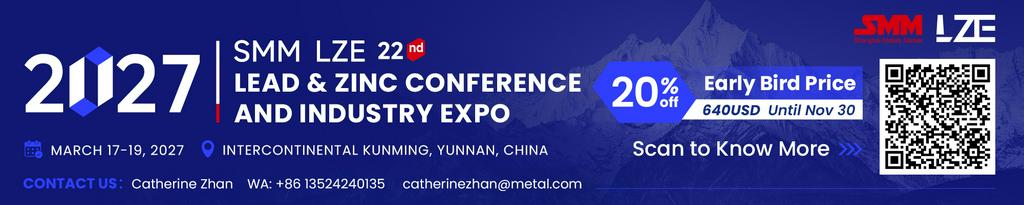
Early Bird Bookings Now Open for 2027 SMM LZE (22nd) Lead & Zinc Conference and Industry Expo in Yunnan next March
——From Conference to Expo · Doubled Scale · Full Upgrade—— [What This Article Brings You] ① Exhibition Introduction ② How to Register ③ First Batch of Exhibitors ④ Conference Agenda I. Doubled Scale, Full Upgrade! In 2026, lead and zinc face sharp volatility—elevated lead prices, scarce high-purity lead, record high LME low-grade lead stocks, lead-acid battery relocation from China to overseas, deeply negative zinc concentrate TCs, tight high-quality imported zinc ore, open export window for zinc ingots, and overseas zinc smelter buildout. The LZE covers market outlook, price forecast, equipment technology, recycling, and downstream applications—driving green transformation and win-win growth. What sets the 2027 (22nd) LZE apart from earlier events is its transformative upgrade: moving from a pure industry conference to a seamlessly combined conference and industry expo — deliver a larger-scale gathering, an expanded industry showcase and far-reaching involvement across the entire lead and zinc value chain. From industry trend analysis to in-depth industry chain exchanges, from upstream and downstream supply-demand matching to concentrated enterprise showcases, from a single industry conference to the further integration of "conference + industry expo"——in 2027, SMM LZE enters the "expo" era! The conference will embrace its 22nd edition with a larger scale, a richer industry lineup, and broader upstream and downstream participation! Scan the QR Code Below to Register as A Visitor for Free 1. Conference Scale Delegation: 6,000+ (up 71.4% from the previous edition) Companies: 2,000+ (up 100% from the previous edition) Exhibitors: 120+ (up 50% from the previous edition) Supply-demand matchmaking: 300+ (up 50% from the previous edition) Dedicated Forums: 7 (1 more than the previous edition) 2. Participant Groups 20% - Miners 23% - Smelters 22% - Processing enterprises 10% - Traders 5% - Lead-zinc end-user procurement 15% - Third-party equipment, technology, auxiliary materials, media, etc. 3% - Government, associations, university research institutions 2% - Financial and futures firms 3. Job Title Breakdown 4. Conference Highlights Price trends, consumption outlook, and policy interpretation Global dialogue on the lead-zinc industry and go-global strategies One-on-One Business Meetings Exploring Breakthrough Paths in Mining & Metallurgy Technology and Resource Recycling Showcase of Cutting-Edge Equipment and Consumables II. Four Identities, One Lead-Zinc Exhibition Whether you are here for market insights, procurement, showcasing or brand exposure, you will find a participation option that suits you. 1. Professional Visitors (Explore the exhibition for business opportunities and connect with the upstream and downstream of the industry) [Visitor Benefits] Exhibition Area Ticket On-site Check-in Gifts SMM Exclusive Lead-Zinc Industry Distribution Map Lead-Zinc Industry Visitor Exchange Group Group Benefits Tickets for Some Forums …… 2. Conference Delegates (Gain insights into new trends and discuss the lead-zinc market) [Delegate Benefits] Exhibition Area Ticket On-site Check-in Gifts SMM Exclusive Lead-Zinc Industry Distribution Map Lead-Zinc Industry Visitor & Conference Exchange Group Ticket for All Forums of the Conference Executive Dinner Voucher Lunch and Dinner Vouchers During the Conference Enterprise Directory Expert Reports 1-on-1 Supply-Demand Matching Post-Conference Field Trip Activities …… 3. Exhibitor (Step onto the industry stage and showcase your strengths) [18㎡ Custom Booth] [Benefits] Design & construction of all materials for the 18㎡ booth, tables, chairs, sofa & reception desk, TV, 5 conference passes, X-banner stand*1, conference booklet color page*1, LOGO display, multi-platform online exposure and promotion, supply-demand 1-on-1 matchmaking, long-term cooperation support from SMM, etc. [9㎡ Premium Booth] [Benefits] Design & construction of all materials for the 9㎡ booth, printed backdrop wall & reception desk & tables and chairs, TV, 3 conference passes, X-banner stand*1 or conference booklet color page*1, LOGO display, multi-platform online exposure and promotion, supply-demand 1-on-1 matchmaking, long-term cooperation support from SMM, etc. [6㎡ Standard Booth] [Benefits] Design & construction of all materials for the 6㎡ booth, one long table & two chairs, 2 X-banner stands with different content, 2 conference passes, multi-platform online exposure and promotion, supply-demand 1-on-1 matchmaking, long-term cooperation support from SMM, etc.
Oct 22, 2026 09:59 (GMT+8)

2027 Global Aluminum Supply-Demand Outlook: High Margins Drive Expansion, Shifting the Market from Tight to Loose
Oct 21, 2026 09:41 (GMT+8)
Chinese $6Billion Battery Investment in Morocco Reshapes EU Lithium Demand Amid Tariff Shifts
Oct 20, 2026 17:02 (GMT+8)
N-Type vs. P-Type Solar PV Modules: What Sets Them Apart, and Why Is N-Type Gaining Ground in the Global Market?
Oct 21, 2026 09:45 (GMT+8)
China’s Spodumene Imports Rise 7% MoM in September, with Australia, Nigeria and Zimbabwe the Top Three Sources
Oct 20, 2026 19:03 (GMT+8)
![[SMM Analysis] Hoa Phat’s record HRC sales reshape Vietnam’s self-sufficiency and China’s export flows](https://imgqn.smm.cn/usercenter/MhPNV20251217171716.jpg)
[SMM Analysis] Hoa Phat’s record HRC sales reshape Vietnam’s self-sufficiency and China’s export flows
Oct 20, 2026 14:36 (GMT+8)
China's Rare Earth Magnet Exports Hit Record in September, Driven by Backlog Release and Regulatory Easing【SMM Analysis】
Oct 20, 2026 16:06 (GMT+8)
Latest News
[Europe terminates the definitive anti-dumping and countervailing duties imposed on solar glass originating in China]
Oct 23, 2026 16:27 (GMT+8)
[SMM PV Newsletter] LONGi and TÜV Rheinland Jointly Release the PV Fire Safety White Paper
Oct 23, 2026 11:45 (GMT+8)
[SMM PV Flash] Two Selected! Maxtian Energy EVO Series Products Included in Zhejiang Provincial List
Oct 23, 2026 11:44 (GMT+8)
[SMM PV News] Targeting Central and Eastern Europe, Kehua Digital Energy Helps Commission Romania's Energy Storage Project!
Oct 23, 2026 11:44 (GMT+8)
[SMM PV News] Qinghai Implements Local Standard for Green Electricity Traceability
Oct 23, 2026 11:43 (GMT+8)
[SMM PV Flash] Lodestone Lists on NZX, Raising NZ$75 Million to Expand Solar Portfolio
Oct 23, 2026 09:15 (GMT+8)
[SMM PV Flash] Encavis Signs Spanish Hybrid Solar and Wind PPA to Supply 60 GWh Annually
Oct 23, 2026 09:14 (GMT+8)
[SMM PV Flash] European Energy Signs 30-Year Traditional Owner Agreements for Australian Solar and Storage Projects
Oct 23, 2026 09:14 (GMT+8)
PV Frame Makers Maintain Stable Operations; Aluminum Prices to Consolidate Amid Mixed Macro Signals [SMM Analysis]
Oct 22, 2026 18:32 (GMT+8)
Macro front bearish factors regain dominance; market focuses on month-end Fed rate meeting [SMM Precious Metals Macro Analysis]
Oct 22, 2026 16:24 (GMT+8)
PV Upstream Multi-Segment Stalemate Holds Steady, Module Prices Continue to Decline [SMM Weekly Review]
Oct 22, 2026 15:31 (GMT+8)
October Glass Prices Stabilize; November Expected to See Significant Price Hikes from Enterprises [SMM Analysis]
Oct 22, 2026 14:56 (GMT+8)
[SMM PV News] Jiangsu 300 MW PV project announced!
Oct 22, 2026 13:27 (GMT+8)
[SMM PV Flash] Trinasolar Invited to Attend the 2026 Sustainable Global Leaders Conference
Oct 22, 2026 13:25 (GMT+8)
[SMM PV Flash] LONGi Selected for "Top 50 Outstanding Manufacturing Enterprises Going Global" List
Oct 22, 2026 13:25 (GMT+8)
[SMM PV Flash] Sineng Electric and SANY Hydrogen successfully complete empirical testing of hydrogen production power supply
Oct 22, 2026 13:24 (GMT+8)
Silver consolidates at lows ahead of US Fed rate meeting; spot trades show weak recovery [SMM Silver Weekly Review]
Oct 22, 2026 13:15 (GMT+8)
[SMM PV Flash] Italy Awards Funding for 505 MW of Agricultural Rooftop Solar Projects
Oct 22, 2026 09:17 (GMT+8)
[SMM PV Flash] Zambia’s Installed Solar Capacity Surpasses 1 GW Amid Renewable Energy Expansion
Oct 22, 2026 09:09 (GMT+8)
[SMM Analysis] China's PV Module Exports, Sep 2026: Up 44% MoM as Middle East Surges and Southeast Asian Demand Improves
Oct 21, 2026 16:01 (GMT+8)