

News
Exclusive analysis article with latest market updates, and in-time news feeds.
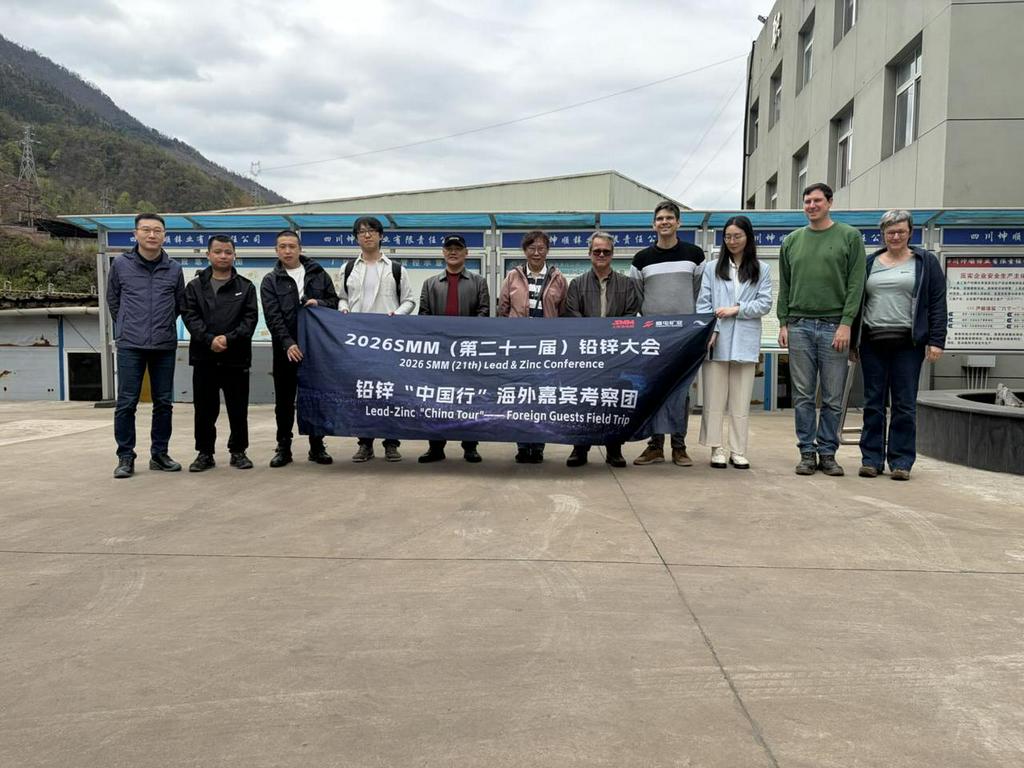
Post-Conference Tour: Connecting Global Lead-Zinc Giants with Key Chinese Players
The 2026 SMM (21st) Lead & Zinc Conference and Industry Expo opened grandly at Howard Johnson Agile Plaza in Chengdu, Sichuan during March 25–27 2026. Organized by SMM, the event brought together global enterprises, professional experts and industry peers from across the entire lead and zinc supply chain. Participants focused on industry hot topics, analyzed market trends and explored development strategies, establishing a highly efficient platform for communication and collaboration to support high-quality growth of the sector. To further strengthen the overseas delegation’s comprehensive understanding of China’s lead and zinc industrial chain and build closer connections between international industry peers and key producers in China, SMM led a high-level overseas delegation on a multi-day industrial tour starting on the afternoon of March 27. The delegation included representatives from global giants, such as Nyrstar, a top European lead and zinc smelting firm, Nexa Resources, a South American giant in lead-zinc mining and smelting, and Befesa, a pioneer in zinc recycling. During the tour, the delegation visited 8 Chinese enterprises. including: COSCO Shipping Sichuan Chengtun Zinc & Germanium Technology Sichuan Kunshun Zinc Industry Yunnan Luoping Zinc & Electricity Hongzhou Hongqian Nonferrous Chemical Yunnan Zhenxing Industrial Group Mengzi Mining & Metallurgy Danxia Smelter of Shenzhen Zhongjin Lingnan Nonfemet The delegation members went deep into production sites, held in-depth discussions and exchanges, and gained a full picture of China’s lead and zinc industry in terms of production operations, technological innovation, capacity scale and market layout, greatly enhancing their insight into and understanding of the entire industrial chain. SMM has systematically compiled detailed information of all enterprises that were visited during this tour, with details below: COSCO Shipping On the afternoon of March 27, the delegation visited COSCO Shipping for an exchange, where they received a warm welcome from the company's leadership. Both sides engaged in discussions on topics such as equipment transportation and technological upgrades. Sichuan COSCO Shipping Logistics Supply Chain Management Co., Ltd. is a wholly-owned subsidiary of COSCO Shipping Logistics Supply Chain Co., Ltd., registered and established in Chengdu, Sichuan Province, with an investment of 30 million yuan. COSCO Shipping Logistics Supply Chain Co., Ltd. is affiliated with China COSCO Shipping Corporation Limited and serves as a core member of the "shipping, ports, and logistics" segment of COSCO Shipping Group, as well as an important component of its global digital supply chain system. The company operates warehouse space exceeding 6 million m², including 19 futures delivery warehouses. China COSCO Shipping Corporation Limited is a globally leading shipping enterprise group, with a combined fleet capacity of 130 million DWT across 1,535 vessels, ranking first in the world. Sichuan COSCO Shipping Logistics Supply Chain Management Co., Ltd. holds business qualifications and an operational scope covering multiple transportation modes including sea, land, air, and rail, providing comprehensive logistics services spanning both international and Chinese markets. Since entering the non-ferrous metals delivery warehouse business in 2016, the company has adhered to the principle of "client-centered and market-oriented," continuously enhancing its service capabilities and achieving steady business growth. Currently, at key logistics periods such as Shanghai Baoshan, Shanghai Yangshan, and Yixing in Jiangsu, the company successfully operates delivery warehouses designated by the Shanghai Futures Exchange for copper, nickel, zinc, and other products. It has become one of the three major non-ferrous metals warehouses of SHFE and was honored with the title of "Top Ten Designated Non-Ferrous Metals Delivery Warehouses" by the Shanghai Futures Exchange for two consecutive years. Sichuan Chengtun Zinc & Germanium Technology Co., Ltd. On March 28, the delegation visited Sichuan Chengtun Zinc & Germanium Technology Co., Ltd. (Shimian City). Both sides engaged in in-depth exchanges on the development of the zinc smelting industry, with a focus on thorough discussions regarding product processing, production techniques, capacity scale, market trends, and the current challenges facing the industry. Sichuan Chengtun Zinc & Germanium Technology Co., Ltd. was established on December 6, 2015, with a registered capital of 1.6 billion yuan. The company has an annual capacity of 300,000 mt of electrolytic zinc, 150,000 mt of sulphuric acid, 400,000 mt of electrolytic zinc waste residue processing, and 40 mt of high-purity germanium dioxide. On January 16, 2019, the company was approved by the China Securities Regulatory Commission and merged into the publicly listed firm Chengtun Mining Group Co., Ltd. The company's main business includes smelting and R&D of zinc-germanium series products, as well as comprehensive recovery of multiple metals. It has formed a complete industry chain from zinc concentrates entering the plant to finished products leaving the plant. Its production lines include zinc calcine, electrolytic zinc, electrolytic zinc waste residue processing, and comprehensive recovery of rare and precious metals. Sichuan Kunshun Zinc Industry Co., Ltd. (Shimian City) On March 28, the delegation headed to Sichuan Kunshun Zinc Industry Co., Ltd. (Shimian City) for a visit and exchange, where they received a warm reception from the enterprise. Both parties held in-depth discussions and exchanges on zinc smelting, covering topics such as production costs, production and market landscape, raw material procurement and processing, industry chain competitive advantages, and distinctive process technologies. Sichuan Kunshun Zinc Industry Co., Ltd. is a specialized and green environmental protection enterprise jointly invested and established by Sichuan Metallurgical Holding Group Co., Ltd. and Shimian Dongshun Zinc Industry Co., Ltd. to implement the national green production philosophy, actively develop the circular economy, and promote the comprehensive utilization of solid waste resources. It integrates solid waste treatment, recycling, and resource regeneration. The company primarily uses high-tech methods to carry out clean utilization and harmless treatment of heavy metal-containing waste generated by industries such as metallurgy and chemicals, eliminating the environmental impact of heavy metal solid waste at the source. The company was established in 2021 and is located in Zhuma Industrial Park, Shimian County, Ya'an City, Sichuan Province, covering an area of 65 mu with a total investment of 180 million yuan. The company has built a 3.5m × 50m Waelz rotary kiln production line, equipped with advanced and well-established low-grade zinc oxide production technology, achieving a resource recovery utilization rate of over 95% and effectively managing waste gas, noise, solid waste, and groundwater risks. It is also equipped with supporting facilities including desulphurization, denitrification, and flue gas defogging towers, as well as a wastewater treatment station, raw material warehouse, raw material pre-washing workshop, water slag processing workshop, biomass semi-gasification furnace, zinc crystallized salt workshop, production safety and environmental protection center, and laboratory for detection and testing. The company holds qualifications for treating hazardous waste categories including HW12, HW17, HW23, HW48, and HW49, with an annual capacity to process 100,000 mt of zinc-containing waste. Its main products include low-grade zinc oxide and zinc crystallized salt. The company has always upheld the green and environmentally friendly development philosophy, adhering to the fundamentals of "being responsible for the environment, for clients, and for employees," guided by technological innovation, and targeting the "reduction, recycling, and detoxification" of solid waste pollution prevention and control. The company is committed to building a modern "solid waste" management and disposal service provider, actively carrying out emergency environmental protection disposal, proactively assuming social service functions, and making positive contributions to promoting the circular economy development in Sichuan and strengthening the ecological civilization construction of lucid waters and lush mountains! Yunnan Luoping Zinc & Electricity Co., Ltd. (Qujing City) On March 30, the delegation visited Yunnan Luoping Zinc & Electricity Co., Ltd. (Qujing City) for exchanges. During the meeting, both sides conducted in-depth discussions on key topics including magnesium removal process optimization, production management organization, and raw material substitution plans, and put forward constructive suggestions on improving the plant environment. Yunnan Luoping Zinc & Electricity Co., Ltd. was established to fully leverage Luoping's local hydropower and lead-zinc mineral resource advantages. In accordance with the "ore, electricity, and smelting integration" development strategy proposed by the Luoping County Party Committee and County Government, and the overall requirements of the Municipal Party Committee and Municipal Government for the reform of industrial enterprises across the city, the company was registered and established at the Yunnan Provincial Administration for Industry and Commerce on December 21, 2000. It was listed on the Shenzhen Stock Exchange A-share market in 2007 and is a state-controlled enterprise under Luoping County. The company's assets are an optimized combination of three components: hydropower, lead-zinc mines, and zinc smelting. In terms of company assets, they are primarily composed of three advantageous resources of Luoping: mineral, hydropower, and zinc smelting. These mainly include six production units: Luoping County Fule Lead-Zinc Mine with an annual processing capacity of 100,000 mt of raw ore, Lazhuang Power Plant with annual power generation of 250 million kWh (installed capacity of 60,000 kW), a zinc smelter with an annual output of 120,000 mt of electrolytic zinc, a zinc powder plant with an annual output of 12,000 mt of ultra-fine zinc powder, a comprehensive utilization plant with an annual processing capacity of 129,500 mt of zinc slag, and a sulphuric acid plant with an annual output of 140,000 mt of sulphuric acid, achieving a total annual industrial output value exceeding 2 billion yuan. The company has six wholly-owned subsidiaries. The company's main businesses include hydropower generation, mining of lead, zinc, and other non-ferrous metals, as well as the production and sales of zinc smelting and its extended products. It is currently the only publicly listed firm in China's zinc smelting industry that integrates mining, power generation, chemical processing, and smelting. Its products include zinc sulphide concentrates, lead concentrates, zinc ingots, industrial sulphuric acid, ultra-fine zinc powder, cadmium, germanium concentrates, silver concentrates, copper concentrates, zinc alloys, industrial and residential electricity, edible oils and fats, among others. Its main product, "Jiulong" brand zinc ingots, is popular in non-ferrous product markets in and outside China thanks to its superior product quality and corporate reputation. Honghe Prefecture Hongqian Non-ferrous Chemical Joint-Stock Co., Ltd. On March 31, the delegation visited Honghe Prefecture Hongqian Non-ferrous Chemical Joint-Stock Co., Ltd. for exchanges. The two sides held in-depth discussions on topics including the economic benefits of smelting by-products, energy utilization efficiency, the current status of enterprise development, and future cooperation intentions. Honghe Prefecture Hongqian Non-ferrous Chemical Joint-Stock Co., Ltd. was established on August 1, 2007, with a registered capital of 50 million yuan. The total investment in project construction was 475.5543 million yuan. The company currently has over 600 employees and covers an area of 443 mu. The plant is located in the Heishenmiaobo Industrial Zone, situated in the central area of the Gejiu-Kaiyuan-Mengzi urban cluster. The company is a new-type joint-stock enterprise centered on crude lead smelting, integrating sulphur dioxide acid production, waste heat power generation, lead electrolysis, and recovery of precious and rare metals such as gold, silver, antimony, and bismuth, with further extension into deep processing of lead-series products including red lead, massicot, electrode plates, and storage batteries. It is a benchmark enterprise among private lead smelters in the city, featuring a relatively large scale, advanced technology, compliance with environmental protection standards, comprehensive utilization of resources, and a complete industry chain. The company pioneered the application of new technologies to upgrade and transform the traditional crude lead smelting model among private enterprises in the city. The company has formulated the working philosophy of "prioritizing environmental protection, ensuring safety, attracting talent, enforcing strict management, and enhancing efficiency," and continues to drive high-quality development. In April 2007, the company commissioned China ENFI Engineering Technology Co., Ltd. to conduct a feasibility study on the lead smelting technological transformation project, and determined a comprehensive industrial facility technological transformation project with a total investment of 490 million yuan and an annual capacity of 60,000 mt of crude lead. On December 21, 2009, the "Demonstration Project of Oxygen-Enriched Bottom-Blowing Lead Smelting Technology with Annual Output of 60,000 mt of Crude Lead" was designated by the Provincial Department of Science and Technology as a 2009 Yunnan Provincial Science and Technology Innovation Project. In 2010, it was further designated as a key industrial project by the provincial, prefectural, and municipal governments. On November 14, 2011, the company obtained ISO9001:2008 quality management system certification. On March 7, 2012, "HSPb99.94PCT" was successfully registered on the London Metal Exchange. In 2019, the company successively passed the safety completion acceptance and environmental impact assessment completion acceptance, fully achieving compliant operations and sustainable development. Yunnan Zhenxing Industrial Group Co., Ltd. On March 31, the delegation headed to Yunnan Zhenxing Industrial Group Co., Ltd. for a visit and exchange. Both parties conducted in-depth discussions on topics including Yunnan Province's mineral resource endowment, smelting industry development trends, corporate business strategies, and technological innovation applications, jointly assessing the current status and prospects of the industry and analyzing the challenges and opportunities ahead. Yunnan Zhenxing Industrial Group Co., Ltd. (hereinafter referred to as "the Group") was founded in 1996 and is located in the Chongposhao New Materials Industrial Park, Shadian Sub-district Office, Gejiu City. The Group currently has 7 subsidiaries, 2 holding companies, and 1 equity-participation company, with approximately 3,000 employees. Its capacity reaches annual output of crude lead (100,000 mt), electrolytic lead (60,000 mt), zinc ingot (20,000 mt), lead-acid battery plates (9 million sets), lead-acid batteries (6 million units), superphosphate (350,000 mt), sulphuric acid (200,000 mt), and monoammonium phosphate (MAP) (60,000 mt). The Group has established five major production sites and five major product brands covering crude lead raw material, lead-zinc smelting, power supply manufacturing, fertilizer and chemical production, and resource recovery. It has formed an internal industrial cycle spanning lead ore mining—lead-zinc smelting—lead-based alloy melting—battery manufacturing—waste battery recycling—precious metals production, making it one of the few private non-ferrous enterprises in China with a complete lead industry chain. Since 2013, the Group has been consecutively recognized as one of the Top 100 Non-Public Enterprises in Yunnan Province. In 2025, it ranked 41st among the "Top 100 Non-Public Enterprises in Yunnan Province" and was selected for the first time into the "Top 20 Private Enterprises in Innovation Capability," ranking 7th. Yunnan Shadian Lead Industry Co., Ltd., a subsidiary controlled by the Group, ranked 71st. The Group has received nearly 100 honors at various levels, including "High-tech Enterprise," "Outstanding Private Technology Enterprise," "Enterprise with Harmonious Labor Relations," "Provincial Model Collective for Ethnic Unity and Progress," and "Key Enterprise for Industrial Development in Honghe Prefecture" in Yunnan Province. The Group's Yunsha brand lead ingot was successfully registered on the London Metal Exchange in 2007 and on the Shanghai Futures Exchange in 2020. In 2021, the Group was rated AAA in enterprise credit rating in the national non-ferrous metals industry. In August 2024, it was designated as a "Qiangyuan Zhuqi" Industry-Finance Service Base by the Shanghai Futures Exchange. Looking ahead, the Group will pursue the philosophy of "seeking survival, pursuing development, and accelerating enterprise transformation and upgrading," adhering to the working approach of "rooting in Honghe, basing in Yunnan, radiating to surrounding regions, and expanding across China." It will thoroughly implement strategies of enterprise management transformation, technology-driven development, talent empowerment, and sustainable development, striving to achieve significant increases in capacity and production of major products by 2035, with gross industrial output value up YoY, and to build itself into a 10 billion green lead-zinc comprehensive recycling technology enterprise. Mengzi Mining and Metallurgy Co., Ltd. On March 31, SMM and the field trip delegation headed to Mengzi Mining and Metallurgy Co., Ltd. for a visit and exchange. Both parties engaged in in-depth discussions on the entire zinc smelting process, covering topics including production technology, raw material supply, product sales, environmental protection governance, and future development plans, aiming to share experience, address industry pain points, and jointly clarify the direction of development. Mengzi Mining and Metallurgy Co., Ltd. was established in 1996. It is a resource-based mining and metallurgy enterprise integrating R&D, exploration, mining, mineral processing, smelting, and trading, with a focus on comprehensive utilization of resources. The company is one of the few comprehensive private enterprises in the non-ferrous metal industry that possesses an entire industry chain and operates independent trading and supply chain business platforms. It is among the top 100 enterprises in Yunnan Province and a key enterprise in Honghe Prefecture. Shenzhen Zhongjin Lingnan Nonfemet Co., Ltd. — Danxia Smelter On April 2, the SMM delegation visited Zhongjin Lingnan's Danxia Smelter for a survey and field trip to the core plant area. In-depth discussions were held on production operations, technological R&D, and raw material procurement, covering key topics such as production capacity, technical cooperation, and raw material procurement strategies. Shenzhen Zhongjin Lingnan Nonfemet Co., Ltd. (hereinafter referred to as "Zhongjin Lingnan") was established in September 1984 and listed on the Shenzhen Stock Exchange in January 1997 (stock code: 000060). It is an internationalized entire industry chain resource company primarily engaged in lead, zinc, and copper mining, mineral processing, and smelting, as well as comprehensive recovery of rare, scattered, and precious metals. It is a publicly listed firm controlled by Guangsheng Holdings Group, a key wholly state-owned enterprise under Guangdong Province. Zhongjin Lingnan's business covers segments including mines, smelting, new materials, and supply chains. It has 23 directly affiliated enterprises, wholly-owned and controlled subsidiaries. Major operating entities include Fankou Lead-Zinc Mine, Shaoguan Smelter, Danxia Smelter, Zhongjin Copper Co., Guangxi Mining Co., Perilya Limited in Australia, Zhongjin Technology Co., and Huajiari Co. The company has an annual output of 300,000 mt of lead and zinc metal content in concentrates, 450,000 mt of smelted lead and zinc products, 450,000 mt of copper cathode, 21,000 mt of aluminum extrusion, 20,000 mt of battery zinc powder, and 5,400 mt of composite metal materials. Among these, its battery zinc powder ranked first in Chinese market share, nickel-metal hydride and nickel-cadmium battery electrode sheets & plates materials ranked first in Chinese market share, and thermal bimetal ranked first in Chinese market share. The 2026 field trip brought together some global lead and zinc industry leaders for an inspiring and highly productive journey across China’s leading smelters and enterprises. The warm welcome, operational excellence, and innovative technologies on display made this event a resounding success — and we extend our deepest gratitude to all the companies and participants who made it happen. Looking ahead – Save the date for 2027: We are excited to announce that the 2027 SMM (22nd) Lead & Zinc Conference and Industry EXPO will take place from March 17–19, 2027 in Kunming, Yunnan, China . This premier event will once again bring together the global lead-zinc community for high-level networking, insight sharing, and industrial exploration. Interactive call – We want to hear from you: As we plan the field trip for the 2027 conference, we’d love your input. Which smelters or companies would you most like to visit for technical exchange and on-site learning? Please share your suggestions in the comments below — your feedback will help shape the 2027 experience. Let us know where the industry should go next!
Apr 7, 2026 14:32
Silver – Fragile Recovery
Since the outbreak of the US-Iran war on February 28, 2026, financial and commodity markets have experienced a severe correction and roller-coaster ride.
Apr 7, 2026 09:39
Merrill remains bullish: Gold still has significant upside potential
Gold has experienced a noticeable setback in recent weeks, even though the macroeconomic environment could have provided support for the precious metal at first glance.
Apr 8, 2026 09:34
Latest News
KMG Acquires 45% Stake in South Carolina Recycling Plant, Strengthening US Aluminum Supply Chain
22 hours ago
Qingdao Port Sees Record 108% Increase in Aluminum Ingot Throughput in Q1
22 hours ago
Inner Mongolia Launches Pure New Energy DC Project for Long-Distance Power Transmission
22 hours ago
500 kV Bozhou Wenli Project Energizes Northern Anhui, Boosts Renewable Energy Integration
On April 8, the first 500 kV project completed in the northern Anhui region during the "Fifteenth Five-Year Plan" - the Bozhou Wenli 500 k V power transmission and transformation project - started power transmission. This project is a key grid project for the transmission of new energy, which is the focus of the State Energy Administration. After the completion of the project, it will be used as the hub transformer of the Bozhou power grid and the main power source of 220 kV in the Qiaocheng area, which will enhance the power supply capacity of north-west Anhui and the Bozhou area, increase the on-grid and off-grid capacity of new energy power generation by about 700,000 kilowatts, and inject strong momentum into the construction of the Bozhou "carbon peak" pilot city.
22 hours ago
China's Power Grid Construction Booms in 2026, Driving Over 250 Billion Yuan in Upstream and Downstream Investments
In the beginning of 2026, a new round of power grid construction boom surged in China. Its China Electric Power Network completed fixed asset investment of more than 129 billion yuan in the first quarter, an increase of 37% year on year, driving investment of more than 250 billion yuan in the upstream and downstream industries; The investment of Southern Power Grid and Inner Mongolia Electric Power Group also maintained rapid growth, reaching 38.45 billion yuan and more than 4 billion yuan respectively, an increase of 49.5% and 16% respectively. The accelerated investment in the power grid promotes the synchronous resonance between the construction of the power grid and the regional economic development.
22 hours ago
[SMM Analysis] Aluminum Processing Rates Show Slow Recovery, Lag Behind Peak-Season Averages
This week, the weekly operating rate of China's leading aluminum downstream processing enterprises pulled back 0.5 percentage points WoW to 64.7%. The industry continued its weak recovery pattern, with divergence among segments intensifying.
Apr 10, 2026 18:04
Imerys to Acquire Great Lakes Minerals, Strengthening North American Presence in Refractory and Abrasive Industries
[SMM Aluminum Express News] Imerys announced on April 10, 2026, a binding agreement to acquire Great Lakes Minerals, a major U.S. processor and distributor of calcined bauxite, mullite, and fused alumina for the refractory and abrasive industries. The acquisition strengthens Imerys’ position in North America, supported by strategic assets along the Ohio River in Kentucky with efficient barge-to-plant logistics. It is expected to generate approximately $80 million in annual revenue post-integration and benefit from ongoing industrial reshoring in the USA. The deal is expected to close in the first half of 2026, subject to standard conditions.
Apr 10, 2026 18:04
Bojun Technology Achieves Milestones in Integrated Die-Casting, Plans Mass Production for Multiple Projects
According to reports, on April 8, Bojun Technology achieved phased results in the integrated die-casting field. Since Q3 2025, some integrated die-casting projects have gradually entered mass production. Currently, mass production projects include rear floor panels, shock tower assemblies, rear inner side panels, safety grab handle brackets, front wheel arch assemblies, and shock tower bracket assemblies, among others. Projects such as front dash panels and rear sill connecting plate assemblies also plan to enter mass production in H1 2026. In addition, the company was awarded the BAIC STELATO project designation in 2025. The project plans to commence production in 2026, primarily involving integrated die-cast rear floor panels and shock towers for three car models.
Apr 10, 2026 17:34
Shiyan Taixiang Redirects IPO Funds to New Automotive Parts Project
According to reports, on April 8, Shiyan Taixiang Industrial Co., Ltd. announced its approval to terminate the original IPO-funded project "Hongma Technology R&D Center Construction Project" and redirect the unused raised funds to a new project, "Automotive Parts Intelligent Manufacturing Technological Transformation Project," to further optimize the efficiency of raised fund utilization and better align with the company's actual business development needs.
Apr 10, 2026 17:34
[SMM News Flash] Chunxing Precision Mechanical Plans to Transfer All Equity of Its Indian Subsidiary
According to reports, Chunxing Precision Mechanical held a total of 100% equity in Chunxing Precision Mechanical (India) Pvt. Ltd. through direct and indirect means. The company now plans to transfer all the above equity to Credicon Asset Management Pvt. Ltd., and simultaneously arrange for the settlement of debts owed by Chunxing India to the company and its subsidiaries. Recently, both parties signed a Conditional Term Sheet.
Apr 10, 2026 17:33
SHFE Cast Aluminum Alloy Warrants Drop by 242 MT on April 10, Total Now at 30,251 MT
Apr 10, 2026 17:17
Data: SHFE, DCE market movement (Apr 10)
Apr 10, 2026 15:56
![Market Trading Sentiment Weakened, Narrowing of Premiums Faced Resistance [SMM Spot Aluminum Midday Review]](https://imgqn.smm.cn/usercenter/DCsGU20251217171652.jpg)
Market Trading Sentiment Weakened, Narrowing of Premiums Faced Resistance [SMM Spot Aluminum Midday Review]
Apr 10, 2026 15:07
Strait Stalemate Unresolved on the Eve of U.S.-Iran Talks, Supply Hard Damage Supports Aluminum Prices Fluctuating at Highs [SMM Aluminum Morning Meeting Minutes]
[Strait Stalemate Unresolved on Eve of U.S.-Iran Talks; Hard Supply Damage Supports Aluminum Prices Fluctuating at Highs] Overall, the macro perspective of restricted strait passage and conflict escalation risks resonated with the fundamental hard supply damage and low global inventory, jointly providing strong bottom support for aluminum prices. However, weak interest rate cut expectations, higher-than-expected aluminum ingot inventory buildup in China, and adverse expectations on consumption and inflation from recent high oil price fluctuations all notably weighed on the upside room for aluminum prices. In the short term, aluminum prices exhibited a trend of fluctuating at highs.
Apr 10, 2026 09:03
Middle East Geopolitical Tensions Remained Uncertain, Aluminum Prices Mainly Fluctuated at Highs in the Short Term [SMM Aluminum Price Weekly Review]
[SMM Aluminum Price Weekly Review: Middle East Geopolitical Tensions Remain Uncertain, Aluminum Prices Expected to Fluctuate at Highs in the Short Term]
Apr 9, 2026 19:23
SHFE Cast Aluminum Alloy Warrants Drop to 30,493 mt on April 9, Down 569 mt From Previous Day
[SMM Update] SHFE data showed that on April 9, the total registered cast aluminum alloy warrants stood at 30,493 mt, a decrease of 569 mt from the previous trading day. By region, Shanghai registered 1,912 mt (unchanged), Guangdong 11,999 mt (down 359 mt), Jiangsu 3,511 mt (down 30 mt), Zhejiang 8,231 mt (down 180 mt), Chongqing 3,634 mt (unchanged), and Sichuan 1,206 mt (unchanged).
Apr 9, 2026 18:00
Data: SHFE, DCE market movement (Apr 09)
The following table shows the ferrous and nonferrous metals movement on the SHFE and DCE on 09 Apr , 2026
Apr 9, 2026 15:59
Futures Prices Pulled Back, Market Confidence in Prices Declined [SMM Spot Aluminum Midday Review]
Apr 9, 2026 14:08
Strait Passage Restrictions Compounded by Supply Hard Damage, Aluminum Prices Firmly Supported at High Levels [SMM Aluminum Morning Meeting Minutes]
[Strait Transit Restrictions Combined with Hard Supply Damage, Aluminum Prices Firmly Supported at High Levels] Overall, from a macro perspective, strait transit restrictions and the risk of conflict escalation resonated with hard supply damage and low global inventory on the fundamentals side, jointly providing strong support for aluminum prices. In the short term, aluminum prices held up well.
Apr 9, 2026 09:35
US and Israeli Military Strike Hits Iran's Largest Aluminium Producer, IRALCO
[SMM Aluminum Express News] The Iran Aluminium Company (IRALCO) in Arak, Iran's largest aluminium producer, was struck during US and Israeli military operations on April 8, 2026. IRALCO is the country’s primary aluminum production facility, with an annual capacity of around 160,000–200,000 tons.
Apr 9, 2026 09:34
Frequent Supply Disruptions Outside China: SMM Updates Global Zinc Concentrates Supply-Demand Balance
Q1 has already passed, and during Q1 this year, disruptions to zinc concentrates outside China occurred frequently. In addition to short-term shipment disruptions in Iran and Australia, some mines also lowered their own production guidance, prompting SMM to adjust the global zinc concentrates supply-demand balance accordingly.
Apr 8, 2026 14:26
![[SMM Analysis] Middle East Tensions: Global Impact & Q2 Steel Export Outlook (2)](https://imgqn.smm.cn/usercenter/VhIgs20251217171719.jpg)
[SMM Analysis] Middle East Tensions: Global Impact & Q2 Steel Export Outlook (2)
Apr 8, 2026 14:30
【SMM Analysis】Sodium-Ion Battery Industry Chain Recovers in March, Setting Tone for Q2 Peak Season
Apr 3, 2026 13:43
【SMM Hot Topic】Vietnam Blocks HRC Exports from China: New Anti-Circumvention Measures Impact Trade
Apr 3, 2026 10:35
Post-Conference Tour: Connecting Global Lead-Zinc Giants with Key Chinese Players
Apr 7, 2026 14:32
Silver – Fragile Recovery
Apr 7, 2026 09:39

Merrill remains bullish: Gold still has significant upside potential
Apr 8, 2026 09:34
Latest News
KMG Acquires 45% Stake in South Carolina Recycling Plant, Strengthening US Aluminum Supply Chain
22 hours ago
Qingdao Port Sees Record 108% Increase in Aluminum Ingot Throughput in Q1
22 hours ago
Inner Mongolia Launches Pure New Energy DC Project for Long-Distance Power Transmission
22 hours ago
500 kV Bozhou Wenli Project Energizes Northern Anhui, Boosts Renewable Energy Integration
22 hours ago
China's Power Grid Construction Booms in 2026, Driving Over 250 Billion Yuan in Upstream and Downstream Investments
22 hours ago
[SMM Analysis] Aluminum Processing Rates Show Slow Recovery, Lag Behind Peak-Season Averages
Apr 10, 2026 18:04
Imerys to Acquire Great Lakes Minerals, Strengthening North American Presence in Refractory and Abrasive Industries
Apr 10, 2026 18:04
Bojun Technology Achieves Milestones in Integrated Die-Casting, Plans Mass Production for Multiple Projects
Apr 10, 2026 17:34
Shiyan Taixiang Redirects IPO Funds to New Automotive Parts Project
Apr 10, 2026 17:34
[SMM News Flash] Chunxing Precision Mechanical Plans to Transfer All Equity of Its Indian Subsidiary
Apr 10, 2026 17:33
SHFE Cast Aluminum Alloy Warrants Drop by 242 MT on April 10, Total Now at 30,251 MT
Apr 10, 2026 17:17
Data: SHFE, DCE market movement (Apr 10)
Apr 10, 2026 15:56
Market Trading Sentiment Weakened, Narrowing of Premiums Faced Resistance [SMM Spot Aluminum Midday Review]
Apr 10, 2026 15:07
Strait Stalemate Unresolved on the Eve of U.S.-Iran Talks, Supply Hard Damage Supports Aluminum Prices Fluctuating at Highs [SMM Aluminum Morning Meeting Minutes]
Apr 10, 2026 09:03
Middle East Geopolitical Tensions Remained Uncertain, Aluminum Prices Mainly Fluctuated at Highs in the Short Term [SMM Aluminum Price Weekly Review]
Apr 9, 2026 19:23
SHFE Cast Aluminum Alloy Warrants Drop to 30,493 mt on April 9, Down 569 mt From Previous Day
Apr 9, 2026 18:00
Data: SHFE, DCE market movement (Apr 09)
Apr 9, 2026 15:59
Futures Prices Pulled Back, Market Confidence in Prices Declined [SMM Spot Aluminum Midday Review]
Apr 9, 2026 14:08
Strait Passage Restrictions Compounded by Supply Hard Damage, Aluminum Prices Firmly Supported at High Levels [SMM Aluminum Morning Meeting Minutes]
Apr 9, 2026 09:35
US and Israeli Military Strike Hits Iran's Largest Aluminium Producer, IRALCO
Apr 9, 2026 09:34