Introduction
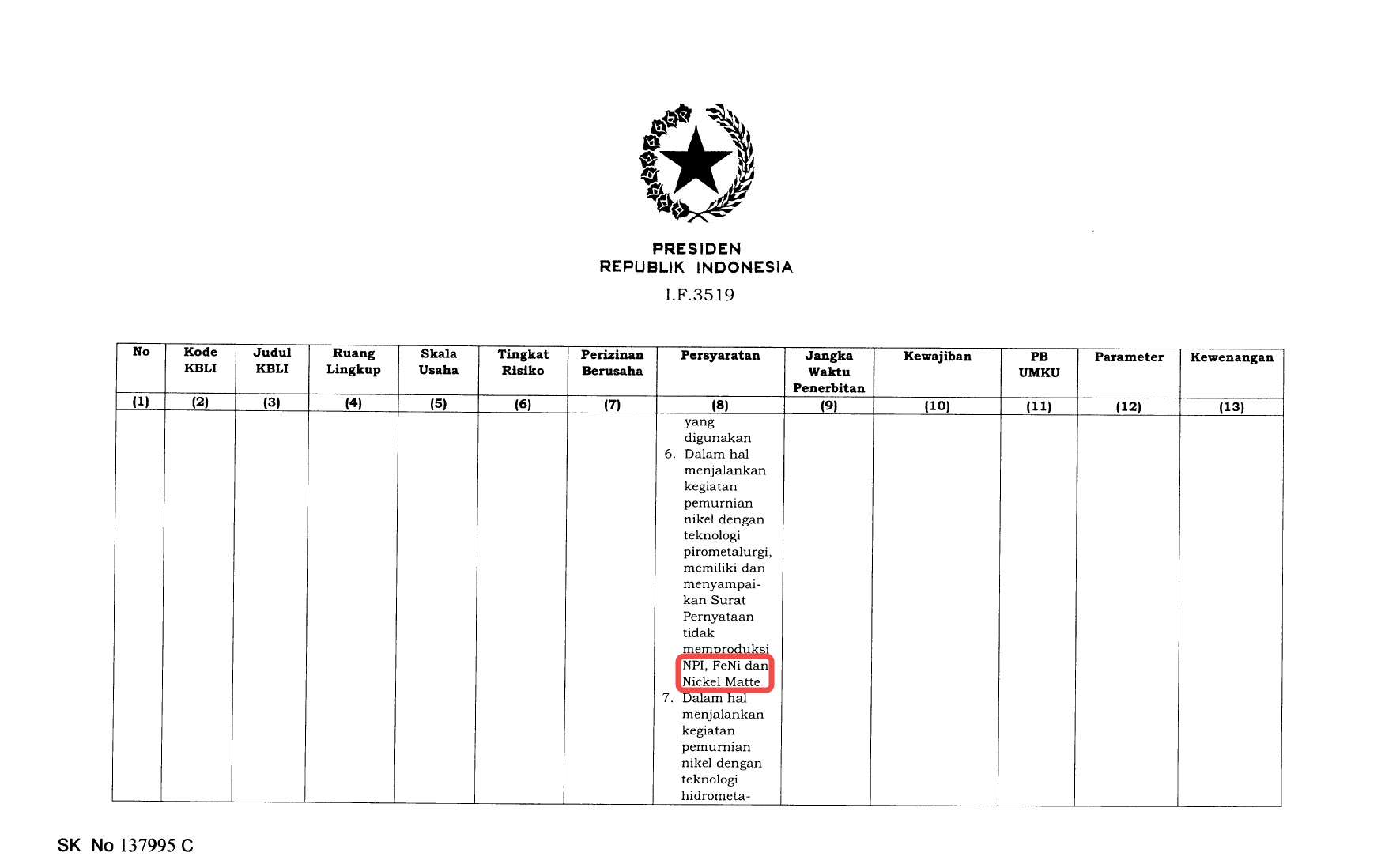
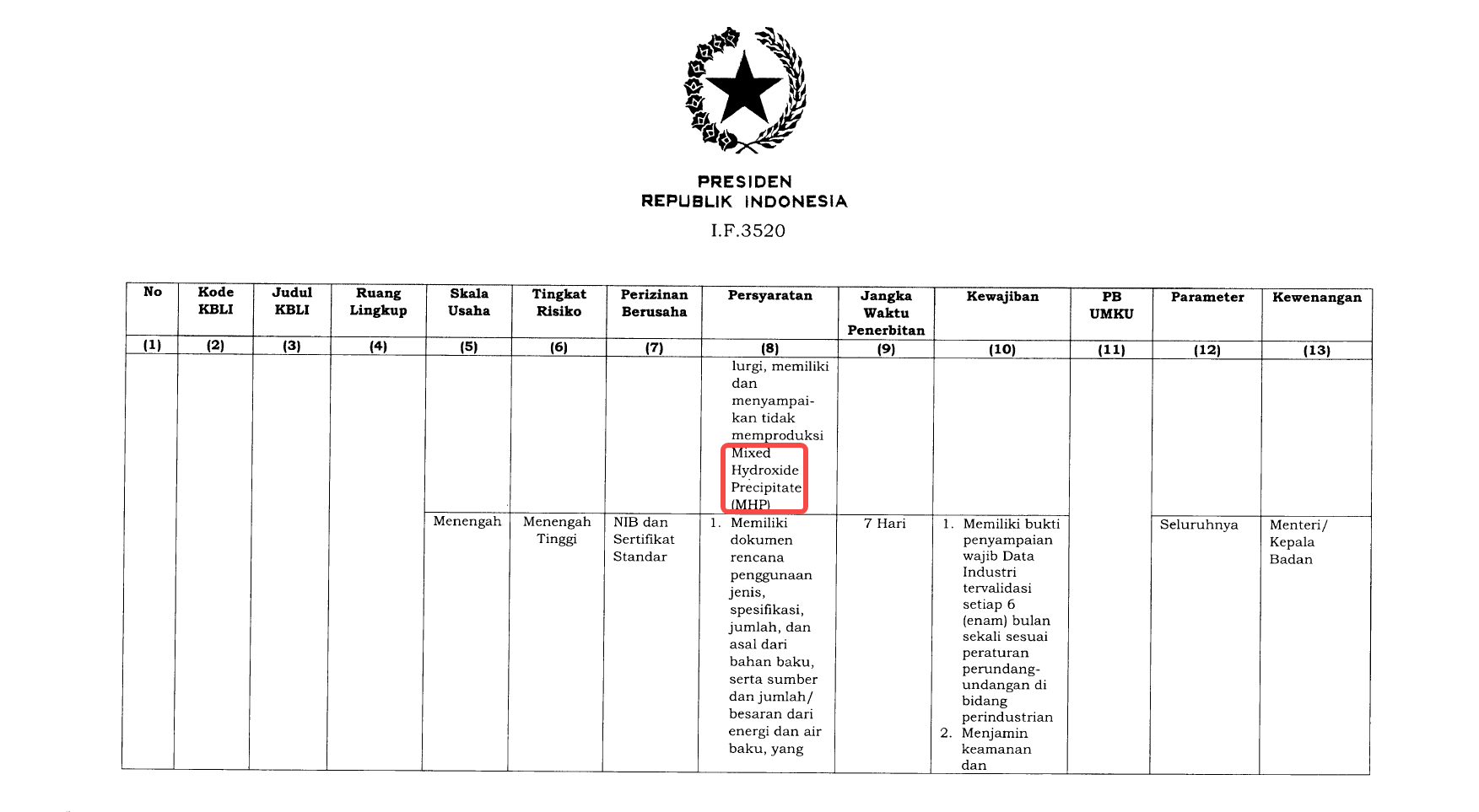
On June 5th 2025, Indonesia's Government has officially released the Government's Regulation No. 28 of 2025 (PP 28/2025), which governs "Implementation of Risk-Based Business Licensing". It is a significant reform of the country's investment and business licensing framework, replacing the previous 2021 regulation. However, the one that seeks the public attention of the nickel industry players is in the Appendix 1.F, which is appointed for Non-Ferrous Base Metal Manufacturing Industry (24202), has several new regulations according production of the nickel smelting products.
I. Overview of "The Regulations":
According to the Appendix 1F attached above, it is listed that administrative moratorium, using the OSS platform to effectively restrict new smelter projects dedicated to producing a specific class of nickel smelting products, including Nickel Matte, MHP, Ferronickel, and NPI. According to the regulation, applicants registered under KBLI 24202 must sign a declaration form, stating that their operations will not produce NPI, FeNi, Nickel Matte, and MHP.
II. Current Situation: Industry Seeks Clarification
A critical ambiguity arises from the scope of Indonesia's new smelter moratorium, specifically whether it applies retroactively to companies that secured their business licenses before PP 28/2025 took effect. While the policy's intent to restrict new market entrants suggests existing license holders should be exempt, the restriction is being enforced administratively through the OSS platform without a formal basis in mining law. This discrepancy between administrative action and statutory legislation creates a significant legal grey area, fostering regulatory uncertainty and raising concerns about inconsistent application and unequal treatment among operators.
According to an SMM conversation with the Indonesia Nickel Industry Forum (FINI), smelters already engaged in operations for the prohibited products are indeed required to submit a declaration form. This applies to facilities that are currently in either the construction or operational phase.
FINI is currently in a discussion phase with the Indonesian government, specifically the Ministry of Industry and other relevant ministries, to seek discretion regarding this policy. This appeal specifically aims to protect companies that had already begun construction or were in pre-production phases prior to the regulation, having committed significant capital investments. The objective is to uphold a stable and fair investment climate while safeguarding the productivity of the nickel downstream sector.
III. SMM's Analysis and Forecast
SMM views this action as one of the Indonesian Government's initiative to promote further downstreaming of nickel products, moving beyond nickel smelting products. As a context, the Indonesian government has established an ambitious downstreaming roadmap for 2025-2029, positioning nickel as the national priority to build a value-added economy and reduce reliance on raw material exports. Nickel is being the largest priority commodity for the downsstreaming realization.
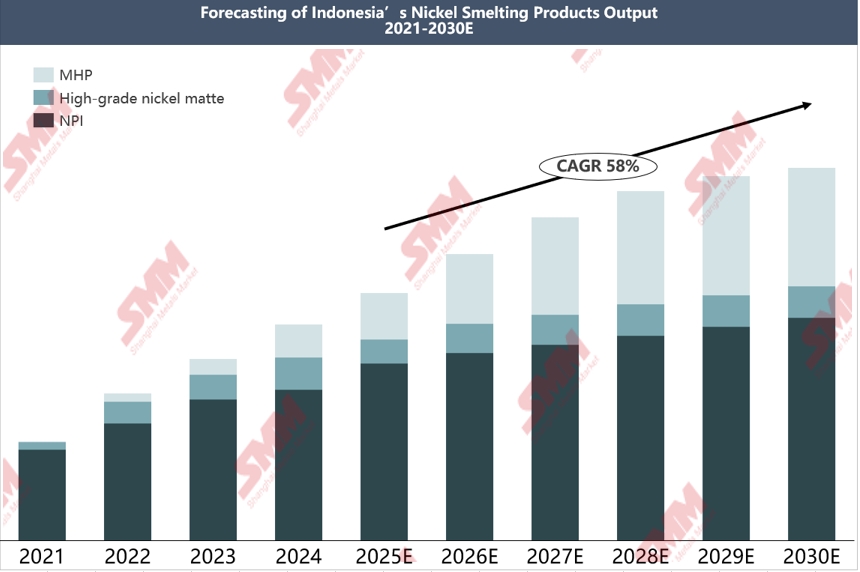
According to the SMM's data, the projected CAGR for the nickel smelting products from 2025 to 2030, which includes MHP, Nickel Matte, and NPI (Indonesian FeNi are only small volume compared to the other three), could reach 58%. It shows that Indonesia's proportion of nickel production will only keep getting larger.
SMM assesses that the full implementation of this regulation would introduce substantial uncertainties, potentially disrupting part of Indonesia's nickel processing sector. Rather than a simple adjustment, the market would face a period of profound instability as it adapts to the new constraints. It is anticipated that these disruptions will severely tighten the supply-demand balance for Indonesian nickel. Key uncertainties include potential project delays, a re-evaluation of investment viability for certain smelting products, and overall market volatility, creating a challenging and unpredictable operational environment for the foreseeable future. SMM will continue to monitor the update of the upcoming regulations.
![[NPI Daily Review] Upstream Costs and Downstream Selling Prices Were Difficult to Match, High-Grade NPI Prices Remained in Stalemate](https://imgqn.smm.cn/usercenter/yaAtG20251217171733.jpg)
![[SMM Nickel Midday Commentary] On April 1, nickel prices rose slightly, and Trump said the war against Iran would end in the short term](https://imgqn.smm.cn/usercenter/WYeHX20251217171733.jpg)
![[SMM Stainless Steel Flash] Aperam Hikes European Stainless Surcharges for April](https://imgqn.smm.cn/usercenter/NHXhQ20251217171733.jpg)