SMM survey on the impact on primary aluminium alloy industry from automaker shutdowns caused by chip shortage

Published: Apr 19, 2021 14:31
Volkswagen announced in March that it had cut production by more than 100,000 vehicles in January and February due to the lack of chips. Honda Motor announced that its Mexican plant would cease production from March 18. General Motors announced the temporary closure of its plant in Lansing, Michigan, and it was expected that it would not restart operations before April this year.

SHANGHAI, Apr 19 (SMM)—Volkswagen announced in March that it had cut production by more than 100,000 vehicles in January and February due to the lack of chips. Honda Motor announced that its Mexican plant would cease production from March 18. General Motors announced the temporary closure of its plant in Lansing, Michigan, and it was expected that it would not restart operations before April this year.

NIO announced on March 26 that it has decided to suspend production at its Hefei Jianghuai Automobile Plant for 5 days starting from March 29 amid chips shortage. On April 12, senior White House officials held a meeting with executives from nearly 20 companies to discuss the global semiconductor shortage that has caused turmoil in the automotive industry and technology companies.

The problem of chip shortages has been exacerbated by the earthquake in Japan, the fire in the Renesas electronics factory, and the cold wave in North America, which has affected the supply of other auto parts suppliers. Wheel hubs are important parts of automobiles. At present, about 90% of A356.2 primary aluminium alloy in China is used to make aluminium alloy wheel hubs.

SMM has conducted surveys with a number of primary aluminium alloy companies.
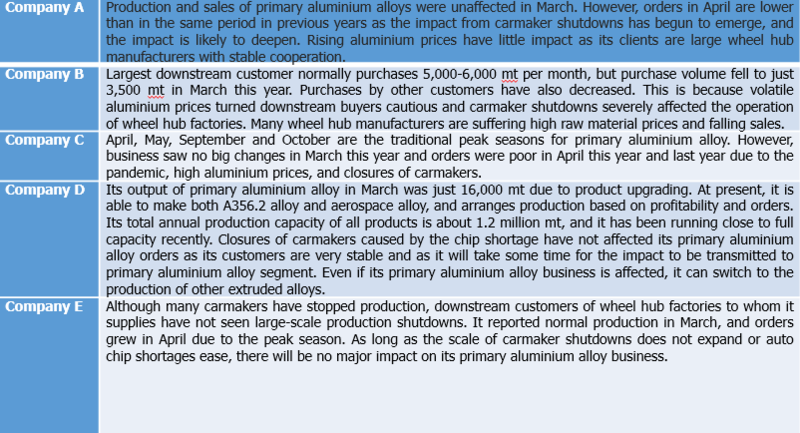
In summary, wheel hub manufacturers restocked as needed amid high aluminium prices in March. The wave of production shutdowns among carmakers triggered by chip shortages has begun to have an impact on the A356.2 alloy industry. Some small and medium-sized primary aluminium alloy companies indicated that their orders in March were not as good as in the same period in previous years, and the purchases from downstream customers generally decreased.

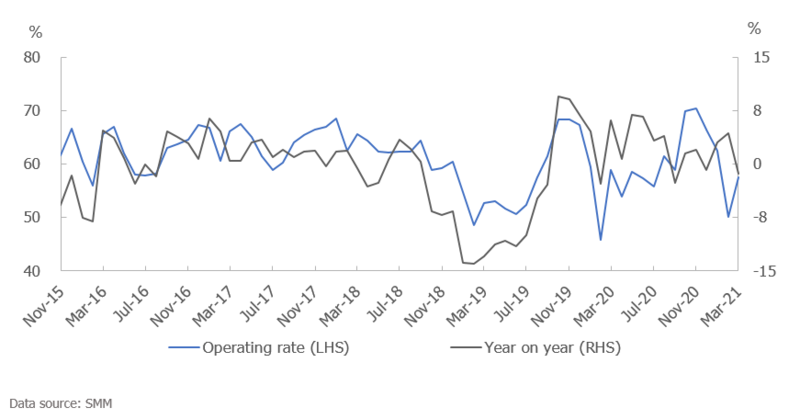
Large primary aluminium alloy companies reported normal output and sales in March. First-class product quality, stable customer resources, and ample cash flow have enable large companies to be little affected by high aluminium prices and carmaker shutdowns. However, some companies have indicated that orders did not improve in the peak season of April and are concerned that carmaker shutdowns will continue to suppress orders for primary aluminium alloys. Some companies have transformed their business and begun to produce a variety of alloy products according to market demand and profitability of each product. Operating rates at A356.2 primary aluminium alloy producers stood at 57.56% in March, up 7.48 percentage points month on month, but down 1.31 percentage points year on year, SMM survey showed.

The chip shortage is not a short-term phenomenon, and it remains to be seen how this problem will evolve in the future. If the worsening of the chip shortage leads to further shutdowns among carmakers, operating rates at primary aluminium alloy producers are likely to fall to about 50% in April, and production and sales in Q2 may drop sharply compared with the same period in previous years.

Operating rates at A356 aluminium alloy producers
Data Source Statement: Except for publicly available information, all other data are processed by SMM based on publicly available information, market communication, and relying on SMM‘s internal database model. They are for reference only and do not constitute decision-making recommendations.

For any inquiries or to learn more information, please contact: lemonzhao@smm.cn
For more information on how to access our research reports, please contact:service.en@smm.cn
Related News
Fed Governor Milan Pushes for Over 100 Basis Points Cut, Contradicts Barkin on Caution
17 hours ago
Fed Governor Milan Pushes for Over 100 Basis Points Cut, Contradicts Barkin on Caution
Read More
Fed Governor Milan Pushes for Over 100 Basis Points Cut, Contradicts Barkin on Caution
Federal Reserve Governor Milan pointed out that it is necessary for the US Fed to cut interest rates by more than 100 basis points this year. At the same time, he is very much looking forward to the performance of Kevin Warsh as Fed Chairman. However, Richmond Fed President Barkin emphasized that monetary policy must remain cautious until inflation fully pulls back to the target level, thereby ensuring the stability of the labour market.
17 hours ago
Democratic Senators Demand Delay in Fed Nomination Amid Criminal Investigation
17 hours ago
Democratic Senators Demand Delay in Fed Nomination Amid Criminal Investigation
Read More
Democratic Senators Demand Delay in Fed Nomination Amid Criminal Investigation
All 11 Democratic members of the US Senate Banking Committee jointly sent a letter to the committee's chairman, Tim Scott, requesting that all nomination processes for the prospective Fed Chairman, Kevin Warsh, be postponed until the criminal investigation into current Fed Chairman Powell and other board members is concluded. However, Scott stated that Warsh's confirmation was a done deal.
17 hours ago
Fed to Keep Large Banks' Capital Levels Unchanged, Postpones Stress Test Reforms Until 2027
17 hours ago
Fed to Keep Large Banks' Capital Levels Unchanged, Postpones Stress Test Reforms Until 2027
Read More
Fed to Keep Large Banks' Capital Levels Unchanged, Postpones Stress Test Reforms Until 2027
The US Fed has announced that it will maintain the capital levels of large banks unchanged during the upcoming stress test cycle (corresponding to the 2026 cycle). At the same time, the US Fed is planning multidimensional reforms to this annual test, aiming to enhance its transparency. The US Fed's Vice Chair for Supervision, Bowman, revealed that adjustments to the stress capital buffer requirements for large banks will be postponed until 2027. This move is intended to provide the US Fed with sufficient time to evaluate potential flaws that may be exposed in its testing models when assessing banks' financial conditions under simulated economic downturn scenarios.
17 hours ago
SMM survey on the impact on primary aluminium alloy industry from automaker shutdowns caused by chip shortage - Shanghai Metals Market (SMM)