Tungsten ore mining quotas in 2021 up by 20%, tight supply situation to be eased

Published: Feb 20, 2021 20:08
SMM believes that the current increment of the tungsten ore mining quotas is the highest over the past three years.

SHANGHAI, Feb 20 (SMM) — The first batch of tungsten ore mining quotas in 2021 totalled 63,000 mt, a 20% (or 7,815 mt) increase as compared to 2020, and is likely to alleviate the current tight supply situation.

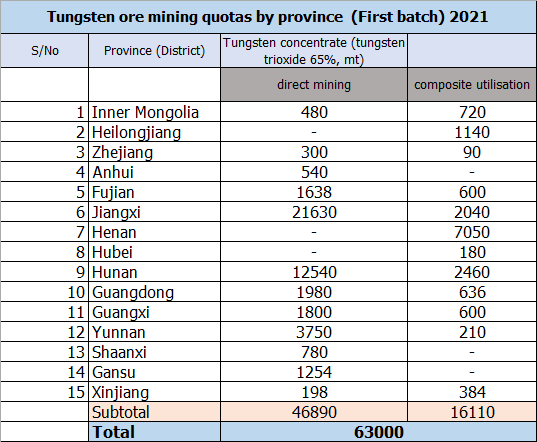
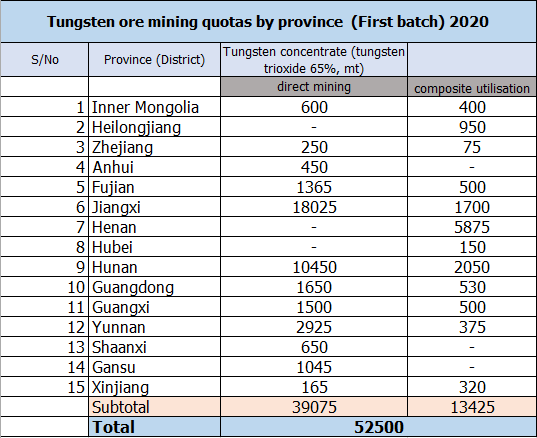
According to the data released by China’s Ministry of Natural Resources, quotas of tungsten concentrate (with 65% tungsten trioxide content) from direct mining is 46,890 mt, while quotas of composite utilisation (tungsten ore mining in other associated tungsten mines) stands at 16,110 mt.

SMM believes that the current increment of the tungsten ore mining quotas is the highest over the past three years. The increment of the quotas is to meet the growing demand in the downstream cemented carbide and the military industry. In addition, this can also alleviate the previous tight supply of some products.

From the perspective of the geographical distribution of tungsten ore quotas, provinces with rich and high-quality tungsten ore resources such as Jiangxi and Hunan will become a bigger contributor to the total tungsten ore output in the future, which is also in line with the economical concept of cluster production. On the other hand, China has not issued new tungsten mining licenses over the past three years, and this important strategic resource continues to be in a state of protective mining. The significant increase in composite utilisation quotas in Henan Province is mainly to better develop the rich tungsten and molybdenum mineral resources in Luanchuan, Luoyang. 

The increase in tungsten ore mining quotas this year mainly comes from Jiangxi and Hunan. Among them, Jiangxi's main mining quotas have increased by 3,605 mt, while Hunan saw an increase of 2,090 mt as compared to a year ago. 

The composite utilisation quotas of tungsten ore in 2021 has increased by 2,685 mt as compared with last year, and the increase will mainly come from Henan, Hunan and Jiangxi. Henan's composite utilisation quotas increased by 1,175 mt while Hunan increased by 410 mt, and Jiangxi quotas rose by 340 mt.
Data Source Statement: Except for publicly available information, all other data are processed by SMM based on publicly available information, market communication, and relying on SMM‘s internal database model. They are for reference only and do not constitute decision-making recommendations.

For any inquiries or to learn more information, please contact: lemonzhao@smm.cn
For more information on how to access our research reports, please contact:service.en@smm.cn
Related News
USA Rare Earth to Start Commercial Magnet Shipments in April, Aiming for 1,200 mt Annual Capacity by 2027
11 hours ago
USA Rare Earth to Start Commercial Magnet Shipments in April, Aiming for 1,200 mt Annual Capacity by 2027
Read More
USA Rare Earth to Start Commercial Magnet Shipments in April, Aiming for 1,200 mt Annual Capacity by 2027
USA Rare Earth will begin commercial shipments of magnets in April. According to a company statement, the first rare earth magnet production line at its Stillwater, Oklahoma facility has been put into operation and is expected to reach full capacity of 600 mt per year by month-end December. In January this year, USA Rare Earth signed a non-binding agreement with the US Department of Commerce and planned to receive $1.6 billion in funding support to build a mine, thereby providing raw material for its magnet production. USA Rare Earth said that by 2027, the capacity of its Oklahoma magnet plant should reach 1,200 mt per year.
11 hours ago
Appia Advances Rare Earths and Uranium Projects in Canada and Brazil, Focusing on EV and Clean Energy Materials
12 hours ago
Appia Advances Rare Earths and Uranium Projects in Canada and Brazil, Focusing on EV and Clean Energy Materials
Read More
Appia Advances Rare Earths and Uranium Projects in Canada and Brazil, Focusing on EV and Clean Energy Materials
Appia Rare Earths & Uranium Corp. (CSE: API) is advancing its diversified portfolio of rare earth element (REE) and uranium projects in Canada and Brazil, providing materials critical to electrification and clean energy technologies. The company is particularly focused on magnetic rare earths such as neodymium and praseodymium, which are key raw materials for EVs, wind turbines, advanced electronics, as well as uranium. Its flagship Alces Lake project, located in Saskatchewan, hosts high-grade monazite mineralization, with reported total rare earth oxide (TREO) grades of up to 50%. The mineralization occurs at or near surface, enhancing potential economic feasibility and benefiting from proximity to the Saskatchewan Research Council's processing facilities.
12 hours ago
American Rare Earths Starts Magnet Production in Oklahoma, Aims for 600 mt/year by December
16 hours ago
American Rare Earths Starts Magnet Production in Oklahoma, Aims for 600 mt/year by December
Read More
American Rare Earths Starts Magnet Production in Oklahoma, Aims for 600 mt/year by December
[SMM Rare Earth Bulletin] American Rare Earths announced that the first rare earth magnet production line at its Stillwater, Oklahoma facility had been put into operation, with commercial shipments to begin in April, and it was expected to reach full capacity of 600 mt per year by the end of December. The company said the plant's capacity would increase to 1,200 mt/year by 2027. In January this year, American Rare Earths signed a non-binding agreement with the US Department of Commerce for $1.6 billion in funding support to build a mine to supply raw material for magnet production.
16 hours ago