[SMM thread] output peaked and fell, supply mountain finally loosened-SMM thread production report in July

Published: Jul 10, 2020 19:47 (GMT+8)


According to SMM research, in July, the blast furnace steel mill, which mainly produces building materials, produced 9.0654 million tons of thread, down 2% from June, while the reel produced 2.694 million tons, an increase of 0.67% from the previous month. In addition, before the global epidemic can not be effectively controlled, domestic steel prices are still high, and the export volume of building materials from steel mills only maintains the basic level, which is basically unchanged from last month.

Table 1: an overview of the trend of thread production in China's mainstream building materials steel mills from 2019 to now


Source: SMM

Table 2: overhaul of building materials in steel mills from June to July (in ten thousand tons)


Source: SMM

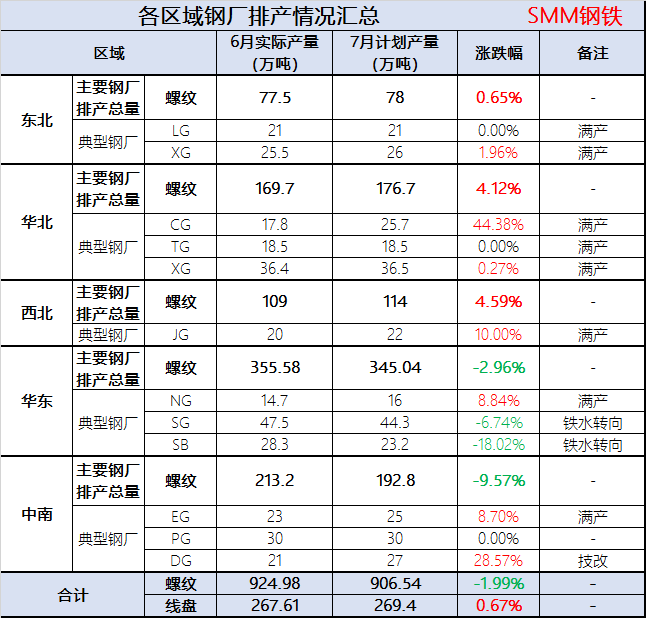
From a sub-regional point of view, the output of South-Central and East China has dropped obviously this month, while that of North China and Northeast China has shown a slight upward trend. Specifically,


Northeast China: thread production increased by 0.65% month-on-month this month

Northwest China: thread production increased by 4.59% month-on-month this month

North China: thread production increased by 4.12% this month.

Mainly due to:

At present, the national market is still in a situation of "strong in the north and weak in the south". The northeast, northwest and even North China are less affected by seasonal interference, the terminal demand is good, the merchants' shipments are smooth, and the spot price is higher than the overall price level in the south. Take Beijing as an example, as of July 10, the base price of Beijing Hegang thread is 3700mur3720 yuan / ton, while the Hangzhou market Shagang thread is only 3660,670 yuan / ton. It is quite different from the situation in previous years (in 2019, the average price of Shagang thread in Hangzhou market is 153.7 yuan / ton higher than that in Beijing), the profitability of steel mills is good, the pressure on factories and depots is relatively small, and the willingness to produce is still high.


East China: thread production decreased by 2.96% month-on-month this month.

Central and South China: thread production decreased by 9.57% month-on-month this month.


Mainly due to:

Since mid-late June, various regions in the south have been deeply affected by the "Meiyu" weather, the construction rhythm of the construction site has been seriously dragged down, merchant shipments are not smooth, and the performance of rebar with stronger seasonality is particularly weak. the enthusiasm of steel mills to produce threads has cooled slightly under the double pressure of profit and inventory, and some steel mills have chosen to turn molten iron to plate coils, profiles and strips.


Table 3: production schedule of building materials in regional steel mills from June to July 2020
 

Source: SMM

Taken together-

The output of steel mills peaked and fell as scheduled in July. At a time when China has not yet completely got rid of the seasonal interference, it is difficult for the "steel needs" of the rebar terminal to break out substantially, and it is difficult to have an obvious strong-weak relationship between the profits of steel mills producing threads and other varieties. In the later period, the supply side is likely to maintain a narrow fluctuation pattern. At the same time, the demand side gradually warmed up under the contraction of the range of rain. Under the marginal improvement of fundamentals, the upward channel of thread spot price has been quietly opened.


Data Source Statement: Except for publicly available information, all other data are processed by SMM based on publicly available information, market communication, and relying on SMM's internal database model. They are for reference only and do not constitute decision-making recommendations.

For any inquiries or for more information, please contact: lemonzhao@smm.cn
For more information on how to access our research reports, please contact:service.en@smm.cn
Related News
Peru sees 1 million t/y copper output boost within five to six years
Sep 26, 2026 01:38 (GMT+8)
Peru sees 1 million t/y copper output boost within five to six years
Read More
Peru sees 1 million t/y copper output boost within five to six years
Peru's Energy and Mines Minister Guillermo Shinno said the country expects to add about 1 million tonnes of annual copper production within five to six years through new mining projects. The world's third-largest copper producer anticipates 2026 output of 2.5 to 2.7 million tonnes, roughly unchanged from 2023 as declining ore grades and recurring social conflicts weigh on supply. The newly elected government is seeking to reverse that stagnation by cutting red tape; in the two months since taking office, mining companies have stepped up engagement with the ministry. Shinno said officials have identified 27 permits that could be eliminated from roughly 100 mining-sector requirements, without lowering environmenta
Sep 26, 2026 01:38 (GMT+8)
BHP-Amazon copper EAC pilot draws mining-sector interest in lower-carbon labelling
Sep 25, 2026 13:25 (GMT+8)
BHP-Amazon copper EAC pilot draws mining-sector interest in lower-carbon labelling
Read More
BHP-Amazon copper EAC pilot draws mining-sector interest in lower-carbon labelling
Spanish-language mining media report that BHP and Amazon have rolled out the first lower-emissions copper pilot at Escondida using Environmental Attribute Certificates, certifying emissions reductions within the mining setting rather than offsetting them elsewhere. Unveiled on 22 September 2026, the pilot leverages Escondida's renewable electricity and desalinated water, with Amazon retiring the certificates to match lower-carbon attributes to its AI infrastructure. Escondida produces about 1.2 million tonnes of copper annually as the world's largest mine, and the label is expected to serve growing demand for low-carbon metal procurement.
Sep 25, 2026 13:25 (GMT+8)
Western Mining Subsidiary Receives 17-Year License for Qinghai Polymetallic Mine
Sep 22, 2026 16:11 (GMT+8)
Western Mining Subsidiary Receives 17-Year License for Qinghai Polymetallic Mine
Read More
Western Mining Subsidiary Receives 17-Year License for Qinghai Polymetallic Mine
On September 22, Western Mining announced that its wholly owned subsidiary, Qinghai Ganxin Mining Development Co., Ltd. (“Ganxin Mining”), recently obtained a Mining License issued by the Department of Natural Resources of Qinghai Province. The mine, named the Geermu Tuwenchahan Iron Polymetallic Mine of Qinghai Ganxin Mining Development Co., Ltd., covers iron, copper, gold, molybdenum, zinc, lead, and silver as the permitted mining commodities. The mining license is valid from August 3, 2026, to August 30, 2043.
Sep 22, 2026 16:11 (GMT+8)