Copper scrap, which is an effective supplement to copper ore resources, can be recycled. Generally, it can be remelted and smelted into copper cathode or directly processed into copper semis. By recycling copper scrap resources, it is helpful to alleviate the tight supply of copper ore.
In addition, the recycling of copper scrap resources can bring good energy saving and emission reduction effects. Compared with the production of primary copper, each mt of secondary copper can save about 1 mt of standard coal, nearly 400 m3 of water, and reduce solid waste emissions by 380 mt, reducing the emission of sulphur dioxide by 0.137 mt. China is the largest copper consumer, but lacks copper resources. Therefore, it is becoming more and more urgent to use copper resources through multiple channels.
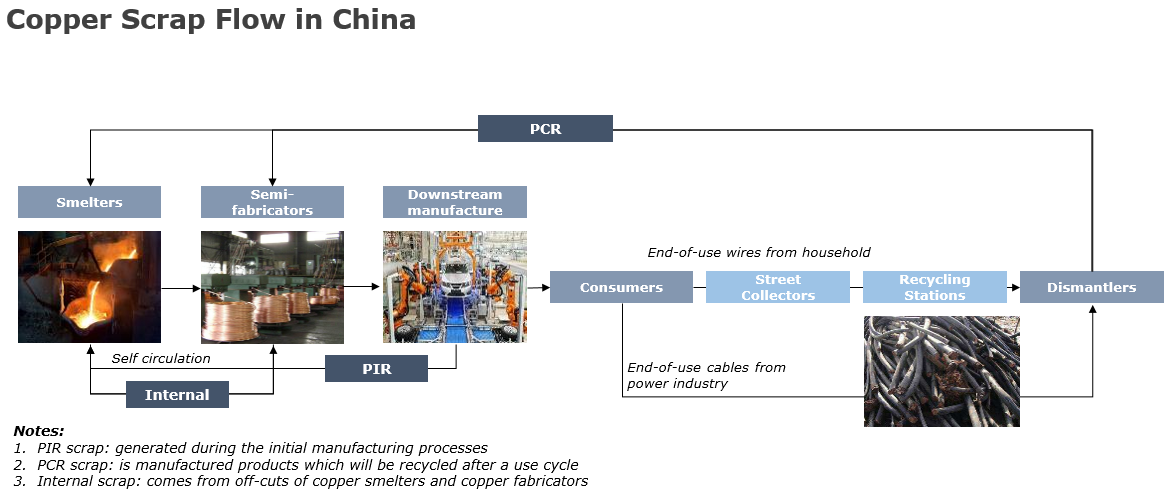
According to the source, copper scrap can be divided into post-industrial recycled scrap (PIR) and post-consumer recycled scrap (PCR). PIR refers to the scrap generated in the process of copper production or utilisation, including copper smelting, copper processing and end product production.
The PIR generated from smelting includes slag and anode slime, and that from processing and end product production includes industrial waste and scrap. More than 90% of the new scrap is recycled by the factory or recycled by the upstream plants instead of flowing to the market. With the development of technology and the realisation of customised size, the output loss of such products will fall. PCR refers to copper-containing products that are discarded after use. The copper metal obtained after recycling or dismantling is called PCR. From the perspective of the average recovery period of copper products, domestic supply of copper scrap is growing rapidly. This article mainly focuses on PCR to introduce the future market trend of copper scrap in China.
Source: SMM
According to SMM statistics, in 2022, China's copper scrap output was around 2.27 million mt, including 1.596 million mt of PCR, and 678,000 mt of PIR. Calculated based on sources, the demand for copper scrap was about 3.98 million mt, and the gap between supply and demand is about 1.706 million mt. With the tightening of China's copper scrap import policy and the continuous improvement of the domestic solid waste recycling system, the amount of imported copper scrap will decline in the future, and the supply of domestic copper scrap will increase amid growing copper demand.
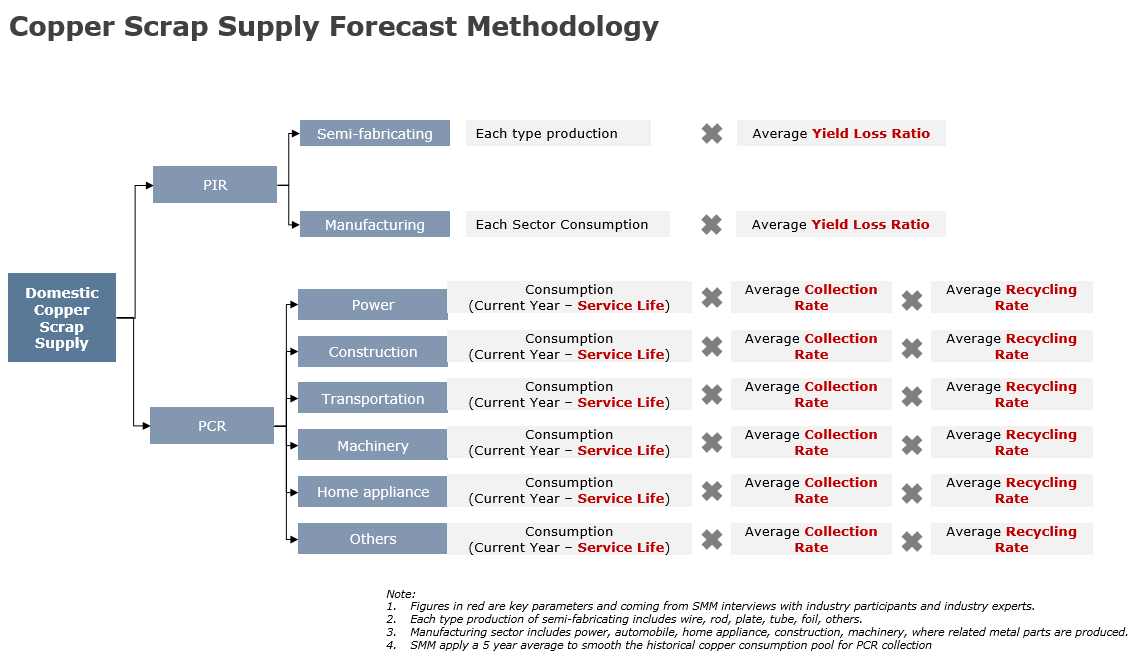
SMM calculated the amount of PIR and PCR. The PIR is calculated according to the copper consumption of different types of products and the corresponding loss rate. For PCR, the amount generated is calculated according to the recovery rate, water yield and product service life of the corresponding product.
Source: SMM
In terms of PCR, the amount generated in the power industry in 2022 was about 477,000 mt, accounting for about 30% of the total PCR; the amount of copper scrap in the transportation industry was about 362,000 mt, accounting for about 23%; the amount generated from durable consumer goods was 377,000 mt, accounting for about 24%. As copper products such as wires, transformers and substation cabinets in the construction field as well as new energy vehicles reach the recycling cycle, they will become the main driving factors of the growth in copper scrap supply in the future.
SMM is an information provider in China's professional non-ferrous consulting field. The consulting products mainly include industry supply and demand price analysis, supply chain management analysis, market research, on-site research, professional research reports, customized research reports, industrial planning books, industry white papers, etc. The reports can be updated quarterly, semi-annually, or annually according to the need of clients.
For more information, please contact:
Nonferrous Consulting Manager Deng Chenyang (17789717229)
![Tight supply coupled with rising sentiment to hold back from selling kept secondary copper prices resilient at high levels [SMM Weekly Review on Secondary Copper Raw Materials Outside China]](https://imgqn.smm.cn/usercenter/HhNHP20251217171708.jpg)
![[Mingyi Electronics Launches High-Aspect-Ratio Gantry Line Electroplating Equipment for AI Servers and IC Substrates]](https://imgqn.smm.cn/usercenter/CaDcj20251217171711.jpg)
![US Inflation Exceeds Expectations, Combined with Inventory Buildup in China, Copper Prices Rebound Under Pressure [SMM Macro Weekly Review]](https://imgqn.smm.cn/usercenter/JnFuh20251217171711.jpg)