Copper Inventory in Major Chinese Markets Fell 2,200 mt on Week

Published: May 27, 2022 14:20 (GMT+8)
Source: SMM
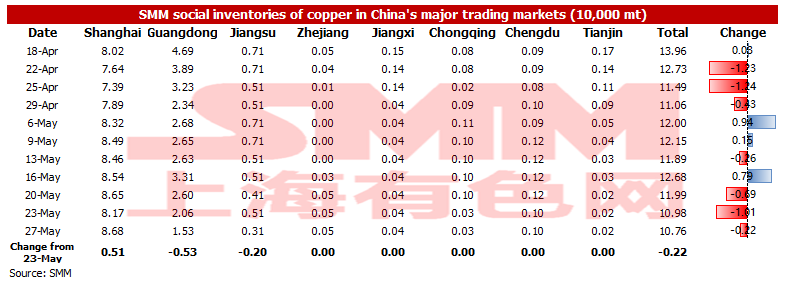
As of May 27, SMM copper inventory across major Chinese markets dropped by 2,200 mt to 107,600 mt from Monday, a decrease of 12,300 mt from last Friday.

SHANGHAI, May 27 (SMM) - As of May 27, SMM copper inventory across major Chinese markets dropped by 2,200 mt to 107,600 mt from Monday, a decrease of 12,300 mt from last Friday. The inventory dropped sharply this week. The inventory in China showed a continuous decline after May 1 mainly because of the decrease in supply and the increase in demand. Compared with the data on Monday, the inventory in most regions of China this week fell, while the inventories in Shanghai rose. The total inventory fell 221,300 mt from the same period last year when the inventory was recorded at 328,900 mt. Because the arrival of imported copper in Shanghai increased, and the logistics of the city have not fully recovered, the inventory in Shanghai increased this week. In Guangdong, the inventory dropped sharply as the arrival of domestic copper increased slightly and some copper cathode was transported to regions where the downstream consumption is relatively good. The inventory in Jiangsu fell due to the increase in pick-up aroused by the recovered downstream consumption.

In detail, the inventory in Shanghai increased by 5,100 mt to 86,800 mt, the inventory in Guangdong dipped by 5,300 mt to 15,300 mt, and the inventory in Jiangsu dropped by 2,000 mt to 3,100 mt.

Looking forward, it is expected that the arrival of imported copper will increase next week, and the domestic supply will also rise, but the consumption may decrease due to the end of the month. SMM expects that the weekly inventory next week will increase slightly, while it dropped compared with the same period last year. The market shall pay attention to whether the downstream enterprises will restock actively during the Dragon Boat Festival.


Disclaimer:

The above representation and data is based on market information SMM believes to be reliable at the time of acquiring as well as the comprehensive assessment by SMM research team, and any and all information provided in this article is for reference only. This article does not constitute a direct recommendation for investment or any decisions in any form and clients shall act on their own discreet and any decisions made by clients are not within the responsibility of SMM.


Data Source Statement: Except for publicly available information, all other data are processed by SMM based on publicly available information, market communication, and relying on SMM's internal database model. They are for reference only and do not constitute decision-making recommendations.

For any inquiries or for more information, please contact: lemonzhao@smm.cn
For more information on how to access our research reports, please contact:service.en@smm.cn
Related News
DRC Launches 36-Month Airborne Geological Mapping Programme, Targets 46.1% Geoscientific Coverage
9 hours ago
DRC Launches 36-Month Airborne Geological Mapping Programme, Targets 46.1% Geoscientific Coverage
Read More
DRC Launches 36-Month Airborne Geological Mapping Programme, Targets 46.1% Geoscientific Coverage
The Democratic Republic of Congo has launched a 36-month nationwide airborne geophysical and geological mapping programme aimed at expanding national geoscientific coverage from 22.27% to 46.1%, according to the Ministry of Mines and the National Geological Service of Congo. The programme, known as PC2G-RDC, will deploy eight aircraft to collect high-resolution magnetic, radiometric, gravimetric and electromagnetic data across priority regions including Kongo Central, Kwango, Kwilu, Greater Kasai and Greater Katanga. The programme is being coordinated by the National Geological Service of Congo, financed by the Fonds Minier pour les Générations Futures and executed by Spanish geophysics company Xcalibur Multiphysics Group. The expansion would increase mapped geoscientific coverage by 23.83 percentage points, more than doubling the current level. Congolese authorities estimate that less than 10% of the country has been thoroughly explored, despite the DRC already ranking as Africa’s largest copper producer and the world’s largest cobalt producer. The latest survey phase builds on geological work previously carried out in Greater Katanga, the country’s main copper-cobalt producing region, while extending systematic airborne mapping into less-explored parts of the DRC. The surveys are intended to identify geophysical anomalies and improve the geological datasets used to prioritize areas for subsequent ground-based exploration. The government expects the resulting datasets to reduce geological uncertainty for future exploration, improve identification of prospective mineral zones and strengthen the state’s ability to evaluate mineral-development opportunities. Any anomalies identified through the airborne surveys would still require ground verification, geochemical work and drilling before a mineral deposit could be established. APAnews Raising national geoscientific coverage from 22.27% to 46.1% would materially expand the amount of modern geological data available for mineral exploration in the DRC. For the copper sector, the immediate impact is on exploration efficiency rather than mine supply: improved airborne datasets can narrow target areas before companies commit capital to detailed fieldwork and drilling. Given that less than 10% of the country has been thoroughly explored, the programme could expand the longer-term pipeline of copper exploration targets beyond the established Greater Katanga Copperbelt. However, the programme itself does not add reserves or production; any prospective anomalies would require years of follow-up exploration and development before contributing to copper supply.
9 hours ago
GoldMining Intersects 400 m of Gold-Copper Mineralization at Yarumalito in Colombia
9 hours ago
GoldMining Intersects 400 m of Gold-Copper Mineralization at Yarumalito in Colombia
Read More
GoldMining Intersects 400 m of Gold-Copper Mineralization at Yarumalito in Colombia
GoldMining Inc. has reported initial assay results from its 2026 diamond drilling programme at the 100%-owned Yarumalito gold-copper project in Antioquia, Colombia, highlighting a broad interval of continuous porphyry-style mineralization from surface. Drill hole YAR-45 returned 399.9 metres grading 0.34 g/t gold, 0.09% copper and 1.21 g/t silver, equivalent to 0.45 g/t gold-equivalent, from surface to the end of the hole. The interval included 74.7 metres grading 0.46 g/t gold, 0.13% copper and 1.41 g/t silver, equivalent to 0.61 g/t AuEq. GoldMining Inc. Within that broader interval, GoldMining also reported 47.0 metres grading 0.54 g/t gold, 0.14% copper and 1.72 g/t silver, equivalent to 0.70 g/t AuEq, as well as a separate 36.0-metre interval grading 0.50 g/t gold, 0.14% copper and 1.07 g/t silver, equivalent to 0.65 g/t AuEq. GoldMining Inc. GoldMining said YAR-45 remained in alteration and mineralization of variable intensity from surface to its final depth of 399.9 metres. The company interpreted the results as supporting continuity of the P-1 intrusive phase, which it identifies as the principal host of porphyry-style gold-copper mineralization at Yarumalito. GoldMining Inc. Assay results from three additional holes — YAR-46, YAR-47 and YAR-48 — remain pending. The holes were drilled to depths of 251.2 metres, 263.25 metres and 304.1 metres, respectively. GoldMining Inc. The YAR-45 result confirms a broad interval of gold-copper mineralization from surface and provides additional geological information on the continuity of the mineralized P-1 intrusive phase. However, the reported intervals are downhole lengths rather than true widths, which GoldMining currently estimates at approximately 50% of the downhole intervals. Attention will now turn to the pending assays from the remaining three drill holes and whether they support further definition or expansion of the mineralized system.
9 hours ago
Canterra Expands Lundberg Indicated Resource by 55% to 26.1 Mt in Newfoundland
9 hours ago
Canterra Expands Lundberg Indicated Resource by 55% to 26.1 Mt in Newfoundland
Read More
Canterra Expands Lundberg Indicated Resource by 55% to 26.1 Mt in Newfoundland
Canterra Minerals has announced an updated Mineral Resource Estimate for its Lundberg copper-zinc deposit, part of the company’s 100%-owned Buchans Project in Newfoundland, Canada, reporting a 55% increase in Indicated resource tonnage to approximately 26.1 million mt. The updated Indicated resource totals 26.08 million mt grading 0.36% copper, 1.31% zinc, 0.56% lead, 5.02 g/t silver and 0.06 g/t gold. This compares with 16.79 million mt grading 0.42% copper in the previous 2019 estimate. The updated Indicated resource contains approximately 94,800 mt of copper, 341,600 mt of zinc and 146,200 mt of lead. Contained copper-equivalent increased by 34% to approximately 226,200 mt compared with the previous estimate. The updated estimate incorporates 4,779 metres of drilling completed since Canterra acquired the project in 2024, alongside an optimized pit shell based on updated metal-price assumptions. Approximately 97% of the reported Mineral Resource tonnage is classified as Indicated, with the remainder classified as Inferred. Canterra said recent exploration has extended mineralisation to the northeast and northwest of the deposit and identified additional massive sulphide mineralisation in the Two Level zone. Results from approximately 6,000 metres of additional drilling remain pending, with further reporting expected through the remainder of 2026 and into 2027. SMM Analysis: The 55% increase in Lundberg’s Indicated resource tonnage and 34% increase in contained copper-equivalent materially expand the scale of the deposit. However, the average Indicated copper grade declined from 0.42% in the 2019 estimate to 0.36% in the latest resource, making future technical work important in assessing processing requirements and project economics. Attention will now turn to the outstanding drilling results and further evaluation of the deposit’s development potential. The updated resource represents in-situ mineralisation rather than economically recoverable copper production.
9 hours ago