14th Five-Year Plan on Green Industry Development and Its Impact on Lithium Battery Recycling

Published: Dec 13, 2021 13:14
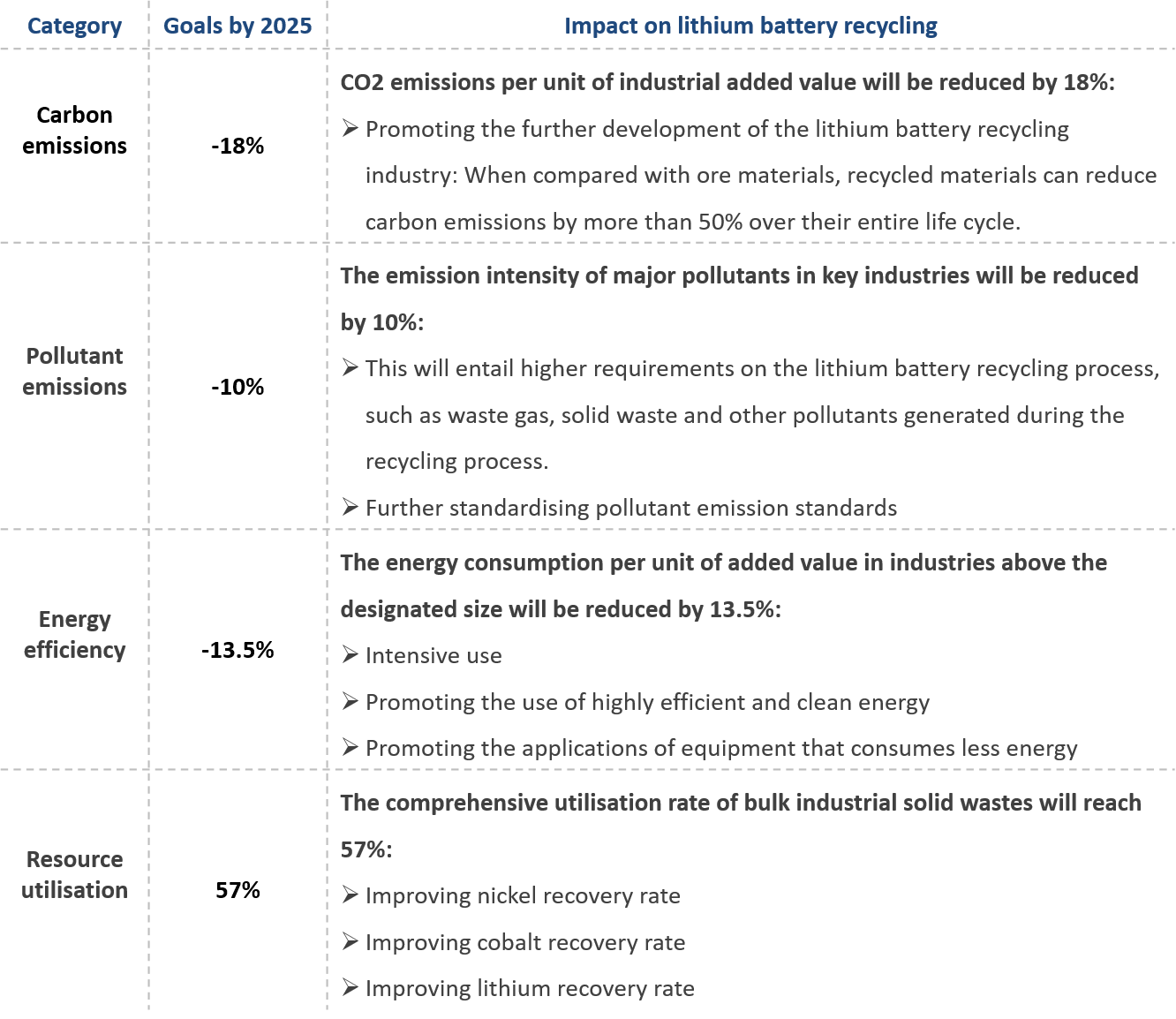
China’s Ministry of Industry and Information Technology (MIIT) released the 14th Five-Year Plan on Green Industry Development on December 3. According to the plan, by 2025, carbon emission intensity will continue to decline, and carbon dioxide emissions per unit of industrial added value will drop by 18%...

SHANGHAI, Dec 13 (SMM) - China’s Ministry of Industry and Information Technology (MIIT) released the 14th Five-Year Plan on Green Industry Development on December 3. According to the plan, by 2025, carbon emission intensity will continue to decline, and carbon dioxide emissions per unit of industrial added value will drop by 18%; pollutant emission intensity will drop significantly, and the emission intensity of major pollutants in key industries will be reduced by 10%, and the energy consumption per unit of added value in industries above the designated size will be reduced by 13.5%; the comprehensive utilisation rate of bulk industrial solid wastes will reach 57%, and the recycling and utilisation of main renewable resources will reach 480 million mt; water consumption per unit of industrial added value will be reduced by 16%. This will lay a solid foundation for achieving the goal of carbon peak in the industrial sector by 2030.
Data Source Statement: Except for publicly available information, all other data are processed by SMM based on publicly available information, market communication, and relying on SMM‘s internal database model. They are for reference only and do not constitute decision-making recommendations.

For any inquiries or to learn more information, please contact: lemonzhao@smm.cn
For more information on how to access our research reports, please contact:service.en@smm.cn
Related News
Peak Energy Challenges Battery Industry with Salt-Based Technology
8 hours ago
Peak Energy Challenges Battery Industry with Salt-Based Technology
Read More
Peak Energy Challenges Battery Industry with Salt-Based Technology
U.S. startup Peak Energy has pledged to supply up to 4.75GWh of sodium-ion battery energy storage systems to Jupiter Power by 2030, leveraging sodium derived from common table salt as a core material. Last week, the company also reached an agreement to provide 1.5GWh of battery storage capacity to Energy Vault, an AI-focused power infrastructure provider.
8 hours ago
Ford to Adopt 48-Volt Electrical Architecture for Pickups, Following Tesla Cybertruck
8 hours ago
Ford to Adopt 48-Volt Electrical Architecture for Pickups, Following Tesla Cybertruck
Read More
Ford to Adopt 48-Volt Electrical Architecture for Pickups, Following Tesla Cybertruck
Ford Motor said on Feb. 17 (local time) that it will introduce a 48-volt electrical architecture for its pickup trucks, a technology commercialized by Tesla in its Cybertruck. The move is part of Ford’s broader plan to invest $5 billion in next-generation battery electric vehicles, as the automaker seeks to improve efficiency, reduce wiring complexity, and enhance overall vehicle performance through updated electrical systems.
8 hours ago
Samsung C&T to Invest Up to KRW 9.4 Trillion Over Three Years in Energy and Bio
8 hours ago
Samsung C&T to Invest Up to KRW 9.4 Trillion Over Three Years in Energy and Bio
Read More
Samsung C&T to Invest Up to KRW 9.4 Trillion Over Three Years in Energy and Bio
Samsung C&T announced it will invest up to KRW 9.4 trillion over the next three years in future growth sectors, including energy and biotechnology. The company plans to allocate approximately KRW 6.5 trillion to KRW 7.5 trillion to energy and bio-related businesses during the period. In the energy segment, Samsung C&T will focus investments on overseas solar power projects and battery energy storage systems (BESS), as well as renewable energy, hydrogen, and small modular reactors (SMRs) with a power generation capacity of around 300MW.
8 hours ago