Divine material: it is expected that the demand for sodium ion battery electrolyte has no effect on the company's existing technology / industry chain layout.

Published: May 25, 2021 15:51
[divine material: it is expected that the demand for sodium ion battery electrolyte will have no effect on the company's existing technology / industry chain layout] Tianci material said that there is already a mass production technology of sodium hexafluorophosphate, and the product has been recognized by customers. Considering that the production reaction process and the equipment and process cost of sodium hexafluorophosphate are basically the same as that of lithium hexafluorophosphate, the only difference is that the raw material is replaced by lithium carbonate by sodium salt. therefore, the production system of sodium ion battery electrolyte can all use the company's existing lithium ion battery system. Therefore, on the whole, it is expected that the market demand for sodium ion battery electrolyte has no impact on the company's existing technology / industry chain layout.

On May 24th, the chairman of Ningde Times made a speech that it would release sodium battery in July. For a time, the discussion on whether sodium batteries will replace the current booming lithium batteries is in full swing, and on the same day, there are several sodium battery concept stocks, including China Salt Chemical and Shengyang shares, which have risen by the daily limit.

However, after a day of cooling, many organizations have issued comments that sodium batteries are temporarily difficult to shake the status of lithium batteries, but will be used as a supplement and support for lithium batteries. But even so, the sodium battery is still hot. Under this background, the every move of the leading enterprises in the lithium battery industry has naturally attracted the attention of people in the industry.

On May 24, investors asked Ganfeng Lithium Industry on the interactive platform whether the company had carried out related research and layout of sodium battery. Ganfeng Lithium Industry admitted that the company had not laid out the sodium battery business for the time being.

On the same day, as a major domestic manufacturer of lithium-ion battery materials and a godsend material that mainly supplies lithium battery electrolyte and cathode material lithium iron phosphate, I also accepted questions from investors about whether the company has the layout of research and development of sodium-ion battery electrolyte. Unlike the answer of Ganfeng lithium industry, Tianzhi material said that the electrolyte of sodium ion battery is similar to that of lithium ion battery, and the biggest difference between the two is that the former electrolyte is composed of sodium hexafluorophosphate, while the latter is lithium hexafluorophosphate.

At present, Divine material has already had the mass production technology of sodium hexafluorophosphate, and the products have been recognized by customers. Considering that the production reaction process and the equipment and process cost of sodium hexafluorophosphate are basically the same as that of lithium hexafluorophosphate, the only difference is that the raw material is replaced by lithium carbonate by sodium salt. therefore, the production system of sodium ion battery electrolyte can all use the company's existing lithium ion battery system. Therefore, on the whole, it is expected that the market demand for sodium ion battery electrolyte has no impact on the company's existing technology / industry chain layout.

However, it should be noted that, considering that sodium hexafluorophosphate and lithium hexafluorophosphate need to share production line capacity, the actual output of sodium hexafluorophosphate will eventually be limited by the excess capacity of lithium hexafluorophosphate.

In fact, although sodium battery has the advantages of low cost and good safety compared with lithium battery, the current energy density of sodium battery can only reach about 130wh/kg, which is much lower than the lithium iron phosphate battery of 170wh/kg on the market, so in the field of power battery with high energy density, sodium battery is difficult to replace lithium battery, so Tianfeng Securities believes that sodium battery and lithium battery are complementary rather than competitive. In the field of power batteries, sodium batteries have no conditions to compete with lithium batteries; in the field of energy storage, distributed energy storage lithium batteries have great advantages, and sodium batteries have certain advantages in large-scale energy storage. Therefore, sodium batteries do not pose a threat to lithium batteries, and the two can complement each other in the field of energy storage. It is worth mentioning that, according to SMM research statistics, the current increase in demand for lithium in the market is mainly from the electric vehicle and energy storage industry.

With the increasing popularity of the new energy vehicle industry, lithium salt as an important part of power batteries, the price performance of major lithium salts such as battery-grade lithium carbonate and lithium hydroxide is also very excellent. In particular, lithium hydroxide, SMM predicts that considering that new overseas high-end models will be on the market in the second half of 2021, the orders of battery factories in Japan and South Korea will increase significantly, while the demand for domestic high-end lithium hydroxide will increase significantly, and the domestic export volume will increase to 60%. Superimposed by the export volume of some large domestic smelters, the export volume will also increase to about 90%, and their domestic supply will be significantly reduced in the future. The upward demand season promotes the upward price of lithium hydroxide. So overall, lithium prices are expected to remain high in 2021. "View details

Tianfeng Securities also made it clear that the demand for high-nickel ternary cathode materials at home and abroad has increased significantly, while the release of lithium hydroxide production capacity is not as expected, strongly supporting the price of lithium hydroxide, and it is expected that in the peak season of demand in the second half of this year, the supply of lithium hydroxide may be tight, and the price of lithium hydroxide will continue to rise.

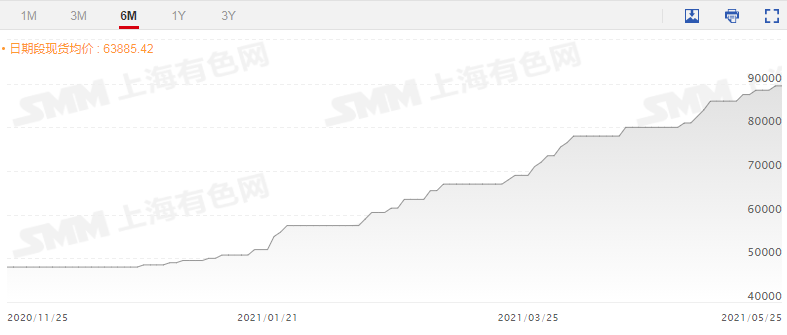
As of May 25, the average price of battery-grade lithium hydroxide in China was 89500 yuan / ton, up 40000 yuan / ton or 80% from the beginning of the year.
"Click to see more SMM metal spot prices.

Data Source Statement: Except for publicly available information, all other data are processed by SMM based on publicly available information, market communication, and relying on SMM's internal database model. They are for reference only and do not constitute decision-making recommendations.

For any inquiries or for more information, please contact: lemonzhao@smm.cn
For more information on how to access our research reports, please contact:service.en@smm.cn
Related News
[SMM Cobalt Morning Meeting Summary] Raw material costs weaken, demand is sluggish, and the price center continues to shift downward
5 hours ago
[SMM Cobalt Morning Meeting Summary] Raw material costs weaken, demand is sluggish, and the price center continues to shift downward
Read More
[SMM Cobalt Morning Meeting Summary] Raw material costs weaken, demand is sluggish, and the price center continues to shift downward
[SMM Cobalt Morning Meeting Summary] Raw material costs weaken, demand is sluggish, and the price center continues to shift downward
The industry chain remained in the doldrums overall this week, with some products stabilizing briefly, but demand-side improvement was limited. Electrolysis product prices stopped falling and rebounded, driven mainly by a phased increase in purchasing, though sustainability remains to be seen. The intermediate product market stayed in a stalemate, with upstream price-holding and low-price transactions intensifying the standoff; if low-priced supply persists, the price center still faces downside risk. Cost support for salt products continued to weaken, as low-cost recycled materials and low-price selling by some enterprises intensified market competition, while downstream purchase willingness remained cautious, leaving prices clearly under pressure. Co3O4 and cobalt chloride were broadly stable, but with both supply and demand weak and inventory digestion slow, there was little upward momentum in the short term. Cobalt powder quotations continued to edge lower, dragged down by weak demand from the cemented carbide sector. Ternary cathode precursors and ternary cathode materials continued to weaken under the impact of falling nickel and lithium raw material prices and reduced end-user orders, with production schedules also trending downward. LCO's traditional peak season performance fell short of expectations, with weak end-user stockpiling; falling costs and insufficient demand created dual pressure, and the market is expected to consolidate on a weak note in the short term.
5 hours ago
[SMM Cobalt-Lithium Morning Meeting Summary] Raw Material Divergence Intensifies; Peak Season Demand Uneven, Prices Consolidate
Sep 11, 2026 09:59
[SMM Cobalt-Lithium Morning Meeting Summary] Raw Material Divergence Intensifies; Peak Season Demand Uneven, Prices Consolidate
Read More
[SMM Cobalt-Lithium Morning Meeting Summary] Raw Material Divergence Intensifies; Peak Season Demand Uneven, Prices Consolidate
[SMM Cobalt-Lithium Morning Meeting Summary] Raw Material Divergence Intensifies; Peak Season Demand Uneven, Prices Consolidate
This week, the industry chain continued to diverge. On the lithium side, lithium carbonate drifted lower, but downstream stockpiling willingness near 140,000 yuan/mt remained strong, providing support for prices. Lithium ore pulled back accordingly, though overseas supply disruptions and mines holding prices firm kept ore prices relatively resilient. Lithium hydroxide was affected by reduced ternary orders, with transactions remaining weak. The materials segment was under pressure overall, with ternary cathode precursors, ternary cathode materials, and LCO continuing to weaken due to raw material pullbacks and insufficient end-use demand. China production schedules declined somewhat, while overseas high-nickel orders remained relatively good. LFP demand stayed robust, with production and sales holding at high levels. Iron phosphate orders increased, and prices edged up. Anode prices were broadly stable, with artificial graphite still having upside room supported by peak-season production schedules and cost support. High-end separator specifications saw tight supply-demand, with expectations of future price increases. Electrolyte cost support strengthened, with short-term stability for now. Sodium-ion batteries remained constrained by insufficient effective anode and cathode capacity, while the recycling market continued to remain under pressure amid raw material price fluctuations.
Sep 11, 2026 09:59
[SMM Cobalt Morning Meeting Summary] Weak Demand Combined with Lower Costs, Industry Chain Price Center Continues to Decline
Sep 11, 2026 09:55
[SMM Cobalt Morning Meeting Summary] Weak Demand Combined with Lower Costs, Industry Chain Price Center Continues to Decline
Read More
[SMM Cobalt Morning Meeting Summary] Weak Demand Combined with Lower Costs, Industry Chain Price Center Continues to Decline
[SMM Cobalt Morning Meeting Summary] Weak Demand Combined with Lower Costs, Industry Chain Price Center Continues to Decline
The industry chain remained weak overall this week, with price centers generally moving lower. Upstream, reports of low-price raw material transactions increased, and the market stalemate showed signs of easing. Midstream, cost support for salts continued to weaken, and some enterprises, affected by funding and inventory pressure, proactively cut prices to sell, further dragging down market sentiment. Downstream, demand recovery fell significantly short of expectations, with orders for ternary cathode precursors, ternary cathode materials, and LCO all revised downward to varying degrees. Enterprises generally maintained cautious purchasing and destocking strategies, and September production schedules were broadly under pressure. Meanwhile, overseas orders for high-nickel materials remained at a relatively high level, serving as one of the few supportive factors. On the end-user side, NEV production and sales in August continued to grow YoY, but peak-season stockpiling had yet to clearly transmit to the materials segment. In the short term, under the combined effects of falling costs, elevated inventory, and weak demand, most products still lack clear momentum for stabilization, and prices are expected to remain in the doldrums. Going forward, attention should focus on Q4 order improvements, the pace of end-user stockpiling, and the release of low-priced supply.
Sep 11, 2026 09:55
Divine material: it is expected that the demand for sodium ion battery electrolyte has no effect on the company's existing technology / industry chain layout. - Shanghai Metals Market (SMM)