Operating rates at aluminium processors rose slightly on recovering rigid demand, it takes time for downstream producers to accept high aluminium prices

Published: Mar 23, 2021 13:28
Operating rates across major aluminium processors rose slightly last week as they had to accept high aluminium prices to deliver orders. End-users find it difficult to accept current high aluminium prices. As some end-users adopt quarterly or semi-annual pricing, high aluminium prices will not pass through to end-users until they complete Q2 pricing.
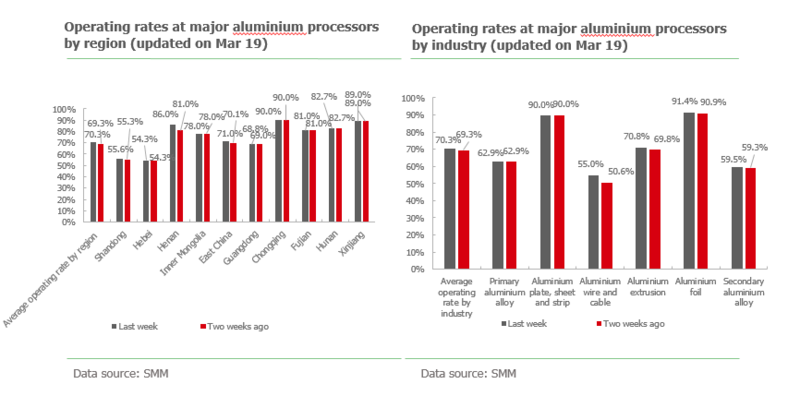
SHANGHAI, Mar 23 (SMM)—Operating rates across major aluminium processors rose slightly last week as they had to accept high aluminium prices to deliver orders. End-users find it difficult to accept current high aluminium prices. As some end-users adopt quarterly or semi-annual pricing, high aluminium prices will not pass through to end-users until they complete Q2 pricing.

Primary aluminium alloy: Operating rates at major primary aluminium alloy enterprises were flat from the previous week at 62.9%. aluminium wheel plants kept raw material stocks at safe levels and avoided excessive stockpiling amid high aluminium prices. Alloy producers have basically resumed normal operations, except for a large factory in Shandong, whose operating rates were below levels before CNY due to relocation. Operating rates will remain stable this week as the fact that car makers make purchase under long-term orders will continue to constrain alloy consumption.

Aluminium plate and strip: Major aluminium plate and strip enterprises maintained full capacity due to heavy backlog orders. Some producers even rejected orders from clients with slow payment. Despite volatile and high aluminium price, large producers did not reduce purchases, but had stricter control over inventory. Operating rates will remain high this week on the back of backlog orders.

Aluminium wire and cable: Operating rates of major aluminium wire and cable producers increased significantly, mostly driven by producers in Henan, due to approaching delivery of orders. However, the outlook for future new orders is not optimistic. Orders from State Grid decreased on a year-on-year basis due to high aluminium prices. Prices under overseas orders were lower than those under domestic orders, inhibiting enthusiasm for taking overseas orders. Operating rates at major producers may remain stable, but are likely to decline at small and medium-scale producers due to the lack of new orders after previous orders were delivered.

Aluminium extrusion: Operating rates at major aluminium extrusion enterprises rose slightly, but remained below normal level. Some end-users are beginning to accept high aluminium prices, but most remain cautious amid high and volatile aluminium prices. Demand for industrial extrusion outperformed demand from other sectors.  Demand of construction extrusion remained weak. Downstream procurement will continue to be driven by rigid demand before aluminium price see significant downward corrections, and operating rate may remain little changed this week.

Aluminium foil: Operating rates at major aluminium foil enterprises continued to rise. Domestic orders for automotive foil, battery foil and air-conditioning foil are full. Operating rates will continue to rise this week with continued recovery of consumption. Many producers have begun to control export orders as high aluminium prices have eroded export profits, but this had little impact on the overall operating rate. Some small and medium-sized enterprises who did not lock in prices and are short of cash still showed low willingness to take orders, purchase and produce.

Secondary aluminium alloy: Operating rate of secondary aluminium alloy enterprises climbed 0.2 percentage point from a week ago to 59.5%. At present, production is normal. Secondary aluminium prices failed to follow primary aluminium up. Orders remained weak due to high aluminium prices, but improved slightly from the previous two weeks as die-casting plants have basically run out of inventory and gradually accepted high prices. Raw material supply remained tight with limited imports of aluminium scrap. Secondary aluminium companies are facing high costs. Operating rate is expected to stabilise this week.
Data Source Statement: Except for publicly available information, all other data are processed by SMM based on publicly available information, market communication, and relying on SMM‘s internal database model. They are for reference only and do not constitute decision-making recommendations.

For any inquiries or to learn more information, please contact: lemonzhao@smm.cn
For more information on how to access our research reports, please contact:service.en@smm.cn
Related News
Fed Governor Milan Pushes for Over 100 Basis Points Cut, Contradicts Barkin on Caution
20 hours ago
Fed Governor Milan Pushes for Over 100 Basis Points Cut, Contradicts Barkin on Caution
Read More
Fed Governor Milan Pushes for Over 100 Basis Points Cut, Contradicts Barkin on Caution
Federal Reserve Governor Milan pointed out that it is necessary for the US Fed to cut interest rates by more than 100 basis points this year. At the same time, he is very much looking forward to the performance of Kevin Warsh as Fed Chairman. However, Richmond Fed President Barkin emphasized that monetary policy must remain cautious until inflation fully pulls back to the target level, thereby ensuring the stability of the labour market.
20 hours ago
Democratic Senators Demand Delay in Fed Nomination Amid Criminal Investigation
20 hours ago
Democratic Senators Demand Delay in Fed Nomination Amid Criminal Investigation
Read More
Democratic Senators Demand Delay in Fed Nomination Amid Criminal Investigation
All 11 Democratic members of the US Senate Banking Committee jointly sent a letter to the committee's chairman, Tim Scott, requesting that all nomination processes for the prospective Fed Chairman, Kevin Warsh, be postponed until the criminal investigation into current Fed Chairman Powell and other board members is concluded. However, Scott stated that Warsh's confirmation was a done deal.
20 hours ago
Fed to Keep Large Banks' Capital Levels Unchanged, Postpones Stress Test Reforms Until 2027
20 hours ago
Fed to Keep Large Banks' Capital Levels Unchanged, Postpones Stress Test Reforms Until 2027
Read More
Fed to Keep Large Banks' Capital Levels Unchanged, Postpones Stress Test Reforms Until 2027
The US Fed has announced that it will maintain the capital levels of large banks unchanged during the upcoming stress test cycle (corresponding to the 2026 cycle). At the same time, the US Fed is planning multidimensional reforms to this annual test, aiming to enhance its transparency. The US Fed's Vice Chair for Supervision, Bowman, revealed that adjustments to the stress capital buffer requirements for large banks will be postponed until 2027. This move is intended to provide the US Fed with sufficient time to evaluate potential flaws that may be exposed in its testing models when assessing banks' financial conditions under simulated economic downturn scenarios.
20 hours ago
Operating rates at aluminium processors rose slightly on recovering rigid demand, it takes time for downstream producers to accept high aluminium prices - Shanghai Metals Market (SMM)