Operating rates at aluminium extrusion producers rose slightly in November

Published: Dec 15, 2020 15:27
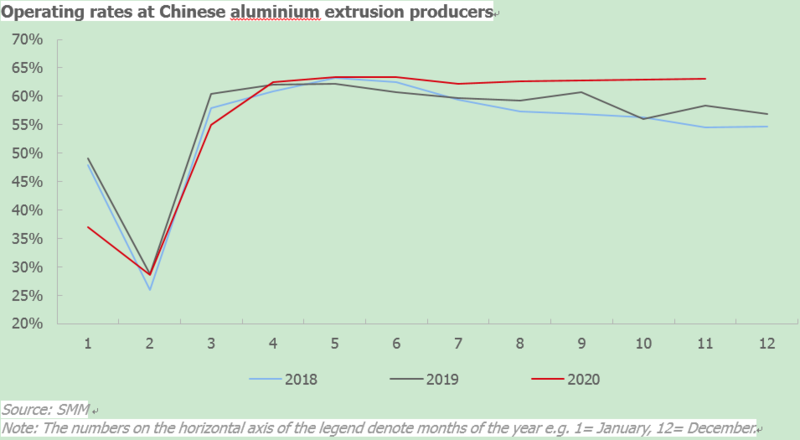
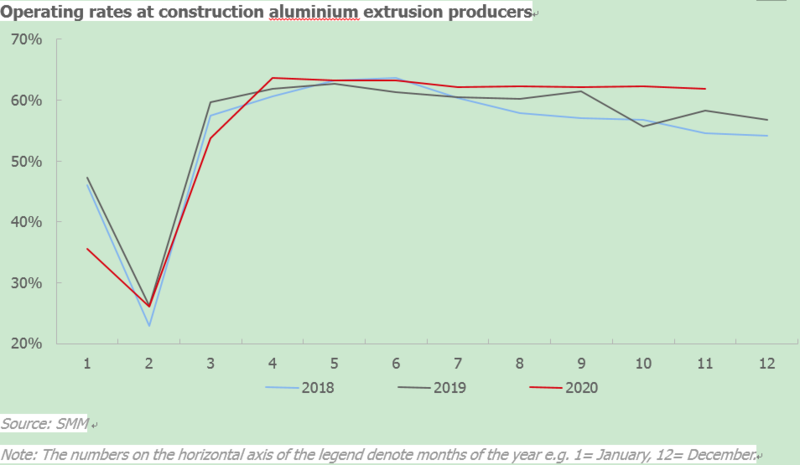
Operating rates at aluminium extrusion producers rose slightly from October at 63.10% in November. Operating rates at industrial extrusion producers rose 2.98 percentage points from October to 69.68%, and fell slightly to 61.84% at construction extrusion producers.

SHANGHAI, Dec 15 (SMM)—Operating rates at aluminium extrusion producers rose slightly from October at 63.10% in November. Operating rates at industrial extrusion producers rose 2.98 percentage points from October to 69.68%, and fell slightly to 61.84% at construction extrusion producers.

Large producers increased operating rates slightly due to moderate orders, while operating rates at smaller producers weakened, depressed by cash flows and lower orders. Operating rates and demand in north China were slightly weaker than those in south China. Producers in Henan and Shandong reduced production due to environmental restrictions. Most aluminium extrusion producers in Henan cut production at 50% and some producers even halted. As the demand and orders for industrial extrusion rose sharply in H2, consumption of automobiles and PV sectors increased significantly. Electronic demand and rail transport demand also performed well. Receivable accounts weighed on producers as long as the conflict between capital and orders continued till the end of the year. The growth of construction extrusion demand mainly in real estate and infrastructure sectors was limited in Q4. However, the consumption demand in aluminium sector is still likely to rise.

China exported 77,300 mt of aluminium extrusion in October, down 3.31% year on year and 9.74% month on month, customs data showed. From January to October, exported aluminium extrusion totalled 714,600 mt, down 17.48% year on year amid weaker overseas demand.

Raw material inventory/output ratio rose 0.18% to 16.51% compared with October. Spot aluminium rose sharply with an increase of 1,940 yuan/mt in November. Most downstream users purchased as required, while some were cautious about stockpiling. The finished product inventory/output ratio dipped to 27.5% as most producers kept inventories stable, lifted cash flows and lowered receivable accounts according to their own operation.

Most large producers have expanded capacity, while smaller producers lowered orders. Stronger fluctuations of aluminium prices depressed the demand in end-user. Better performance of demand in industrial extrusion segment supported the operating rates in H2. Aluminium extrusion consumption in Q4 is expected to rise. Operating rates at aluminium extrusion producers are likely to rise to 64% in December.
For more detailed market information on the aluminium markets, please subscribe to China Aluminium Monthly.
Data Source Statement: Except for publicly available information, all other data are processed by SMM based on publicly available information, market communication, and relying on SMM‘s internal database model. They are for reference only and do not constitute decision-making recommendations.

For any inquiries or to learn more information, please contact: lemonzhao@smm.cn
For more information on how to access our research reports, please contact:service.en@smm.cn
Related News
Data: SHFE, DCE market movement (Apr 08)
22 mins ago
Data: SHFE, DCE market movement (Apr 08)
Read More
Data: SHFE, DCE market movement (Apr 08)
The following table shows the ferrous and nonferrous metals movement on the SHFE and DCE on 08 Apr , 2026
22 mins ago
India's Aluminum Industry Struggles with Supply Chain Disruptions and Rising Costs Amid West Asia Conflict
1 hour ago
India's Aluminum Industry Struggles with Supply Chain Disruptions and Rising Costs Amid West Asia Conflict
Read More
India's Aluminum Industry Struggles with Supply Chain Disruptions and Rising Costs Amid West Asia Conflict
[SMM Aluminum Express News] India’s midstream and downstream aluminum industry is facing a severe crisis due to the ongoing West Asia conflict and disruptions in the Strait of Hormuz, according to the Aluminum Extrusion Manufacturers Association of India (ALEMAI). The conflict has broken supply chains for raw materials and aluminum scrap, causing production in the extrusion segment to drop sharply by 40–50%. Against an installed capacity of 4.2 million tons, extrusion units are currently operating at only 1.2–1.3 million ton, while rolled products stand at around 1.5 million tons. Rising input costs, especially for aluminum scrap, combined with higher logistics expenses and cheap imports, have significantly eroded the competitiveness of domestic producers.
1 hour ago
Ceasefire Unlikely to Resolve Supply Shortcomings, Aluminum Prices Remain Supported at High Levels [SMM Aluminum Morning Meeting Minutes]
6 hours ago
Ceasefire Unlikely to Resolve Supply Shortcomings, Aluminum Prices Remain Supported at High Levels [SMM Aluminum Morning Meeting Minutes]
Read More
Ceasefire Unlikely to Resolve Supply Shortcomings, Aluminum Prices Remain Supported at High Levels [SMM Aluminum Morning Meeting Minutes]
[Ceasefire Unlikely to Resolve Supply Weakness; Aluminum Prices Retain Strong Support at High Levels] Overall, the two-week ceasefire news was unable to reverse the firm pattern underpinned by substantive supply damage and low inventory. Expectations of tangible supply contraction triggered by attacks on Middle Eastern aluminum smelters, combined with low global inventory and the recovery of peak-season demand in China, will provide strong upward momentum for aluminum prices. In the near term, aluminum prices are expected to hold up well.
6 hours ago