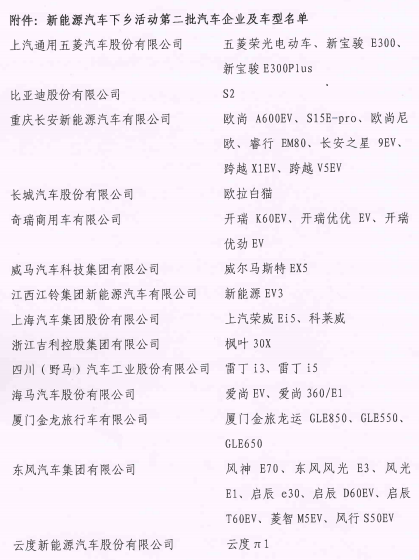
SMM9 March 4: recently, the Ministry of Industry and Information Technology released a list of the second batch of automobile companies and models for new energy vehicle activities in the countryside, including 14 companies including SAIC General Motors Wuling, BYD, Changan Automobile, Great Wall Automobile, Chery Commercial vehicles, etc., as well as a total of 36 models, and a total of 52 models from 19 automobile companies in the two batches of the list.
At present, the popularization rate of new energy vehicles in rural areas is not high. According to relevant data, in the rural market, the electrification rate of residential vehicles is less than 1%, which is only 1% of that of urban residents, and the huge consumption potential has not been effectively released. Some analysts pointed out that at present, rural electrified vehicles are mainly two-wheeled motorcycles and low-speed electric vehicles, and going to the countryside through new energy vehicles will help upgrade the consumption of the rural automobile market.
Compared with the urban market, because most of the rural areas are large courtyards with single families, there is more space to install charging piles, and new energy vehicles are driven by electric power, so they are more cost-effective than fuel vehicles in terms of travel cost and maintenance cost. in addition, the traffic between villages and towns is relatively underdeveloped, not so many subway buses, driving can be said to be a rigid demand.
In terms of models, in the first batch of the list in July, most of the prices ranged from 30, 000 yuan to 100000 yuan, and the new energy vehicles went to the countryside by enterprises to take the initiative to make profits. According to relevant data, the average discount is as high as 2000 yuan to 5000 yuan. More may be as much as 8000 yuan. During the event, local governments at all levels will also issue subsidies for new energy vehicles in the region to the countryside, local models that enjoy subsidies and preferential measures for related enterprises.
From the perspective of car demand in rural areas, most of the popular models of consumers focus on scooters and commercial vans, emphasizing the low cost and low mileage requirements, either within 300km, such as miniature or small new energy models, which are safe and cheap and can replace the widely existing scooters for the elderly.
According to relevant data, in July 2020, the production and sales of new energy vehicles completed 100000 and 98000 respectively, an increase of 15.6% and 19.3% respectively over the same period last year. In terms of power battery production, in July 2020, China's power battery output totaled 6.16H, an increase of 6.4% over the same period last year and 13.8% month-on-month. This car trip to the countryside is expected to drive the production and marketing of new energy vehicles in the future and benefit power battery enterprises at the same time.
Click to understand and sign up for the 2020 China Automotive New Materials Application Summit Forum.
Scan the QR code above to view the business cards of the participating companies and sign up online

![[SMM Analysis] High-Grade NPI Prices Decline as Supply Recovers and Market Activity Slows](https://imgqn.smm.cn/usercenter/LNpBh20251217171732.jpeg)