China HRC inventories started to increase

Published: Sep 04, 2020 13:39 (GMT+8)
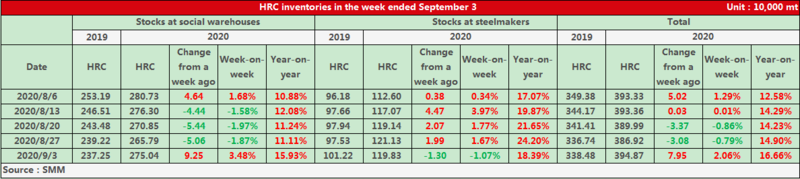
SMM data showed that inventories of hot-rolled coils (HRC) and plates across social warehouses and steelmakers, which are used in automobiles and home appliances, stood at 3.95 million mt in the week ended September 4, after a 2.06% increase in the previous week.

SHANGHAI, Sep 4 (SMM) - SMM data showed that inventories of hot-rolled coils (HRC) and plates across social warehouses and steelmakers, which are used in automobiles and home appliances, stood at 3.95 million mt in the week ended September 4, after a 2.06% increase in the previous week. The stocks were 16.7% higher than the same period last year.


Operating rates of blast furnaces (BFs) at Chinese steelmakers this week came in at 89.6%, which remained unchanged from last week, according to SMM survey. In addition, the hot rolling output maintained stable at a high level this week as operating rates and production of hot rolling lines at various steelmakers basically remained stable. The actual end-users consumption less than expectations at high prices led to a rise of inventories.


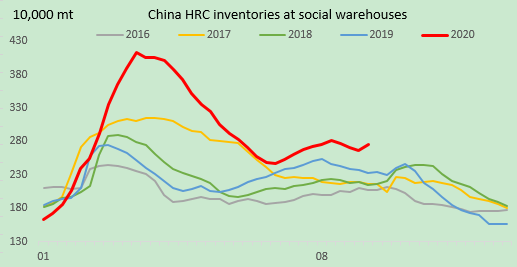
SMM data showed that HRC stocks across social warehouses stood at 2.75 million mt this week, with a rise of 3.48% from the prior week, and up 15.9% from a year ago.


The impact of typhoon weather on shipments gradually weakened and steelmakers in north China significantly increased HRC shipments to the south. Steelmakers correspondingly accelerated the shipments to social warehouses, improving the market supply from the previous period. However, affected by the news environmental protection which limited production, hot-rolled coils spot resources rose again at a high level this week, leading to concerns about high prices and cautious purchasing. The actual consumption was less than expectations. That also accounted for the sharp rise of HRC stocks across social warehouses this week.


In-plant HRC inventories decreased 1.07% week on week and advanced 18.4% year on year to 1.2 million mt in the week ended September 4, showed SMM data.


Steelmakers in north China accelerated the shipment recently, and the in-plant inventories gradually shifted to the social warehouse. In-plant HRC inventories halted its buildup and started to fall due to the enlarged prices difference between cold-rolled coils and hot-rolled coils and large shipment of the cold-based resources of steelmakers.
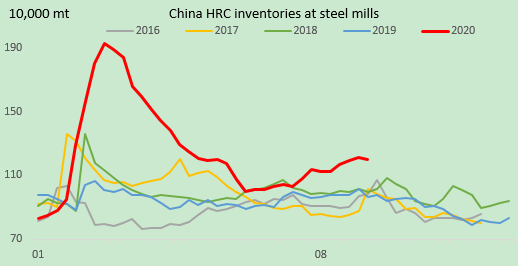


Although the output of hot-rolled coil was relatively stable, high prices suppressed the end-user demand obviously, leading to the accumulation of hot-rolled coil inventories and increasing the market supply pressure, especially in east China.


Demand is likely to improve in the following weeks, while the overall release will be delayed due to the suppression of high prices. Meanwhile, traders are pressurised by increasing inventories. Spot prices are expected to trend lower in the next few weeks without the support of positive news.

 

Data Source Statement: Except for publicly available information, all other data are processed by SMM based on publicly available information, market communication, and relying on SMM's internal database model. They are for reference only and do not constitute decision-making recommendations.

For any inquiries or for more information, please contact: lemonzhao@smm.cn
For more information on how to access our research reports, please contact:service.en@smm.cn
Related News
Heyuan Issues Strict Regulations and Fines for Unauthorized Waste Lead-Acid Battery Management
Sep 28, 2026 17:34 (GMT+8)
Heyuan Issues Strict Regulations and Fines for Unauthorized Waste Lead-Acid Battery Management
Read More
Heyuan Issues Strict Regulations and Fines for Unauthorized Waste Lead-Acid Battery Management
[Waste Lead-Acid Battery Market Update] Recently, the Heyuan Municipal Ecology and Environment Bureau issued the "Notice on Regulating the Management of Waste Lead-Acid Batteries." According to the Ecological Environment Code of the People's Republic of China, enterprises and public institutions that engage in the collection and storage of waste without a permit may be fined 200,000-1 million yuan; those that engage in utilization and disposal operations without a permit may be fined 1-5 million yuan and ordered to suspend operations or shut down, with responsible persons fined 100,000-1 million yuan; if the act constitutes a crime, criminal liability shall be pursued in accordance with the law.
Sep 28, 2026 17:34 (GMT+8)
"Guangzhou Tightens E-bike Waste Lead-Acid Battery Management, Clarifies Hazardous Waste Rules"
Sep 28, 2026 17:33 (GMT+8)
"Guangzhou Tightens E-bike Waste Lead-Acid Battery Management, Clarifies Hazardous Waste Rules"
Read More
"Guangzhou Tightens E-bike Waste Lead-Acid Battery Management, Clarifies Hazardous Waste Rules"
[Market Dynamics of Waste Lead-Acid Batteries from E-bikes] Recently, the Guangzhou Municipal Ecology and Environment Bureau issued a notice on the key points for environmental management of waste lead-acid batteries from e-bikes in Guangzhou. The document clarifies that waste lead-acid batteries are hazardous waste (HW31, 900-52), and scrap batteries generated from store recycling, trade-in, and repair must be transferred to licensed units. Units holding a hazardous waste collection permit (including 900-52) are exempt from electronic transfer manifests during the collection process under the centralized collection pilot program.
Sep 28, 2026 17:33 (GMT+8)
Peru sees 1 million t/y copper output boost within five to six years
Sep 26, 2026 01:38 (GMT+8)
Peru sees 1 million t/y copper output boost within five to six years
Read More
Peru sees 1 million t/y copper output boost within five to six years
Peru's Energy and Mines Minister Guillermo Shinno said the country expects to add about 1 million tonnes of annual copper production within five to six years through new mining projects. The world's third-largest copper producer anticipates 2026 output of 2.5 to 2.7 million tonnes, roughly unchanged from 2023 as declining ore grades and recurring social conflicts weigh on supply. The newly elected government is seeking to reverse that stagnation by cutting red tape; in the two months since taking office, mining companies have stepped up engagement with the ministry. Shinno said officials have identified 27 permits that could be eliminated from roughly 100 mining-sector requirements, without lowering environmenta
Sep 26, 2026 01:38 (GMT+8)