SMM1 March 14: recently, at the 2020 NIO Day held by Xilai, Li Bin, in addition to officially launching his first flagship car, the ET7, also threw out a blockbuster-150KWH solid-state battery, which is expected to be mass produced in the fourth quarter of 2022.
It is understood that this technology will use solid-liquid electrolyte of in-situ curing process, silicon-carbon negative electrode of inorganic pre-lithiation process, and ultra-high nickel cathode material with nano-scale coating process, the cell density will reach 360Whamhamkg, and the ET7 mileage of the battery will reach 1000km, more than all electric vehicles on the market. All of a sudden, it won a lot of attention.
As we all know, the current power battery cell has several important components, namely, positive and negative electrode, diaphragm, electrolyte. No matter what the shape of the power battery on the market, it is still essentially a liquid lithium-ion battery. The so-called solid-state lithium battery is relative to the liquid lithium battery, which means that the solid electrolyte replaces the original liquid electrolyte and diaphragm in the battery structure, which results in almost no liquid in its structure.
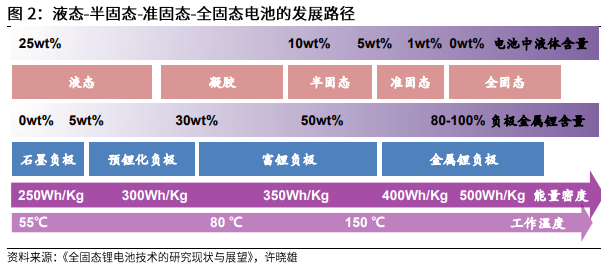
The so-called 150kwh solid-state battery released by Weilai this time is more likely to be a semi-solid-state battery. In essence, it is a combination of the existing liquid battery process and the immature solid-state battery technology. By replacing part of the electrolyte with all-solid-state electrolyte, its content gradually decreases from 20wt%, and the compromise product obtained by using pre-lithiated silicon-carbon negative electrode, as shown in the following figure,
In the final analysis, what are the advantages of all-solid-state batteries over traditional lithium-ion power batteries?
a. The energy density is much higher than before.
To a large extent, the energy density of lithium-ion battery is determined by both positive and negative materials, but now the limitation of positive and negative materials makes it difficult to meet the requirements. Some data show that the electrochemical stability window of solid-state battery can reach more than 5V, while the improvement of stability window of ternary battery between 4.2V-4.5V means that it can match higher performance electrode materials. It can not only use lithium-rich materials with higher energy density than high nickel ternary energy density in cathode materials, but also make it possible to use metal lithium anode. In the existing positive and negative material system, 300Wh/kg has a relatively high energy density, but the use of lithium metal anode can reach more than 500Wh/kg. The use of solid-state batteries can increase the current volume utilization rate from 20% 50% to 80-100%, and the energy density can be increased by more than 40%.
b. Security.
For a long time, because of its flammability, liquid electrolyte is prone to leakage or volatilization in the event of impact, resulting in safety accidents such as battery fire and explosion. The solid-state battery uses non-flammable all-solid electrolyte instead of liquid electrolyte, even after the physical impact, it can not smoke, fire, explosion, and the safety performance has been greatly improved. At the same time, the main obstacle faced by lithium metal as a negative material battery is that during the dissolution and deposition of lithium negative electrode in the charge-discharge cycle, lithium dendrites continue to form and break into "dead lithium", this part of lithium ion no longer contributes to the capacity of the battery. on the contrary, due to continuous accumulation, the battery will eventually pierce the diaphragm and cause the battery short circuit and even cause the battery explosion. This is the lithium dendrite phenomenon. Because of this characteristic, the application of lithium anode in traditional liquid batteries is faced with great challenges. However, solid-state battery can solve this problem, because all its electrolytes exist in solid form and the diaphragm is completely replaced, the phenomenon of lithium dendrite is restrained enough to ensure its safety.
c. Strong low temperature performance
Because of the existence of liquid electrolyte, traditional lithium battery is easy to freeze in the low temperature environment in winter, the resistance increases, and the actual capacity decreases rapidly. This is reflected in the fact that recently many owners of new energy vehicles have complained about the sharp decline in the range of their cars in winter. On the other hand, the solid-state battery has a wider theoretical temperature range and excellent performance at high temperature and low temperature, which can effectively prevent the problem of service life shrinking. Some data show that the solid-state battery can still work normally from minus 40 ℃ to minus 80 ℃. Solve the problem of service life shrinkage of new energy vehicles in cold areas at one fell swoop.
Current technical difficulties:
1. The problem of bonding of solid electrolytes
In the traditional electrolyte, the electrolyte wraps the positive and negative electrodes of the battery. However, because the electrolyte in the solid-state battery is also solid, the contact surface between the battery and the positive and negative electrode is easy to produce uneven contact surface or gap, which leads to poor contact of the battery and increases the difficulty of mass production.
two。 Low conductivity
The interface between electrolyte and electrode material in solid-state battery is solid-solid state, so the effective contact between electrode and electrolyte is weakened, the resistivity is high, and the conductivity is low, which affects its charge-discharge ability.
Follow-up impact:
Based on the compatibility of high-energy materials and the use of metal lithium in negative materials, solid-state batteries increase the demand for lithium and further enhance the influence of lithium in power batteries. As two kinds of metals responsible for high energy density and stability in cathode materials, the importance of cobalt and nickel may change fundamentally. Flammable liquid electrolytes are replaced by safer and more stable solid electrolytes in solid-state batteries, so that when the structure of the whole battery has been very stable, the demand for cobalt, as a major stabilizing rare metal, may be greatly reduced. On the other hand, the demand for nickel may increase due to the pursuit of high energy density.
At the same time, for the industry as a whole, the current barriers to the solid-state battery industry are relatively high, and the use of solid-state batteries in the future may have a great impact on the industry. Enterprises with large scale, strong funds or first-mover advantage may occupy the leading position in the industry. Their strong material control ability and bargaining power are sufficient to support them for further research and development, but it is more difficult for small and medium-sized enterprises to do so. Great changes will take place in the overall pattern of the industry. At the same time, due to the abandonment of the diaphragm electrolyte, its related industry chain will also be affected.
For downstream new energy vehicles, solid-state batteries will greatly improve the mileage of new energy vehicles because of their high energy density. At the same time, its excellent low temperature resistance will also greatly promote its comprehensive replacement of traditional fuel vehicles. At the same time, its excellent safety may lead to a great increase in the demand for new types of power batteries such as ships and aircraft.
Overall, in the context of the increasing technical requirements for power batteries in documents such as made in China 2025, and the energy density is expected to reach 400-500WH/KG from 2020 to 2030, the current liquid lithium-ion battery technology is trapped by its theoretical limit and it is gradually difficult to keep up with the rising requirements, and solid-state batteries are indeed the most likely route to break the situation. But at the same time, solid-state battery technology itself still has many problems to be solved, it is still in the early stage of the industry, and it is still far from mass production. However, the 'solid-state battery' or 'semi-solid battery' introduced this time or the demand for raw materials such as lithium are driven by the demand for lithium and other raw materials. At the same time, apart from having a little impact on the demand for diaphragm electrolyte, the impact on the power battery industry as a whole is relatively limited. However, it is still a positive attempt to apply it to the main flagship model.
![Серия о твердотельных аккумуляторах на следующее десятилетие, часть 6 из 9: тройной маршрут может снова стать великим [Анализ SMM]](https://imgqn.smm.cn/usercenter/JSjkr20251217171728.jpg)
![Твердотельные аккумуляторы: сентябрьский анализ и квартальный обзор: политика и капитал разогреваются, спотовый рынок материалов остывает, индустриализация переходит от «кг» к «млн т» [Анализ SMM]](https://imgqn.smm.cn/usercenter/olwlF20251217171731.jpg)