SMM, October 15:
In the metals market:
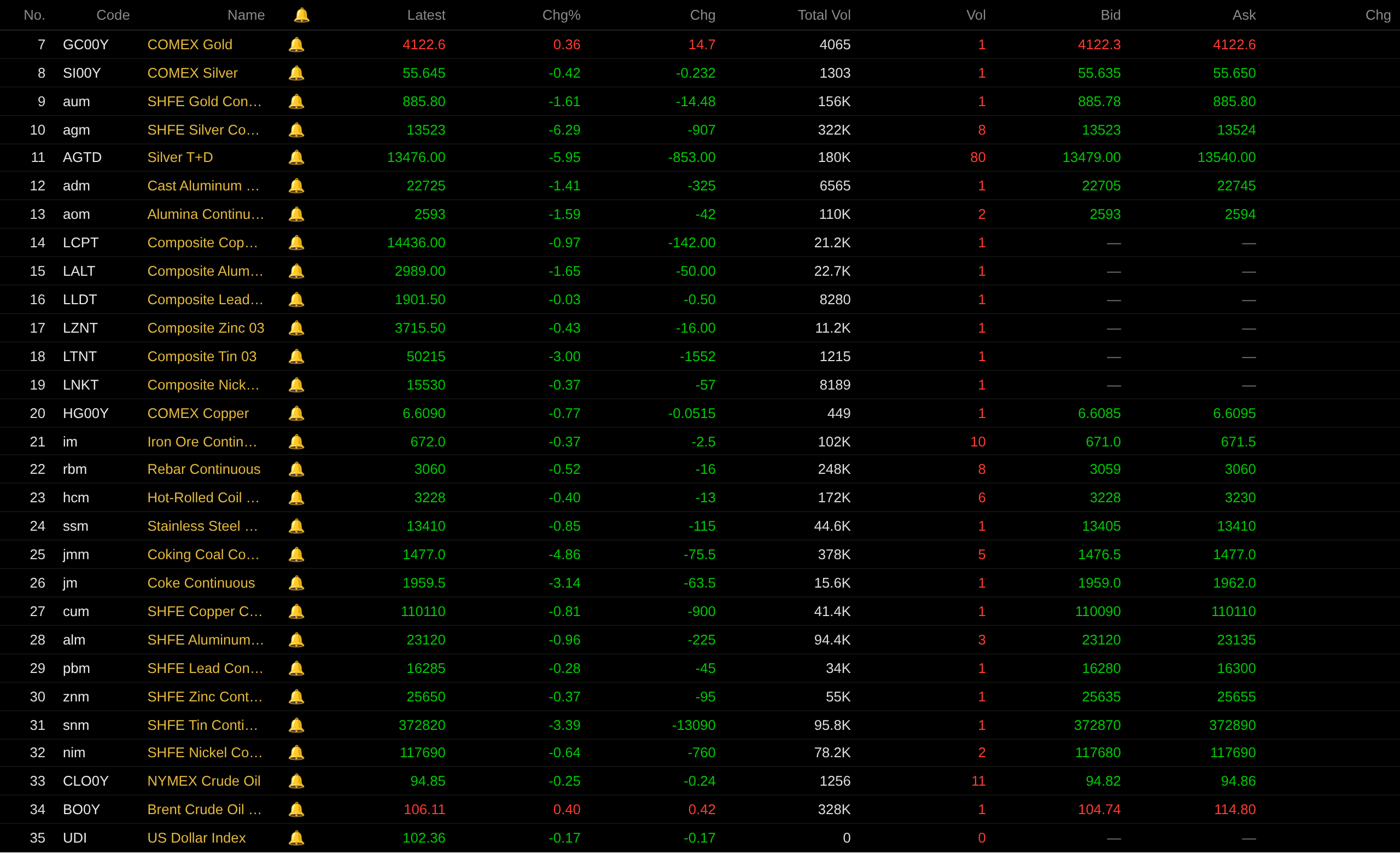
Overnight, base metals in the domestic market fell across the board. SHFE copper fell 0.81%, SHFE aluminum fell 0.96%, and SHFE lead fell 0.28%. SHFE zinc fell 0.37%, and SHFE tin fell 3.39%. SHFE nickel fell 0.64%. In addition, the most-traded alumina futures contract fell 1.59%, and the most-traded cast aluminum contract fell 1.41%.
Overnight, ferrous metals all fell. Stainless steel fell 0.85%. Iron ore fell 0.37%, and rebar fell 0.57%. Hot-rolled coil fell 0.4%. In coking coal and coke: the most-traded coking coal contract fell 4.86%, and the most-traded coke contract fell 3.14%.
Overnight in the overseas metals market, LME base metals fell across the board. LME copper fell 0.97%, and LME aluminum fell 1.65%. LME lead fell 0.03%. LME zinc fell 0.43%. LME tin fell 3%. LME nickel fell 0.37%.
Overnight in the precious metals market: COMEX gold fell 1.2%, and COMEX silver fell 6.26%. Overnight, the most-traded SHFE gold contract fell 1.61%, and the most-traded SHFE silver contract fell 6.29%.
As of 7:19 on October 15, overnight closing prices:
Macro front
Domestic:
[PBoC: Aggregate social financing increased by RMB 27.46 trillion in the first three quarters, with new loans of RMB 11.52 trillion] Preliminary PBoC statistics show that in the first three quarters of 2026, the cumulative increase in aggregate social financing was RMB 27.46 trillion, down RMB 2.63 trillion from the same period last year. Of this, RMB loans to the real economy increased by RMB 11.5 trillion, down RMB 3.04 trillion YoY; foreign currency loans to the real economy, in RMB terms, increased by RMB 245.1 billion, up RMB 339.7 billion YoY; entrusted loans increased by RMB 22.2 billion, up RMB 79.4 billion YoY; trust loans decreased by RMB 138.3 billion, down RMB 338.7 billion YoY; undiscounted bankers' acceptances increased by RMB 74.8 billion, down RMB 226.3 billion YoY; net corporate bond financing was RMB 2.75 trillion, up RMB 1.18 trillion YoY; net government bond financing was RMB 10.3 trillion, down RMB 1.16 trillion YoY; domestic equity financing by non-financial enterprises was RMB 535.9 billion, up RMB 219.1 billion YoY. RMB loans increased by RMB 11.52 trillion in the first three quarters. By sector, household loans decreased by RMB 1.03 trillion, of which short-term loans decreased by RMB 1.14 trillion and medium and long-term loans increased by RMB 106.2 billion; loans to enterprises and public institutions increased by RMB 12.55 trillion, of which short-term loans increased by RMB 4.64 trillion, medium and long-term loans increased by RMB 6.53 trillion, and bill financing increased by RMB 1.24 trillion; loans to non-bank financial institutions decreased by RMB 586.5 billion. At the end of September, the balance of broad money (M2) was 359.63 trillion yuan, up 7.2% YoY. The balance of narrow money (M1) was 116.76 trillion yuan, up 3.2% YoY. Currency in circulation (M0) was 15.02 trillion yuan, up 10.6% YoY.
[China has approved and issued over 600 national standards for clean energy such as hydropower and PV] It was learned from the World Standards Day themed event co-hosted by the State Administration for Market Regulation and three other departments that China is the world's largest energy producer and consumer, and its clean energy industries such as wind power, PV, nuclear power, and ultra-high voltage rank among the world's top, with standardization playing an important supporting role. Currently, China has approved and issued over 600 national standards, over 1,300 group standards, and 345 foreign-language versions of national standards for clean energy such as hydropower, PV, solar thermal, and hydrogen energy. China has led the formulation and release of 174 international energy standards, accounting for about 15% of all published international energy standards. China also hosts the secretariats of 10 technical committees of international standards organizations in areas such as solar energy and mechanical energy storage, and holds 34 working group convener positions, making positive contributions to strengthening international cooperation on energy standards and promoting global green transition. (CCTV News)
[China now has 180 effective national standards for hydrogen energy] The China National Institute of Standardization released the Blue Book on Standardization of China's Hydrogen Energy Industry (2026). The Energy Law effective in 2025 included hydrogen energy in energy management for the first time, the 15th Five-Year Plan outline listed hydrogen energy as a future industry for forward-looking deployment, and five pilot city clusters for comprehensive hydrogen energy applications were approved for implementation - China's hydrogen energy industry is moving from demonstration introduction to large-scale development, with the strategic position of standardization at an unprecedented level. (CCTV News)
US dollar:
The US dollar index rose 0.32% overnight to 102.53.
US inflation data came in hot across the board, rate hike expectations suddenly heated up, and financial markets came under pressure. Data released by the US Bureau of Labor Statistics on Wednesday showed that the September Consumer Price Index (CPI) rose 3.7% YoY, the largest increase in five months, higher than market expectations of 3.6% and further widening from the previous reading of 3.4%. Core CPI rose 2.6% YoY, also exceeding the expected 2.5%, the fastest pace in five months, with the persistence of inflationary pressures exceeding the market's earlier forecast. On a MoM basis, US September CPI rose 0.6%, in line with expectations, versus 0.4% previously. Core CPI rose 0.3% MoM, higher than the expected 0.2% and unchanged from the previous reading. Traders sharply raised bets on a Fed rate hike in October, with the probability of an October hike surging to 50%, while expecting the Fed to deliver three more cumulative rate hikes by the end of 2027. This data is the final CPI report before the Fed's interest rate decision on October 27-28, and the results will directly influence policymakers' judgment on the rate path. In addition, Fed Chairman Kevin Warsh will speak Thursday evening (New York time) at the IMF meeting in Bangkok, and the market will closely watch his latest remarks.(Wallstreetcn)
Fed Governor Bowman said: Inflation remains above our target, (but) I do not currently see a need for the Fed to rush into further rate adjustments. After the last hike, we need some time to observe how financial conditions develop before taking further action. (Jin10 Data APP)
According to CME "FedWatch": The probability of the Fed keeping rates unchanged in October is 66.8%, and the probability of a cumulative 25bp hike is 33.2%. The probability of the Fed keeping rates unchanged in December is 9.1%, the probability of a cumulative 25bp hike is 62.2%, and the probability of a cumulative 50bp hike is 28.7%. (Jin10 Data APP)
In addition, when asked whether he had discussed the inflation report with Fed Chairman Warsh and the market's increased bets on rate hikes, US President Trump said: "We are doing very well. Inflation over the past three months was 1.7%. We inherited an extremely bad inflation situation from Biden. We are performing excellently now."
The Fed's latest Beige Book shows that the US economy continued to grow overall, but growth was sluggish in most sectors. Of the 12 Fed districts, two reported moderate economic growth, three reported modest growth, four reported slight growth, and three were basically flat. Manufacturing was relatively strong, but consumer spending changed little in most districts, and more than half of the districts said consumption was driven mainly by high-income households. On inflation, three districts reported strong price increases, eight reported moderate increases, and four said price increases accelerated from the previous period. All districts were affected by rising oil prices, with high diesel prices and fuel surcharges pushing costs through supply chains, while tariffs, insurance, and other commodity prices also continued to exert pressure. Some enterprises expect prices to rise further in the coming months as existing contracts expire and hedging and delivery contracts are renegotiated. On employment, most districts reported little change in employment levels, but shortages of professional, technical, and skilled workers persisted. Five districts said some enterprises, after investing in AI to improve productivity, had reduced headcount through attrition, delayed hiring, or expected fewer new positions. Meanwhile, rising inflation and welfare costs are pushing employees to demand higher pay. The Beige Book noted that most enterprises remain positive about the economic outlook for the coming months, but generally expect limited growth, with ongoing impacts from energy prices, tariffs, and other uncertainties. (Jin10 Data APP)
A Huatai Securities research report said that US core CPI inflation rose more than expected MoM in September, with the unexpected pickup in the housing component being the main driver, while other components also showed broad-based increases. The CPI data suggests US inflation pressures may be fairly broad, but given recent US Fed official remarks and already tightened financial conditions, the US Fed still has room to wait and see. Huatai maintains its call for the US Fed to hold off on a hike in October and hike once in December. (Jin10 Data APP)
Prestige Economics President Jason Schenker said the US Fed may consider a larger 50 bp hike in December. Schenker, an early predictor of the US Fed's most recent hike, now believes the US Fed may "let policy effects breathe for a bit" after the September hike before considering a larger hike in December. Schenker expects that if a larger hike occurs in December, further hikes may be paused early next year. Between the October and December meetings, US Fed officials will also receive two employment reports and another CPI release, which could inform their future decisions. Schenker said: "While they only have to wait six weeks, they will get more data. If they find 25 bp has no effect, then I think they could roll out a 50 bp hike." Schenker expects a larger hike could lead to a pause in further hikes early next year; while if only a 25 bp hike occurs in December, another hike in Q1 next year is more likely. (Jin10 Data APP)
Data:
Today will bring the UK August GDP MoM 3-month rate, UK August manufacturing output MoM, UK August seasonally adjusted goods trade balance, UK August industrial output MoM, France September final CPI MoM, Eurozone August industrial output MoM, Canada August wholesale sales MoM, US initial jobless claims for the week ending October 10, US September retail sales MoM, US September PPI YoY, US September PPI MoM, US October New York Fed manufacturing index, US October Philadelphia Fed manufacturing index, US August business inventory MoM, China September total electricity consumption YoY, and China September total electricity consumption.
In addition, watch for: 2027 FOMC voter and Richmond Fed President Barkin participating in a fireside chat; the US Fed releasing the Beige Book on economic conditions; 500 billion yuan in outright reverse repos maturing today; the central bank conducting 700 billion yuan in outright reverse repo operations; US Fed Governor Bowman speaking; TSMC holding an earnings call after releasing Q3 results; the Ministry of Commerce holding its first regular press conference of October; Bank of England Governor Bailey speaking; a new round of domestic refined oil price adjustments opening; the National Energy Administration releasing total electricity consumption data around the 15th of each month; the G20 finance ministers and central bank governors meeting; and the 140th Canton Fair taking place in Guangzhou from October 15 to November 4, 2026. Chinese Premier Li Qiang will attend the opening ceremony and related events and deliver a keynote speech.
Crude oil:
Both oil futures rose overnight, with US oil up 1.09% and Brent up 0.4%.
Beyond the twin pressures of inflation and AI credit, turmoil in the energy market constitutes the third dimension of this "triple blow." WTI crude prices rebounded on Wednesday. Meanwhile, mutual strikes on energy infrastructure between Russia and Ukraine continue, with European diesel prices having more than doubled since the start of the year, and US retail diesel prices remaining near record highs, exerting sustained upward pressure on the US CPI. Emily Ashford, head of energy research at Standard Chartered Bank, said: Developments over the past week have reminded the market once again that restored transport flows do not equate to secure transport flows. With infrastructure and shipping continuing to face threats, the risk premium is unlikely to fade. (Wall Street CN)
According to the New York Post, a US source revealed that Russian diesel is expected to enter the US market before the November 3 midterm elections. Last month, US fuel prices hit a record high of $6.53 per gallon. The source said: "If all goes well, the diesel should arrive within these two weeks," and noted that Russia has agreed to supply a "considerable" amount. The source did not specify the concrete plan for shipping Russian diesel to the US. (Jin10 Data APP)
![US Fed's October meeting rate hike expectations heat up, most-traded SHFE tin contract continues to decline in night session [SMM Tin Morning Meeting Summary]](https://imgqn.smm.cn/usercenter/ASfFn20251217171751.jpg)
![Tight spot cargo supply & high premiums, while downstream wait-and-see sentiment intensifies; room for lead price increases is limited [SMM Lead Morning Meeting Summary]](https://imgqn.smm.cn/usercenter/riosq20251217171722.jpg)
![US September CPI Exceeds Expectations, LME Zinc Center Continues to Shift Downward [SMM Zinc Morning Meeting Summary]](https://imgqn.smm.cn/usercenter/XrnKf20251217171755.jpg)