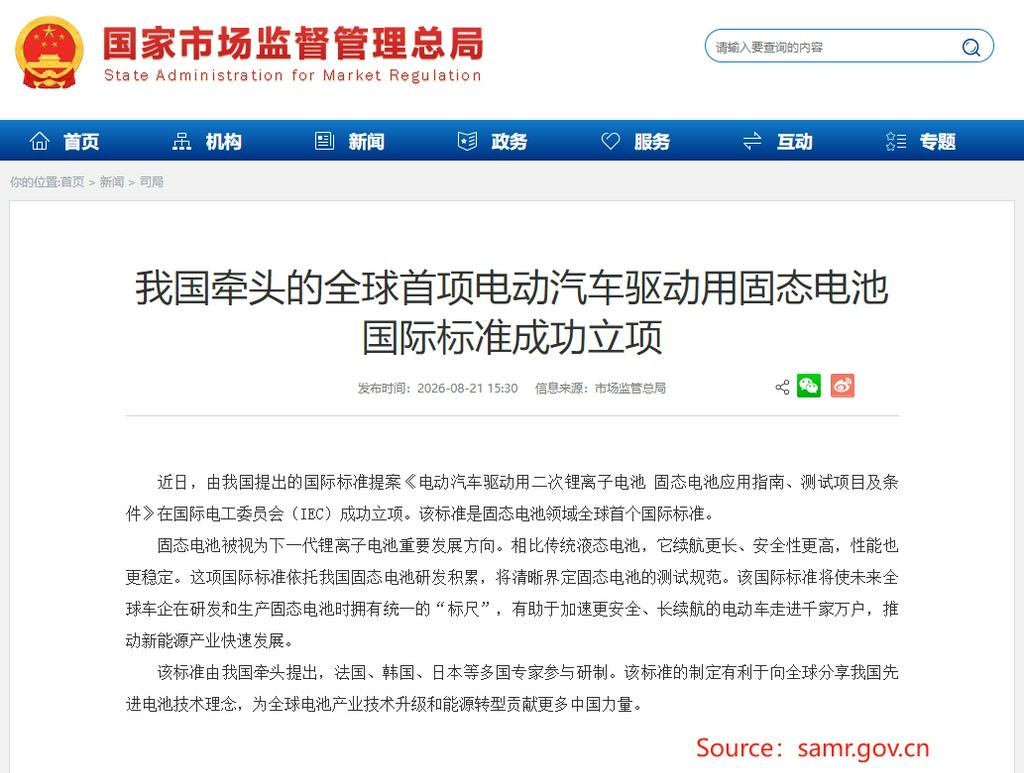
Poin-Poin Utama: Pada 21 Agustus 2026, Administrasi Negara untuk Regulasi Pasar (SAMR) mengumumkan bahwa proposal standar internasional yang diajukan China, yaitu Panduan Aplikasi, Butir Uji, dan Kondisi untuk Baterai Solid-State untuk Baterai Lithium-Ion Sekunder untuk Propulsi Kendaraan Listrik, berhasil dimulai di Komisi Elektroteknik Internasional (IEC). Ini adalah standar internasional pertama di dunia dalam bidang baterai solid-state. Standar ini dipimpin oleh China, dengan partisipasi para ahli dari Prancis, Jepang, Korea Selatan, dan negara-negara lain dalam pengembangannya. Standar ini akan mendefinisikan spesifikasi pengujian yang jelas untuk baterai solid-state, menyediakan "tolok ukur" yang seragam bagi produsen mobil di seluruh dunia.
Standar internasional pertama di dunia untuk baterai solid-state kini telah ditetapkan: diusulkan oleh China dan berhasil dimulai di IEC. Proposal IEC yang dipimpin China resmi diluncurkan, dengan para ahli dari negara-negara besar bertenaga baterai – Prancis, Jepang, Korea Selatan – semuanya berpartisipasi. Ini bukan hanya pengakuan internasional atas kekuatan teknologi China, tetapi juga tanda bahwa rantai industri global mulai menerima pendekatan China sebagai tolok ukur bersama.
 Butir
Butir
I. Mengapa Sekarang? – "Kehausan akan Standar" pada Titik Infleksi Industri
Dari awal hingga akhir tahun, industri baterai solid-state telah menarik perhatian yang belum pernah terjadi sebelumnya, dengan setiap perusahaan yang menyentuh label "solid" mendapatkan visibilitas yang sangat besar. Namun di tengah hiruk-pikuk ini, industri telah lama menghadapi kenyataan yang canggung: setiap orang berbicara dengan bahasa mereka sendiri. Apa yang disebut Perusahaan A sebagai "solid-state" mungkin sangat berbeda dengan definisi Perusahaan B – oksida, sulfida, polimer, semi-solid, quasi-solid, all-solid – konsep beterbangan, dan metode pengujian sangat bervariasi.
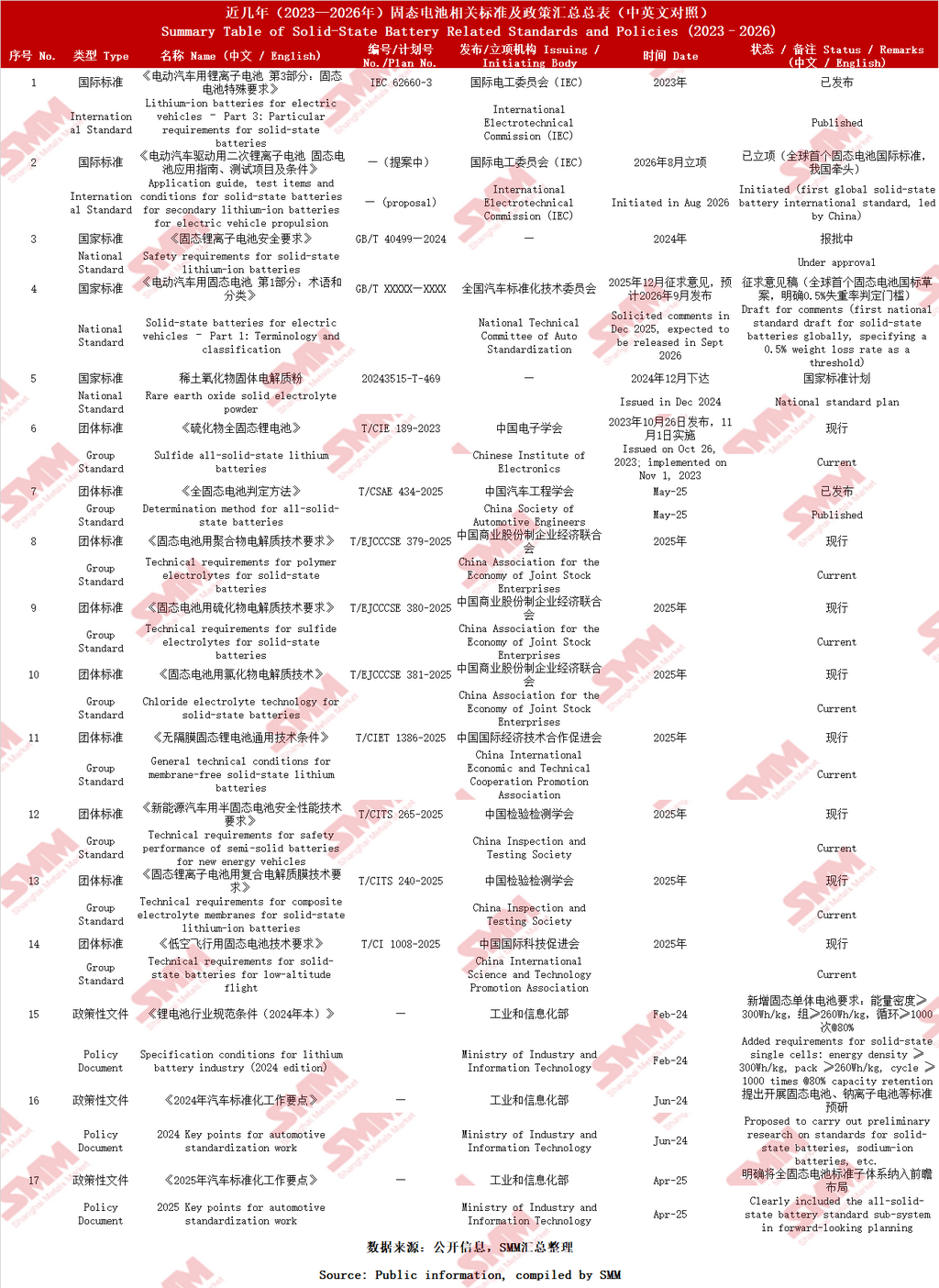
Penelitian awal SMM telah mengungkapkan bahwa standar baterai solid-state domestik masih dalam pengembangan, dengan Terminologi dan Klasifikasi Baterai Solid-State telah menyelesaikan drafnya untuk komentar. Kini setelah standar internasional memimpin di IEC, hal ini menunjukkan bahwa industri telah mencapai titik kritis di mana standar menjadi sangat penting – produsen mobil di seluruh dunia mengembangkan baterai solid-state, tetapi tanpa pengukur yang sama, perbandingan sederhana "baik atau buruk" pun tidak mungkin dilakukan.
II. Mengapa China Dapat Memimpin? – Akumulasi Kekuatan Riset dan Pengembangan yang Membuahkan Hasil
Standar ini dibangun di atas akumulasi riset dan pengembangan baterai solid-state China. Secara objektif, ini bukanlah kebetulan.
Di sisi perusahaan, Qingtao Energy memulai dengan jalur teknologi elektrolit oksida dan telah membangun jalur produksi massal; produknya sudah dipasang di model SAIC. Baterai semi-padat Weilan New Energy telah diperkenalkan pada model produksi massal bekerja sama dengan NIO. Di sisi kebijakan, Administrasi Regulasi Pasar Negara telah secara jelas mengidentifikasi "baterai daya solid-state" sebagai arah baru utama yang perlu dipromosikan.
Partisipasi para ahli dari Prancis, Jepang, Korea Selatan, dan negara-negara lain menunjukkan bahwa kekuatan teknologi telah meraih suara. Ini bukan tentang "suara lantang", melainkan tentang akumulasi R&D yang solid dan praktik industrialisasi.
III. Apa yang Akan Diubah oleh Standar Ini? – Dari "Kepemimpinan Teknologi" ke "Pembuatan Aturan"
Di masa lalu, kami adalah pengikut di bidang baterai lithium, dengan standar yang ditetapkan oleh pihak lain. Sekarang, di era baterai solid-state, situasinya telah berubah.
Pertama, tolok ukur yang seragam mengurangi gesekan R&D global. Tanpa standar, setiap produsen mobil memiliki metode pengujian sendiri, sehingga sulit untuk membandingkan hasil R&D secara horizontal. Dengan standar yang seragam, produsen mobil di seluruh dunia memiliki bahasa yang sama dalam mengembangkan dan memproduksi baterai solid-state, yang akan membantu mempercepat adopsi kendaraan listrik yang lebih aman dan berjarak tempuh lebih panjang.
Kedua, konsep Tiongkok mendunia. Pengembangan standar ini akan membantu membagikan konsep teknologi baterai canggih Tiongkok ke dunia. Ini berarti metode pengujian dan sistem evaluasi Tiongkok mungkin menjadi standar global – yang lebih berharga daripada menjual baterai dalam jumlah berapa pun.
Ketiga, memaksa peningkatan industri dalam negeri. Setelah standar internasional ditetapkan, perusahaan dalam negeri yang tidak memenuhinya bahkan tidak akan mendapatkan tiket untuk "go global". Hal ini pada gilirannya akan mempercepat konsolidasi industri dan membersihkan kapasitas yang usang.
IV. Sebuah Pemikiran yang Menyadarkan: Standar Adalah Titik Awal, Bukan Titik Akhir
Mencapai penerapan massal baterai all-solid-state pada level juta unit sebelum tahun 2030 sangat sulit, meskipun instalasi demonstrasi skala kecil pada model kelas atas diperkirakan antara tahun 2027 dan 2029. Biaya baterai solid-state saat ini masih 5 hingga 10 kali lipat dari baterai lithium konvensional.
Inisiasi standar memecahkan masalah "bagaimana mengukur", namun tantangan "bagaimana membuat" dan "bagaimana membuatnya terjangkau" masih perlu diatasi. Standar adalah katalis untuk industrialisasi, bukan solusi untuk segalanya.
standar baterai keadaan padat Tiongkok terkini
Akhirnya, merekomendasikan konferensi unggulan SMM, perkembangan terkini dan beberapa perusahaan serta perwakilan yang berpartisipasi:

**Catatan:** Untuk detail lebih lanjut atau pertanyaan mengenai pengembangan baterai keadaan padat, silakan hubungi:
Telepon: 021-20707860 (atau WeChat: 13585549799)
Kontak: Chaoxing Yang. Terima kasih!
![Seri Dekade Berikutnya Baterai Solid-State, Bagian 7 dari 9: Lanskap Kompetitif Global—"Perang Bayangan Paten" dan Perlombaan Industrialisasi antara Tiongkok, Jepang, dan Korea Selatan [Analisis SMM]](https://imgqn.smm.cn/usercenter/MyEcZ20251217171727.jpg)
![Seri Dekade Berikutnya Baterai Solid-State, Bagian 6 dari 9: Rute Terner Mungkin Menjadi Hebat Lagi [Analisis SMM]](https://imgqn.smm.cn/usercenter/JSjkr20251217171728.jpg)