Qiu Qiwen investigated the improvement project of rare earth saline-alkali land in North China.

Published: Sep 8, 2020 15:38

SMM: on Sept. 4, Qiu Qiwen, director of the office of the inter-ministerial coordination group for the pilot construction of "waste-free city" and director of the solid waste and Chemicals Department of the Ministry of Ecology and Environment, visited the 2000 mu saline-alkali land improvement experimental plot of rare earths in the north. Wang Meibin, vice mayor of Baotou City; Li Xiaolu, director of Baotou City Ecological Environment Bureau, and Zhang Qing, deputy director of Baotou City Ecological Environment Bureau; Sun Guolong, general manager of Baotou Iron and Steel (Group) Company; Wang Shengping, executive deputy general manager and party committee standing committee member of Baotou Iron and Steel (Group) Company; and Zhao Dianqing, deputy general manager and member of the party committee standing committee of Baotou Steel (Group) Co., Ltd.

Next to the experimental field for saline-alkali land improvement, Qiu Qiwen carefully examined the growth of rice in the experimental field and asked in detail about the current planting cost of rice, the expected yield this year, and the next planting plan. Zhao Dianqing reported on the improvement project of rare earth saline-alkali land in the north. At present, while vigorously strengthening the prevention and control of pollution, rare earths in the north are consciously groping for "manufacturing green" economic growth points from "green manufacturing". We will explore the project of "research and development of new technologies and field tests for the resource utilization of ammonia and nitrogen by-products from rare earth smelting and saline-alkali land treatment", and vigorously develop rare earth agricultural fertilizers and related industries by using ammonium nitrate, ammonium sulfate and ammonium chloride, so as to achieve recycling and enhance the added value of products. Next, the northern rare earths will continue to vigorously develop circular economy, build "green factories", and implement the strategy of ecological protection and high-quality development of the Yellow River Basin with practical actions.

Qiu Qiwen fully affirmed the achievements of the rare earth saline-alkali land improvement project in the north, and suggested that the rare earths in the north should take the rice experimental field as the carrier, engage in more symbiotic varieties, and realize the diversification of planting and breeding species. It is hoped that the northern rare earths will continue to promote the reduction and recycling of the "three wastes" in rare earth production, constantly explore and innovate relevant systems and market models, and do a good job in the follow-up management and experience summary of pilot projects to form a demonstration effect. to contribute more successful cases and advanced experiences to promote the construction of "waste-free cities" throughout the country.

Notice of meeting

Sponsored by SMM, Dongguan Magnetic Materials Industry Association, Ganzhou rare Earth Industry Association jointly sponsored the 2020 China rare Earth permanent Magnet Industry Market Application Development Forum will be held in Ganzhou, Jiangxi Province on October 15-16, when industry experts, business leaders, industry elites, investment circles and other people will gather together to explore the development trend of the rare earth industry and explore potential business opportunities in the industry. SMM sincerely invites you to join us for innovation and resplendence!

"Click to learn more and sign up online
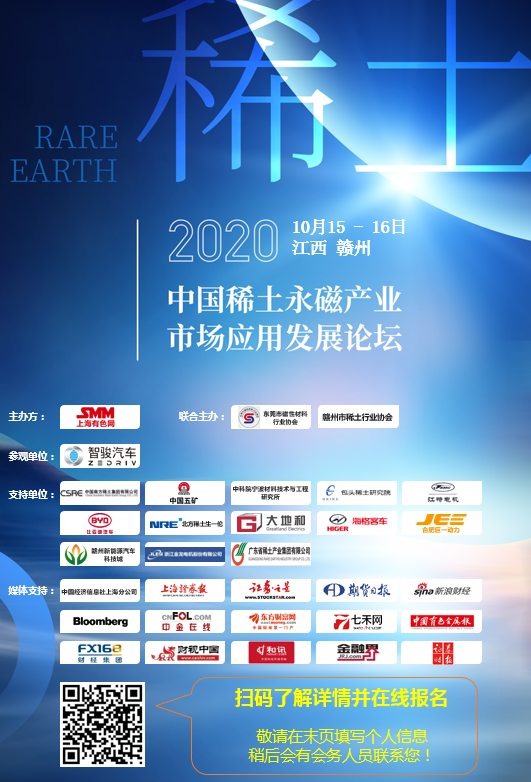
Please fill in your personal information on the last page and the meeting staff will contact you later!

Scan the QR code and apply to join the SMM rare earth industry exchange group

Data Source Statement: Except for publicly available information, all other data are processed by SMM based on publicly available information, market communication, and relying on SMM's internal database model. They are for reference only and do not constitute decision-making recommendations.

For any inquiries or for more information, please contact: lemonzhao@smm.cn
For more information on how to access our research reports, please contact:service.en@smm.cn
Related News
[SMM Chromium Flash] Transnet Posts First Profit in Four Years as Rail Volumes Rise 4.9% to 167.9 Mt
27 mins ago
[SMM Chromium Flash] Transnet Posts First Profit in Four Years as Rail Volumes Rise 4.9% to 167.9 Mt
Read More
[SMM Chromium Flash] Transnet Posts First Profit in Four Years as Rail Volumes Rise 4.9% to 167.9 Mt
[SMM Chromium Flash] Transnet Posts First Profit in Four Years as Rail Volumes Rise 4.9% to 167.9 Mt
South Africa's state-owned freight logistics group Transnet reported a R4.6 billion profit for the financial year ended March 31, 2026, its first annual profit in four years, reversing a R1.9 billion loss in the prior year. Revenue rose 7.1% to R88.6 billion, driven by higher rail and pipeline volumes together with weighted average tariff increases. Rail volumes, handled by Transnet's largest operating division, increased 4.9% to 167.9 million mt from 160.1 million mt a year earlier, while pipeline volumes grew 6.9% to 14.3 billion litres. EBITDA rose 0.7% to R30.9 billion, with the EBITDA margin narrowing 2.2 percentage points to 34.8%, and net operating expenses increased 10.8% to R57.7 billion. A substantial portion of the profit stemmed from a once-off transaction rather than operations. Transnet disposed of a 49.999% interest in the Durban Gateway Terminal to International Container Terminal Services Inc. for R10.5 billion, effective January 1, 2026, generating a R12.5 billion profit on disposal including a related fair value adjustment. Group CEO Michelle Phillips said the company still has a long way to go in its recovery, noting that rail volumes remain below the previously announced 180 million mt target, which she described as a prerequisite for the underlying business to break even. Borrowings rose to R150.7 billion, and capital investment totalled R23.3 billion during the year, with a further R129.1 billion planned over the next five years. The results carry relevance for South Africa's chrome sector, which depends on Transnet's rail and port network to move record chrome ore export volumes, and where rail and port logistics constraints have been repeatedly cited by industry bodies as a structural drag on ferroalloys competitiveness, forcing greater reliance on costlier road transport. Transnet also reported progress on opening its rail network to third-party operators, having concluded Rail Access Agreements with 11 train operating companies, with the first services expected to commence during the 2026/27 financial year. Transnet's results did not disclose chrome ore or ferroalloys-specific volumes within the rail or port figures, leaving the extent of any improvement in chrome-specific logistics performance unquantified.
27 mins ago
[SMM Chromium Flash] Outokumpu Signs Long-Term Ground Support Deal for Kemi, Europe's Sole Working Chrome Mine
1 hour ago
[SMM Chromium Flash] Outokumpu Signs Long-Term Ground Support Deal for Kemi, Europe's Sole Working Chrome Mine
Read More
[SMM Chromium Flash] Outokumpu Signs Long-Term Ground Support Deal for Kemi, Europe's Sole Working Chrome Mine
[SMM Chromium Flash] Outokumpu Signs Long-Term Ground Support Deal for Kemi, Europe's Sole Working Chrome Mine
Global mining infrastructure products provider Jennmar has entered into a long-term partnership with stainless steel producer Outokumpu Corporation to supply ground control products for the Kemi mine in Finland, the country's largest underground mine and Europe's only operational chrome mine. Jennmar has established a dedicated Jennmar Finland entity to streamline commercial transactions for Outokumpu and the mine's management teams. Under the multi-year agreement, Jennmar will supply a full range of ground support equipment tailored to Kemi's underground conditions, including roof bolts, cable bolts, mesh, steel accessories and pumpable resins. The company said it will draw on its global supply chain and technical expertise to support safety, stability and production efficiency at the operation, and will work with Kemi's mine management and underground technical teams on a structured change-management process aimed at optimising mining operations. Jennmar Europe president Mike Petkovich described Kemi as one of the largest and most impressive mining operations in Europe. The Kemi mine has an ore processing capacity of 2.7 million t/y and supplies the chrome feeding Outokumpu's ferrochrome and stainless steel production at Tornio in northern Finland, making it a rare example of a fully integrated mine-to-stainless chromium value chain operating within Europe. Outokumpu operates production sites across Finland, Germany, Sweden, the Netherlands, the United States and Mexico. The agreement underscores continued investment in the operational reliability of Europe's only domestic chrome ore source at a time when the region's ferrochrome producers face sustained competition from lower-cost imported material.
1 hour ago
[SMM Chromium Flash] Chrome Ore Among Only Two SA Mining Sectors to Grow in July as Output Falls 7.5%
1 hour ago
[SMM Chromium Flash] Chrome Ore Among Only Two SA Mining Sectors to Grow in July as Output Falls 7.5%
Read More
[SMM Chromium Flash] Chrome Ore Among Only Two SA Mining Sectors to Grow in July as Output Falls 7.5%
[SMM Chromium Flash] Chrome Ore Among Only Two SA Mining Sectors to Grow in July as Output Falls 7.5%
South Africa's mining production fell 7.5% year-on-year in July 2026, with ten of the country's twelve mining sectors recording declines, according to Statistics South Africa's latest Mining: Production and Sales release. Chromium ore was one of only two sectors to post growth, rising 13.7% year-on-year, alongside manganese ore at 4.9%. Platinum group metals were the largest negative contributor, with production down 13.5% and subtracting 3.2 percentage points from the headline figure. Coal production fell 7.5%, contributing -2 percentage points, while iron ore declined 8.1% for -1.3 percentage points. Diamonds recorded the steepest fall at 48.2%, with nickel down 18.8%, alongside weaker output in gold and copper. On a seasonally adjusted basis, mining production decreased 1.9% month-on-month in July, following a marginal 0.1% rise in June and a 5.6% decline in May. Chromium ore also stood out on the sales side. Mineral sales at current prices fell 5.6% year-on-year in July, with gold the largest negative contributor as sales declined 33.4%, subtracting 8.5 percentage points. Sales of other non-metallic minerals dropped 26% and nickel sales fell 51.7%. Against that, chromium ore sales rose 20%, contributing 1.6 percentage points and ranking as the largest positive contributor, with coal sales up 5% for a further 1 percentage point. Seasonally adjusted mineral sales at current prices fell 15.1% month-on-month in July, following a 2% increase in June. Stats SA Principal Survey Statistician Jean-Pierre Terblanche characterized the month as a significant year-on-year decline for the sector overall, with chromium ore and manganese the exceptions to an otherwise broad-based contraction.
1 hour ago