[SMM Review] what are the reasons for the stagnation of rare earth exports in August?

Published: Sep 7, 2020 16:49

SMM9: as we all know, China, as the country with the richest rare earth resources in the world, accounts for more than 95% of the global rare earth demand with 23%, and has become the country's "strategic resource". And China also has the leading global production technology. Data show that in the field of extraction and separation, China accounts for 70% to 80% of the global market share, and the purity of rare earth smelting separation in China has reached 99.9999%. But recently, China's exports of rare earths have slowed down.

China's exports of rare earths totaled 1640 tons in August, down 1.36% from the previous month and a sharp decline of 62.3% from a year earlier, according to data released by the General Administration of Customs today. From January to August, rare earth exports totaled 24378 tons, down 25.7 percent from the same period last year. On the price side, the export price of rare earths rose significantly in August, up 79% from the same period last year.
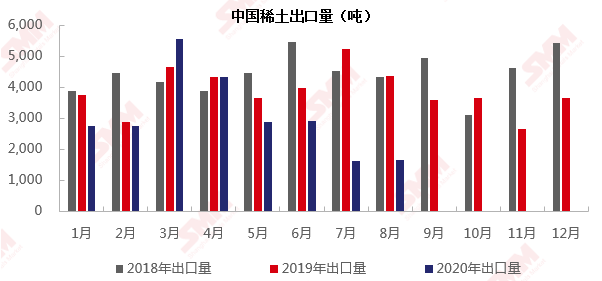
SMM believes that July and August are the overseas summer break. In addition, under the interference of the epidemic, overseas market demand remains sluggish. According to some traders, the atmosphere of overseas inquiry orders in July is light, and correspondingly, the operating rate of domestic rare earth factories is relatively low, resulting in a sharp decrease in rare earth exports in August from the previous month, and there is no big fluctuation compared with July. In addition, the prices of rare earth varieties such as praseodymium, neodymium, terbium and dysprosium are rising this year, especially the price of terbium oxide has risen to an all-time high of nearly eight years, which also makes the export prices of domestic enterprises rise.

[SMM Analysis] the impact of the epidemic is far-reaching. Rare earth exports fell nearly 70% in July compared with the same period last year.

Industry trends

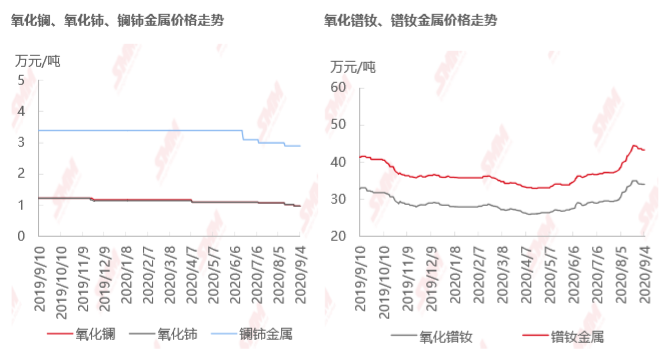
According to SMM, the domestic rare earth market cooled last week, praseodymium, neodymium, dysprosium, terbium and other mainstream products have varying degrees of pullback; market transactions are sporadic, consumers are cautious to purchase. Light rare earths, lanthanum and cerium still maintain long-term stability, fundamentals and trading conditions have not changed much. The price of praseodymium and neodymium oxide fell back last week, especially as the previous high price began to fall. In terms of medium and heavy rare earths, products such as terbium and gadolinium are under pressure this week.

Today, the prices of products in the rare earth market are the same as last Friday, with praseodymium-neodymium oxide at 33.8-342000 yuan / ton, praseodymium-neodymium metal at 43-436000 yuan / ton, terbium oxide at 4870-4920 yuan / kg, and oxidation at 1740-1760 yuan / kg.
"apply for free to view the historical price of SMM

The Resource tax Law of the people's Republic of China came into force on September 1. In the resource tax law, the fixed tax rate for medium and heavy rare earths is reduced from 27% to 20%, while the floating tax rate for light rare earths is 7%, 12%, and the specific tax rate is determined by the people's government at the provincial level. Among them, Baotou mine tax rate is 11.5%, Sichuan mine is 9.5%, Shandong mine is 7.5%. Some companies said that the tax rate on medium and heavy rare earths has been reduced by 7 percentage points, which will reduce the cost for mineral processing enterprises, or affect the price positioning of medium and heavy rare earth products in the later stage.

Notice of meeting

Sponsored by SMM, Dongguan Magnetic Materials Industry Association, Ganzhou rare Earth Industry Association jointly sponsored the 2020 China rare Earth permanent Magnet Industry Market Application Development Forum will be held in Ganzhou, Jiangxi Province on October 15-16, when industry experts, business leaders, industry elites, investment circles and other people will gather together to explore the development trend of the rare earth industry and explore potential business opportunities in the industry. SMM sincerely invites you to join us for innovation and resplendence!

"Click to learn more and sign up online
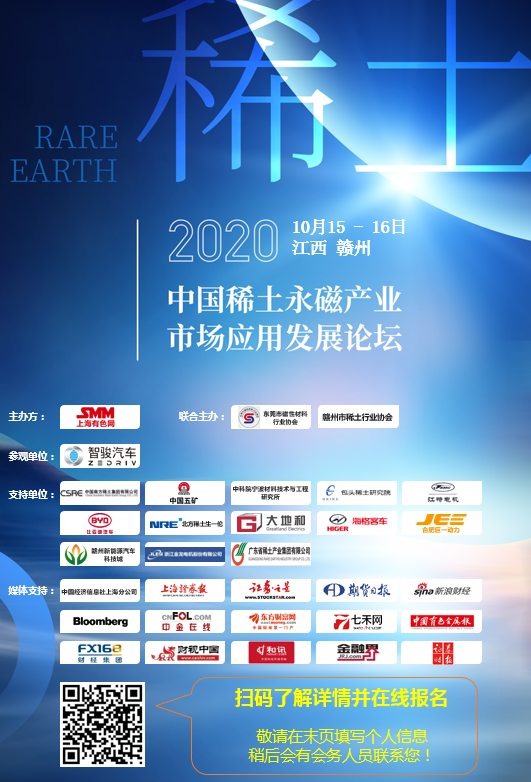
Please fill in your personal information on the last page and the meeting staff will contact you later!
Scan the QR code and apply to join the SMM rare earth industry exchange group
Data Source Statement: Except for publicly available information, all other data are processed by SMM based on publicly available information, market communication, and relying on SMM's internal database model. They are for reference only and do not constitute decision-making recommendations.

For any inquiries or for more information, please contact: lemonzhao@smm.cn
For more information on how to access our research reports, please contact:service.en@smm.cn
Related News
Magnesium Ingot Inventory Rises 1.59% Month-on-Month, Market Struggles with Weak Demand and High Shipping Costs
56 mins ago
Magnesium Ingot Inventory Rises 1.59% Month-on-Month, Market Struggles with Weak Demand and High Shipping Costs
Read More
Magnesium Ingot Inventory Rises 1.59% Month-on-Month, Market Struggles with Weak Demand and High Shipping Costs
【SMM Magnesium Flash】This week, the social inventory of magnesium ingots increased by 1.59% month-on-month, leading to an overall increase in inventory pressure. At the beginning of the week, a wave of concentrated replenishment of just-needed inventory appeared in the market, briefly driving spot transactions to pick up. However, the effect of boosting the market was fleeting and failed to persist. On the one hand, magnesium producers are firm in their attitude towards price support, which to some extent dampens the enthusiasm of downstream purchasing. On the other hand, the actual demand from end-users is weak, and the market lacks sustained purchasing momentum. There is no significant improvement in foreign trade, and current transactions rely heavily on the delivery of existing orders from earlier periods, with no new large orders to support. Meanwhile, due to recent weather conditions, port shipment schedules are tight and shipping costs remain high, which has hindered the delivery of foreign trade orders and significantly slowed down the pace of export inventory reduction. It is difficult for on-site purchasing sources to quickly be transmitted and digested downstream and overseas, resulting in continuous backlog of supply. Ultimately, this has led to a significant accumulation of social inventory, especially port inventory, this week.
56 mins ago
Silicon Metal Finds Stronger Cost Support After Consecutive Declines; Focus on Realization of Polysilicon Production Cut Expectations [SMM Silicon Industry Weekly Review]
56 mins ago
Silicon Metal Finds Stronger Cost Support After Consecutive Declines; Focus on Realization of Polysilicon Production Cut Expectations [SMM Silicon Industry Weekly Review]
Read More
Silicon Metal Finds Stronger Cost Support After Consecutive Declines; Focus on Realization of Polysilicon Production Cut Expectations [SMM Silicon Industry Weekly Review]
[Silicon Metal Finds Stronger Cost Support After Continuous Declines; Focus on Whether Polysilicon Production Cut Expectations Materialize]: Overall, expectations for Q4 polysilicon production cuts have been building recently, and with some silicon enterprises in the northwest resuming production, bearish market sentiment has kept silicon metal prices in the doldrums. Although silicon metal's own fundamentals in September still showed a MoM supply reduction and slight inventory destocking, growing concerns over downstream demand have kept prices under sustained pressure. As the most-traded silicon metal contract fell to around 8,400-8,500 yuan/mt, cost support and buying interest below futures prices have strengthened, and prices may shift to consolidation. The subsequent trend will hinge on whether polysilicon production cut expectations materialize substantively, changes in operating rates among enterprises in the north and south on the supply side, and capital sentiment.
56 mins ago
Cautious downstream purchasing sentiment in the silicone market, with weak new order transactions [SMM Silicone Weekly Review]
58 mins ago
Cautious downstream purchasing sentiment in the silicone market, with weak new order transactions [SMM Silicone Weekly Review]
Read More
Cautious downstream purchasing sentiment in the silicone market, with weak new order transactions [SMM Silicone Weekly Review]
[SMM Silicone Weekly Review: Downstream purchasing sentiment cautious in the silicone market, new order transactions weak] Since monomer plants raised prices successively last week, this week the market has mainly been digesting the increases. Monomer plant quotes remained stable, but transactions for high-priced orders in the market were relatively weak. On the raw material side, affected by geopolitical conditions, import prices for raw material methanol remained firm, providing some support to silicone DMC prices. Overall, the current silicone market is in a tug-of-war between upstream and downstream: the supply side has a strong willingness to hold prices firm, while the demand side is mainly restocking on a just-in-time basis, with limited high-priced transactions in the market. In the short term, silicone prices will remain stable, and attention should be paid to changes in downstream stockpiling pace before the holiday and the trend of raw material methanol prices.
58 mins ago