China’s bauxite imports hit record high in Q1

Published: May 21, 2020 14:40
China's imports of bauxite, the main ore source of aluminium and which has to be first refined into alumina, rose to a record high in the March quarter, due to greater demand and lower sea freight costs.

SHANGHAI, May 21 (SMM) – China's imports of bauxite, the main ore source of aluminium and which has to be first refined into alumina, rose to a record high in the March quarter, due to greater demand and lower sea freight costs.


China imported 28.41 million mt of bauxite in the first three months of 2020, marking the highest quarterly import volume on record, according to China customs data under HS code 26060000. That was up 26.01% from the fourth quarter of 2019, and 9.99% from the first quarter of 2019.
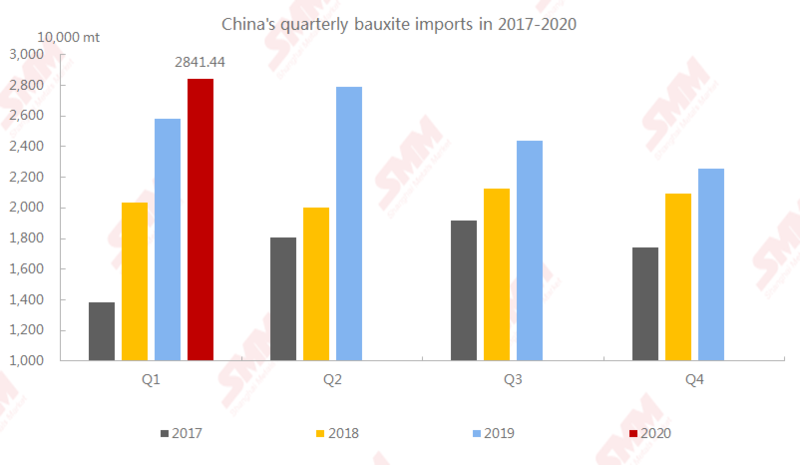
 

Source: Data from China customs compiled by SMM


The Republic of Guinea remained the top bauxite exporter to China, and its first-quarter supplies were barely changed at 13.37 million mt from a year earlier, accounting for nearly half of China’s total bauxite imports.  


Australia and Indonesia took the second and third places. China’s bauxite imports from Australia increased 22.95% year on year to 9.24 million mt in Q1, while those from Indonesia jumped 46.45% to 4.73 million mt.


The ramp-up of alumina refineries that have upgraded their facilities to adapt foreign ore, a decline in logistical costs caused by lower sea freight rates and subdued recovery of domestic mines due to COVID-19 boosted China’s demand for imported bauxite to an all-time high in Q1.


However, the appeal of imported bauxite has waned, as greater losses in prices of domestic ore, lower prices of caustic soda and coal make it more cost-effective to use domestic bauxite, and approximately 2 million mt per year of alumina capacity using imported bauxite have gone offline. 

Data Source Statement: Except for publicly available information, all other data are processed by SMM based on publicly available information, market communication, and relying on SMM‘s internal database model. They are for reference only and do not constitute decision-making recommendations.

For any inquiries or to learn more information, please contact: lemonzhao@smm.cn
For more information on how to access our research reports, please contact:service.en@smm.cn
Related News
Data: SHFE, DCE market movement (Mar 03)
12 mins ago
Data: SHFE, DCE market movement (Mar 03)
Read More
Data: SHFE, DCE market movement (Mar 03)
The following table shows the ferrous and nonferrous metals movement on the SHFE and DCE on 03 Mar , 2026
12 mins ago
Domestic Secondary Aluminum Alloy Ingot Inventory Down by 364 mt, Foshan Sees Major Destocking
6 hours ago
Domestic Secondary Aluminum Alloy Ingot Inventory Down by 364 mt, Foshan Sees Major Destocking
Read More
Domestic Secondary Aluminum Alloy Ingot Inventory Down by 364 mt, Foshan Sees Major Destocking
[SMM News Flash] Inventory of secondary aluminum alloy ingots in major domestic consumption areas decreased by 364 mt MoM from the previous day, with destocking mainly concentrated in the Foshan area.
6 hours ago
New Locomotives Boost Guinea's TransGuinean Rail for Iron Ore, Bauxite Transport
6 hours ago
New Locomotives Boost Guinea's TransGuinean Rail for Iron Ore, Bauxite Transport
Read More
New Locomotives Boost Guinea's TransGuinean Rail for Iron Ore, Bauxite Transport
[SMM Aluminum Express News] Four new locomotives, Foussein, Lanny-Ninkin, Kaporo, and Gbereakhory have entered service on Guinea's TransGuinean corridor rail line, managed by La Compagnie du TransGuinéen (CTG). Primarily built to haul high-grade iron ore from Simandou mine to Morebaya port (650 km), these Wabtec units (part of a 78-locomotive fleet) support heavy loads for faster, reliable shipments. The corridor's high-capacity infrastructure (12 stations, 206 bridges, rugged terrain adaptations) also enables transport of bauxite and other minerals, creating a multi-commodity logistics backbone that could shorten transit for landlocked neighbors (e.g., Mali) and boost regional mineral exports.
6 hours ago