Lithium carbonate producers in China to be compelled to cut output in Q2

Published: Apr 14, 2020 14:37
Inventory pressure of lithium carbonate, a raw material for digital and power batteries, may continue to mount in April as Chinese lithium salt producers have not yet planned to wind down production. Elevated inventories together with limited downsides in lithium carbonate prices with support from costs, however, may trigger output cut in the second quarter.

SHANGHAI, Apr 14 (SMM) – Inventory pressure of lithium carbonate, a raw material for digital and power batteries, may continue to mount in April as Chinese lithium salt producers have not yet planned to wind down production. Elevated inventories together with limited downsides in lithium carbonate prices with support from costs, however, may trigger output cut in the second quarter. 


SMM data showed that the accumulative inventories of lithium carbonate have exceeded 50,000 mt as of early April, which included the amount of lithium carbonate for producing lithium hydroxide. 
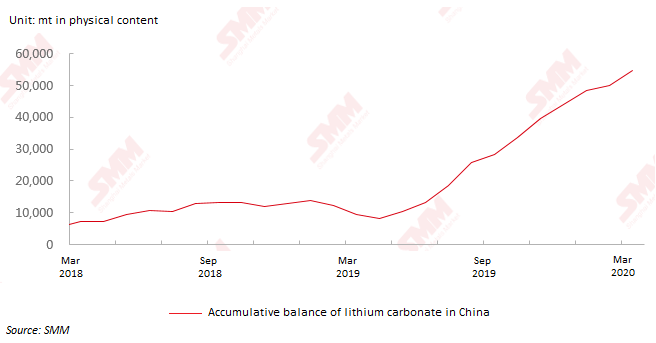


Supply of lithium carbonate has increased since March with output recovery amid the slowdown of the spread of the COVID-19 in China. Producers in Jiangxi, the area badly hit by the epidemic, get back to business quickly last month and plants in Qinghai also moved up a gear as the weather improved.  


The overall operating rates at lithium salts producers showed no signs of decline for April, despite an absence of a significant pickup in downstream demand. Some lithium salts smelters that use spodumene as raw materials strived to meet their production targets while no new orders were received. At the same time, cost advantages drove smelters that use mica and salt lake brines as feedstock to keep operating rates at high levels. 


The ramped-up operation will likely offset the impact of maintenance at some key producers in Sichuan and Qinghai in the first half of April. The maintenances are slated to last for 7-15 days. 


SMM expects China’s production of lithium carbonate to rise 12.7% from March to 15,000 mt in April, 26.5% higher from the same period last year. 


Demand for lithium carbonate reduced since mid-March as an escalation in the COVID-19 outbreak outside China took a toll on China’s exports


On the consumer battery front, the coronavirus-driven shutdown of South-east Asian factories that consumed Chinese battery materials led to the cancellation of orders, prompting Chinese producers of lithium manganese oxide (LMO), lithium cobalt oxide (LCO) and ternary materials to slow down operations in the second half of March. 


In the power battery market, producers restarted production with the return of automakers, but end-users demand remained sluggish and drove battery mills to delay purchases for raw materials since mid-March. These resulted in thin trades of battery-grade lithium carbonate and reduced orders of industrial-grade lithium carbonate in March. 


Market participants told SMM that power battery producers in China continued to run at low rates, which may depress demand for ternary materials in April. 


Demand for lithium iron phosphate (LFP) from the energy storage sector recovered. This could lift consumption of lithium carbonate to 9,800 mt in April, SMM assessed. 
 

Data Source Statement: Except for publicly available information, all other data are processed by SMM based on publicly available information, market communication, and relying on SMM‘s internal database model. They are for reference only and do not constitute decision-making recommendations.

For any inquiries or to learn more information, please contact: lemonzhao@smm.cn
For more information on how to access our research reports, please contact:service.en@smm.cn
Related News
BAIC R&D Unveils High-Performance Sodium-Ion Battery Prototypes with Industry-Leading Specs
14 hours ago
BAIC R&D Unveils High-Performance Sodium-Ion Battery Prototypes with Industry-Leading Specs
Read More
BAIC R&D Unveils High-Performance Sodium-Ion Battery Prototypes with Industry-Leading Specs
SMM learned that BAIC R&D recently announced the successful development of sodium-ion battery prototypes. The first prismatic battery pack using prismatic battery cells achieved an energy density exceeding 170 Wh/kg, placing it in the industry’s top tier. It also supports 4C ultra-fast charging, enabling recharging in 11 minutes. Its temperature-range adaptability and safety performance are outstanding, with stable operation across an ultra-wide range from -40°C to 60°C, energy retention above 92% at -20°C, and no risk of thermal runaway under extreme scenarios. At present, this sodium-ion battery has completed sample finalization, established mass-production processes for prismatic products, and filed 20 patents around core technologies. BAIC has also leveraged this to complete a full technology roadmap covering lithium batteries, solid-state batteries, and sodium-ion batteries, and has mastered a complete set of core sodium-ion battery technologies.
14 hours ago
L&F Secures KRW 1.6 Trillion LFP Cathode Supply Deal with Samsung SDI
15 hours ago
L&F Secures KRW 1.6 Trillion LFP Cathode Supply Deal with Samsung SDI
Read More
L&F Secures KRW 1.6 Trillion LFP Cathode Supply Deal with Samsung SDI
According to a regulatory filing on the 24th, L&F announced that it signed a mid- to long-term supply agreement for lithium iron phosphate (LFP) cathode materials with Samsung SDI on the 23rd. The contract is valued at KRW 1.6067 trillion, equivalent to approximately 84.23% of L&F’s recent annual revenue of KRW 1.9074 trillion. The supply will primarily target North America, including the United States, with the contract period running from March 30 through Dec. 31, 2029.
15 hours ago
Toyota to Invest $1 Billion in Kentucky and Indiana, Advance Battery Production Plans
15 hours ago
Toyota to Invest $1 Billion in Kentucky and Indiana, Advance Battery Production Plans
Read More
Toyota to Invest $1 Billion in Kentucky and Indiana, Advance Battery Production Plans
On March 23 (local time), Toyota announced plans to invest $800 million in its Kentucky plant to prepare for a second battery electric vehicle (BEV) production line and expand capacity for the Camry and RAV4. The company will also invest $200 million across two facilities in Indiana to increase production of the Grand Highlander SUV, while advancing parallel efforts related to battery manufacturing.
15 hours ago