Many investors see gold as an important safe haven in times of turmoil, and the price of gold soared during the escalation of the conflict between Russia and Ukraine. Steve Land, a portfolio manager at global investment firm Franklin Templeton, recently released a report outlining how his team invests in the metals industry and why smaller gold producers (gold stocks) are particularly attractive.
The spot price of gold, often seen as a safe haven in times of international tension, climbed above $2040 an ounce in March as many investors sought to hedge against inflation and political instability. On March 8, gold futures prices were just above $2043 an ounce, not far from the historical record of $2069 an ounce, the highest closing price of the day since January 1975. Gold outperformed other widely seen safe havens in February and March, including US Treasuries, whose attractiveness was undermined by high inflation, as well as the yen and the Swiss franc.
Western sanctions against Russia have also prompted Russia's central bank to promise to resume purchases of precious metals, which have been suspended for nearly two years. The central bank has bought Russian-produced gold in the past as a way to increase government reserves, but it may have seen the effect of supporting existing supplies because gold is an asset that has nothing to do with any country or financial system. Western sanctions also make it difficult for gold producers operating in Russia to sell their gold to the world, making the Russian government a key buyer of operations.
Rising global inflation is another key factor supporting gold prices this year. In particular, the US consumer price index (CPI) accelerated in early 2022, bringing annual inflation to a 40-year high. Demand for gold coins and bars has been strong over the past few years, and recent geopolitical events seem to have only played a driving role, with spot price premiums rising in some markets. The spot settlement price of gold has been higher than the futures price several times since March, and as of the latest price, the spot gold price is still slightly higher than the futures price, which partly reflects a shortage of available physical supply relative to demand.
Three key factors support gold stocks
Gold has performed well, but Steve Land and his team still believe there are many potential drivers that could push gold higher. They believe that gold may benefit from a new round of market volatility and the lingering negative impact of the COVID-19 epidemic on economic growth. Tensions between Russia and Ukraine have brought broader uncertainty to global economic growth, and a typical feature of gold is its very low correlation with other asset classes. this has led to a surge in interest in gold as a tool for portfolio diversification in volatile markets.
Steve Land and his team said that as investors in gold mining stocks, they expected to gain exposure to three key value creation activities in the industry: (1) discovery of new gold through exploration; (2) successful development of new mines; and (3) solid operations of mining assets focused on generating strong free cash flow.
Directional volatility in gold prices is a key driver of stock performance in the short term, but Steve Land and his team believe it is also important to focus on long-term developments in the industry. Over the past two years, the average price of gold has exceeded $1750 an ounce, a level that provides a highly profitable backdrop for most gold producers. Higher by-product copper credit (copper mines are usually found along with gold in many parts of the world) further supported strong cash flow generation in 2021 and early 2022 at a time when the balance between global copper supply and demand has historically been tight. In many cases, it helps to offset the single-digit cost inflation that the mining industry is currently experiencing.
Over the past two years, profit margins for gold producers have continued to be higher than in previous gold cycles. Unlike previous cycles, most gold companies do not pursue growth, but pay more attention to cost control and cash creation.
The current cycle is also unique because most of the new money entering the gold market favours physical gold exchange traded funds (ETF). As a result, in the past few years, we have seen gold stocks lead the cyclical market, with rising gold prices pushing gold stocks higher. As a result, while the correlation between the two is still high, valuation multiples are still quite low, and price and cash flow multiples often fall as gold prices rise, especially among medium-sized producers.
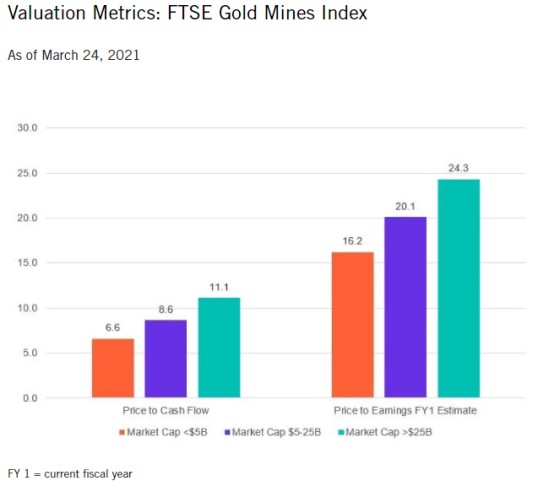
Although Steve Land and his team believe that gold mining companies as a whole are in better shape than at any time since the world left the gold standard in 1971, many companies have very low price-to-earnings ratios and low prices relative to the general market, compared with the historical level of rising gold cycles. Steve Land and his team say that when investors think prices are likely to weaken in the medium term, their team expects the current trading opportunities to come from highly cyclical companies, but this does not seem to be consistent with a market where investors are net buyers of physical gold, where the only way to make a profit is to make prices higher.
At current prices, most gold producers generate substantial cash flow and have real free cash flow to return to investors, even after reinvesting in their businesses. So Steve Land and his team believe this creates an attractive opportunity for those who believe that gold prices can remain at current levels or go higher, as they believe that many gold stocks are currently discounted at well below the spot price of gold.
Previous gold rally cycles are usually accompanied by an increase in stock valuation multiples, reflecting investors' belief that gold prices will rise further in the future and that if gold prices do not rise, there is a strong possibility of a downside. While they expect gold stocks to continue to fluctuate, they also believe that downside risks have been mitigated by current lower valuations and stronger balance sheets, and that gold stocks should outperform physical gold in an environment where prices have flattened to higher.
According to the team's analysis, many smaller gold producers, which are usually still in the exploration and development stage of building new gold mines, are valued at much lower valuations than their peers. Companies in the development stage have the opportunity to promote the project and expand the size of assets, which tend to expand over time as the project enters the production stage.
Another potential theme, of course, is that many established, well-capitalised gold miners have not reinvested enough in their current operations to organise and maintain their existing production bases. As a result, acquiring smaller companies is likely to be a more effective way to replenish depleted gold reserves and increase production, helping them gain an edge over their competitors. But the team now favours "pre-production" gold companies, arguing that these stocks could still benefit from higher gold prices while providing better opportunities to release value to shareholders without being affected by fluctuations in gold prices.
Steve Land and his team said that while economic conditions in the United States and the rest of the world have improved significantly, after two years of blockades and restrictions triggered by the COVID-19 epidemic, global economic growth is still under pressure and the road to a full global economic recovery is unlikely to be smooth around the world.
The situation in Russia and Ukraine complicates the road to recovery. In this environment, they believe that inflation will be a major problem for many countries, as governments may seek to tighten policies to get rid of the additional debt they have been forced to take on since the outbreak. This could boost demand for gold in these regions, as gold is seen as a proven alternative to holding paper money in an inflationary environment.
The risk can not be ignored.
Steve Land and his team also mentioned the risks in their report. All investments are risky, including possible principal losses. The value of the investment may fall or rise, and investors may not be able to recover all their investment. Stock prices sometimes fluctuate rapidly and violently due to factors that affect the market conditions of individual companies, specific industries or sectors or the whole market. The precious metals industry involves fluctuations in the prices of gold and other precious metals and is more vulnerable to the economic environment and the development of regulatory regimes. In addition, during a period of steady economic growth, traditional equity and debt investments may provide greater appreciation potential, and the prices of gold and other precious metals may be adversely affected.
Special risks are related to foreign investment, including currency fluctuations, economic instability and political development. Investing in emerging markets involves higher risks associated with these factors in addition to the risks associated with the smaller size and illiquidity of these markets. Smaller and newer companies may be particularly sensitive to changing economic conditions, so their growth prospects are not as deterministic and predictable as larger, more mature companies, and they may be more volatile. Non-diversified portfolios have greater risk of price fluctuations than diversified portfolios.