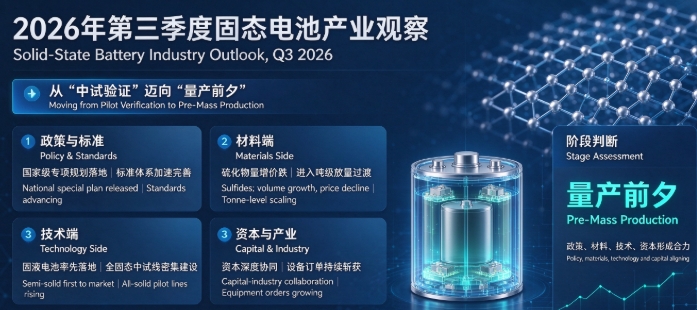
Key takeaway:In the third quarter of 2026, the solid-state battery industry is at a critical stage of transition from “pilot-scale validation” to “the eve of mass production.” National-level special plans have been implemented, and the standards system is being accelerated and improved. On the materials side, sulfide electrolytes are seeing “rising volume and falling prices,” entering a transition period of ton-level volume ramp-up. On the technology side, solid-liquid (semi-solid) batteries are the first to be deployed in scenarios such as commercial vehicles, energy storage, and eVTOL, while pilot lines for all-solid-state batteries are being built intensively. Capital and industry are collaborating deeply, equipment orders continue to be secured, and downstream application scenarios are flourishing in multiple areas. At the same time, however, risks such as insufficient capacity utilization, lagging orders, and interface and manufacturing bottlenecks remain, requiring a rational view of the pace of industrialization.
Foreword: Material Price Analysis—Policy Side Hot, Spot Side Cold, Sulfide “Rising Volume, Falling Prices”
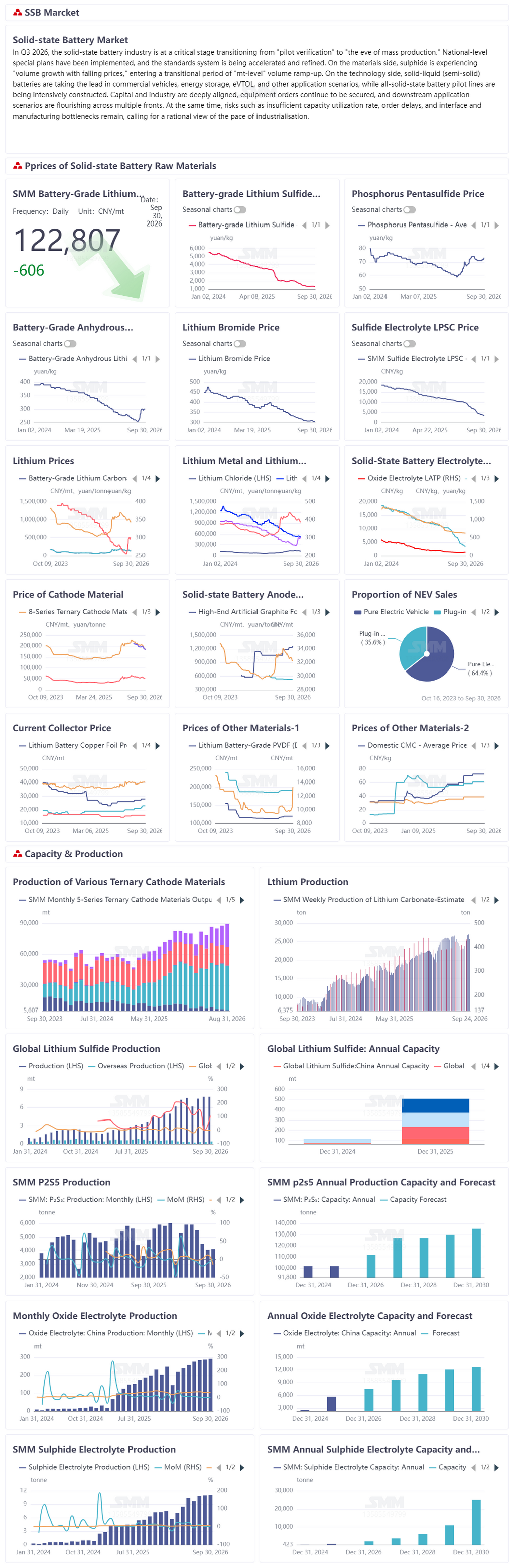
In Q3 2026, the solid-state battery sector showed a striking divergence: “hot on the policy side, cold on the materials spot side.” On September 28, the Ministry of Industry and Information Technology (MIIT) and six other departments issued the “15th Five-Year Plan for the Development of the New Battery Industry,” clarifying preliminary large-scale application of all-solid-state batteries by 2030, which drove the battery sector and solid-state battery sector stronger on September 29. However, on the materials spot side, the pricing anchor centered on lithium salts declined unilaterally, and sulfide electrolytes showed a typical pattern of “rising volume, falling prices.”
On lithium salts, the average spot price of battery-grade lithium carbonate in Q3 was about RMB 148,000/ton. At the end of the quarter, the quotation on September 29 for battery-grade lithium carbonate was RMB 123,000/ton, with a Q3 cumulative decline of -22.9%.
On solid-state-battery-specific materials, sulfide electrolytes were the segment with the most obvious “price collapse” this quarter. From January to August 2026, China’s cumulative output of sulfide electrolytes was 70 tons, up 119.7% year-on-year, already exceeding the full-year 2025 output of 58.29 tons, but only 19.6% of the annual forecast target of 360 tons was completed. In August, capacity utilization was only 5.82%, product prices continued to plummet, and LPSC fell by more than 24% in a single month. Lithium sulfide also ramped up simultaneously: in August, China’s battery-grade lithium sulfide output was 7.79 tons, up 3.6% month-on-month and up 143% year-on-year; the January-August cumulative total was 52.9 tons, already exceeding the global full-year 2025 output of 34 tons. China’s output accounts for about 95% of the world total. It is expected that monthly output in Q4 will rise to 9–10 tons, with full-year output of 85–95 tons.
On the supply side, Q3 saw the concentrated landing of “hundred-ton-level” production lines: Tinci Materials’ hundred-ton-level lithium sulfide and solid electrolyte pilot line was completed and put into production in Q3; Shandong Chuanglu’s 150-ton/year solid electrolyte production line completed installation and commissioning; Capchem’s oxide electrolyte will put thousand-ton-level capacity into operation in 2026. However, in the first half of the year, both supply and demand for lithium sulfide and sulfide electrolytes were weak, and price pressure was the main theme of Q3. Anode materials were relatively resistant to decline, and additives were structurally strong. Overall, the solid-state battery materials sector has entered a transition stage from “kilogram-level transactions” to “ton-level transactions,” with the price center moving downward. Q4 needs to verify the quality of ton-level volume ramp-up.
I. Solid-State Battery Materials
-
Electrolytes: Sulfide Upstream Volume Rises but Prices Remain Under Pressure; Oxide Capacity Takes the Lead in Scaling; Halides Accelerate Reserve
The sulfide route was the most intensively expanded direction on the materials side in Q3. The high-purity lithium sulfide pilot line of a subsidiary controlled by Semcorp has been completed, with plans to achieve thousand-ton-level mass production of sulfur-halide solid electrolytes in 2026–2027. Tinci Materials’ hundred-ton-level lithium sulfide and solid electrolyte pilot line was completed and entered trial production in Q3, using a self-developed liquid-phase method with costs 30%–40% lower than the mainstream solid-phase method. XTC New Energy’s high-purity lithium sulfide entered trial production. Yahua Group’s lithium sulfide pilot line entered the demonstration and design stage and has been sent to customers for samples. Tianqi Lithium’s 50-ton lithium sulfide pilot project is under construction and is expected to be completed in the second half of the year; most processes for argyrodite-type sulfide electrolyte preparation have been removed from glove boxes. Gotion Holding’s world’s first ten-thousand-ton-level high-purity lithium sulfide line started in Anqing, with plans to complete pilot testing by the end of 2026 and full mass production in 2027, with purity reaching 99.99%. Qinghai Weixiang’s 3,000-ton lithium sulfide project completed filing, with Phase I of 500 tons and Phase II of 2,500 tons, planned for completion in July 2027. Easpring’s sulfide electrolyte has entered small-scale validation with leading solid-state battery customers and has scalable supply capability. Guoci Materials’ sulfide solid electrolyte automated production line was completed, with a strategic focus on sulfides. Langu New Energy’s sulfide and halide solid electrolytes have achieved hundred-ton-level capacity, with the next step planned to expand to thousand-ton or even ten-thousand-ton levels. Tengyuan Cobalt and Hunan Lithium Sulfur jointly built a lithium sulfide pilot line.
The oxide route leads in engineering and capacity. Langu New Energy’s oxide solid electrolyte capacity has reached the ten-thousand-ton level; Shenzhen Xinyuanbang, in which Senior Material holds a stake, has thousand-ton-level oxide electrolyte capacity and hundred-ton-level shipments; Yibin Chenfeng’s RMB 530 million thousand-ton solid electrolyte project was signed and settled in Heyuan, Guangdong, mainly producing oxide solid electrolytes, planned for production in October 2027; Capchem’s oxide electrolytes have been mass-produced and sold, and thousand-ton-level capacity will be put into operation in 2026; Kunlun New Material’s thousand-ton-level oxide solid-liquid hybrid electrolyte capacity at its Huzhou base is gradually being released; Mitsubishi Chemical plans to invest about JPY 15 billion to build a new oxide solid electrolyte production line with annual capacity of 1,000 tons, planned for Q1 2028. Oriental Zirconium’s zirconia powder has received preliminary R&D trial recognition from some solid-state battery material manufacturers; Mengguli obtained an invention patent for nanoscale oxide solid electrolyte; Jiuwu Hi-Tech’s LATP solid electrolyte passed extreme overcharge and overdischarge tests; Penghui Energy’s oxide-route laboratory energy density exceeded 400Wh/kg, with an operating temperature range of -40°C to 105°C.
The halide route is accelerating its layout as a potential alternative. Xinyuren’s second-generation halide solid electrolyte was successfully trial-produced and entered preliminary testing; Sumitomo Chemical plans to mass-produce halide solid electrolytes in fiscal 2028; Shanghai Jiao Tong University publicly tendered an intelligent halide solid electrolyte preparation and testing system.
-
Cathodes: High-Nickel, Ultra-High-Nickel, and Lithium-Rich Manganese-Based in Parallel; Solid-Liquid Cathodes Ramp First; All-Solid-State Cathodes Enter Ton-Level Validation
BTR has achieved full coverage of the three core material systems for solid-state batteries: cathode, anode, and electrolyte. For hybrid solid-liquid batteries, it adopts a polymer + oxide composite solution; for all-solid-state batteries, it focuses on sulfide electrolyte materials and has developed the industry’s first high-performance three-dimensional framework material matching lithium-carbon composite anodes for all-solid-state batteries.
Easpring’s all-solid-state cathode materials have passed tests by multiple leading companies and are undergoing vehicle installation validation, with cumulative shipments of 50 tons; solid-liquid battery cathode materials have achieved cumulative thousand-ton-level shipments, and dual-phase composite solid-state cathode materials have achieved stable batch shipments of more than one hundred tons per month; new sulfide solid electrolytes have scalable supply capability. Ronbay’s solid-state battery cathode materials received good customer test feedback, with the shipment share of 9-series high-nickel rising to 35%, expected to reach hundred-ton-level demand this year, and a ten-ton-level solid electrolyte line is planned to be completed within the year. GEM’s high-nickel, ultra-high-nickel, and lithium-rich manganese-based cathodes for solid-state batteries have all achieved ton-level or above shipments, and it jointly established a solid-state battery cathode material joint laboratory with Academician Sun Xueliang’s team. Tianhua New Energy’s subsidiary Jiangsu Yili started its solid-state battery cathode material mass production line, planning ten-thousand-ton-level high-nickel ternary cathode capacity, supported by a thousand-ton-level pilot line. Zhenhua New Material’s solid electrolyte pilot line installation is in the final stage, while simultaneously advancing industrialization of medium-nickel high-voltage, high-nickel, ultra-high-nickel ternary, and lithium-rich manganese-based materials. Sichuan University released ultra-high-nickel all-solid-state battery results: ultra-high-nickel cathode 0.1C discharge specific capacity exceeded 240mAh/g, solid-state battery energy density exceeded 400Wh/kg, and cycle life reached more than 800 cycles.
Overall, cathode materials are advancing along high-nickel, ultra-high-nickel, and lithium-rich manganese-based directions; semi-solid/solid-liquid battery cathodes are ramping first, while all-solid-state cathodes remain in ton-level validation and vehicle installation validation.
-
Anodes: Silicon-Carbon Anode Industrialization Accelerates; Lithium Metal Anode Pilot Advances; Composite Anodes/3D Frameworks Become New Directions
BTR developed the industry’s first high-performance three-dimensional framework material matching lithium-carbon composite anodes for all-solid-state batteries. Dowstone’s silicon-carbon anode has achieved batch shipments, single-wall carbon nanotube products have been supplied in batches to multiple cell manufacturers, and solid electrolytes have been supplied in small batches to some customers. Xiangfenghua’s CVD silicon-carbon anode is in the customer certification stage, and product validation with Qingtao Energy continues. LiTan’s silicon-carbon anode project went into mass production, with annual capacity of 6,500 tons, Phase I 1,500 tons, and after full production it is expected to account for 30% of the domestic market. Yibin signed a project for 5,000 tons of porous carbon and 1,000 tons of silicon-carbon anode materials dedicated to solid-state batteries. Furi acquired 78.80% equity of BSL for RMB 399.6 million; BSL has entered mass production supply for Gotion High-tech and Yinrui battery materials, with annual capacity of about 540 tons. Zhihua Energy completed a C round of financing to increase investment in silicon-carbon anodes. Shanshan plans anodes for solid-state batteries and solid electrolyte composite anodes. Putailai’s silicon-carbon anodes, lithium metal anodes, and solid electrolytes (LLZO/LATP) can all be applied to solid/solid-liquid batteries. Tianqi Lithium can produce 300mm-wide roll-to-roll ultra-thin lithium metal strips, which can be directly supplied to solid-state battery manufacturers as anode metal materials. Ganfeng Lithium is advancing both silicon-carbon and lithium metal anode routes.
-
Others: Equipment Leads; Separators/Aluminum-Plastic Films/Binders/Additives Follow
Equipment was one of the most active industrialization segments in Q3. Naconor launched lithium strip calendering equipment, lithium supplementation composite all-in-one machines, electrolyte transfer printing equipment, and isostatic pressing equipment. Some have entered customer validation or delivery, with orders in hand of RMB 2.718 billion. Senior Technology has opened up the entire process for all-solid-state battery mass production, achieving full coverage of complete line solutions and key equipment in each stage, and continued to win orders from leading customers in Q3, covering dry electrodes, electrolyte coating, transfer printing, solid-state stacking, and isostatic pressing. Lyric Robot’s all-solid-state complete line project completed phased acceptance, and warm isostatic pressing equipment reached mass production delivery standards, obtaining key model and pilot line orders from two leading customers. Jinyinhé plans a private placement to raise no more than RMB 1.5 billion, investing in R&D of high-end intelligent equipment for solid-state batteries. United Winners Laser delivered an all-solid-state assembly line to a leading customer for trial production. Putailai has delivered dry-process and solid-state battery electrode equipment to leading domestic and overseas customers, with cumulative orders exceeding RMB 200 million. ST Funeng’s subsidiary Chaoye Precision achieved small-batch delivery of solid-state battery-related equipment.
On auxiliary materials, Mingguan New Material completed customer sample trials for solid-state battery aluminum-plastic film, resistant to 120°C high temperature; Zhonglun New Material’s BOPA film dedicated to solid-state batteries is in sample validation; Senior Material and Ruigu New Material jointly developed high-performance solid electrolyte film; Semcorp is laying out lithium sulfide, sulfide electrolytes, and oxide-coated films for solid-liquid batteries; Huitian New Material’s lithium battery anode adhesive and thermal conductive adhesive can adapt to solid-liquid (semi-solid) battery application scenarios; Tinci Materials’ supporting solid-state battery UV frame adhesive is in small-batch sampling.
II. Solid-State Battery Technology
-
Technology: Sulfides Pursue High Conductivity and Low Pressure; Oxides Lead in Engineering; Polymers Stand Out in Processability; Solid-Solid Interfaces and Continuous Manufacturing Remain Core Bottlenecks
Sulfide technology: Boron-doped mixed-halide argyrodite electrolyte achieved ionic conductivity of 7.53mS/cm, with significantly enhanced air tolerance and lithium plating/stripping reversibility; the Qingdao Institute of Bioenergy and Bioprocess Technology, CAS, broke through the dry electrode process for sulfide all-solid-state batteries, using polyamide-based binder melt bonding; Zhejiang University’s Tu Jiangping and Zhong Yu team achieved kilogram-level liquid-phase synthesis of high-conductivity sulfide electrolytes, with LSPS0.45 room-temperature conductivity of 5.42mS/cm; FAW and Eastern Institute of Technology developed an ionic elastomer interface, enabling large-capacity sulfide all-solid-state cells to cycle stably at low pressure of 5MPa; defect-engineered LiYO2 interface layers improve compatibility between high-nickel cathodes and sulfide electrolytes; dynamic redox control builds adaptive interfaces to stabilize lithium metal anodes; Academician Sun Xueliang’s team revealed that electronic conductivity of solid electrolytes is a “hidden killer” of self-discharge; when electrolyte thickness is reduced to 20μm, capacity loss after one month of standing can reach 94.5%; Stanford/SLAC found that mechanical extrusion can force lithium dendrites to expand horizontally; Purdue University revealed the mechanism of interface defect formation.
Oxide technology: Penghui Energy’s oxide-route laboratory battery energy density exceeds 400Wh/kg, operating temperature -40°C to 105°C; Changan Automobile completed validation of a 20Ah oxygen-polymer composite solid-state battery, with new electrolyte conductivity >4.5mS/cm, energy density >350Wh/kg, and hot box test at 250°C; Baima Lake Laboratory’s boride solid-state battery has energy density of 400Wh/kg, cycle life over 2,000 cycles, hot box resistance at 180°C, operating pressure reduced to below 5MPa, and completed trial production of 20Ah cells; Jiuwu Hi-Tech’s LATP solid electrolyte passed extreme overcharge and overdischarge tests.
Polymer technology: Sunwoda’s polymer all-solid-state battery “Xin·Bixiao” has energy density of 400Wh/kg, cycles 1,200 times under ultra-low pressure, passes 200°C hot box, and plans to build a 0.2GWh pilot line by the end of 2025; Ion Energy’s 51Ah automotive-grade polymer-based all-solid-state battery has energy density of 520Wh/kg, supports 6-minute ultra-fast charging, operates from -45°C to 120°C, cycles more than 3,500 times, and passed GB38031-2025.
Halide technology: Xinyuren’s second-generation halide solid electrolyte was successfully trial-produced; Sumitomo Chemical plans to mass-produce halide electrolytes in fiscal 2028.
Overall, the focus of technology competition has extended from “material formulation” to “interface engineering + low-pressure operation + continuous manufacturing + electronic conductivity control.” Solid-solid interface contact, side reactions, porosity, continuous manufacturing, and self-discharge remain core bottlenecks in all-solid-state battery industrialization.
-
Products: Automotive-Grade Large-Capacity Cells Break Through; Solid-Liquid (Semi-Solid) Lands First; All-Solid-State Small-Batch in 2027, Preliminary Scale in 2030
CATL’s sulfide all-solid-state battery has energy density of 500Wh/kg and cycle life exceeding 2,000 cycles; samples have entered vehicle installation testing, with small-batch production planned for 2027. Chairman Zeng Yuqun said bluntly that before 2030, the possibility of million-level all-solid-state vehicle installations is very small. BYD confirmed it will launch solid-state battery demonstration vehicles in 2027. Chery’s Rhino solid-state cell has energy density of 400Wh/kg; the solid-liquid hybrid version will be installed in vehicles in Q4 2026, and the all-solid-state version will undergo vehicle validation in 2027. Geely Holding targets 500Wh/kg all-solid-state batteries, with cross-brand pilot installation in 2027. Changan Automobile completed validation of a 20Ah oxygen-polymer composite solid-state battery. Dongfeng Motor aims to launch 100 solid-state battery demonstration vehicles by the end of 2026 and achieve small-scale mass production around 2030. Gotion High-tech’s G垣 solid-liquid hybrid battery has mass production capability; its 197Ah prismatic cell has energy density of 300Wh/kg and system energy density of 235Wh/kg, with planned 12GWh Tongcheng capacity; Jinshi all-solid-state battery passed multiple safety tests. EVE Energy’s “Longquan No. 3” and “Longquan No. 4” all-solid-state batteries rolled off the line, with capacity of 60Ah, achieving a breakthrough from small capacity to automotive grade. Farasis Energy’s first-generation sulfide all-solid-state battery has energy density of 400Wh/kg; the second generation uses lithium-rich manganese-based/high-nickel ternary cathode and lithium metal anode, with energy density increased to 500Wh/kg. Ganfeng Lithium’s 500Wh/kg-class 10Ah product achieved small-batch mass production, and its 400Wh/kg battery cycle life exceeded 1,100 cycles. ProLogium’s Gen3.5 lithium ceramic battery was mass-produced; its 185.4Ah cell has energy density of 381Wh/kg and 903Wh/L, passed TÜV certification, and is classified as an all-solid-state battery under GB/T43568-2026; its Dunkirk, France plant Phase I plans 4GWh, with long-term total capacity of 44GWh. Samsung SDI’s all-solid-state battery mass production target is locked for the second half of 2027, with the first commercial application likely from humanoid robots. LG Energy Solution plans to establish an all-solid-state dry electrode pilot line in the second half of the year. Panasonic is expected to start all-solid-state battery sampling in Q4 2026.
III. Solid-State Battery Projects: Q3 Moves from “Pilot Lines” to “Mass Production Lines”; Equipment and Material Projects Land in Concentration
Q3 project-side showed three major characteristics: first, material projects expanded from kilogram-level/ten-ton-level to hundred-ton, thousand-ton, and ten-thousand-ton levels; second, cell projects advanced from laboratory pilot to GWh-level mass production lines; third, equipment orders moved from validation to delivery.
Key September projects include: BTR achieved full coverage of cathode, anode, and electrolyte core materials; Naconor’s solid-state battery core equipment entered customer validation or delivery; Semcorp completed its high-purity lithium sulfide pilot line, planning thousand-ton-level mass production in 2026–2027; Jinyinhé plans a private placement to raise no more than RMB 1.5 billion for solid-state battery high-end intelligent equipment; Yibin Chenfeng’s RMB 530 million thousand-ton solid electrolyte project settled in Heyuan; Zhongke Circular Industrial Park started in Yingkou, Liaoning, planning annual output of 2GWh solid-state batteries and 5,000 tons of solid electrolyte materials; the Suzhou advanced prismatic all-solid-state battery industrialization project plans a 0.2GWh pilot line and a 4GWh PACK mass production line; Ion Energy’s Wuhan R&D and production base was put into operation, moving polymer-based all-solid-state batteries toward scale mass production; Dongfeng’s oxide-polymer composite solid-liquid (semi-solid) battery entered mass production; Yinrui Technology’s high-rate solid-state battery project for UAVs Phase I plans 1GWh.
Key August projects include: Qingsong Gusheng’s 10GWh solid-state battery project settled in Dongtai, with total investment of RMB 3 billion; Tuoyi Gusheng invested RMB 6 billion in Inner Mongolia to build a 30GWh solid-state battery project; Xinjie Energy completed a B round of over USD 100 million and added a 3GWh solid-state battery mass production line; Shen’an Lithium Energy’s Shaoxing base invested RMB 200 million to build a 500MWh cell production line; Guangdong Shanhui invested RMB 2 billion to build a 3GWh all-solid-state battery finished product project; Hukou Chunli New Energy’s 6GWh all-solid-state energy storage battery project Phase I is expected to start trial production at the end of September; Enpower’s Wuxi 2GWh advanced battery Pack base was put into operation; WeLion New Energy landed a 3GWh solid-state battery pack and electric heavy truck industrial park in Qingyang, Gansu.
Key July projects include: Yaoshi Lithium Battery’s project with annual output of 20 million high-energy-density solid-state batteries was signed in Nanping, Fujian; Guosheng Global (Tieling) 10GWh solid-state battery project’s first-line equipment entered the workshop; Saike Power’s first domestic all-solid-state battery intelligent manufacturing pilot line is expected to be completed by the end of the year; DocTos’s all-solid-state battery GWh production line was put into operation, with energy density of 350Wh/kg; Sunwoda’s Zaozhuang base Phase III lays out two solid-state battery production lines.
Overall, Q3 solid-state battery project investment concentrated in sulfide electrolytes, oxide electrolytes, silicon-carbon anodes, solid-state equipment, and GWh-level cell lines, but actual effective demand is still in the ramp-up stage, and some projects face the risk of “capacity first, orders lagging.”
IV. Solid-State Battery Financing and Cooperation: National Teams and Industrial Capital Increase Investment; Overseas Cooperation Deepens
Q3 financing and cooperation were active. Jinyu New Energy completed a B+ strategic financing round, with investors including the National Social Security Fund, BOC Asset Management, ABC Capital, Zhejiang Venture Capital, and Hangzhou Capital; its 1.2GWh solid-state battery production line was put into operation in January 2026. Saike Power completed financing of several hundred million yuan for sulfide electrolytes, high-safety batteries, all-solid-state cells, and PACK production line construction. Xinjie Energy completed a B round of over USD 100 million led by Puhua Capital and added a 3GWh solid-state battery mass production line. Guxin Energy completed hundred-million-level financing led by Toukong Donghai, strategically upgrading to target embodied intelligence, low-altitude economy, and commercial aerospace. Ruizhi New Energy received tens of millions of yuan in Pre-A+ state-owned financing. Heyuan Lithium Creation completed a Series A financing of several hundred million yuan led by Xiaomi Yangtze River Fund. Zhihua Energy completed a C round to increase investment in silicon-carbon anodes. Yili Technology completed a Series A financing with participation from Skyworth Group and others.
In cooperation, GEM and Academician Sun Xueliang’s team jointly built a solid-state battery cathode material joint laboratory; Tinci Materials and Samsung SDI exchanged on lithium sulfide and sulfide electrolyte production lines; Factorial Energy and Mitsui Kinzoku cooperated to advance large-scale mass production of sulfide solid electrolytes; WeLion New Energy signed a 150MWh solid-liquid (semi-solid) energy storage project framework agreement with Hungary’s Szermann Kft and a 50MWh energy storage cooperation with Romania’s HOSTIX Zso; Mercedes-Benz and ProLogium signed a joint testing agreement, locking in priority testing rights for Gen4 all-inorganic solid-state batteries; SK Innovation invested USD 30 million in Solid Power to jointly develop all-solid-state batteries; Kyushu Electric Power plans to strategically invest in ProLogium; CATARC New Energy and Leapmotor signed a technical cooperation agreement to carry out R&D collaboration around solid-state batteries and other frontier directions; Tengyuan Cobalt and Hunan Lithium Sulfur jointly built a lithium sulfide pilot line.
Overall, capital is concentrating in leading material, equipment, and cell companies, with national teams, industrial capital, and overseas strategic investors jointly promoting solid-state battery industrialization.
V. Overseas Progress in Solid-State Batteries: Japan, South Korea, the U.S., and Europe Advance on Multiple Lines; Sulfides and Oxides Race
Overseas, Hyundai Motor Group reiterated that it will not give up all-solid-state battery development. Mercedes-Benz and ProLogium signed a joint testing agreement, obtaining priority testing rights for Gen4 all-inorganic solid-state batteries; ProLogium’s Taoyuan plant completed GWh-level manufacturing validation, and its Gen3.5 lithium ceramic battery has been mass-produced. Schaeffler announced progress in solid electrolyte coating processes, noting that solid electrolytes are one of the most expensive components of all-solid-state batteries. SK Innovation invested USD 30 million in Solid Power to jointly develop all-solid-state batteries. Samsung SDI’s all-solid-state battery mass production target is locked for the second half of 2027, with the first commercial application likely from humanoid robots; it also visited Tinci’s Jiujiang line to inspect domestically produced sulfide electrolytes. LG Energy Solution plans to start an all-solid-state dry electrode pilot line in the second half of the year. Panasonic is expected to start all-solid-state battery sampling in Q4 2026, initially for industrial machinery and automotive sensors. EcoProBM formed an all-solid-state battery team covering the entire “raw materials–materials–cells” chain, targeting commercialization in 2027; EcoPro’s sulfide solid electrolyte pilot line has been put into operation, aiming for mass production in 2027. Solid Power plans to set up a joint venture in South Korea, planning a maximum 20,000-ton/year solid electrolyte production base. Factorial Energy obtained its first commercial UAV battery order and cooperated with TulipTech to advance commercial deployment of UAV solid-state batteries. QuantumScape shipped QSE-5 cells to a major U.S. defense contractor and established new cooperation with Honda. Financial reports of U.S. companies such as Amprius, SES, and Enovix showed revenue growth or narrowed losses. Mitsubishi Chemical plans to expand oxide electrolyte production; Sumitomo Chemical plans to mass-produce halide electrolytes in fiscal 2028. ITEN participated in the SOLIMED project to advance solid-state energy storage for medical implant devices. Gelion and Mitsui Kinzoku cooperated to advance nano-encapsulated sulfur cathode materials. Korea Ocean UAV Technology and Solitec signed a strategic cooperation to develop 500Wh/kg-class UAV solid-state batteries.
Overall, Japan and South Korea are advancing firmly on sulfide all-solid-state batteries and mass production timetables; the U.S. leads in niche scenarios such as lithium metal, silicon anodes, and defense aviation; Europe is accelerating validation through cooperation between automakers and startups. China has advantages in material supply chains, equipment, and solid-liquid (semi-solid) mass production, but pressure from overseas leading customer validation and patent competition is rising.
VI. Solid-State Battery Industry Voices or Expert Voices: Solid-Liquid (Semi-Solid) Landing First Becomes Consensus; All-Solid-State Still Awaits Breakthroughs in Interfaces and Manufacturing
Wan Gang proposed a three-tier advancement strategy: “deepen R&D and industrial application of all-solid-state batteries; accelerate R&D and large-scale application of hybrid solid-liquid batteries; continue to optimize and improve liquid batteries, and encourage R&D and application of new sodium-ion batteries.” Academician Ouyang Minggao pointed out that dual technology routes are indispensable; breakthroughs in all-solid-state batteries are highly dependent on AI R&D platforms; the next five years will be a key window for battery R&D to shift from traditional models to AI intelligent R&D; he expects China’s lithium-ion battery shipments to exceed 3,600GWh by 2030. Zhang Jinhua proposed that the industry will form a three-tier development pattern of “liquid foundation, solid-liquid connection, solid-state breakthrough,” with all-solid-state batteries expected to enter a large-scale application window in 2035. Yin Tongyue revealed that Chery’s solid-state cell energy density is 400Wh/kg; solid-liquid hybrid will be installed in vehicles in Q4 2026, and all-solid-state will undergo vehicle validation in 2027. Yang Hongxin believes that before 2030, all-solid-state batteries will be difficult to popularize on a large scale; hybrid solid-liquid batteries will be a transitional solution and will see rapid penetration growth first; companies should adopt a “hybrid solid-liquid first, all-solid-state later” route. Miao Lixiao said bluntly that all-solid-state batteries are being “pushed forward by force,” and the two barriers of solid-solid interfaces and continuous manufacturing have not yet been opened. Wang Fang pointed out that solid-state batteries face new problems distinct from liquid batteries, such as solid-solid interface contact and side reactions, impedance, and porosity, and refuted rumors that CATARC had conducted compliance determinations on solid-state battery companies. Yuan Wenjing believes solid electrolytes remain the least mature segment, and solid-liquid hybrid batteries may instead be more industrially competitive. Zeng Yuqun said the possibility of million-level all-solid-state vehicle installations before 2030 is very small. CATL’s Wu Kai said solid-state batteries are expected to achieve small-batch production in 2027. SMM predicts that all-solid-state batteries will reduce Wh cost to below RMB 1 by 2030–2031, on par with current high-nickel ternary.
Industry consensus is gradually becoming clear: 2026–2027 semi-solid/solid-liquid batteries will land first; 2027–2028 all-solid-state passenger vehicles will be introduced on a small scale; 2030 preliminary large-scale application; 2035 large-scale popularization. Bottlenecks are concentrated in solid-solid interfaces, continuous manufacturing, low-pressure operation, self-discharge caused by electronic conductivity, cost, and yield.
VII. Solid-State Battery Policies and Regulations: From Encouraging R&D to Guiding Mass Production; Standards and Tax Exemption Window in Parallel
Q3 policies were intensive, marking that solid-state batteries have moved from “R&D encouragement” to “mass production guidance.”
On September 28, MIIT and six other departments issued the “15th Five-Year Plan for the Development of the New Battery Industry,” the first national-level special plan, clarifying preliminary large-scale application of all-solid-state batteries by 2030. On September 17, MIIT and the National Development and Reform Commission issued the “15th Five-Year Plan for the Development of the Electronic Information Manufacturing Industry,” proposing to continue advancing key materials such as solid-state batteries, new electrolytes, high-nickel cathodes, and silicon-based anodes, and accelerate solid-state battery pilot testing and demonstration vehicle installation. On September 9, MIIT and eight other departments issued the “15th Five-Year Plan for the Development of the Intelligent Connected New Energy Vehicle Industry,” incorporating vehicle solid-state batteries into the special standards system and accelerating supply of frontier technology standards. On September 16, the “Application Guide, Test Items and Conditions for Solid-State Batteries for Secondary Lithium-Ion Batteries for Electric Vehicle Drive” led by China was successfully approved by the IEC, becoming the world’s first international standard in the solid-state battery field.
On consumption tax, starting September 1, 2026, lithium-ion batteries will be subject to a 2% consumption tax, rising to 4% on September 1, 2027; sodium-ion batteries, solid-state batteries, and fuel cells are exempt until December 31, 2028, and tax reductions or exemptions require compliance with corresponding national standards. On July 1, the world’s first national standard for vehicle solid-state batteries, GB/T43568-2026 “Electric Vehicles—Solid-State Batteries—Part 1: Terminology and Classification,” was implemented; GB38031-2025 “Safety Requirements for Power Batteries for Electric Vehicles” has also been implemented. Two group standard initiation review meetings for solid-state batteries for embodied intelligent robots were held. MIIT and relevant departments listed technical breakthroughs in the four main materials—cathode, anode, electrolyte, and separator—as key directions in the “Manufacturing Core Competitiveness Improvement” special project.
Overall, policies include national special plans + standards system + consumption tax exemption + international standards, providing regulatory support and window-period dividends for solid-state battery industrialization.
Summary and Q4 Focus
In Q3 2026, the solid-state battery industry showed a pattern of “policy and capital warming up, materials spot cooling down, technology and products accelerating, projects and equipment leading.” In September, policies landed intensively, international standards broke through, equipment orders continued to be secured, sulfide materials saw “rising volume and falling prices,” oxide capacity was released, silicon-carbon anode industrialization accelerated, and high-nickel/lithium-rich manganese-based cathodes entered ton-level validation. Semi-solid/solid-liquid batteries took the lead in commercial vehicles, energy storage, eVTOL, robots, and other scenarios, while all-solid-state batteries remain in pilot and vehicle validation stages.
Q4 needs to focus on: first, whether sulfide electrolyte average monthly output in Q4 can fulfill the 10–20 ton ramp-up expectation; second, before the 2027 solid-state battery vehicle installation node, the progress of material procurement shifting from “kilogram-level” to “ton-level”; third, whether core bottlenecks of all-solid-state batteries—solid-solid interfaces, continuous manufacturing, low-pressure operation, and self-discharge—achieve engineering breakthroughs; fourth, under the consumption tax exemption window, whether leading companies accelerate solid-state battery capacity and order locking.


**Note:** For further details or inquiries regarding solid-state battery development, please contact:
Phone: 021-20707860 (or WeChat: 13585549799)
Contact: Chaoxing Yang. Thank you!
![Analyse de septembre et revue trimestrielle des batteries à l'état solide : les politiques et les capitaux s'intensifient, le marché spot des matériaux se refroidit, l'industrialisation passe du « kg » à la « tonne métrique » [Analyse SMM]](https://imgqn.smm.cn/usercenter/olwlF20251217171731.jpg)
![Série sur la prochaine décennie des batteries à l'état solide, partie 4 sur 9 : sera-t-elle écrasée sous les roues d'une involution industrielle généralisée à la manière du photovoltaïque ? [Analyse SMM]](https://imgqn.smm.cn/usercenter/lzgUR20251217171731.jpg)