In recent years, many cell makers have released 4C fast charging products for LFP batteries, which are used in the field of EV. This move will help quickly increase the market share of LFP batteries in the power sector, and also accelerate the penetration of EVs.
1. LFP battery with 4C fast charging is installed in the car: charging for 10 minutes and driving 800 miles will enter public life.
In 2024, lithium iron phosphate battery 4C fast charging landed on the car, equipped with Chery Starway Star Era ET new energy vehicles, Geely Krypton's new car Krypton 001 can be equipped with Shenxing 5C fast charging battery. Prior to this, in October 2023, CATL released "10 minutes of charging, range of 400 kilometers" fast-charging battery, at that time, there are a number of car companies expressed the intention to cooperate, including Avita, Chery and other car companies.
God line super charging battery winter test results show that in the minus 20 ℃ environment, equipped with God line super charging battery Star Era ET only 24 minutes, can be done to charge the battery from 20% of the power to 80%. The Extreme Kryptonite 001 Godbound battery has a 5C fast charging capability, and can be charged from 10% to 80% in just 11.5 minutes on the V3 Extreme Charging Pile.
2024 enterprise lithium iron phosphate 4C or even 5C fast charging information situation:
On February 20, 2024, CATL announced that Shenxing Superfast Charging Battery 4C battery mass production loaded, the world's first ride landed in chery's starway star epoch ET. 4C represents 15 minutes can be fully powered.
On February 23, 2024, Sunwoda said that the company has completed the development of 4C lithium iron phosphate batteries, followed by a product launch, it is reported that the energy density of the electric core can reach 235Wh/kg.
The race for fast charging and supercharging has also become a consensus at the end of car companies. Recently, Huawei held a conference on the top ten trends in the charging network industry in 2024. Huawei said that electric vehicles are accelerating towards high-voltage supercharging, "It is expected that by 2028, the proportion of high-voltage supercharging models will exceed 60%. Comprehensive supercharging is one of the top ten trends for the future development of the charging industry."
On February 27, 2024, the new Geely Zeekr New Energy Vehicle was released, and the new Zeekr 001 Shenxing battery has a 5C fast-charging capability, which can be charged from 10% to 80% in just 11.5 minutes on the V3 Extreme Charging Pile. Zeekr 's goal: to accumulate 1,000 extreme charging stations by 2024 and 10,000 extreme charging piles by 2026. At the same time, Zeekr also released the world's highest single-gun power output charging pile, V3, which is an 8C charging pile. Extreme Charge V2: 800V platform models can be charged from 10% to 80% of SoC in as fast as 15 minutes when using Extreme Charge V2 and above charging piles.
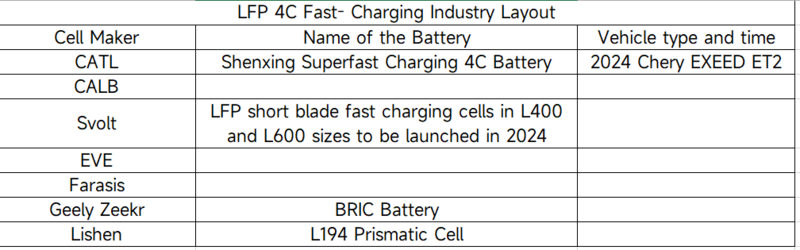
2. Fast charging market map
The development of ternary battery 4C fast charging market is better than lithium iron phosphate battery 4C fast charging. But since lithium iron phosphate material is more cost friendly and safe, its battery 4C fast-charging market, product development, mass production and mounted on the car is also breaking through constantly.
3. Problems: big market and big challenges, 4C fast charging battery power charging station to be improved.
Problems to be solved: the construction of charging stations, which is currently the main obstacle restricting the development of the fast-charging market.
Voltage requirements: 800V high voltage.
At present, enterprises led by Huawei and Geely are laying out super-charging networks in major areas of the country, and gradually expanding under the auspices of technology iteration and capital. However, the investment cost is very high, of which the charging module is one of the core components of the charging pile, which accounts for 40%-50% of the cost of the whole pile of the charging pile.
4. Market forecast: LMFP competition or weaken, LFP battery 4C fast charging proportion to increase.
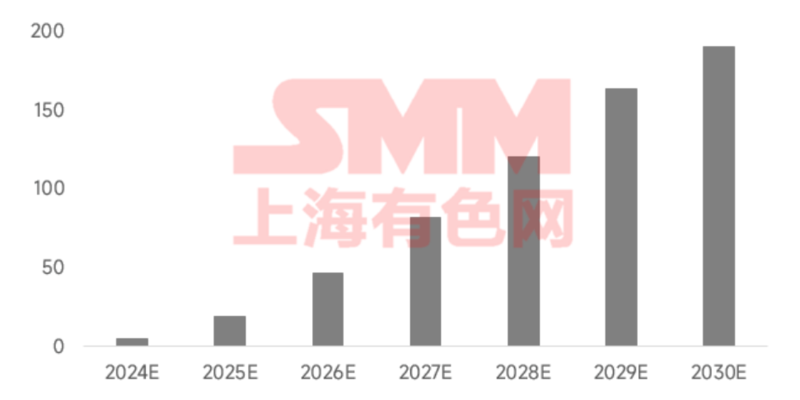
4C or 5C or even (4 + N) C market demand is large, its popularity is greatly affected by the four main materials especially the anode material. 2024 is the first year of LFP 4C fast-charging batteries installed in the car, the future demand for the annual compound growth rate of more than 50%.
Below if the demand forecast for fast-charging LFP fast-charging materials in 10k tons:
For more information, please contact cathycai@smm.cn
![[SMM Analysis] Les prix du LCO ont continué de baisser au T3 ; le repli devrait s'atténuer au T4, un creux et une reprise étant attendus en 2027](https://imgqn.smm.cn/usercenter/hoPFT20251217171727.jpg)
![[SMM Analysis] Progrès technologiques plus lents dans les batteries au lithium grand public ; les changements de matériaux se normalisent, les politiques de sécurité se durcissent](https://imgqn.smm.cn/usercenter/MyEcZ20251217171727.jpg)
![[SMM Analysis] Le marché des batteries au lithium grand public diverge ; l'oxyde de lithium-cobalt haut de gamme et les lunettes IA émergent](https://imgqn.smm.cn/usercenter/QBuyW20251217171726.jpg)