SMM October 14 news:
In the metals market:
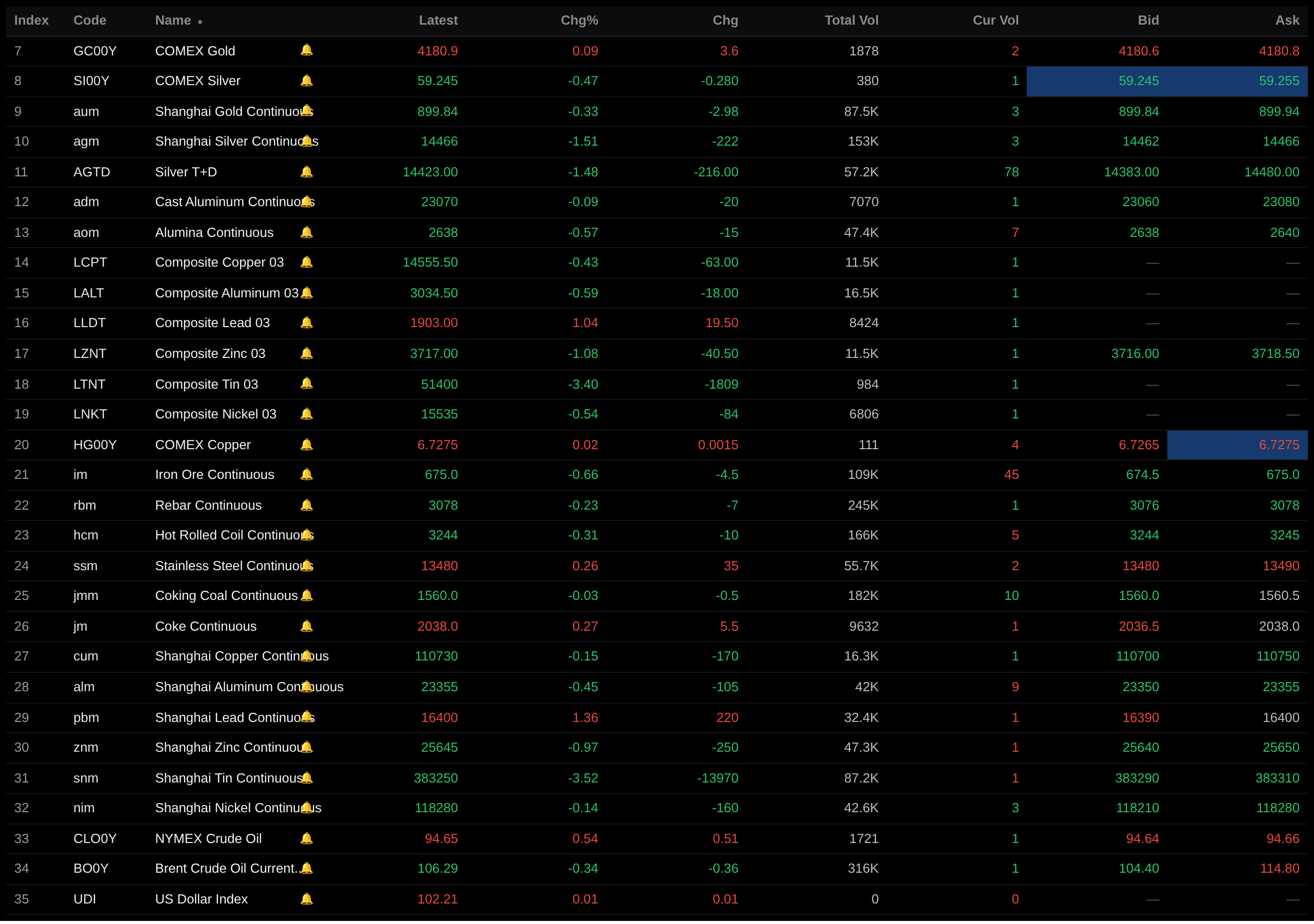
Overnight, base metals in the domestic market mostly fell. SHFE copper fell 0.15%, SHFE aluminum fell 0.45%, and SHFE lead rose 1.36%. SHFE zinc fell 0.97%, and SHFE tin fell 3.52%. SHFE nickel fell 0.14%. In addition, the most-traded alumina futures contract edged down 0.09%, and the most-traded cast aluminum contract fell 0.57%.
Overnight, ferrous metals mostly fell. Stainless steel rose 0.26%. Iron ore fell 0.66%, and rebar fell 0.23%. Hot-rolled coil fell 0.31%. In coking coal and coke: the most-traded coking coal contract fell 0.03%, and the most-traded coke contract rose 0.27%.
Overnight in the overseas metals market, LME base metals were nearly all down. LME copper fell 0.43%, and LME aluminum fell 0.59%. LME lead rose 1.04%. LME zinc fell 1.08%. LME tin fell 3.4%. LME nickel fell 0.54%.
Overnight in the precious metals market: COMEX gold fell 0.15%, and COMEX silver fell 1.85%. Overnight, the most-traded SHFE gold contract fell 0.33%, and the most-traded SHFE silver contract fell 1.51%.
As of 7:24 on October 14, overnight closing prices:
Macro front
Domestic news:
[Three departments: By 2028, inland waterway new energy vessel ownership to double from 2025] The Ministry of Transport and two other departments issued the Notice on Printing and Distributing the Action Plan for Promoting the Application of New Energy Vessels in Inland Waterways (2026-2030). By 2028, inland waterway new energy vessel ownership will double from 2025, with electric transport vessels exceeding 1,000, methanol-powered vessels exceeding 100, and the number of electric official vessels and port operation vessels increasing significantly, achieving initial full-scenario demonstration applications. Methanol bunkering service capacity along the Yangtze River main line will achieve full coverage, and ship charging and battery swapping facilities in the Yangtze River Delta water network area will basically form a network. Green shipping corridors along the Yangtze River and Xijiang River main shipping lines and the Beijing-Hangzhou Grand Canal, as well as pilot areas for vessel electrification such as the Yangtze River Delta, will be basically completed, forming a total of 3,000 kilometers of zero-carbon waterway transport corridors. (Jin10 Data APP)
[National Energy Administration conducts survey on power supply guarantee for the Fifth Plenary Session of the 20th CPC Central Committee] On October 10, the National Energy Administration conducted a survey in Beijing on power supply guarantee for the Fifth Plenary Session of the 20th CPC Central Committee, led by Regulatory Director Liang Changxin. The survey team visited relevant key power supply guarantee sites to inspect power equipment operation and emergency equipment conditions on site. The survey team stressed that all relevant units should raise their political awareness, tighten and consolidate power supply guarantee responsibilities, and firmly establish bottom-line thinking; implement detailed power supply guarantee prevention and control measures, improve power supply plans and emergency plans for important venues, and strengthen work safety and cybersecurity protection; strictly enforce duty and watch arrangements, promptly report and handle emergencies, and make every effort to ensure reliable power supply during the plenary session. (National Energy Administration)
[China Chamber of Commerce for Import and Export of Machinery and Electronic Products: Fully supports and highly appreciates the positive outcomes achieved in this consultation]Recently, the second regular meeting of the China-EU trade and investment consultation mechanism was successfully held in Beijing. The two sides conducted reciprocal, professional, and constructive talks on multiple topics and reached a number of consensus outcomes. The China Chamber of Commerce for Import and Export of Machinery and Electronic Products expresses full support and high appreciation for the positive outcomes achieved in this consultation. The Chamber particularly noted that the two sides reached important consensus in the field of automobile trade. The Chamber is deeply encouraged by this. On hybrid vehicles, the two sides, guided by the principles of mutual respect and equal consultation, reached an understanding on trade arrangements, fully accommodating the reasonable concerns of both industries based on current realities. This arrangement provides a stable, predictable, and sustainable trade environment for the industrial sectors on both sides, averts an escalation of trade frictions, safeguards the practical interests of Chinese enterprises, and lays a solid foundation for the healthy and stable development of China-EU hybrid vehicle trade. On EVs, the two sides reviewed the general guidance document on price undertakings in the anti-subsidy case, and both sides will continue to advance the relevant procedures for enterprise price undertakings and reviews. This outcome is also of positive value, helping Chinese enterprises actively pursue their legitimate rights and interests in exports to Europe. (Jin10 Data APP)
US dollar:
The overnight US dollar index fell 0.37% to 102.2. Market attention is now locked on the September CPI data to be released on Wednesday, which is expected to serve as an important guide for the US Fed's rate path.
US Fed officials sent conflicting signals on Tuesday, and the market experienced repeated shifts in rate hike expectations. Chicago Fed President Austan Goolsbee said that if inflation returns to the 2% target and employment remains at full levels, rates could be lowered, but he also warned that a rise in services inflation and AI demand running off track and overheating other sectors of the economy would make the path more difficult to discern. Richmond Fed President Thomas Barkin also said the US Fed "can see the impact of AI investment on US inflation." Meanwhile,John Williams' subsequent dovish remarks tempered market bets somewhat, as he made clear that he does not see a need for further rate hikes before 2027. (Wall Street CN)
US Fed Governor Waller said the surge in long-term US Treasury yields is dampening demand in interest rate-sensitive sectors such as housing and automobiles, playing a role in tightening monetary policy to some extent. Speaking at the New Economy Forum in New Delhi on Tuesday, Waller said: "Will rising yields affect housing, automobiles, and other interest rate-sensitive sectors?"Of course," he noted that while this was not the US Fed's intention, rising yields have indeed "played a somewhat restrictive policy role." Waller hinted last week that the Fed may still need to raise rates further to curb inflation, but he added that officials still have some flexibility on timing when considering the next hike. Economists expect inflation data released on Wednesday to show that US headline inflation accelerated in September, driven by higher energy costs from the US-Iran war, while core inflation is expected to slow down. (Jin10 Data APP)
On the data front: According to Wall Street CN, US existing home sales in September came in at a seasonally adjusted annual rate of 3.99 million units, up 1.5% MoM, beating market expectations of 3.95 million units and marking the first rebound in four months.
In addition, the US small business confidence index edged down again in September. Previously, Fed rate hikes pushed up borrowing costs and dampened corporate borrowing. The National Federation of Independent Business (NFIB) said the Small Business Optimism Index fell 0.8 points to 97.9 in September, slightly below the 52-year average. NFIB Chief Economist Bill Dunkelberg said, "Small business owners are taking a cautious approach, assessing the impact of rising costs, higher interest rates, and difficulty finding qualified workers on their businesses." The NFIB survey showed that actual sales conditions deteriorated further. On a seasonally adjusted basis, the net share of business owners reporting higher nominal sales over the past three months was negative 8%. About 26% of small business owners cited labor quality or labor supply as their top issue; 20% cited inflation as their top issue. (Jin10 Data APP)
On the data front:
Today will see the release of China's September CPI YoY, US September unadjusted CPI YoY, US September seasonally adjusted CPI MoM, US September seasonally adjusted core CPI MoM, US September unadjusted core CPI YoY, and China's September trade balance (TBD), among other data.
In addition, attention should be paid to: 2027 FOMC voting member and Richmond Fed President Barkin speaking; 2028 FOMC voting member and Boston Fed President Collins speaking; ECB President Lagarde attending a dialogue event hosted by CNN; ASML releasing Q3 earnings; Bank of Canada Governor Macklem participating in a fireside chat at the Institute of International Finance (IIF) Annual Membership Meeting in Bangkok; ECB President Lagarde speaking on Europe's digital future; and Fed Governor Bowman speaking.
On the crude oil front:
Overnight, the two major oil futures diverged, with WTI crude up 1.12% and Brent crude down 0.34%. Multiple geopolitical risks combined to support oil prices.
Oil prices experienced wild swings this Tuesday, lacking a single catalyst as multiple forces took turns dominating. Overnight, the market briefly held hopes for a Russia-Ukraine energy ceasefire, driving oil prices to pull back. However, the Russia-Ukraine conflict reignited, shattering ceasefire expectations, and diesel prices rose in response. On the demand side, OPEC sharply lowered its 2026 oil demand growth forecast from 1.4 million barrels per day at the start of the year to around 400,000 barrels per day, and Saudi Arabia also made statements about potential export capacity expansion, factors that weighed on oil prices for a time. But ultimately, the escalating geopolitical conflict dominated price movements. The market is also watching the evolution of the Middle East conflict. (Wallstreetcn)
Despite escalating attacks on oil tankers, Middle East oil supply has shown strong resilience, but soaring shipping and insurance costs are driving significant divergence in crude oil prices across different regions. Goldman Sachs estimates that the average global crude transportation cost has climbed from $4 per barrel a year ago to $30, while freight rates on Middle East routes have risen to $35 per barrel. Goldman Sachs analysts said: "Although Red Sea attacks have led to increased vessel rerouting and the Iranian fleet has been blockaded, factors that have tightened the shipping market, we believe ship-to-ship transfers are the main factor driving freight rates higher." Meanwhile, rising transportation and insurance costs for transiting the Strait of Hormuz have further widened the price spread between crude grades loaded at different locations. Goldman Sachs data shows that Murban crude loaded at Fujairah port outside the Strait of Hormuz has seen its premium over Basrah crude loaded inside the Persian Gulf surge from $2 per barrel in February to $43. Rising transportation costs are prompting refiners to favor crude grades sourced closer to their destinations to avoid paying high long-distance freight charges. This shift has further widened regional crude price spreads, especially in the physical crude market. Goldman Sachs data shows that Dated Brent, the benchmark for physical crude trading, currently commands a premium of $40 per barrel over comparable US WTI crude and $24 per barrel over Dubai crude. (Jin10 Data APP)
![The most-traded SHFE tin SN2611 contract fell 3.52% overnight, breaking below 380,000 yuan, while LME tin dropped 2.71% to $51,767, pressured by both macro and AI sector sentiment [SMM Tin Morning Meeting Summary]](https://imgqn.smm.cn/usercenter/SkvFp20251217171752.jpg)
![SHFE lead remains strong & spot cargo supply is tight, lead prices consolidate on a strong note [SMM Lead Morning Meeting Summary]](https://imgqn.smm.cn/usercenter/rDPju20251217171722.jpg)