Analysis of Downstream Holiday Schedules and Order Conditions
I. Conclusion
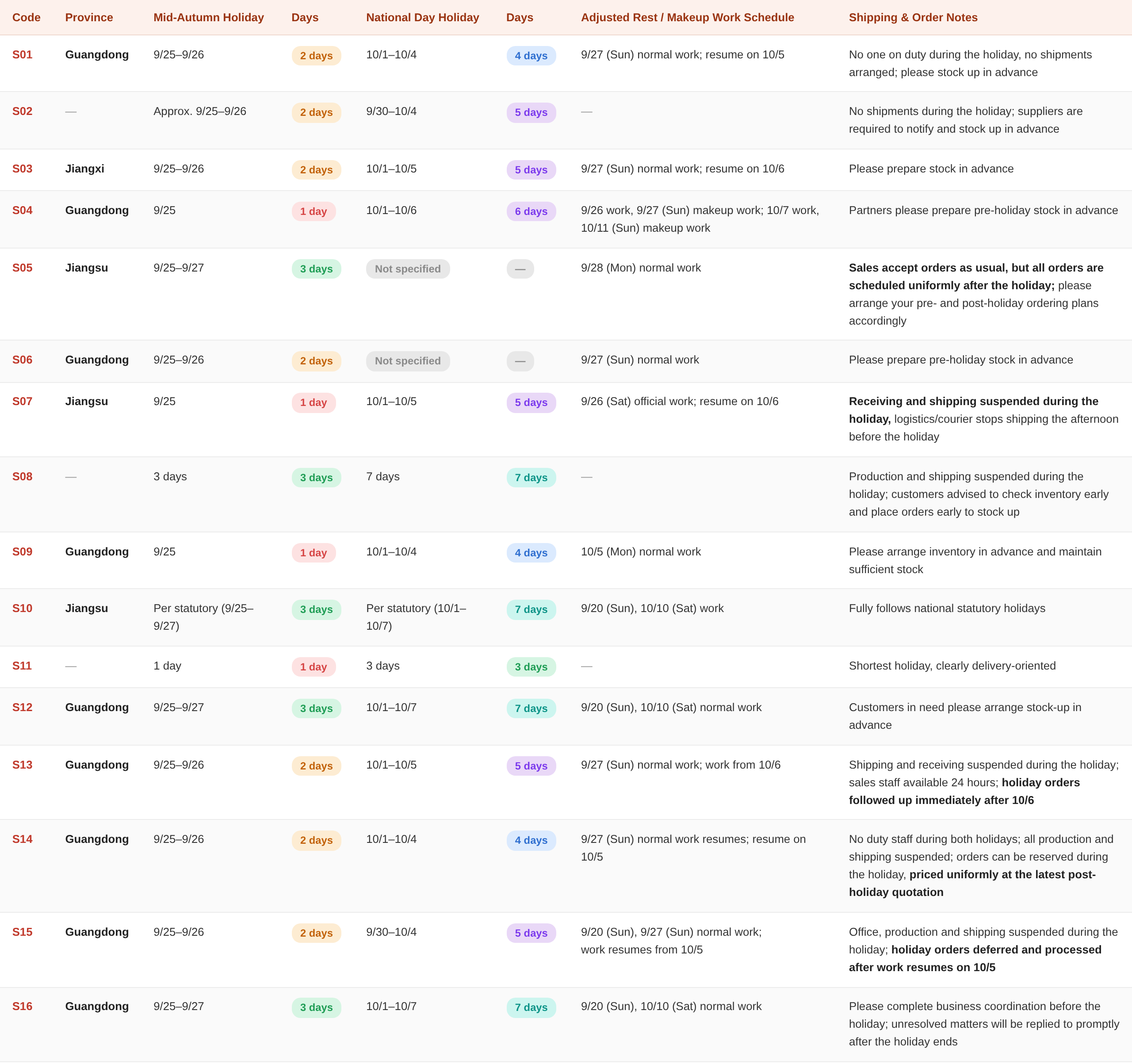
From the cross-examination of enterprise notices and industry conditions, the downstream market during this year's double holiday period presents one distinct characteristic: holiday arrangements are not particularly long, but order quality is notably weak.
Notices from the node side are dominated by phrases such as "no shipments during the holiday," "please stockpile in advance," and "unified arrangements after the holiday," indicating that the supply chain is proactively shifting inventory pressure toward the client side. Approximately 30% of solder enterprises reported order growth of only 3%–10%, and "the growth rate is not significantly higher than the traditional September-October peak season increase," with most enterprises seeing stable orders and no notable changes. In other words, the peak season itself was already subdued, and the holiday merely extended this mediocrity further.
II. Downstream Holiday Schedules
In terms of holiday arrangements for downstream enterprises, industry distribution differences are greater than regional differences. SMM historical data shows that downstream solder enterprises generally have a 5–6 day National Day holiday, while terminal electronics assembly and home appliance enterprises have longer holidays, with some reaching 7 days; by comparison, smelters have higher production continuity and shorter holiday periods. This is precisely the basis for the node-side statement that "make-up workday nodes will still ship normally"—such nodes are typically smelting or deep processing stages, serving as the only buffer position throughout the entire holiday.
Combining node notices with industry practices, the downstream holiday pace during the double holiday period can be summarized into three phases:
Mid-to-late September, the pre-holiday stockpiling period. Downstream enterprises place concentrated orders and hoard general-purpose materials, and nodes can still maintain normal shipments during this phase, but will gradually tighten order cutoff times as the holiday approaches. This is the most concentrated phase of downstream-node bargaining—downstream hopes to keep inventory low, while nodes hope to lock in volume in advance.
Late September to early October, the work stoppage vacuum period. Nominal stagnation lasts about 13 days; after deducting make-up workdays and the pre-holiday order cutoff period, the effective shipping vacuum is approximately 9–10 days. The most easily overlooked part is the last few days of September: most downstream enterprises have already ended their holiday, but nodes no longer accept rush orders, and clients tend to misjudge this as "shipping is already possible," when in reality departures generally have to wait until after the holiday.
Mid-to-late October, the post-holiday recovery period. After downstream operations resume, orders flood in concentratedly, and nodes schedule production by order size, with delivery dates for small and medium clients being pushed back as the norm. Demand during this phase is often a combination of two parts—genuine incremental orders, plus the portion that was overdrawn by pre-holiday stockpiling in September.
Regionally, SMM observes that trading sentiment among solder enterprises in south China is better than in east China. East China is more oriented toward consumer electronics and white goods, with the underperformance in peak season being more pronounced. The majority of the notices are from Guangdong, Jiangsu, and Jiangxi, which aligns with this distribution.
III. Order Situation
Order growth is limited, and the peak season has fallen short of expectations. SMM statistics show that the monthly operating rate of solder enterprises in August 2026 was 72.8%, flat MoM, still at a relatively low level for the same period over the past five years. Meanwhile, SMM has learned that this year's "September peak season" has not fully materialized. In the same period of 2026, about 30% of enterprises saw order growth of only 3%–10%, a clear gap from normal peak season levels. This indicates that downstream enterprises are not unwilling to place orders, but rather are generally adopting a strategy of purchasing as needed without stockpiling amid high tin prices.
Demand structure is highly polarized. This is the biggest difference from previous years. Tin consumption per AI server is more than three times that of a traditional server, and advanced packaging and humanoid robots constitute new growth drivers. However, traditional solder and consumer electronics are seeing sluggish growth, and orders from PV welding strip enterprises are notably below expectations. The varying order conditions within the solder industry can no longer be summarized by a single metric—high-end specialty materials are in tight supply, general-purpose materials are mediocre, and PV materials are under pressure.
Inventory is extremely thin, and transmission is rapid. Currently, most solder enterprises hold inventory (including raw materials, semi-finished products, and finished products) at around half a month's level, with some at only 7–10 days. The thinner the inventory, the more easily disruptions caused by holidays are amplified—once demand is released in a concentrated manner after the holiday, delivery lead times will be the first to feel the pressure.
IV. Risk Warning
Price risk is two-sided:Tin prices are at historical highs, with a possibility of pulling back in Q4. Stockpiling volumes need to be tied to sales forecasts to avoid inventory depreciation. However, on the supply side, the full resumption of production at Wa State in Myanmar has been postponed to 2027, Indonesian exports are subject to quota controls, and mining operations in the DRC face safety risks. Any deterioration in these variables could push prices upward.
Rising compliance costs: EU RoHS and REACH regulations continue to tighten, raising compliance costs for lead-containing solder exports. Products involving European clients need to have formulations and certification status confirmed in advance.
![[US Treasury yields break above 5% across the board, coupled with pre-holiday caution; the most-traded SHFE tin contract opens lower then stabilizes with sluggish trading [SMM Tin Midday Review]]](https://imgqn.smm.cn/usercenter/TYKtM20251217171753.jpg)
![[SMM Analysis] Myanmar Ore Shipment Recovery Lifts August Raw Material Supply; Tin Metal Stays in Net-Import Territory](https://imgqn.smm.cn/usercenter/qWcEp20251217171751.jpeg)
![[SMM Analysis] Indonesia Issues New OJK Rules for BMKS, Laying Legal Basis for Domestic Commodity Price Formation](https://imgqn.smm.cn/usercenter/BBJUa20251217171751.jpg)