Overall pattern
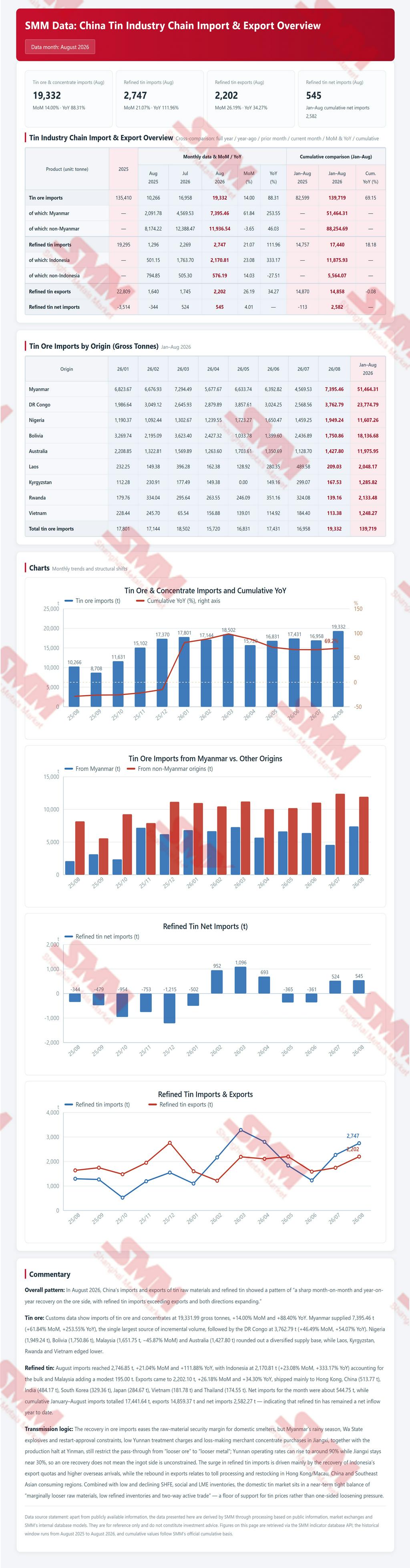
In August 2026, China's imports and exports of tin raw materials and refined tin showed an overall pattern of "a sharp month-on-month and year-on-year recovery on the ore side, with refined tin imports exceeding exports and both directions expanding."
Tin ore
Customs data show that imports of tin ore and concentrates reached 19,331.99 gross tonnes, up 14.00% MoM and 88.40% YoY. Of this, Myanmar supplied 7,395.46 t (+61.84% MoM, +253.55% YoY), the largest source of incremental volume, followed by the DR Congo at 3,762.79 t (+46.49% MoM, +54.07% YoY). Nigeria (1,949.24 t), Bolivia (1,750.86 t), Malaysia (1,651.75 t, −45.87% MoM), Australia (1,427.80 t) and others supplemented a diversified supply base, while Laos, Kyrgyzstan, Rwanda and Vietnam edged lower. Overall, the strong YoY growth reflects both the recovery of shipments from Myanmar's Wa State and improved logistics in the DR Congo, as well as the low base of the same period last year. However, on a gross-tonne basis the volumes still need to be converted into contained metal tonnes according to the grade of each ore, so they cannot be taken as equivalent to an increase in smelter output.
Refined tin
On the refined tin side, August imports reached 2,746.85 t, +21.04% MoM and +111.88% YoY, with Indonesia at 2,170.81 t (+23.08% MoM, +333.17% YoY) accounting for the bulk of imports and Malaysia adding a modest 195.00 t. Exports came to 2,202.10 t, +26.18% MoM and +34.30% YoY, shipped mainly to Hong Kong, China (513.77 t), India (484.17 t), South Korea (329.36 t), Japan (284.67 t), Vietnam (181.78 t) and Thailand (174.55 t). Net imports for the month were approximately 544.75 t, while cumulative January–August imports totalled 17,441.64 t, exports 14,859.37 t and net imports 2,582.27 t — indicating that refined tin has remained a net inflow year to date.
Transmission logic
The recovery in ore imports eases the raw-material security margin for domestic smelters. However, Myanmar's rainy season, Wa State's explosives and restart-approval constraints, low Yunnan treatment charges and losses on merchant concentrate purchases in Jiangxi still restrict the transmission from "looser ore" to "looser metal." Yunnan operating rates can rise to around 90%, while Jiangxi remains at a low level of about 30% — so a recovery in ore volumes does not mean the ingot side is unconstrained. The surge in refined tin imports is mainly driven by Indonesian exports and higher overseas arrivals, while the rebound in exports is linked to toll processing and restocking in Hong Kong/Macau, China and Southeast Asian consuming regions. Combined with low and declining SHFE, social and LME inventories, the domestic tin market is in a short-term tight balance characterized by "marginally looser raw materials, low refined inventories and active two-way import and export trade" — providing underlying support for tin prices rather than one-sided loosening pressure.
![[SMM Analysis] Indonesia Issues New OJK Rules for BMKS, Laying Legal Basis for Domestic Commodity Price Formation](https://imgqn.smm.cn/usercenter/BBJUa20251217171751.jpg)
![[SMM Analysis] Indonesia Issues New OJK Regulations on BMKS/Icomex: Legal Framework for Strategic Mineral Exchange Takes Shape, Accelerating China's Pricing System Development](https://imgqn.smm.cn/usercenter/reOma20251217171751.jpg)
![After the rate hike, macro pressure was released, and the most-traded SHFE tin SN2610 contract consolidated above 410,000 yuan/mt [SMM Tin Morning News]](https://imgqn.smm.cn/usercenter/sRGMJ20251217171752.jpg)