BMKS, or Bursa Mineral dan Komoditas Strategis, is the formal legal term used in Indonesia’s newly issued OJK regulations for the country's planned Mineral and Strategic Commodity Exchange. In public discussion, the same exchange initiative is also commonly referred to as Icomex, or the Indonesia Commodity Exchange. Therefore, this article uses BMKS/Icomex to refer to the same planned exchange framework, while noting that BMKS is the official regulatory term used in POJK No. 15/2026 and POJK No. 16/2026. OJK's own regulation and press release use the term BMKS, while Indonesian media and market discussion often describe BMKS as Indonesia Commodity Exchange, or Icomex.
POJK refers to Peraturan Otoritas Jasa Keuangan, or an OJK Regulation issued by Indonesia's Financial Services Authority. OJK is Indonesia's financial-sector regulator, broadly comparable to a financial market supervisory authority. In this case, the POJKs are formal regulations that create the legal and operational basis for BMKS/Icomex.
BMKS/Icomex can be understood as Indonesia's planned regulated marketplace for strategic minerals and commodities. Unlike ordinary bilateral physical trading, it is designed to integrate trading, clearing, settlement, electronic proof of ownership, quality verification, risk management, and price formation into one supervised ecosystem. This is why the two POJKs matter: POJK No. 15/2026 defines the transfer of supervisory authority from Bappebti to OJK, while POJK No. 16/2026 sets the rules for how BMKS/Icomex will operate.
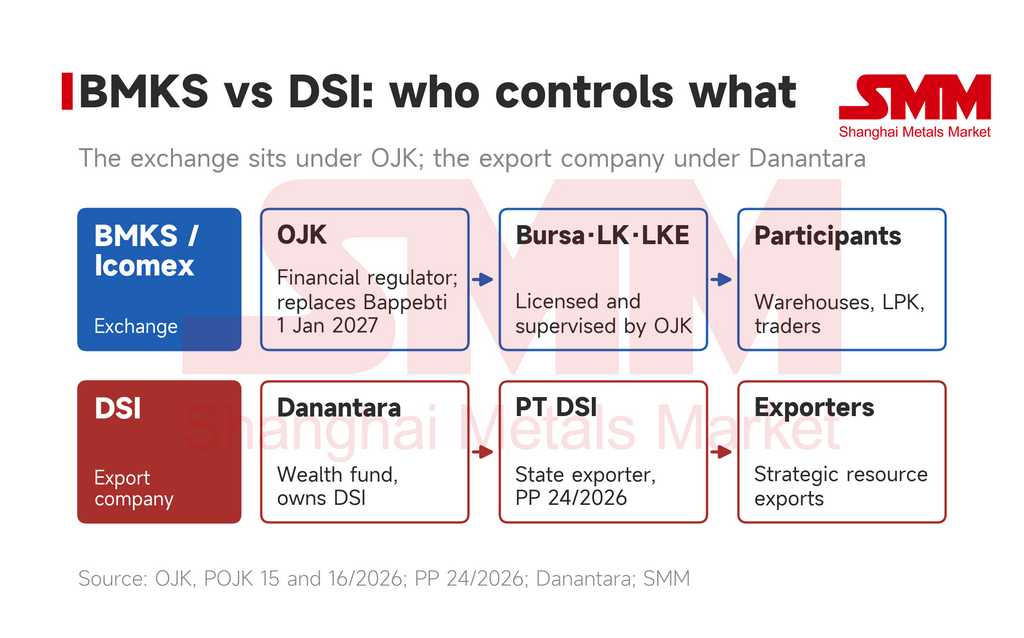
This should also be distinguished from the previously discussed DSI export digitalisation system. DSI is more related to export administration and government monitoring, covering items such as export documents, shipment data, contract information, prices, grades, destination, and export proceeds. BMKS/Icomex has a different function: it is not only a reporting or monitoring system, but a regulated exchange infrastructure where eligible commodities may be traded, priced, cleared, settled, and potentially used to form an official Indonesia Reference Price.
In simple terms, DSI focuses on export-flow supervision, while BMKS/Icomex focuses on transaction infrastructure and price discovery. DSI helps the government monitor what is exported and under what commercial terms; BMKS/Icomex is designed to create a more formal market mechanism for strategic commodities, supported by quality checks, electronic ownership records, clearing, settlement, and market surveillance.
Indonesia's Financial Services Authority has issued two new regulations on BMKS/Icomex, marking a key step toward the launch of Indonesia’s strategic mineral and commodity exchange framework. The two regulations are POJK No. 15 Tahun 2026, which regulates the phased transfer of BMKS supervision from Bappebti to OJK, and POJK No. 16 Tahun 2026, which regulates the operation and governance of BMKS itself. OJK's press release confirmed that both regulations were issued as part of the mandate under the amended Financial Sector Development and Strengthening Law, or UU P2SK, which gives OJK the authority to regulate and supervise BMKS transactions.
From SMM's perspective, the issuance of these two POJKs shows that Indonesia is moving from policy planning to institutional implementation in its strategic commodity governance framework. BMKS/Icomex is not only a new exchange platform, but also a potential mechanism to improve transaction transparency, strengthen domestic price discovery, create an Indonesia-based reference price, and increase state supervision over strategic mineral and commodity flows.
Regulatory Timeline
September 17, 2026 — POJK No. 15/2026 becomes effective
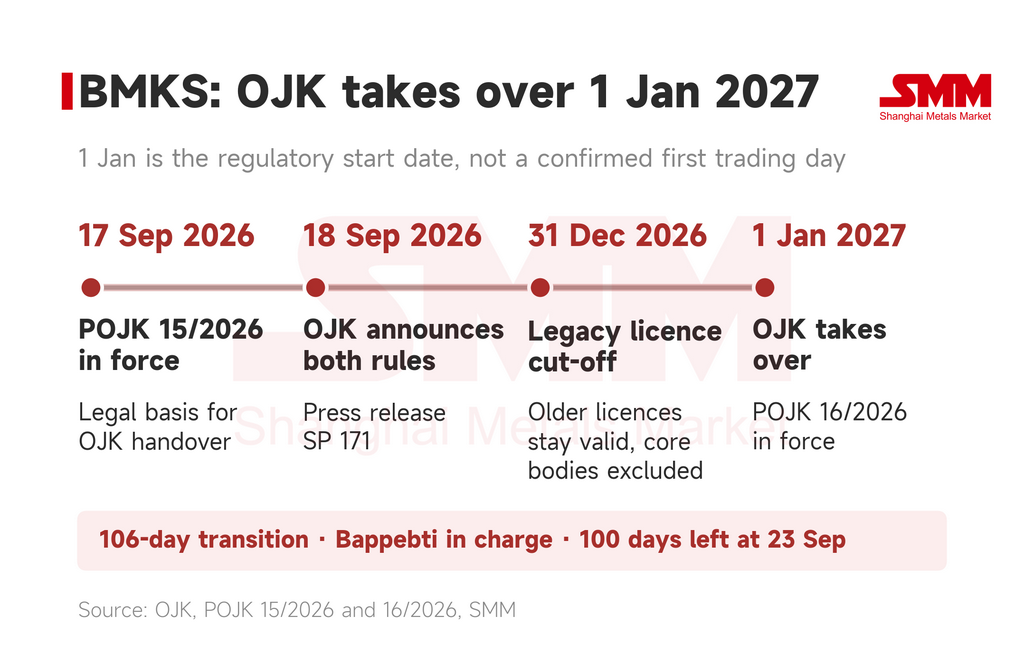
POJK No. 15/2026 was established on September 17, 2026 and regulates the phased transfer of regulatory and supervisory authority over BMKS transactions from Bappebti to OJK. The regulation states that OJK will carry out BMKS regulatory and supervisory duties starting January 1, 2027, while POJK No. 15/2026 itself became effective on September 17, 2026.
September 18, 2026 — OJK announces two BMKS POJKs
OJK announced the issuance of the two BMKS-related POJKs on September 18, 2026 through press release SP 171/DKPU/OJK/IX/2026. The press release stated that POJK No. 15/2026 concerns the phased transfer of BMKS supervision from Bappebti to OJK, while POJK No. 16/2026 concerns the organization and operation of BMKS.
January 1, 2027 — OJK supervision starts and POJK No. 16/2026 becomes effective
The transfer of BMKS regulatory and supervisory authority from Bappebti to OJK will begin when BMKS operates on January 1, 2027. OJK’s press release also states that POJK No. 16/2026 will become effective on January 1, 2027.
What Is BMKS/Icomex?
Under POJK No. 16/2026, BMKS is defined as an organized and integrated market system for the trading of strategic minerals and strategic commodities, including their derivatives. It is supported by a financing ecosystem, digital-based financial instruments, price mechanisms, quality mechanisms, transaction settlement, and risk management.
The regulation defines Mineral Strategis as minerals with high economic value and/or strategic importance for defense industry and national interest, including primary, secondary, and tertiary sources controlled by the state for the prosperity of the people. Komoditas Strategis refers to commodities with high economic value and/or strategic importance for national interest.
In short, BMKS/Icomex is designed as a regulated exchange ecosystem for strategic commodities, but the POJKs do not yet specify which commodities will be included first. This remains one of the most important implementation details to monitor.
-
Key Point 1: POJK No. 15/2026 Transfers BMKS Supervision from Bappebti to OJK
POJK No. 15/2026 mainly handles the transition of authority. It gives OJK the legal basis to regulate and supervise BMKS transactions and states that OJK’s BMKS authority will start from January 1, 2027.
The transition is designed to avoid regulatory gaps. The regulation allows OJK to coordinate with Bappebti during the preparation period, including identifying transaction data, transaction mechanisms, market participants, activities, and infrastructure; mapping and reviewing BMKS-related licenses and regulations; evaluating business actors’ readiness; preparing resources; and receiving relevant documents and data.
The regulation also states that licensing, approval, and registration processes related to BMKS that are still being processed at Bappebti will be continued by OJK once the supervisory authority shifts. Existing BMKS-related licenses issued under commodity futures regulations until December 31, 2026 will remain valid, except for certain core BMKS institutions such as the exchange operator, clearing and guarantee institution, electronic custodian institution, and conformity assessment institution.
For market participants, the key message is that BMKS/Icomex will be moved into an OJK-supervised framework, closer to financial-market regulation and risk-management standards.
-
Key Point 2: POJK No. 16/2026 Creates the Full Operational Framework for BMKS
POJK No. 16/2026 is the more detailed operational regulation. It covers the structure of BMKS, market participants, trading procedures, transaction settlement, risk management, user protection, market integrity, product development, digital financial instruments, derivatives, and OJK supervision.
The BMKS ecosystem consists of several entities: the Bursa, clearing institution (LK), electronic custodian institution (LKE), exchange members, warehouse managers, conformity assessment institutions (LPK), and supporting professions. OJK directly supervises the Bursa, LK, LKE, and trading intermediaries, while the Bursa supervises service users, warehouse managers, LPK, and other approved parties.
BMKS integrates multiple functions, including trading, clearing, settlement guarantee, transaction settlement, electronic ownership proof management, risk management, price mechanism, quality mechanism, digital-based financial instruments, financing ecosystem, and other supporting infrastructure.
This means BMKS/Icomex is designed as a full commodity-market infrastructure, not merely a trading screen.
Market Infrastructure: Bursa, LK, LKE, Warehouse and LPK
The regulation sets strict institutional requirements for the BMKS ecosystem.
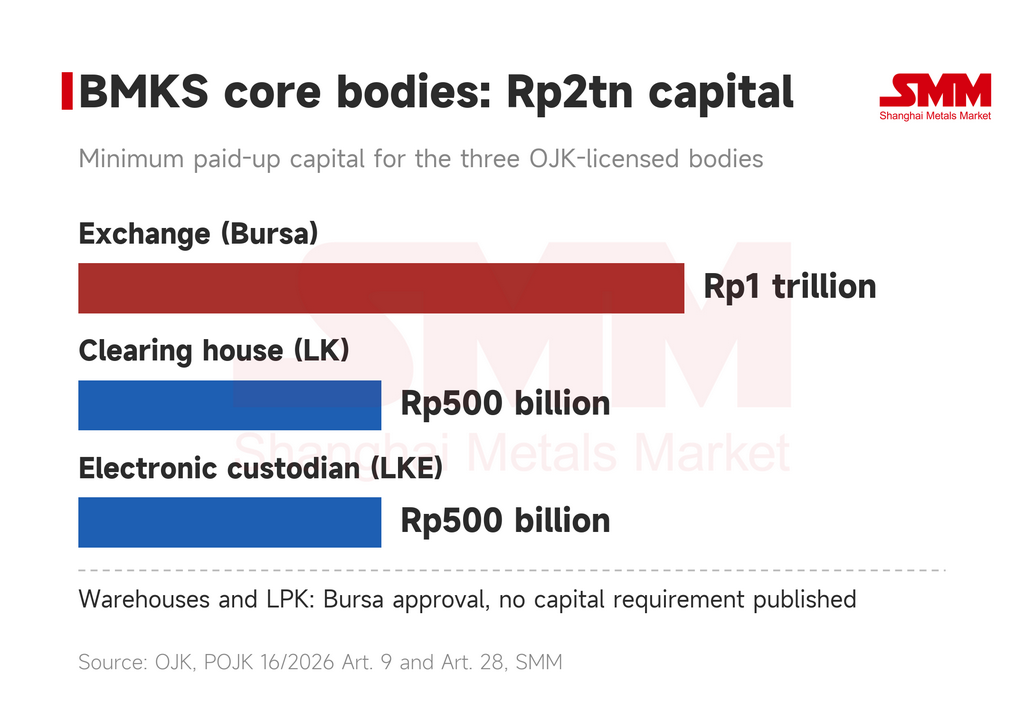
The Bursa must obtain an OJK license and is responsible for organizing BMKS trading, operating the trading system, setting exchange rules, supervising trading participants, ensuring physical and warehouse data availability, and carrying out other functions determined by OJK. The Bursa must also have at least Rp1 trillion in paid-up capital.
The LK, or clearing institution, handles clearing, settlement guarantee, and transaction settlement. It must obtain an OJK license and have at least Rp500 billion in paid-up capital.
The LKE, or electronic custodian institution, handles electronic recording, storage, security, and administration of BMKS transactions. It must also obtain an OJK license and have at least Rp500 billion in paid-up capital.
The warehouse manager must obtain approval from the Bursa and is responsible for verifying, storing, and physically delivering strategic minerals and commodities under its control. The regulation makes clear that the warehouse manager’s responsibility does not transfer to the Bursa or OJK.
The LPK, or conformity assessment institution, is responsible for checking the quality and quantity of strategic minerals and commodities traded through BMKS. It must obtain approval from the Bursa and is responsible for quality and quantity conformity checks according to applicable standards and exchange rules.
How BMKS Transactions Will Work
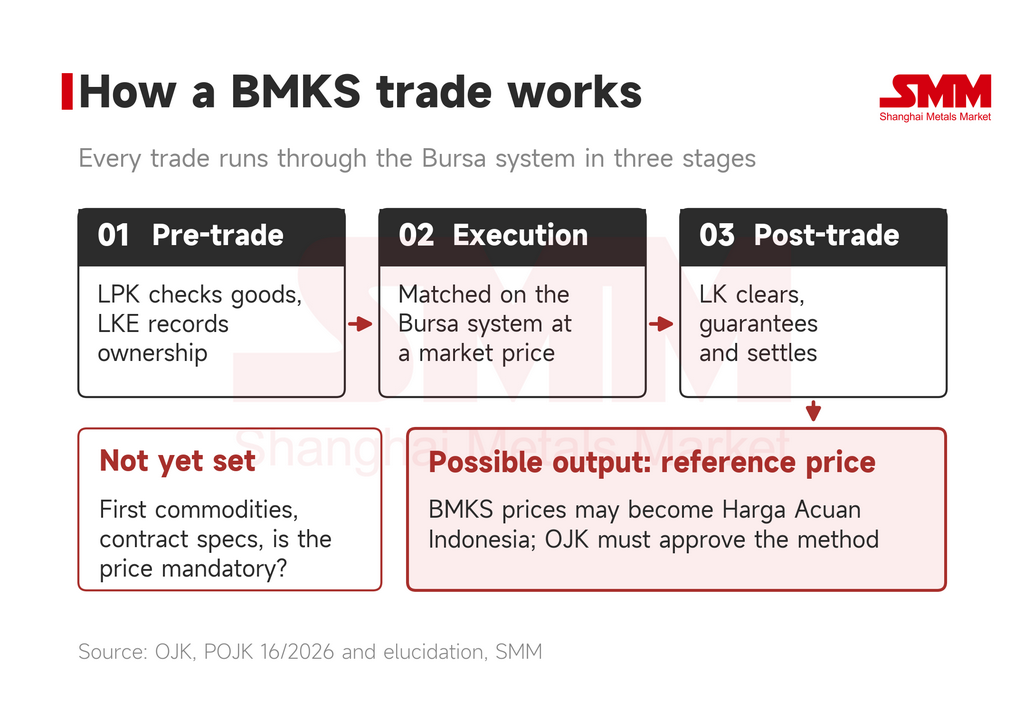
POJK No. 16/2026 divides BMKS transactions into three stages: pre-trade, trade execution, and post-trade. All transactions must be carried out through the Bursa trading system integrated with BMKS infrastructure and must meet principles of orderliness, fairness, transparency, efficiency, settlement certainty, market integrity, and risk management.
In the pre-trade stage, strategic minerals and commodities can only be traded after obtaining tradable status from the LPK. This status is based on quality inspection, quantity verification, storage in a Bursa-approved warehouse, administrative compliance, and other exchange-rule requirements.
After the commodity meets the requirements, the LKE issues Bukti Kepemilikan Elektronik, or electronic proof of ownership.
In the trade execution stage, transactions are conducted through order input into the Bursa trading system, either directly by service users or through trading intermediaries. Prices are formed by market mechanisms in an orderly, fair, transparent, and efficient manner.
In the post-trade stage, settlement is conducted through the LK under principles of legal certainty, security, and efficiency. The LK must also have mechanisms to handle settlement failure.
Price Formation: BMKS Could Create an Indonesia Reference Price
One of the most important points for commodity markets is that BMKS transaction prices may be used as Harga Acuan Indonesia, or Indonesia Reference Price. The Bursa must prepare the methodology for forming this reference price based on fair, transparent, and high-integrity transactions, and the methodology must obtain OJK approval.
The explanatory section clarifies that the reference-price methodology may cover data sources, transaction criteria, data collection and validation methods, calculation methods, observation period, handling of unavailable or unusable data, and methodology review mechanisms. It also states that the methodology is intended to ensure that the resulting price reflects relevant market conditions, is reliable, and is not influenced by specific interests.
For SMM, this is one of the most important policy signals. If BMKS/Icomex gains sufficient liquidity, the exchange could eventually become a formal domestic pricing reference for strategic minerals and commodities. For nickel, coal, bauxite, tin, or other strategic commodities, this could gradually affect how domestic pricing, reporting, and transaction benchmarks are formed.
Market Integrity and Supervision
POJK No. 16/2026 gives significant weight to market integrity. Bursa is required to supervise all BMKS transactions continuously. If indications of violation are found, Bursa must take action according to exchange rules and report to OJK. The regulation prohibits actions that create artificial, misleading, or non-market-reflective trading conditions, prices, or transaction volumes. Bursa must also have mechanisms to detect, prevent, and handle market manipulation and irregular trading practices.
OJK may order the Bursa to suspend trading, restrict trading, adjust trading parameters, or take other necessary actions under certain conditions.
The explanation further states that irregular market conditions may include disruptions in the underlying physical market, such as scarcity or supply disruption, limited storage capacity, delivery-location disruption, or material changes in commodity quality and availability that could affect physical delivery.
This is important because BMKS/Icomex is not purely financial. It is closely tied to physical commodity availability, storage, logistics, quality, and delivery.
Product Development: Derivatives and Digital-Based Instruments Are Included
BMKS is also designed to support future product development. The Bursa may develop products, services, and trading mechanisms with OJK approval, with the aim of improving efficiency, liquidity, market integrity, and competitiveness.
The regulation also allows the Bursa to trade digital-based financial instruments representing rights over strategic minerals and commodities, provided the instruments are backed by verifiable underlying assets recorded in the Bursa system.
In addition, BMKS may support derivatives trading on strategic minerals and commodities, subject to risk management, clearing, settlement, transaction supervision, and contract regulation.
This suggests that BMKS/Icomex could start from physical or spot-linked transactions but may eventually develop into a broader commodity-finance ecosystem.
Compliance, Risk Management and User Protection
The regulation requires BMKS operators to apply effective, integrated, continuous, sound, and integrity-based risk management. Bursa, LK, LKE, warehouse managers, and LPK must also apply IT risk management, business continuity plans, disaster recovery centers, and periodic system-resilience testing.
BMKS operators must also prioritize user protection and market integrity. User protection includes clear and non-misleading information, fair treatment, protection of user data and information, complaint handling, and dispute resolution.
OJK also has broad supervisory powers, including requesting data, documents, explanations, system access, and other actions under applicable laws. Bursa, LK, and LKE must provide OJK data access according to OJK's authority.
Market Implications
For Indonesia's mineral and commodity markets, BMKS/Icomex could become a major step toward more transparent and supervised transaction governance. If implemented successfully, it may help reduce information asymmetry, improve transaction records, support reference-price formation, and strengthen monitoring over strategic commodity flows.
For the nickel market, the main question is whether nickel ore, NPI, ferronickel, MHP, or other nickel-related products will be included in BMKS/Icomex in the early stage. The current POJKs provide the market infrastructure, but they do not yet specify the first batch of commodities. If nickel products are eventually included, market participants may face stricter quality verification, warehouse requirements, electronic ownership documentation, trading-system reporting, and reference-price methodology.
For the coal market, BMKS/Icomex could become relevant if coal is included as a strategic commodity. Indonesia already has several coal price benchmarks, including HBA and ICI-related market references. BMKS/Icomex could add another regulated transaction-based price-formation layer, depending on commodity inclusion and liquidity.
For bauxite, tin, and other strategic minerals, BMKS/Icomex may support stronger transaction governance and reduce risks such as under-invoicing, opaque bilateral pricing, and weak traceability. However, successful implementation will depend on physical market readiness, storage infrastructure, LPK capacity, warehouse approval, participant onboarding, and whether enough real transactions move into the exchange.
What Still Needs Clarification
Several key points still need to be clarified before the market can assess the full impact:
- Which commodities will be included first. The POJKs establish the framework but do not specify the first batch of minerals or commodities.
- Whether nickel products will be included. The market needs clarity on whether nickel ore, NPI, ferronickel, MHP, or related products will enter BMKS/Icomex.
- How existing physical contracts will be treated. Many commodity transactions in Indonesia are still bilateral or based on long-term supply agreements.
- How warehouse and quality-verification systems will be implemented. Tradable status depends on LPK verification and Bursa-approved warehouses.
- Whether BMKS prices will become mandatory references or supplementary references. The regulation allows BMKS transaction prices to become Harga Acuan Indonesia, but actual implementation will depend on methodology, liquidity, and OJK approval.
- How fast market participants can adapt. Miners, processors, traders, smelters, and industrial buyers may need to adjust internal systems, documentation, compliance processes, and trading workflows.
SMM View
SMM believes the issuance of POJK No. 15/2026 and POJK No. 16/2026 marks a structural step in Indonesia’s strategic commodity governance. The main significance is not only the creation of a new exchange, but the building of a regulated ecosystem for strategic mineral transactions, price formation, quality verification, ownership recording, settlement, and risk management.
In the short term, BMKS/Icomex is unlikely to immediately replace existing physical trading channels. The most important market focus should be the first commodity list, participation rules, quality standards, contract specifications, warehousing arrangements, and whether existing bilateral trading practices will need to be adjusted.
In the medium to long term, BMKS/Icomex could become an important platform for Indonesia to strengthen domestic price discovery, reduce pricing opacity, improve transaction traceability, and capture greater resource value. For nickel and other strategic minerals, BMKS/Icomex could eventually reshape how domestic pricing and transaction reporting are conducted, especially if the exchange gains sufficient liquidity and official reference-price recognition.
Overall, BMKS/Icomex represents Indonesia’s shift toward a more structured, supervised, and exchange-based strategic commodity market. The framework is now clearer, but the real market impact will depend on execution: which commodities enter first, how quickly infrastructure is prepared, and whether market participants are willing and able to trade through the new system.
![[SMM Coal Flash] Indonesia Plans Energy Sector BLU for Coal and Gas Supply](https://imgqn.smm.cn/usercenter/SduBz20251217171716.jpg)
![[SMM Coal Flash] Indonesia Looks to Converting Low-Calorie Coal into Gas and Fuel](https://imgqn.smm.cn/usercenter/aPBtI20251217171717.jpg)
![[SMM Coal Flash] ESDM Approves Bayan Resources’ 2026 RKAB Revision](https://imgqn.smm.cn/usercenter/LSkpO20251217171720.jpg)