BMKS, or Bursa Mineral dan Komoditas Strategis, is the formal legal name used in Indonesia's latest OJK regulations and can be translated as the Mineral and Strategic Commodity Exchange. In public market discussions, the same exchange project is also often referred to as Icomex, or Indonesia Commodity Exchange. Accordingly, this article uses BMKS/Icomex to refer to the same exchange framework, but it should be noted that BMKS is the formal regulatory term in POJK No. 15/2026 and POJK No. 16/2026. OJK official documents and press releases use the name BMKS, while Indonesian market and media discussions often refer to it as the Indonesia Commodity Exchange or Icomex.
POJK refers to Peraturan Otoritas Jasa Keuangan, namely the Indonesian Financial Services Authority Regulation, issued by the Indonesian Financial Services Authority (OJK). OJK is Indonesia's financial sector regulatory agency and can be understood as the official body responsible for financial market regulation and supervision. These two POJK are not ordinary commodity market news, but formal regulations that establish the legal basis, regulatory framework, and operational rules for BMKS/Icomex.
BMKS/Icomex can be understood as a regulated strategic mineral and strategic commodity trading platform that Indonesia plans to establish. Unlike traditional bilateral spot trade, BMKS/Icomex aims to integrate trading, clearing, settlement, electronic ownership certificates, quality verification, risk management, and price formation mechanisms into a regulated exchange ecosystem. The core significance of the two POJK lies in the following: POJK No. 15/2026 stipulates that regulatory authority over BMKS is transferred from Bappebti to OJK; POJK No. 16/2026 stipulates how BMKS itself is organized and operated.
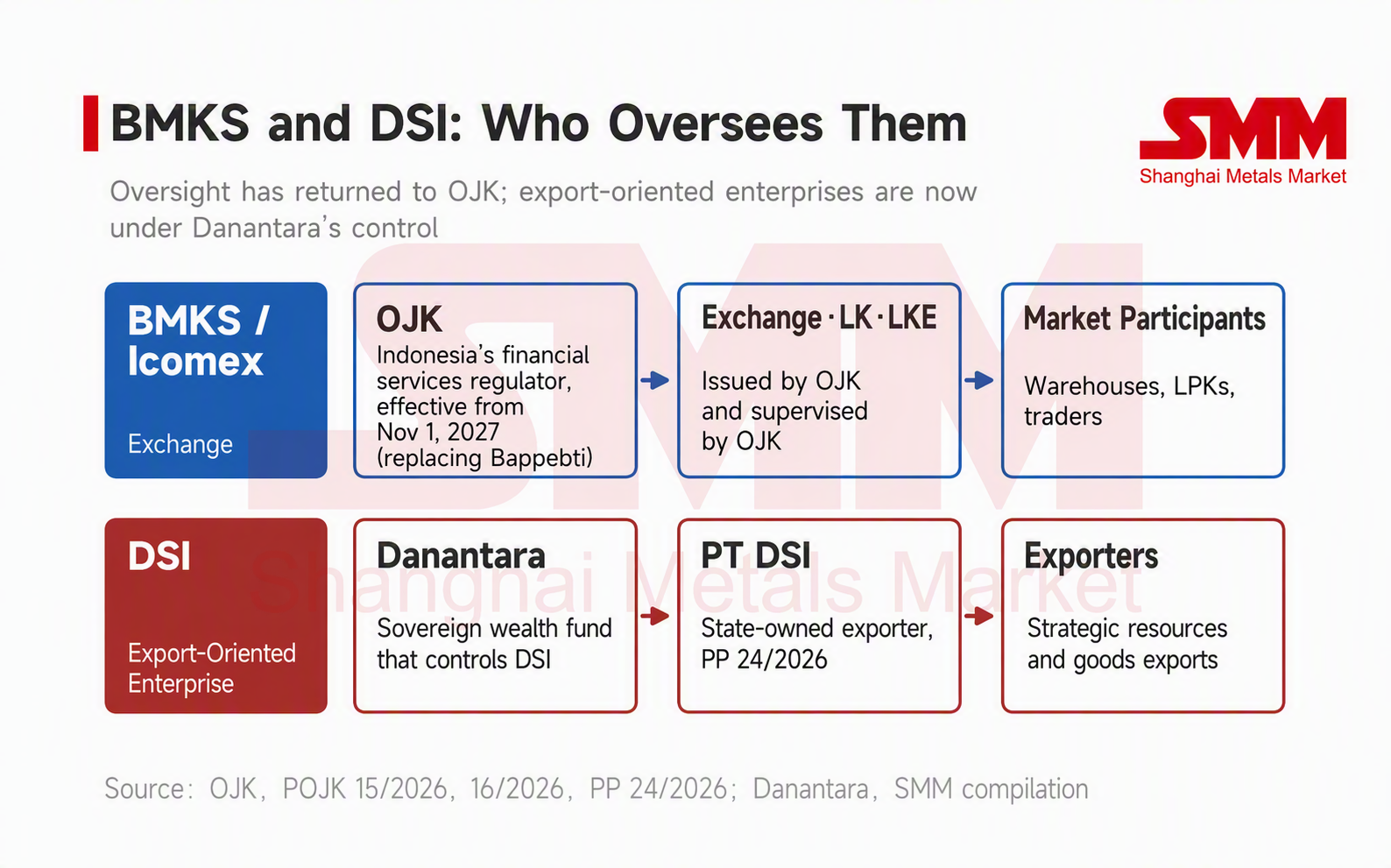
This mechanism also needs to be distinguished from the DSI export digitalization and export governance system that has been widely discussed in the market. DSI is mainly oriented toward export declaration, export process monitoring, and government data supervision, such as export documents, shipping schedules, contracts, prices, grades, destinations, and export proceeds. The function of BMKS/Icomex is different, with its focus not on export declaration or export process monitoring, but on establishing a regulated market infrastructure capable of trading, pricing, clearing, and settlement, and potentially forming Indonesia's reference price (Harga Acuan Indonesia).
In simple terms, DSI leans more toward export flows, export compliance, and export foreign exchange supervision; BMKS/Icomex leans more toward trading infrastructure, price discovery, and market regulation. DSI helps the government obtain information on commodity export destinations, buyers, prices, and foreign exchange repatriation; BMKS/Icomex seeks to bring strategic commodity trading into a more standardized, transparent, and supervised market system through exchange mechanisms.
Indonesia's Financial Services Authority (OJK) recently issued two regulations related to BMKS/Icomex, marking the entry of Indonesia's strategic mineral and strategic commodity exchange development into the institutional implementation phase. The two regulations are: POJK No. 15/2026, concerning the phased transfer of BMKS trading regulatory and supervisory authority from Bappebti to OJK; and POJK No. 16/2026, concerning the organization and operation of BMKS. According to an OJK press release, these two POJKs are part of the implementation of the mandate following the amendment of the Financial Sector Development and Strengthening Law (UU P2SK), which grants OJK the authority to regulate and supervise BMKS trading.
From SMM's perspective, the issuance of the two POJKs indicates that Indonesia's strategic commodity governance is moving from policy conception to institutional development. BMKS/Icomex is not merely a new trading platform, but is more likely to become an important tool for Indonesia to enhance trading transparency, strengthen domestic price discovery, establish local reference prices, and tighten oversight of strategic mineral and commodity flows.
Regulatory issuance timeline
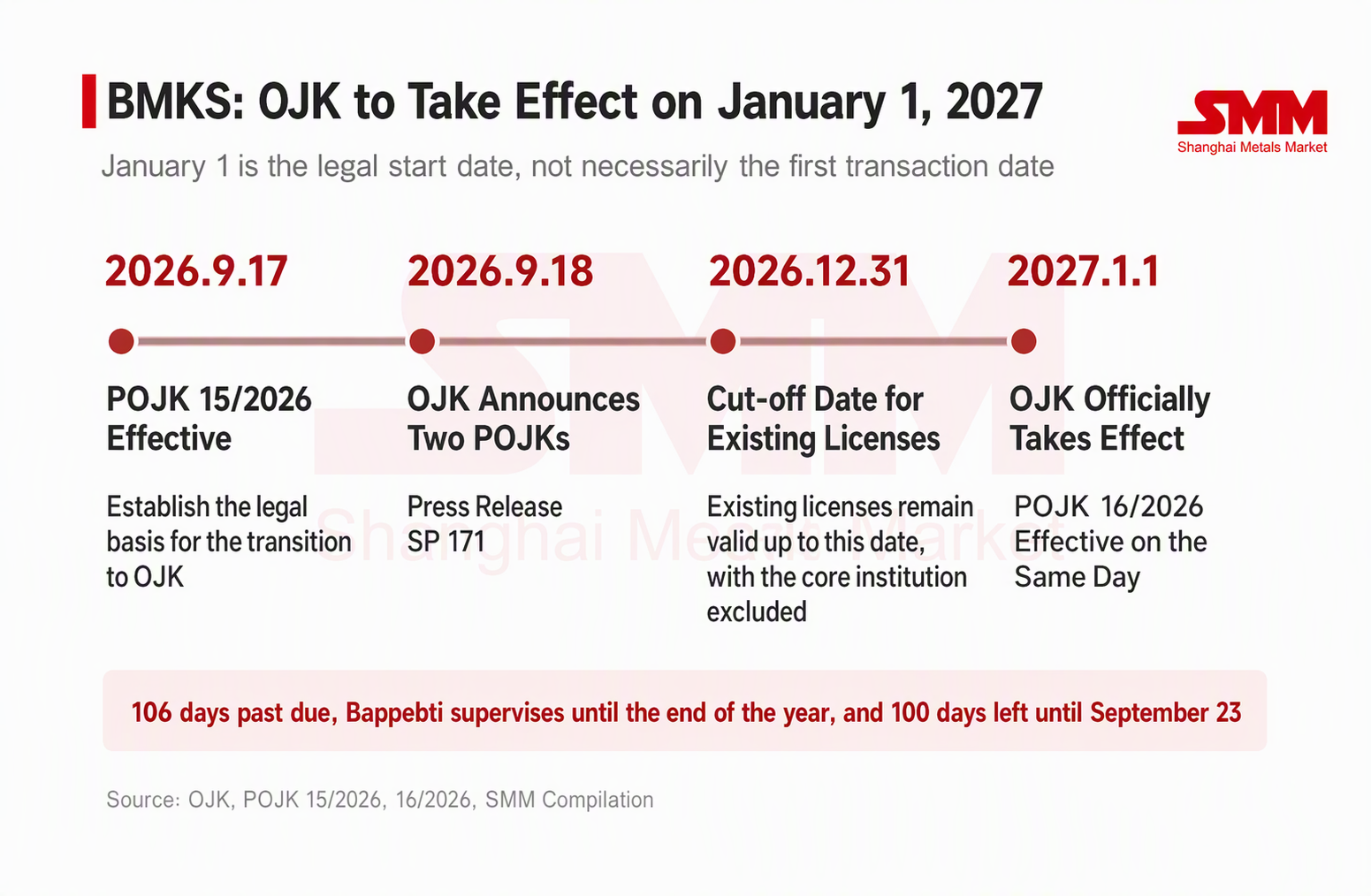
- September 17, 2026: POJK No. 15/2026 takes effect.
POJK No. 15/2026 was enacted on September 17, 2026, and stipulates the phased transfer of BMKS trading regulatory and supervisory authority from Bappebti to OJK. The regulation specifies that OJK will assume BMKS regulatory and supervisory duties starting January 1, 2027, while POJK No. 15/2026 itself takes effect on September 17, 2026.
- September 18, 2026: OJK issues a press release on the two BMKS-related POJKs.
OJK announced the issuance of the two BMKS-related POJKs on September 18, 2026, through press release SP 171/DKPU/OJK/IX/2026. POJK No. 15/2026 concerns the transfer of BMKS regulatory authority from Bappebti to OJK, while POJK No. 16/2026 concerns the organization and operation of BMKS.
- January 1, 2027: OJK regulatory authority officially commences, and POJK No. 16/2026 takes effect.
The transfer of BMKS regulatory and supervisory authority from Bappebti to OJK will commence when BMKS begins operations on January 1, 2027. The OJK press release also clarifies that POJK No. 16/2026 will take effect on January 1, 2027.
What is BMKS/Icomex?
Under POJK No. 16/2026, BMKS is defined as an organized, integrated market system for trading strategic minerals and strategic commodities, including their derivatives. The system is supported by elements including the financing ecosystem, digital financial instruments, price mechanisms, quality mechanisms, transaction settlement, and risk management.
The regulation also defines two key concepts. Strategic minerals (Mineral Strategis) refer to minerals with high economic value and/or strategic significance for the defense industry and national interests, including primary, secondary, and tertiary sources controlled by the state and serving the welfare of the people and national interests; strategic commodities (Komoditas Strategis) refer to commodities with high economic value and/or strategic significance for national interests.
In other words, BMKS/Icomex is a regulated exchange ecosystem established by Indonesia for strategic minerals and strategic commodities. However, the two POJK regulations themselves have not yet specified the initial list of commodities to be traded, which remains one of the most closely watched implementation details for the market going forward.
-
POJK No. 15/2026: Transfer of Regulatory Authority from Bappebti to OJK
POJK No. 15/2026 primarily addresses the transition of regulatory authority. The regulation provides the legal basis for OJK to regulate and supervise BMKS trading and stipulates that OJK will assume BMKS-related regulatory and supervisory duties effective January 1, 2027.
The transition mechanism is designed to avoid a regulatory vacuum. The regulation allows OJK to coordinate with Bappebti during the preparatory phase, including identifying transaction data, trading mechanisms, market participants, activities, and infrastructure; reviewing and examining BMKS-related licenses and regulations; assessing the readiness of relevant enterprises; preparing regulatory resources; and receiving relevant documents and data.
The regulation also stipulates that after the transfer of regulatory duties, BMKS-related licensing, approval, and registration procedures still being processed at Bappebti will be continued by OJK. Meanwhile, BMKS-related licenses issued by December 31, 2026 under regulations in the commodity futures trading sector will remain valid, except for core institutions such as exchange operators, clearing and guarantee institutions, electronic custodians, and conformity assessment bodies.
For market participants, this means BMKS/Icomex will be brought under the OJK regulatory framework, aligning it more closely with financial market regulatory logic, with higher expected requirements for trading integrity, risk management, market supervision, and user protection.
-
POJK No. 16/2026: Establishing the Complete Operational Framework for BMKS
POJK No. 16/2026 is a more detailed operational regulation covering BMKS organizational structure, market participants, trading processes, transaction settlement, risk management, user protection, market integrity, product development, digital financial instruments, derivatives trading, and OJK supervision.
The BMKS ecosystem comprises multiple entities, including the exchange (Bursa), clearing institution (LK), electronic depository institution (LKE), exchange members, warehouse managers, conformity assessment bodies (LPK), and supporting professional institutions. Among them, OJK directly supervises the exchange, LK, LKE, and trading intermediaries; the exchange supervises service users, warehouse managers, LPK, and other approved entities.
BMKS integrates trading, clearing, trade settlement guarantees, trade settlement, electronic ownership certificate storage and management, risk management, price mechanisms, quality mechanisms, digital financial instruments, financing ecosystems, and other supporting infrastructure.
This means BMKS/Icomex is not merely a trade-matching platform, but a complete commodity market infrastructure covering commodity admission, quality confirmation, ownership records, trade execution, clearing and settlement, and risk management.
Market Infrastructure: Exchange, Clearing Institution, Electronic Depository, Warehouse, and LPK
POJK No. 16/2026 sets high admission and operational requirements for the core institutions in the BMKS ecosystem.
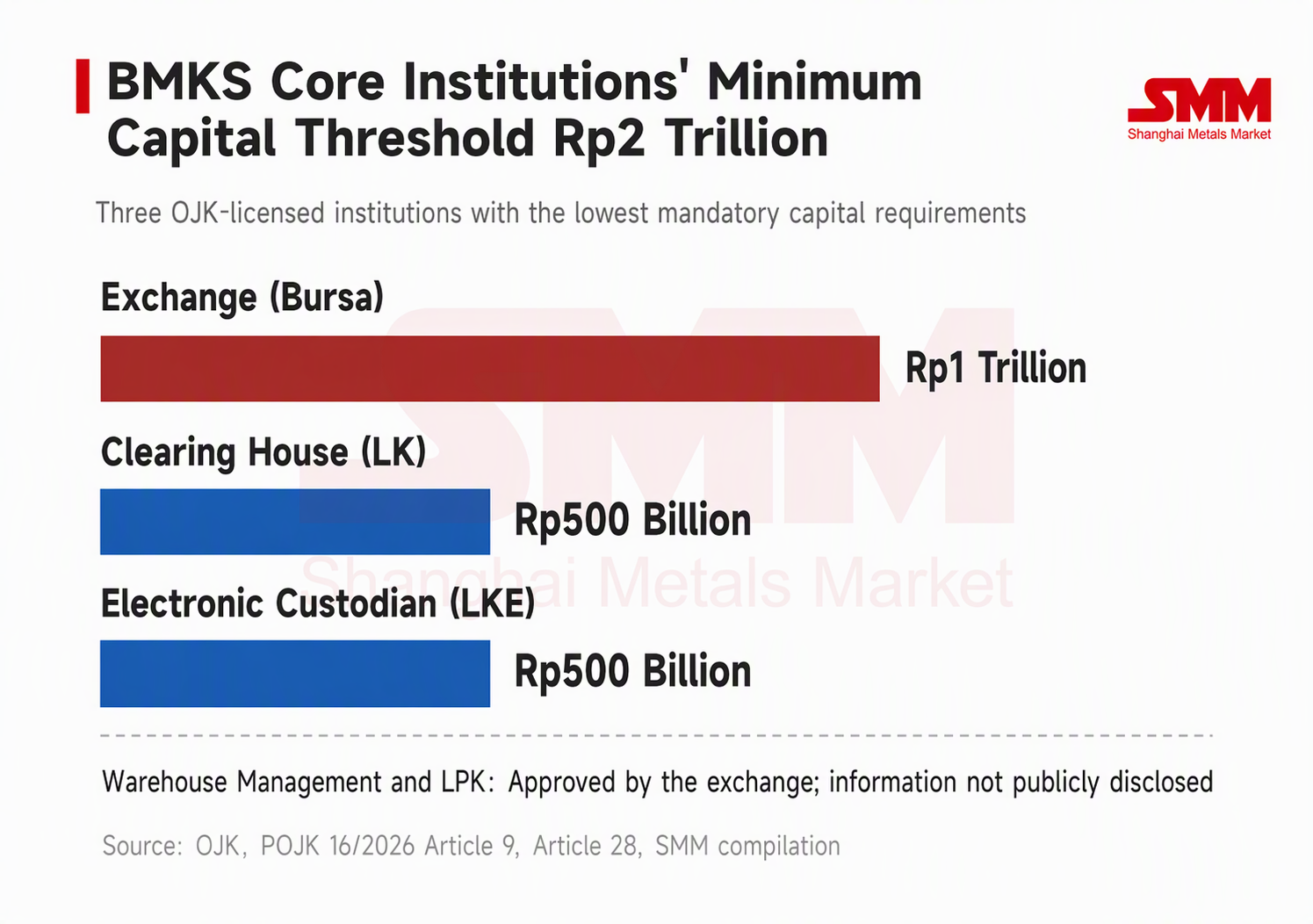
The exchange (Bursa) must obtain an OJK business license and is responsible for organizing trading of strategic minerals and strategic commodities, providing and operating the BMKS trading system, formulating exchange rules, supervising trading participants, ensuring the availability of physical commodity and warehousing data, and performing other functions stipulated by OJK. The minimum paid-up capital requirement for the exchange is IDR 1 trillion.
The clearing institution (LK) is responsible for clearing, trade settlement guarantees, and trade settlement, must obtain an OJK license, and has a minimum paid-up capital of IDR 500 billion.
The electronic depository institution (LKE) is responsible for electronic records, storage, security assurance, and management of BMKS transactions, must also obtain an OJK license, and has the same minimum paid-up capital of IDR 500 billion.
Warehouse managers must obtain exchange approval and are responsible for verifying, safeguarding, and physically delivering strategic minerals and strategic commodities delivered and stored. The regulation explicitly states that the warehouse manager's responsibility for the commodities under its management will not be transferred to the exchange or OJK.
LPK, or conformity assessment bodies, are responsible for quality and quantity inspection of strategic minerals and strategic commodities traded on BMKS. LPK must obtain exchange approval and bear responsibility for quality and quantity conformity inspection in accordance with relevant standards and exchange rules.
How Does the BMKS Trading Process Work?
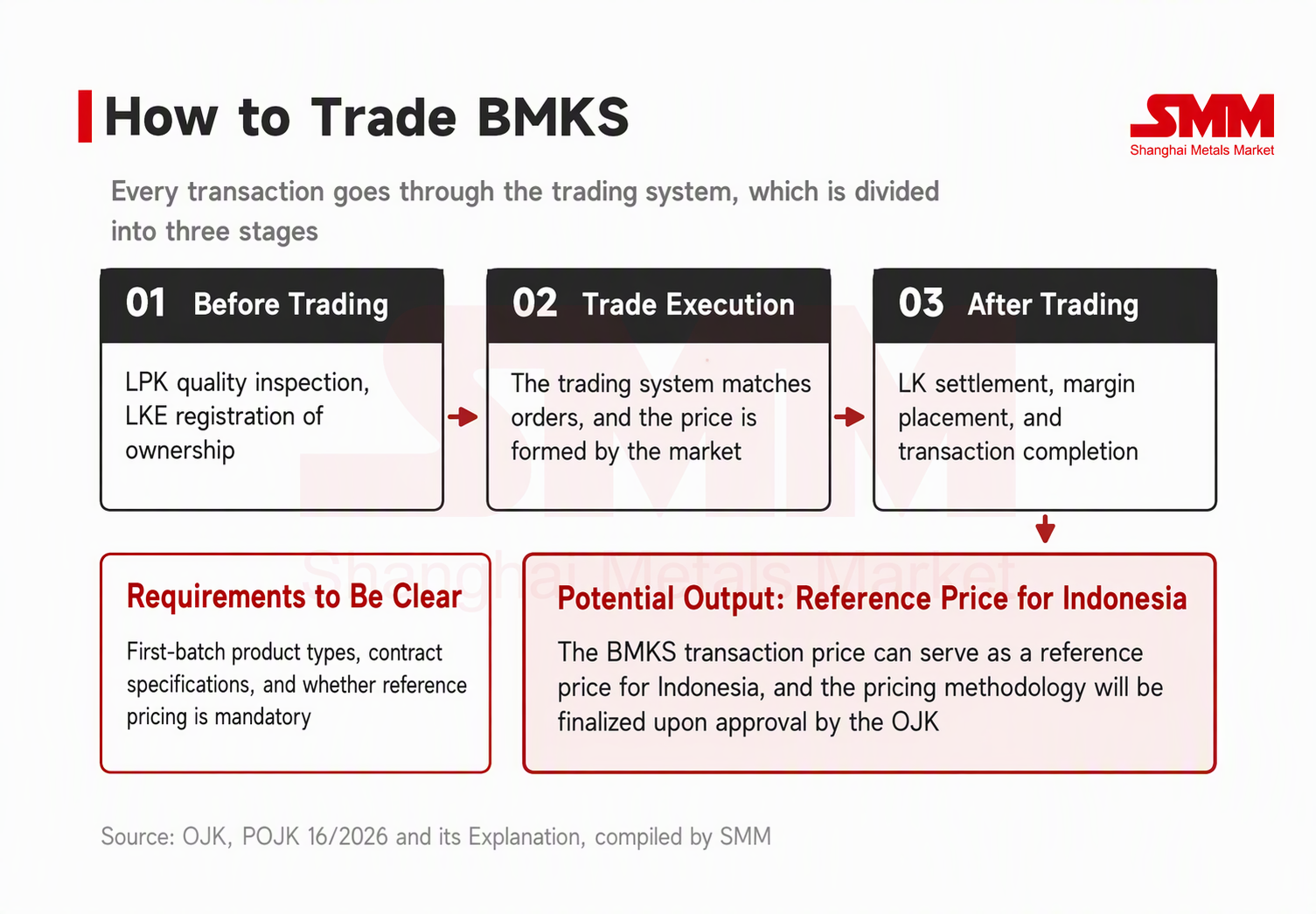
POJK No. 16/2026 divides the BMKS trading process into three stages: pre-trade, trade execution, and post-trade. All BMKS transactions must be conducted through exchange systems connected to BMKS infrastructure and satisfy principles of orderliness, fairness, transparency, efficiency, settlement certainty, market integrity, and risk management.
In the pre-trade stage, strategic minerals and strategic commodities can only be traded through BMKS after obtaining "tradable" status issued by LPK. Tradable status depends on quality inspection, quantity verification, storage in exchange-approved warehouses, administrative compliance, and other requirements stipulated by exchange rules.
After commodities meet the relevant conditions, LKE will issue an electronic ownership certificate (Bukti Kepemilikan Elektronik) as the basis for ownership records and trading in the BMKS system.
In the trade execution stage, transactions are completed by entering orders into the exchange system, which can be submitted directly by service users or through trading intermediaries. BMKS trading prices are formed through orderly, fair, transparent, and efficient market mechanisms.
In the post-trade stage, trade settlement is completed through LK and follows the principles of legal certainty, security, and efficiency. LK must also have mechanisms to handle trade settlement failures.
Price Formation: BMKS May Become Indonesia's Reference Price Formation Mechanism
For commodity markets, the most important point is that BMKS trading prices may in the future be used as Indonesia's reference price (Harga Acuan Indonesia). The exchange must formulate a methodology for Indonesia's reference price formation based on fair, transparent trading with market integrity, and obtain OJK approval.
The explanatory section of the regulation further clarifies that the Indonesia reference price methodology may include data sources, trade screening criteria, data collection and verification methods, calculation methods, observation periods, handling of unavailable or unusable data, and methodology evaluation and adjustment mechanisms. The goal of the methodology is to ensure that the final price reflects relevant market conditions, is reliable, and is not influenced by specific interests.
SMM believes this is one of the most noteworthy policy signals in the regulation. If BMKS/Icomex can subsequently develop sufficient liquidity, its trading prices may gradually become the official domestic pricing reference for Indonesia's strategic minerals and strategic commodities. For nickel, coal, bauxite, tin, and other strategic commodities, this may gradually affect domestic price formation, trade reporting, and pricing benchmark systems.
Market Integrity and Regulatory Mechanisms
POJK No. 16/2026 places great emphasis on market integrity. The exchange must continuously monitor all BMKS transactions; if signs of violations are detected, the exchange must take action in accordance with exchange rules and report to OJK.
The regulation prohibits any conduct that creates false, misleading, or non-reflective trading conditions, prices, or trading volumes that do not reflect normal market mechanisms. The exchange must also have mechanisms to detect, prevent, and handle market manipulation and abnormal trading behavior.
Under specific circumstances, OJK may order the exchange to suspend trading, restrict trading, adjust trading parameters, or take other necessary measures.
The explanatory section of the regulation also mentions that abnormal market conditions may include disruptions in the underlying physical market, such as supply deficits of strategic minerals or commodities, supply disruptions, limited warehousing capacity, disruptions at delivery locations or facilities, and significant changes in commodity quality or availability that affect physical delivery capability.
This point illustrates that BMKS/Icomex is not a purely financialized trading platform, but rather market infrastructure highly connected to physical commodity supply, warehousing, logistics, quality, and delivery.
Product Development: Derivatives and Digital Financial Instruments Included in the Framework
BMKS is also designed as a trading system that can support future product development. The exchange may develop products, services, and trading mechanisms after obtaining OJK approval to enhance efficiency, liquidity, market integrity, and competitiveness.
The regulation also allows the exchange to organize trading of digital financial instruments based on rights to strategic minerals and strategic commodities, provided that such instruments have verifiable underlying assets and are recorded in the exchange system.
In addition, BMKS may also support derivatives trading of strategic minerals and strategic commodities, provided that supporting mechanisms such as risk management, clearing, trade settlement, trade supervision, and contract rules are in place.
This means BMKS/Icomex may start with spot or physical delivery-related trading and gradually evolve into a broader commodity financial ecosystem in the future.
Compliance, Risk Management, and User Protection
The regulation requires BMKS operating entities to implement effective, integrated, continuous, robust, and integrity-based risk management. The exchange, LK, LKE, warehouse managers, and LPK must also implement information technology risk management, have business continuity plans, disaster recovery centers, and regularly test system resilience.
BMKS operating entities must also prioritize user protection and market integrity. User protection includes providing truthful, clear, and non-misleading information, treating all users fairly, protecting user data and information, handling complaints, and resolving disputes in accordance with relevant regulations.
OJK also has broad supervisory powers, including requiring the provision of data, documents, explanations, system access, and taking other regulatory measures in accordance with the law. The exchange, LK, and LKE must provide data access to OJK in accordance with OJK's authority.
Market Impact
For Indonesia's mineral and commodity markets, BMKS/Icomex may become an important step toward enhancing trading transparency and regulatory intensity. If implemented smoothly, it will help reduce information asymmetry, improve trade records, support reference price formation, and strengthen government monitoring of strategic commodity flows.
For the nickel market, the key question is whether BMKS/Icomex will in the future include nickel ore, NPI, nickel pig iron, MHP, or other nickel-related products. The two current POJK regulations have established the market infrastructure, but have not yet specified the first batch of commodities to be included. If nickel-related products are included, market participants may face stricter quality verification, warehousing requirements, electronic ownership documents, trading system reporting, and reference price methodology requirements.
For the coal market, if coal is included in the strategic commodity scope, BMKS/Icomex may also have an impact. Indonesia currently has price reference systems such as HBA and ICI, and BMKS/Icomex may add an additional layer of transaction-based price reference formed by a regulated exchange, with the specific impact depending on the commodity inclusion scope and trading liquidity.
For bauxite, tin, and other strategic minerals, BMKS/Icomex can help strengthen trading governance and reduce risks such as underreporting of prices, opaque bilateral pricing, and insufficient traceability. However, its actual effectiveness still depends on physical market readiness, warehousing infrastructure, LPK inspection capacity, warehouse approval, market participant access, and whether sufficient real transactions enter the exchange system.
Issues to Watch Going Forward
The market still needs to await more implementation details and practical arrangements, especially in the following areas:
- The first batch of commodities to be included in trading. POJK has established the framework, but has not specified the first batch commodity list in the regulatory text.
- Whether nickel-related products will be included. The market needs to watch whether nickel ore, NPI, nickel pig iron, MHP, and other products will enter BMKS/Icomex.
- How existing physical trade contracts will be handled. A large volume of commodity trading in Indonesia is still based on bilateral contracts or long-term supply agreements.
- How the warehousing and quality verification system will be implemented. Commodities obtaining "tradable" status depend on LPK inspection and the exchange-approved warehouse system.
- Whether BMKS prices will become a mandatory reference or a supplementary reference. The regulation allows BMKS trading prices to form Indonesia's reference price, but actual effectiveness depends on methodology, liquidity, and OJK approval.
- The speed of market participant adaptation. Mines, processing enterprises, traders, smelters, and industrial buyers may need to adjust internal systems, document processes, compliance arrangements, and trading methods.
SMM View
SMM believes that the issuance of POJK No. 15/2026 and POJK No. 16/2026 marks Indonesia's strategic commodity governance framework entering a new phase of institutional development. Its core significance lies not only in establishing a new exchange, but also in building a regulated, integrated ecosystem for strategic mineral trading, price formation, quality verification, ownership records, settlement, and risk management.
In the short term, BMKS/Icomex is unlikely to immediately replace existing physical trade channels. The market should focus more on the first batch commodity list, participant admission rules, quality standards, contract specifications, warehousing arrangements, and whether existing bilateral trade models need to adapt to the new exchange framework.
In the medium and long term, if BMKS/Icomex can develop sufficient liquidity and obtain clear regulatory enforcement rules, it may become an important platform for Indonesia to strengthen domestic price discovery, reduce pricing opacity, enhance trade traceability, and capture resource value. For nickel and other strategic minerals, if they enter the BMKS/Icomex system in the future, domestic pricing and trade reporting methods may gradually change.
Overall, BMKS/Icomex reflects Indonesia's push to develop its strategic commodity market in a more structured, transparent, more strongly regulated, and exchange-oriented direction. The current regulatory framework is largely clear, but the real market impact still depends on subsequent implementation: which commodities are included first, the speed of infrastructure readiness, and whether market participants are willing and capable of trading through the new system.
![[SMM Analysis] Indonesia Issues New OJK Rules for BMKS, Laying Legal Basis for Domestic Commodity Price Formation](https://imgqn.smm.cn/usercenter/BBJUa20251217171751.jpg)
![After the rate hike, macro pressure was released, and the most-traded SHFE tin SN2610 contract consolidated above 410,000 yuan/mt [SMM Tin Morning News]](https://imgqn.smm.cn/usercenter/sRGMJ20251217171752.jpg)
![SHFE tin fell 0.49% in the night session, giving back daytime gains as bulls and bears battle again at the 410,000 level [SMM Tin Morning Meeting Summary]](https://imgqn.smm.cn/usercenter/QgNfJ20251217171752.jpg)