SMM August 7 news:
Metals market:
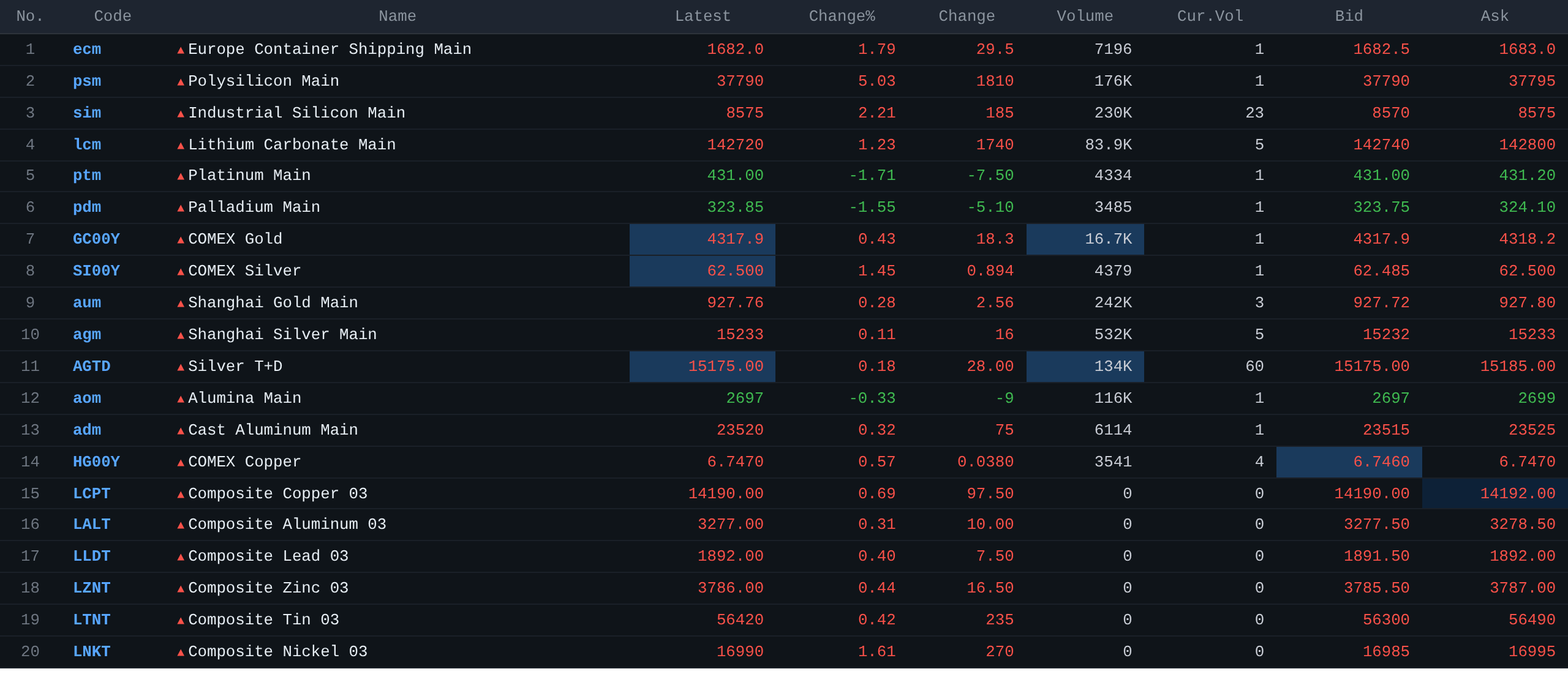
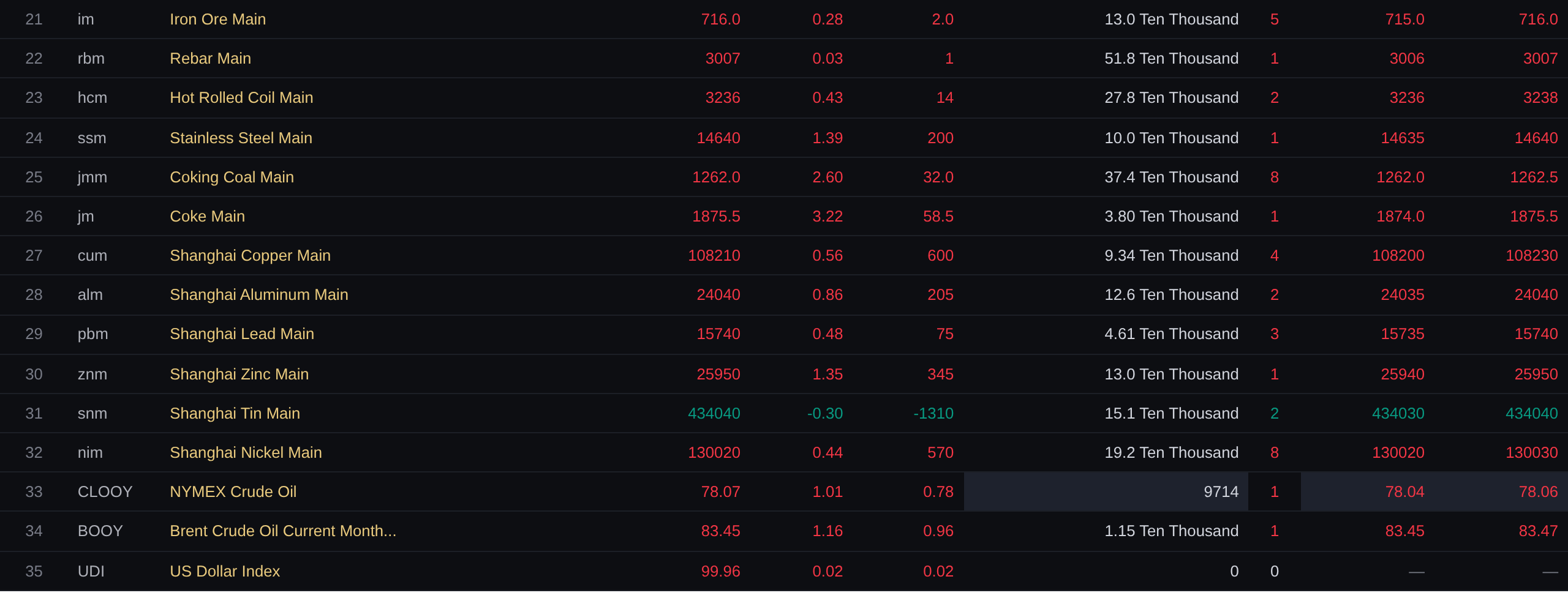
As of the midday close, domestic base metals nearly all rose. SHFE copper rose 0.56%, SHFE aluminum rose 0.86%. SHFE lead rose 0.48%. SHFE zinc rose 1.35%. SHFE tin fell 0.3%. SHFE nickel rose 0.44%.
In addition, cast aluminum most-traded contract futures rose 0.32, alumina most-traded contract fell 0.33%. Lithium carbonate most-traded contract rose 1.23%. Silicon metal most-traded contract rose 2.21%. Polysilicon most-traded contract futures rose 5.03%.
Ferrous metals all rose. Iron ore rose 0.28%, rebar edged up, HRC rose 0.43%. Stainless steel rose 1.39%. Coking coal and coke: the most-traded coking coal contract rose 2.6%, the most-traded coke contract rose 3.22%.
Overseas base metals: As of 11:40, LME metals all rose. LME copper rose 0.69%, LME aluminum rose 0.31%, LME lead rose 0.4%, LME zinc rose 0.44%. LME tin rose 0.42%. LME nickel rose 1.61%.
Precious metals: As of 11:40, COMEX gold rose 0.43%, COMEX silver rose 1.45%. Domestic precious metals: SHFE gold rose 0.28%, the most-traded SHFE silver contract rose 0.11%.
Furthermore, as of the midday close, platinum most-traded contract futures fell 1.71%, palladium most-traded contract futures fell 1.55%.
As of the midday close, the most-traded European container shipping contract rose 1.79% to 1,682 points.
As of 11:40 on August 7, selected futures midday quotes:
Spot and fundamentals
Copper: Today, Guangdong #1 copper cathode spot against the front-month contract: high-quality copper was at 160 yuan/mt, up 70 yuan/mt from the previous trading day; standard-quality copper was at a premium of 60 yuan/mt, up 50 yuan/mt from the previous trading day; SX-EW copper was at 0 yuan/mt, up 30 yuan/mt from the previous trading day. The average price of Guangdong #1 copper cathode was 108,355 yuan/mt, up 455 yuan/mt from the previous trading day; the average price of SX-EW copper was 108,245 yuan/mt, up 425 yuan/mt from the previous trading day...
Macro front
Domestic:
[Over 30 trillion yuan! China's foreign trade imports and exports continued to grow in the first seven months of this year] The General Administration of Customs today released statistics showing that in the first seven months of this year, China's total foreign trade imports and exports reached 30.13 trillion yuan, up 17.3% YoY, maintaining a sound growth momentum. Of this, exports stood at 17.44 trillion yuan, up 14%; imports were 12.69 trillion yuan, up 22%. In July alone, imports and exports totaled 4.66 trillion yuan, up 19.2% YoY. Of this, exports were 2.71 trillion yuan, up 17.8%, and imports were 1.95 trillion yuan, up 21.2%.
[National Energy Administration: Increase independent R&D of key power equipment, promote breakthroughs in key technologies such as power chips and UHV components] The National Energy Administration issued the "15th Five-Year Action Plan for Power Safety Production". It mentioned strengthening "AI+" safety governance, innovating high-precision fault prediction and health management methods for equipment, promoting the integration of AI technology into intelligent safety tools, and studying AI large model-based decision support technology for power safety production. Increase independent R&D of key power equipment, strengthen R&D of new protective materials, set up a special plan for technical breakthroughs in core components of power equipment, and promote breakthroughs in key technologies such as power chips and UHV components. Promote technological innovation in safety and quality control for power construction projects, study and build intelligent supervision systems for power construction projects, and use AI, big data and other means to strengthen off-site supervision and quality supervision of key power projects. (National Energy Administration)
[General Administration of Customs: China's integrated circuit exports rose 99.5% YoY in January-July] Data released by the General Administration of Customs showed that China's integrated circuit export value reached $38.74 billion in July, with cumulative exports in January-July reaching $216 billion, up 99.5% YoY. (Jin10 data app)
[PBOC drained a net 133 billion yuan via open market operations today, and a net 1,225.5 billion yuan this week] The PBOC conducted 1 billion yuan of 7-day reverse repo operations today. With 134 billion yuan of 7-day reverse repos maturing today, a net drain of 133 billion yuan was achieved. This week, the PBOC conducted 176.5 billion yuan of 7-day reverse repo operations, 300 billion yuan of overnight reverse repo operations, and 500 billion yuan of outright reverse repo operations. With 116.5 billion yuan of 7-day reverse repos and 900 billion yuan of overnight reverse repos maturing this week, a net drain of 1,225.5 billion yuan was achieved. (Jin10 data app)
As of 11:40, the US dollar index rose 0.02% to 99.96. The market focused on US non-farm payrolls data for clues on the interest rate outlook. According to CME's "Fed Watch": The probability of the Fed keeping interest rates unchanged in September is 45%, and the probability of a cumulative 25 basis point rate hike is 55%. The probability of keeping rates unchanged through October is 31%, while the probability of a cumulative 25 bp hike is 51.9% and a cumulative 50 bp hike is 17.1%. (Jin10 data app)
Fed's Musalem: The current inflation rate is far above the Fed's 2% target, and monetary policy must effectively suppress underlying inflation rather than tolerating high inflation now in the hope of future productivity gains.
US labor productivity grew faster than expected in Q2, largely because businesses sought to ease cost pressures. Data released on Thursday showed that nonfarm productivity rose at an annualized rate of 1.4% in Q2, up from an upwardly revised 0.8% in Q1, surpassing the broad market forecast. Unit labor costs increased 1.3%, lower than expected. Fed officials, investors and economists have been looking for signs whether hundreds of billions of dollars in AI investment are starting to lift productivity. However, due to large quarterly fluctuations in official data, it will take time to observe a clear trend. Labor costs are one of the largest expense items for many businesses, and efficiency gains can allow wages to rise without fueling inflation. In the long term, higher productivity helps improve living standards, but some economists worry that if AI-driven productivity growth persists, some businesses might delay hiring or even cut staff. The productivity gain in Q2 was supported by the strongest output growth since Q3 2025, along with a modest increase in hours worked. (Jin10 data app)
Data:
Today, markets will see the release of France's Q2 ILO unemployment rate, Germany's June seasonally adjusted industrial output MoM, Germany's June seasonally adjusted trade balance, the UK's July Halifax house price index MoM, France's June trade balance, Switzerland's July consumer confidence index, Canada's July employment change, the US July unemployment rate, US July seasonally adjusted nonfarm payrolls, US July average hourly earnings YoY, US July average hourly earnings MoM, the US July New York Fed 1-year inflation expectations, China's July trade balance in USD terms, China's July foreign exchange reserves, China's July trade balance, and other data. Watch for: 2028 FOMC voting member and St. Louis Fed President Musalem to speak on the US economy and monetary policy; 2027 FOMC voting member and Richmond Fed President Barkin to speak.
Crude oil:
As of 11:40, both benchmark oil prices rose, with WTI up 1.01% and Brent up 1.06%. Concerns over Strait of Hormuz transit outlook supported oil prices.
According to preliminary US government data, US imports of Saudi crude oil fell to zero in July, marking the first full month without Saudi crude imports since 1985. Data released by the US Department of Energy on Wednesday showed that Saudi crude shipments to the US completely ceased in July. This is a significant decline given that US refiners purchased more than 800,000 barrels per day of Saudi crude earlier this year. With the closure of the Strait of Hormuz and other war-related supply disruptions pushing up crude prices linked to global benchmarks, US refiners have been seeking alternative supplies to Saudi crude. Saudi crude deliveries to the US have historically dropped to zero in individual weeks, but July is the first full month at the lowest level in over 40 years. According to Kpler data, US imports of Saudi crude are expected to resume at around 300,000 barrels per day this month, in line with recent historical norms. (Jin10 data app)
Saudi Arabia lowered its key crude prices for Asia even as negotiations progressed for a deal to ease shipping pressure in the Strait of Hormuz. Despite the Houthi threat to alternative Red Sea routes for eastward crude shipments, Saudi Arabia still cut prices. A price list showed that Saudi Aramco, the state oil company, reduced the price of its Arab Light crude for Asian customers for next-month delivery by 50¢ per barrel to a discount of $2 per barrel versus the regional benchmark. A previous survey showed traders expected Aramco to keep its flagship crude price unchanged. This week, global benchmark Brent crude fell sharply and is now trading near $80 per barrel. (Jin10 data app)
Spot market at a glance:
►
►
►
Midday comments for other metals will be updated later, please refresh to view~
![[SMM Rebar Production Schedule] Losses on Production Coupled with Cash Flow Pressures, August Rebar Planned Production Continues to Decline.](https://imgqn.smm.cn/usercenter/JYbQQ20251217171736.jpg)
![Guangdong Zinc: Affected by high futures prices, Guangdong premiums fell today [SMM Midday Review]](https://imgqn.smm.cn/usercenter/cirme20251217171754.jpg)
![Copper prices continued to shoot up, and spot discounts in North China widened further [SMM North China Copper Spot]](https://imgqn.smm.cn/usercenter/FSTyq20251217171713.jpg)