The freight rate fell for 12 weeks in a row! Shanghai blockade and global port congestion impact on the gathering market

Đã xuất bản: Apr 13, 2022 09:09
[freight rates have fallen for 12 weeks in a row! With the severe epidemic situation in Shanghai and the continuous impact on the container shipping market by the global port blockage, the SCFI index fell 12 times to the lowest level since August last year. On April 8, the Shanghai Shipping Exchange announced that the latest Shanghai export container freight index (SCFI) fell to 4263.66 points, a weekly decline of 1.96%, a record decline for 12 consecutive weeks. Freight rates on both the European line and the western line fell, with the European line at a 10-month low, but the eastern line rebounded.
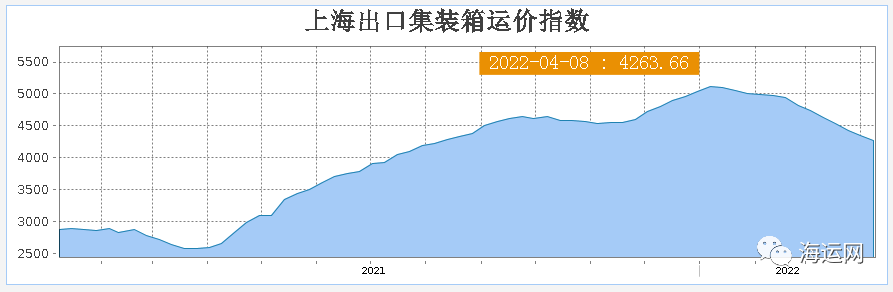
With the severe epidemic situation in Shanghai and the continued impact of global congestion on the container shipping market, the SCFI index fell 12 times to its lowest level since August last year.

On April 8, the Shanghai Shipping Exchange announced that the latest Shanghai export container freight index (SCFI) fell to 4263.66 points, a weekly decline of 1.96%, a record decline for 12 consecutive weeks. Freight rates on both the European line and the western line fell, with the European line at a 10-month low, but the eastern line rebounded.

Among them, the freight rate per FEU of the far East to the US West Line fell by 56 US dollars, or 0.7%, to US $7860, falling for five consecutive weeks and setting a new low so far this year; the freight rate per TEU of the far East to the US East Line rebounded by US $186 to US $10581, an increase of 1.8%; and the freight rate per TEU of the far East to Europe line fell to US $6157 in a row, the lowest since June last year.

People in the industry pointed out that recently, in order to prevent a strike by dock workers in the United States and the West, manufacturers began to transfer goods to the East of the United States, but the shipping space in the East of the United States is already less than that of the United States and West, and the problem of blocking the port has not been solved, so the freight rate of the East Line of the United States has risen.

In terms of the overall trend of freight rates, it is expected that freight rates will still fall slightly in mid-April, and freight rates, which were originally expected to recover in the second half of April, may have to wait until early May before they begin to rise. The main reason is that the collection and transportation companies began to draw boats on the western line of the United States, and after the release of the epidemic in Shanghai and other places, the tide of shipments is expected, which will be able to push up freight rates.

Despite the continuous decline in the SCFI index, freight rates are actually still at historic highs. However, people in the industry also believe that it may be difficult for freight rates to reach new highs, and freight rates this year are unlikely to increase as much as last year, but will not decline too much, but will remain volatile at high levels.

On the other hand, although the current shortage of space has eased somewhat, the slightly loose space and the ease of congestion will help to improve ship turnover, even if freight rates decline slightly, as long as cargo volume remains high and freight rates remain relatively high, the performance of container carriers this year is unlikely to be lower than that of last year.

About 10 per cent of the world's container ships are unable to move because of port jams in China and other parts of the world, according to ONE.

ONE CEO Jeremy Nixon said at the Marine Money conference in Singapore on April 5 that container ships are stuck in congested areas and consume a lot of fuel, and if the bottleneck can be solved, the service will be on time again.

Last year, there were 5587 ships carrying 24.7 million containers in the global container fleet, according to USDA data, which means about 500 ships are now queuing up to load and unload goods, according to Bloomberg estimates.

The COVID-19 epidemic has entered its third year, and the global supply chain is still hit by manpower shortages and outbreaks. Industry insiders say that although congestion at ports on the west coast of the United States has finally eased after several months of delays, cities such as Shanghai and Shenzhen have been blocked, resulting in an increase in queues for ships off the coast of China, which could worsen cargo delays in the coming months and push up freight rates.

Tuyên bố về Nguồn Dữ liệu: Ngoại trừ thông tin công khai, tất cả dữ liệu khác được SMM xử lý dựa trên thông tin công khai, giao tiếp thị trường và dựa trên mô hình cơ sở dữ liệu nội bộ của SMM. Chúng chỉ mang tính chất tham khảo và không cấu thành khuyến nghị ra quyết định.

Để biết thêm thông tin hoặc có thắc mắc gì, vui lòng liên hệ: lemonzhao@smm.cn
Để biết thêm thông tin về cách truy cập báo cáo nghiên cứu, vui lòng liên hệ:service.en@smm.cn
Tin Liên Quan
Giá bạc biến động dữ dội với trung tâm dịch chuyển lên cao; bạc giao ngay chuyển từ chiết khấu sang phí bảo hiểm [SMM Bạc Đánh giá hàng tuần]
6 giờ trước
Giá bạc biến động dữ dội với trung tâm dịch chuyển lên cao; bạc giao ngay chuyển từ chiết khấu sang phí bảo hiểm [SMM Bạc Đánh giá hàng tuần]
Đọc thêm
Giá bạc biến động dữ dội với trung tâm dịch chuyển lên cao; bạc giao ngay chuyển từ chiết khấu sang phí bảo hiểm [SMM Bạc Đánh giá hàng tuần]
[SMM Điểm tin bạc hàng tuần: Giá bạc biến động dữ dội với trung tâm dịch chuyển lên cao; Giá giao ngay chuyển từ chiết khấu sang phụ trội] Tuần này, giá bạc biến động dữ dội với trung tâm dịch chuyển nhẹ lên cao. Dữ liệu bảng lương phi nông nghiệp mạnh hơn dự kiến ban đầu gây áp lực lên giá bạc, nhưng sự suy yếu liên tục sau đó của đồng đô la Mỹ đã thúc đẩy sự phục hồi, và báo giá giao ngay chuyển từ chiết khấu sang phụ trội. Các yếu tố vĩ mô trái chiều, và thị trường chờ đợi sự dẫn dắt từ CPI và cuộc họp của Fed Mỹ, với dự kiến biến động dữ dội trong ngắn hạn. Tồn kho tăng nhẹ 6 tấn, lượng nắm giữ ETF tăng nhẹ, và tâm lý chờ đợi quan sát được củng cố.
6 giờ trước
WPIC điều chỉnh dự báo thị trường bạch kim năm 2026 xuống mức thặng dư 265.000 ounce do nhu cầu đầu tư suy yếu
7 giờ trước
WPIC điều chỉnh dự báo thị trường bạch kim năm 2026 xuống mức thặng dư 265.000 ounce do nhu cầu đầu tư suy yếu
Đọc thêm
WPIC điều chỉnh dự báo thị trường bạch kim năm 2026 xuống mức thặng dư 265.000 ounce do nhu cầu đầu tư suy yếu
[SMM Flash] Hội đồng Đầu tư Bạch kim Thế giới (WPIC) đã điều chỉnh dự báo cân bằng thị trường bạch kim năm 2026 lên mức thặng dư 265.000 oz, đảo ngược dự báo thâm hụt 297.000 oz trước đó. Báo cáo Platinum Quarterly mới nhất, công bố ngày 9 tháng 9, cho thấy thặng dư quý II là 244.000 oz do tổng cung tăng 1% so với cùng kỳ năm ngoái lên 1,91 triệu oz trong khi nhu cầu giảm 16% xuống 1,66 triệu oz. Việc điều chỉnh chủ yếu phản ánh dòng vốn đầu tư chảy ra trong nửa đầu năm 2026 hơn là sự phục hồi đáng kể của nguồn cung khai thác. Bất chấp dự báo thặng dư cả năm, WPIC cho biết tồn kho trên mặt đất vẫn bị hạn chế sau ba năm thâm hụt đáng kể liên tiếp. Tổ chức này kỳ vọng thị trường sẽ chuyển từ mức thặng dư 548.000 oz trong nửa đầu năm sang mức thâm hụt 283.000 oz trong nửa cuối năm, khi hoạt động bán đầu tư giảm bớt. Cân bằng nửa cuối năm vẫn là dự báo chưa phải là kết quả được xác nhận.
7 giờ trước
Bạch kim có thể vượt trội hơn giá vàng khi giao dịch phòng ngừa mất giá lấy lại đà tăng – WPIC
7 giờ trước
Bạch kim có thể vượt trội hơn giá vàng khi giao dịch phòng ngừa mất giá lấy lại đà tăng – WPIC
Đọc thêm
Bạch kim có thể vượt trội hơn giá vàng khi giao dịch phòng ngừa mất giá lấy lại đà tăng – WPIC
7 giờ trước