SMM1 March 11: last Friday, the outer disk metal market fell sharply, with Lun Copper down 1.07%, Lunzn Zinc down 3.15%, Lun Aluminum down 0.39%, Lenny Nickel down 3.01%, Lunxi down 0.73%, Lun lead down 1.99%. (LME) copper futures on the London Metal Exchange fell from a nearly eight-year high on Friday, raising doubts about how many infrastructure stimulus measures the next US government will be able to introduce. In addition, the U.S. Department of Labor announced on Friday that U.S. non-farm payrolls fell by 140000 after a quarterly adjustment in December, up from an increase of 245000, and the market is expected to increase by 50, 000. The unemployment rate in the United States was 6.7% in December, up from 6.7%, and the market is expected to be 6.8%. In the domestic market, international copper fell 0.67%, Shanghai copper fell 0.62%, Shanghai Aluminum fell 1.49%, Shanghai lead fell 2.46%, Shanghai nickel fell 2.64%, Shanghai zinc fell 2.16%, and Shanghai tin fell 1.62%.
The dollar index rose on Friday after a poor US non-farm payrolls report for December raised expectations of further stimulus measures to support an economy hit by the epidemic and related blockade measures. the market is waiting for the final details of the Biden administration's stimulus measures. The dollar fell briefly after the jobs report and then continued to rise as expectations of additional stimulus measures were increasingly expected to help prop up the economy until the vaccination process allowed the blockade to be relaxed.
In terms of US stocks, the three major stock indexes all set an all-time high closing record. Us non-farm payrolls data for December fell far short of expectations, raising the likelihood that investors would expect the new government to step up its stimulus policies. Congressional leaders such as Pelosi and Schumer have called on Trump to resign immediately. The Dow closed up 56.84 points, or 0.18%, at 31097.97; the Nasdaq was up 134.50 points, or 1.03%, at 13201.98; and the S & P 500 was up 20.89, or 0.55%, at 3824.68.
In terms of crude oil, international crude oil futures rose on Friday, rising about 8% on the weekly line, mainly due to Saudi Arabia's recent decision to take the initiative to reduce its crude oil production by 1 million barrels a day from next month. Saudi Arabia promised earlier this week to cut production by 1 million barrels a day in February and March. This led to the prospect of supply tightening sooner than expected, while the prospect of further fiscal stimulus from the Biden administration also spurred a broad rally in financial markets.
In terms of precious metals, international gold prices tumbled more than 4 per cent on Friday, while silver prices plunged nearly 10 per cent as precious metals markets were hit by the prospect of a smooth transfer of power in Washington and soaring US bond yields. Analysts point out that gold is undergoing a major and fundamental shift for many investors, who are starting to give up safe-haven trading. You may see some strong capital flows in the US bond market, which weakens some of the attractiveness of gold.
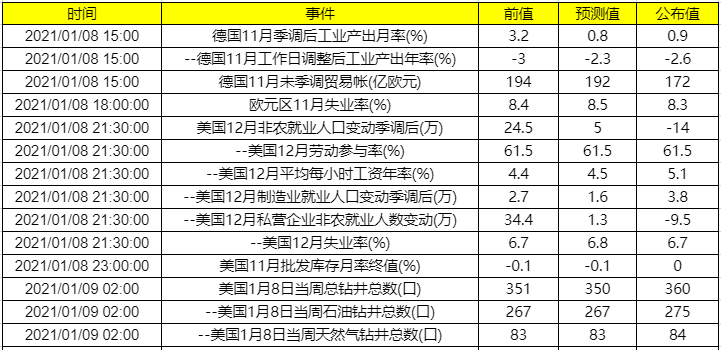
On the data side, Germany's unquarterly trade account in November (100 million yuan), the previous value of 194, is expected to be 192, announced 172. Germany's unseasonally adjusted current account in November (100 million yuan), with a previous value of 225, is expected to be 240. Germany's monthly industrial output rate after quarterly adjustment in November, the previous value of 3.20%, expected 0.7%, announced 0.9%, revised 3.4% (previous value).
The unemployment rate in the euro zone in November, which was 8.40%, is expected to be 8.50%, and reported 8.3%.
The unemployment rate in the United States in December, the previous value of 6.70%, is expected to be 6.80%, the release of 6.7%, the announcement of 213. Us non-farm payrolls (10,000) after quarterly adjustment in December, with a previous value of 24.5, expected to be 7.1, released-14. Us non-farm payrolls fell by 140000 after the December quarterly adjustment, the first decline since April last year.
Us Bureau of Labor Statistics: job losses in leisure, hotel and private education in December were partially offset by job growth in professional and business services, retail trade and construction. Non-farm payrolls were revised from 610000 to 654000 in October and from 245000 to 336000 in November. From March to November, the Bureau of Labor Statistics publishes an estimate of the unemployment rate that includes misclassified workers. If calculated in the same way, the overall unemployment rate in December would be 0.6 percentage points higher than reported. But this is the biggest error caused by the misclassification of the data. (the margin of error last month was 0.4 percentage points)
The overall Forexlive: data of Caijing Wang station is not good, but the positive correction in the past two months has mitigated the loss. The income data are interesting, but I tend to think it's because low-income workers have lost their jobs.
Analyst Chris Anstey: for economists who have not yet predicted the size of the bailout package after the Biden administration takes office, the non-farm payrolls report is likely to increase their expectations.
Analyst Chris Anstey: needs to note that even if non-farm payrolls fell in December and employment participation was flat from the previous month, the unemployment rate remained unchanged. This shows that the upward revision of employment in the previous two months basically offset the loss in December, keeping the unemployment rate flat.
Financial blog Zero hedging: as the outlook says, the December employment data will be a "very ugly number". A new economic stimulus package was passed at the end of last month, and further stimulus packages are likely in the coming months, and the prospect of vaccine-related normalization is still hovering in the future. Given all this, it is surprising that the non-farm figures for December are so bad.
[after the non-farm announcement] according to CME "Fed Watch", the probability of the Fed keeping interest rates in the range of 0% Mo 0.25% in January this year is 100%, and the probability of raising interest rates by 25 basis points to 0.25% Mo 0.5% is 0%. The probability of keeping interest rates in the range of 0% Mo 0.25% in March this year is 100%, and the probability of raising interest rates by 25 basis points is 0%. (all consistent with those before the non-agricultural announcement)
The monthly rate of wholesale sales in the United States in November, the previous value of 1.80%, is expected to announce 0.2%, revised 1.7% (previous value).
The total number of oil drilling in the United States in the week to January 8, with a previous value of 267, is expected to be 267, and 275 was announced.