Background: In recent years, new energy vehicles have developed rapidly, especially since the second half of last year, the demand has increased significantly, which result in the shortage of raw materials. Among that, cobalt, nickel and lithium resources are insufficient, and prices have risen sharply. In the long run, the cobalt, lithium, nickel raw materials will be in a tight balance in the next 5 years. For lithium batteries, which account for a relatively large material cost (occupies 85%), it will be difficult to reduce the cost in the next 5 years, which will put greater pressure on batteries and car companies.
In this case, CATL recently released sodium-ion batteries, whose relatively higher energy density, fast charging rate, better high and low temperature performance, sufficient resources and low prices have attracted great attention from the lithium battery industry.
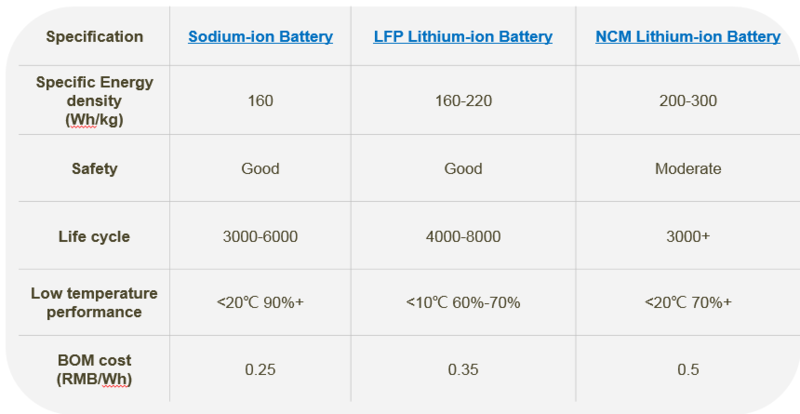
Sodium-ion battery specification
- Relatively higher specific energy density
The energy density of the battery cell has reached 160Wh/kg, which is higher of 120-130 Wh/kg, and is close to energy density of LFP&LMO battery cell ( Wh/kg).
- Good safety
The of sodium-ion battery is stable, although sodium-ion battery is easy to , its safety test performance is better than that of lithium-ion battery.
- Long Life cycle
The battery cell can achieve 3000-6000 , which is significantly higher than that of LCO and NCM battery cell. The life cycle is different in different scenarios, and the cycle will be longer with water cooling systems. It is expected to be more than 8,000 times in the future which is to LFP battery life cycle.
- Better low temperature performance
Discharge rate of Sodium-ion battery is 0.3c at -30 degrees, with a capacity retention rate of 80%. And at -20 degrees, capacity retention rate of Sodium-ion battery is above 90%, which is higher than that of Lithium-ion battery.
- Lower battery BOM cost
The Sodium-ion battery BOM cost is 0.25 RMB/Wh, which is lower than that of LFP battery (0.35 RMB/Wh). , the BOM cost of sodium-ion battery is 30% lower than that of LFP battery, but the current manufacturing costs of sodium-ion battery are still relatively high. BOM cost plus production costs of Sodium-ion battery are currently higher than that of LFP batteries, because Sodium-ion battery . But it is expected to reach to or lower than LFP battery around 2025.
- Sufficient raw material resources
The of sodium-ion battery are higher than lithium-ion battery, and the is lower. The global reserves of sodium are about 2.5% to 3%, which is about 1,000 times than that of lithium resources. In addition, sodium-ion battery almost use no rare metals, but mainly use metals such as iron, aluminum and manganese. These elements are relatively inexpensive compared to cobalt, nickel, lithium that used in lithium-ion battery and the huge market demand in the future.
Sodium-ion battery future application area
- Energy storage area
At present, the batteries energy storage market mainly use LFP battery and lead-acid battery. Lithium-ion battery are gradually replacing lead-acid batteries because of their high cycle life, safety and cost performance. From the perspective of cycle life, sodium-ion battery with more than 3,000 times can be used in 5G base stations, and their price may be lower than LFP batteries in 2025, or gradually replace LFP battery in 2025. Large energy storage (such as wind power photovoltaics, etc.) has higher requirements for life cycle, which is basically about 8,000 times, and its , or it is more inclined to use LFP battery with higher cycle life.
- Light electric vehiclesarea
Light electric vehicles require moderate life cycle (around 2000 times), lower battery cost and . Sodium-ion battery meet the requirement and its battery cost will be lower than LFP battery, so it may in light electric vehicles in 2025.
In conclusion, Sodium-ion battery will be applied to scenarios that do not require high energy density, but require cost-efficient and higher life cycle, such as energy storage,light electric vehicles, low-to-medium level new energy vehicles and construction machinery. It will not be able to replace the lithium-ion battery for a considerable period of time in the future, and it will be complementary to the lithium-ion battery.
![[SMM สรุปการประชุมเช้าโคบอลต์-ลิเธียม] แนวโน้มราคาวัตถุดิบแตกต่างกัน; แรงหนุนอุปสงค์-อุปทานสำหรับวัสดุแบตเตอรี่มีความแข็งแกร่งแตกต่างกัน](https://imgqn.smm.cn/usercenter/MaxcL20251217171730.jpg)
![[SMM สรุปการประชุมโคบอลต์ช่วงเช้า] อุปสงค์อ่อนแอและราคาวัตถุดิบที่ลดลงเพิ่มแรงกดดันในการระบายสต็อกทั่วทั้งห่วงโซ่อุตสาหกรรม](https://imgqn.smm.cn/usercenter/ZVhtl20251217171724.jpeg)
![บทวิเคราะห์ตลาดอิเล็กโทรไลต์และเซลล์แบตเตอรี่โซเดียมไอออนเดือนกันยายน: อิเล็กโทรไลต์มีแนวโน้มเติบโตด้านปริมาณ ขณะที่เซลล์แบตเตอรี่เผชิญแรงกดดันในช่วงฤดูพีค [บทวิเคราะห์ SMM]](https://imgqn.smm.cn/usercenter/oVqJl20251217171730.jpg)