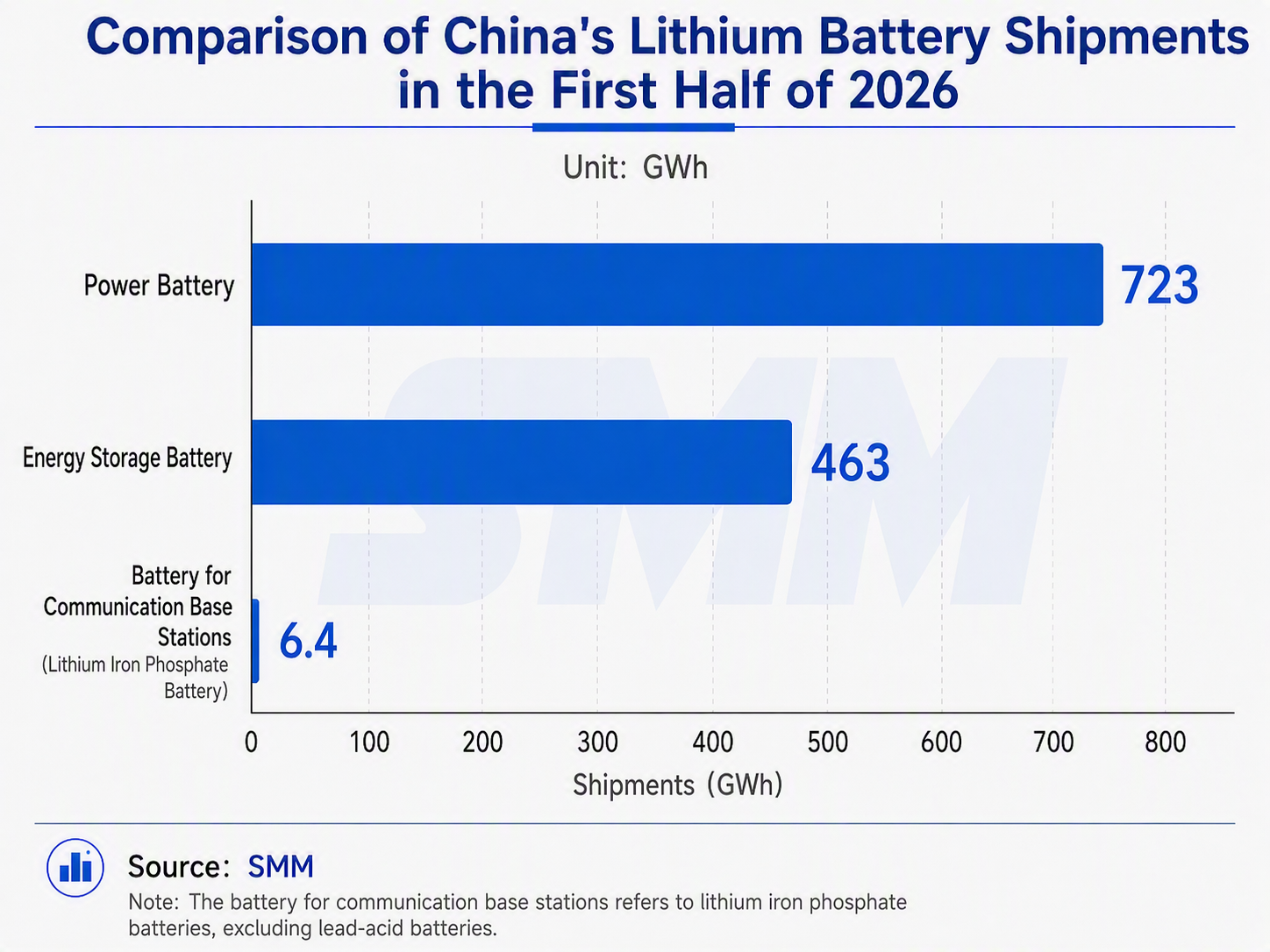
In H1 2026, China's lithium battery market continued to maintain a relatively high shipment scale. Application-wise, power batteries remained the primary demand source, with China's shipments reaching approximately 723 GWh in H1; ESS battery shipments were about 463 GWh, roughly 64% of the power battery scale.
Within the ESS battery segment, power generation and grid-side ESS, industrial and commercial ESS, and residential ESS accounted for the majority of shipment volumes, with utility-scale energy storage on the power generation and grid side attracting the most market attention. In comparison, telecom base station backup power had a significantly smaller volume; in H1 2026, LFP battery shipments for telecom base station backup power in China were approximately 6.4 GWh, representing about 1.4% of China's ESS battery shipments during the same period.
It should be noted that the telecom base station backup power market discussed in this article primarily adopts an LFP battery shipment caliber, and the aforementioned 6.4 GWh excludes lead-acid batteries. Lead-acid batteries are still present in some existing telecom sites, and their subsequent switch to LFP batteries represents a significant source of lithium battery demand for telecom backup power.
Telecom base station backup power is not a simple extension of utility-scale energy storage. Its demand sources, operating conditions, product requirements, and client systems are all highly independent. As China's telecom infrastructure construction gradually entered a mature stage, the market drivers were also shifting from new base station construction further toward existing asset replacement, lead-acid battery substitution, and site energy management capability enhancement.
I. Telecom Backup Power Has Formed a Relatively Independent Lithium Battery Application Market
In terms of scale, telecom backup power, power batteries, and utility-scale energy storage are not on the same order of magnitude.
According to SMM data, in H1 2026, China's power battery shipments were approximately 723 GWh, and ESS battery shipments were about 463 GWh, while LFP battery shipments for telecom base station backup power were around 6.4 GWh. The shipment scale of LFP batteries for telecom backup power was equivalent to only about 0.9% of power battery shipments, and accounted for approximately 1.4% of ESS battery shipments.
This difference first stems from the application scenarios.
Power battery demand is directly linked to the production and sales of NEVs, while electricity storage batteries mainly serve new energy absorption, power grid regulation, and behind-the-meter energy management. Although telecom base station backup power falls within the energy storage application category, its primary task is to ensure continuous operation of telecom equipment during grid power abnormalities, and its demand formation mechanism differs significantly from that of utility-scale energy storage.
For utility-scale energy storage, new energy installations, power market mechanisms, peak-valley price spreads, and project yields all directly influence project investment and battery demand; in contrast, telecom base station backup power is more akin to an infrastructure assurance-type demand, with its deployment primarily determined by telecom network reliability requirements and site backup power needs.
Therefore, on one hand, communication backup power will not see a short-term demand surge of tens or even hundreds of GWh like utility-scale energy storage, driven by centralized construction of large projects; on the other hand, the massive existing communication infrastructure ensures a long-term need for continuous equipment renewal and battery replacement.
Limited scale but sustained demand is a key market characteristic distinguishing communication backup power from utility-scale energy storage.
II. Differences in Operating Conditions Determine Mainstream Product Logic
Both utility-scale energy storage and communication backup power widely use LFP batteries, but their current mainstream operating conditions differ significantly, leading to distinct product priorities.
Currently, utility-scale energy storage cells are continuously upgrading to large-capacity products of 314Ah and above 500Ah, with product development focused on reducing system integration costs, improving cycle life, enhancing energy efficiency, and lowering the levelized cost of electricity over the full life cycle.
This is because utility-scale energy storage typically needs to participate in power regulation or generate project revenue through continuous charging and discharging. Under high cycling frequency, battery cycle life, capacity degradation, charge/discharge efficiency, and system availability directly impact project economics.
Communication base station backup power is different.
For most traditional communication sites, the primary function of the battery remains emergency backup. Under normal grid conditions, the battery is in standby mode for long periods, with actual deep charge/discharge frequency significantly lower than that of utility-scale energy storage.
Therefore, mainstream communication backup power products at this stage focus more on long-term reliability, capacity retention, environmental adaptability, system stability, and ease of operation and maintenance, rather than solely pursuing extremely high cycle times and the lowest levelized cost of electricity.
Particularly in outdoor sites, remote area sites, and unmanned sites, extreme temperatures, long-term online operation, equipment aging, and maintenance costs all place high demands on battery stability.
However, this difference is not absolute.
As some communication sites gradually acquire more refined energy management capabilities, if the battery needs to undertake more active charging and discharging tasks, the importance of its cycle life, energy efficiency, and battery management capabilities will correspondingly increase.
Therefore, future communication backup power products are more likely to exhibit a degree of demand stratification: traditional backup-type products will continue to prioritize reliability and standby capability, while sites equipped with energy management functions will place greater emphasis on cycle life, energy efficiency, and full life cycle usage costs.
This means that significant differences still exist between communication backup power and utility-scale energy storage in mainstream product logic, but as application scenarios extend, some product performance requirements may also show a certain degree of convergence.
III. Demand Focus Shifts from New Construction to Existing System Replacement
After years of construction, China's communication network has built up a massive existing base station inventory.
In the early stages of industry construction, communication backup power demand largely followed the growth in new base station numbers. With the large-scale deployment of 4G and 5G networks nearing completion, the room for high-speed demand growth solely driven by new sites has narrowed.
Against this backdrop, the demand structure for LFP batteries in communication backup power is changing.
Currently, lithium battery demand for domestic communication base station backup power mainly comes from three sources.
First is the supporting demand for new communication facilities.
As 5G networks continue to improve, there is still some network filling, coverage optimization, and construction of new-type communication infrastructure in certain regions, so new base stations will still bring some battery configuration demand. However, compared to the large-scale network construction phase, the marginal contribution of new sites to overall demand has already declined.
Second is the renewal demand for existing LFP batteries.
As early-deployed communication backup lithium batteries gradually enter the mid-to-late stages of their life cycle, some batteries experience capacity degradation and performance decline, requiring replacement. Given the vast number of communication base stations, even a low annual replacement rate can still generate sustained battery demand.
Third is the switch from existing lead-acid batteries to LFP batteries.
Lead-acid batteries have long been an important technology route for communication backup power, characterized by technical maturity and relatively low initial procurement costs. However, they have limitations in terms of weight, volume, service life, and maintenance requirements.
In contrast, LFP batteries offer certain advantages in energy density, service life, maintenance convenience, and environmental adaptability. As the lithium battery industry chain continues to mature and battery costs decline, there is still room for LFP batteries to further increase their penetration rate during the renewal of some existing sites.
Therefore, future assessment of lithium battery demand for communication base station backup power can no longer be simply based on new base station numbers.
After the growth of new base stations gradually stabilizes, the existing lithium battery replacement cycle, the scale of existing lead-acid batteries, and changes in LFP penetration rate will become more important variables influencing communication backup power shipments.
The demand logic of the communication backup power market is also shifting from being mainly driven by new construction in the past to being jointly driven by new supporting facilities and existing system replacement.
IV. Dispersed Site Characteristics Limit Market Size Ceiling
Although the number of communication base stations in China is huge, it cannot be simply equated to huge annual battery demand.
This is a significant difference from utility-scale energy storage.
Utility-scale energy storage is highly project-based. A single energy storage project can have a capacity of hundreds of MWh, with large-scale projects even reaching the GWh level. Once projects enter the construction and delivery phase in a concentrated manner, they can generate very substantial battery demand in a relatively short time.
Communication base stations, on the other hand, exhibit typical characteristics of being dispersed, small-capacity, and multi-site.
The backup power capacity of a single communication site is limited. Even with a huge national total, when converted to per-site battery configuration, the overall demand scale is still significantly lower than that of utility-scale energy storage.
At the same time, communication backup power equipment typically has a long service life. The construction time, operating environment, and equipment status of different base stations are not uniform, so existing batteries will not enter the replacement cycle in a concentrated manner within a single year; instead, demand is released gradually over an extended period.
Therefore, there is no simple linear relationship between the number of communication base stations and annual battery shipment volume.
This also determines that communication backup power can hardly replicate the development path of utility-scale energy storage in recent years, which achieved rapid volume growth through centralized project construction.
Its market is closer to a continuous renewal demand based on a huge existing base: individual project scale is relatively small, and demand is scattered, but a large number of existing sites collectively form a stable long-term battery replacement foundation.
From this perspective, the 6.4 GWh LFP battery shipment scale in H1 2026 does not indicate insufficient application space for communication backup power, but rather reflects its market characteristics of limited per-site capacity, highly dispersed demand, and relatively long equipment renewal cycles.
This also determines that communication backup power is more appropriately viewed as a stable niche market, rather than being judged by the growth logic of utility-scale energy storage.
V. Energy Management is an Extension of Backup Function, Not a Change in Mainstream Operating Conditions
Besides equipment renewal and technology replacement, there is also potential for further extension in the usage modes of batteries at communication sites.
Traditional communication backup power systems primarily perform the function of emergency power supply. Under normal grid conditions, the battery is in standby mode most of the time, resulting in relatively low asset utilization.
As base station energy management systems gradually improve, some sites are beginning to have more refined battery condition monitoring and charge/discharge management capabilities. On the premise of ensuring backup capacity and communication security, some sites with suitable electricity price conditions, load characteristics, and battery configurations can further carry out a certain degree of energy optimization.
For example, by optimizing battery charging periods and site electricity consumption strategies while ensuring necessary backup power, electricity costs can be reduced, and the utilization efficiency of existing battery assets can be improved.
However, this does not mean that communication base stations will generally switch to a high-frequency cycling operation mode similar to utility-scale energy storage.
First, communication security remains the primary constraint for site battery operation. Regardless of the energy management model adopted, sufficient backup capacity must be retained as a priority to deal with abnormal situations such as grid power outages.
Second, different sites vary greatly in terms of peak-valley electricity prices, grid stability, load levels, and equipment configuration. Not all base stations have the conditions to obtain economic benefits through frequent charging and discharging.
Therefore, energy management is more likely to become an additional function for some suitable sites, rather than a fundamental shift in the overall operation mode of the communication backup power market.
For sites undertaking more frequent charging and discharging tasks, the requirements for cycle life, energy efficiency, battery management systems, and operational strategies will correspondingly increase, thus forming a segmented demand distinct from traditional backup-type products.
From this perspective, the product system for communication base station batteries might gradually differentiate from relatively single backup demand to different application tiers: traditional sites will continue to prioritize reliable backup, while some energy-management-type sites will further emphasize cycle performance and asset utilization efficiency.
VI. Communication Backup Power is Closer to a Stable Niche Market
From the shipment structure in H1 2026, communication base station backup power accounts for a relatively low proportion of the overall lithium battery market, not on the same order of magnitude as power batteries and electricity ESS.
However, the relatively small market size does not mean this field lacks independent value.
The demand formation mechanism for communication backup power is significantly different from that of utility-scale energy storage. Its growth does not mainly rely on the centralized implementation of large projects, but is more influenced by factors such as the scale of existing communication infrastructure, equipment renewal cycles, lead-acid battery replacement, and changes in lithium battery penetration rates.
Therefore, as China's communication network construction gradually enters a mature stage, the core variable of the communication backup power market is shifting from the number of new base stations to the structure of existing equipment and the pace of replacement.
To judge this market in the future, it is inappropriate to focus solely on the annual number of new communication base stations. More attention needs to be paid to the speed at which early-deployed lithium batteries enter the renewal cycle, the replacement process of existing lead-acid batteries, and the change in the penetration rate of LFP batteries in the communication backup power field.
At the same time, improved site energy management capabilities may bring new usage scenarios for some communication batteries, but its essence still needs to comply with communication reliability requirements and will not transform the entire industry into a high-cycling application market similar to utility-scale energy storage.
For lithium battery enterprises, communication base station backup power is unlikely to become a scale market comparable to power batteries or utility-scale energy storage, but it has a huge existing base, continuous equipment renewal demand, and a relatively independent product and client system.
Compared to relying on new projects for rapid expansion, communication base station backup power is closer to a stable niche market continuously supported by existing system renewal, technology replacement, and increasing lithium battery penetration.
SMM New Energy Industry Research Department
Wang Cong 021-51666838
Ma Rui 021-51595780
Feng Disheng 021-51666714
Lyu Yanlin 021-20707875
Zhang Haohan 021-51666752
Wang Zihan 021-51666914
Wang Jie 021-51595902
Xu Yang 021-51666760
Chen Bolin 021-51666836
Yang Le 021-51595898
Li Yisha 021-51666730
Huang Chencong 021-51595860
![[Análise SMM] Mandrake inicia produção de salmoura em Evelyn Chambers, Utah](https://imgqn.smm.cn/usercenter/WyqWW20251217171729.jpg)
![[SMM Analysis] Corica conquista contrato de serviços de mineração a céu aberto de US$ 348 milhões no Projeto de Lítio Goulamina, Mali](https://imgqn.smm.cn/usercenter/wZUBk20251217171729.jpg)