SMM10 March 19: on Friday, the outer plate metal green fat was red and thin, Lunqin fell 1.85%, Lunzn Copper fell 0.75%, Lunxi fell 0.61%, Lunxi fell 0.22%, Lunxi Aluminum rose 0.49%, Lunnickel rose 1.85%, Len Aluminum closed higher on Friday and hit an intraday high of more than 17 months. Strong demand from China, the main consumer country, expectations of economic growth and rising demand in other parts of the world, and a weaker dollar, all contributed to the buying momentum. The purchase momentum was boosted by strong demand from China, a major consumer country, expectations of rising economic growth and demand in other parts of the world, and a weaker dollar. There are ups and downs in the domestic metal market, with Shanghai lead down 1%, Shanghai Copper down 0.45%, Shanghai Zinc down 0.37%, Shanghai Tin down 0.35%, Shanghai Nickel up 0.67%, Shanghai Aluminum up 1.23%.
The dollar index fell 0.09 per cent to 93.70, with weekly gains narrowing to 0.69 per cent. The euro rose 0.09 per cent to $1.1718 against the dollar; the euro fell 0.9 per cent this week, supported by previous buying below 1.1700, and options-related selling around 1.1800 limited gains. Previously released data showed better-than-expected growth in US retail sales and a slight rise in consumer confidence in early October. The pound held steady as traders remained hopeful about the prospect of a trade deal between the UK and the EU and the two sides would continue negotiations next week. The Swedish krona and the Canadian dollar led the rise in the Gmure 10 currency, with the Australian dollar falling the most.
The three major indexes of US stocks closed mixed. The Dow closed up 112.10 points, or 0.39%, at 28606.31; the S & P 500 closed up 0.50 points, or 0.01%, at 3483.81; and the NASDAQ closed down 42.30 points, or 0.36%, at 11671.56. Us retail sales beat expectations in September. Big companies such as Boeing and Pfizer issued optimistic statements. Us fiscal stimulus talks remain deadlocked and Republicans are divided over the size of the package.
Precious metals fell on Friday, and analysts believe the main reason for gold's decline this week is the appreciation of the dollar. Gold futures markets have generally fluctuated in a narrow range this week due to volatility in expectations of the US fiscal stimulus package, a surge in global coronavirus cases and pre-election unease in the US. The gold market is clearly waiting for a new catalyst to determine the future direction.
Crude oil closed slightly lower on Friday, but crude oil futures prices rose for the second week in a row on concerns that a surge in global coronavirus infections would prompt countries to impose new economic blockades, leading to a drop in energy demand. But oil prices were supported by a decline in US crude inventories last week and new signs of OPEC+ 's commitment to abide by the production reduction agreement. (JMMC), the OPEC+ 's joint ministerial oversight committee, will consider the outlook when it meets on Monday; JMMC can make policy recommendations; and OPEC+ plans to reduce production by 2 million b / d from 2021, compared with the current 7.7 million b / d.
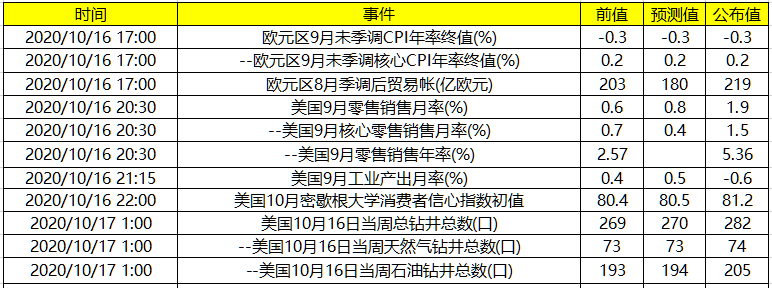
In terms of data, the monthly CPI rate of the euro zone in September, the previous value of 0.10%, is expected to be 0.10%, and 0.1% is announced. Euro zone quarterly adjusted trade account (100 million yuan) in August, with a previous value of 203, expected to be 180, announced 219. The euro zone's final annual CPI rate in September, with a previous value of-0.30%, is expected to be-0.30%, and is reported to be-0.3%.
The euro zone recorded a quarterly adjusted trade account of 21.9 billion ou yuan in August, the highest level since March 2020. Forexlive commented on the euro zone's quarterly adjusted trade account in August: exports increased by 2% year-on-year, while imports increased by 0.5% year-on-year, resulting in a large trade surplus in August. The good news is that both sides are improving and they are slowly returning to pre-epidemic levels. But there will be more questions about the pace of recovery in the fourth quarter, so this will be the focus now, rather than the more optimistic outlook for the third quarter.
The monthly rate of retail sales in the United States in September, with a previous value of 0.60% and an expected rate of 0.70%, was announced at 1.9%.
CNBC reviews monthly retail sales rate in September: consumer spending grew much faster than expected in September, with retail sales up 1.9%, indicating that the biggest driver of the u.s. economy is still healthy.
The monthly rate of US industrial output in September, the previous value of 0.40%, is expected to be 0.5%, reported-0.6%.
Federal reserve: us industrial output fell at a monthly rate of 0.6% in September, the first decline after four consecutive months of growth. Most major market sectors fell in September. The consumer goods index fell 1.6%, led by automotive products and consumer energy products, down more than 4%. Production of commercial equipment decreased by 1.2 per cent as the decrease in information processing equipment was partially offset by an increase in transport equipment. Output of defence and space equipment increased by 2.1 per cent, while the construction supply and materials index remained virtually unchanged.
Monthly commercial inventory rate in the United States in August, previous value 0.10%, expected 0.40%, announced 0.3%, revised-5.5% (previous value).
The preliminary consumer confidence index of the University of Michigan in October, the previous value of 80.4, is expected to be 80.5, released 81.2.
Richard Curtin, chief consumer economist, commented on the preliminary consumer confidence index of the University of Michigan in October: slowing job growth, a rise in COVID-19 infection and no additional federal aid, all of which have prompted consumers to pay more attention to the current economic situation. But these concerns have been largely offset by a modest rise in the economic outlook for the coming year.
The total number of oil drilling in the United States in the week to October 16, with a previous value of 193, is expected to be 194, announced 205.
Baker Hughes oil suit: us oil companies have added drilling rigs for the fourth week in a row. The number of oil and gas rigs in the US increased by 13, the biggest weekly increase since January.