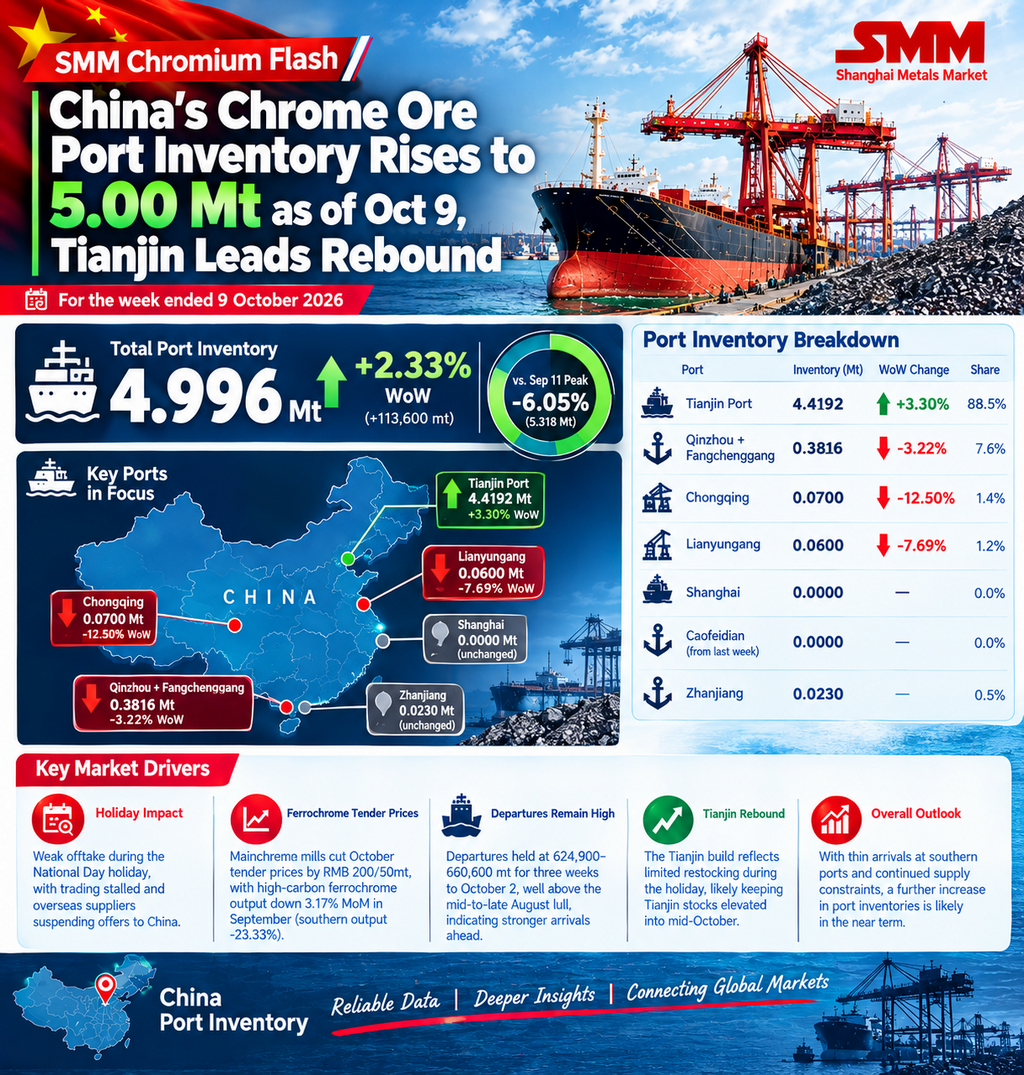
[SMM Chromium Flash] China’s Chrome Ore Port Inventory Rises to 5.00 Mt as of Oct 9, Tianjin Leads Rebound

Published: Oct 12, 2026 20:10 (GMT+8)

As of October 9, 2026, China’s total chrome ore inventory at ports rose to 4.996 million mt, up 113,600 mt (+2.33%) from 4.882 million mt on September 30, the first increase after three straight weekly declines. The comparison spans the National Day holiday, with the prior dataset cut on September 30. Stocks remain 321,800 mt (-6.05%) below the September 11 peak of 5.318 million mt.

Tianjin Port accounted for the entire rebound, rising 141,300 mt (+3.30%) to 4.4192 million mt, lifting its share of the national total to 88.5% from 87.6%. Other ports drew a combined 27,700 mt: Qinzhou plus Fangchenggang fell 12,700 mt (-3.22%) to 381,600 mt, Chongqing fell 10,000 mt (-12.50%) to 70,000 mt, and Lianyungang fell 5,000 mt (-7.69%) to 60,000 mt. Shanghai, Caofeidian and other ports, and Zhanjiang were unchanged.

The Tianjin build reflects weak offtake during the holiday. Trading stalled, overseas suppliers suspended offers to China, and smelters made only small restocking purchases. Mainstream mills had cut October ferrochrome tender prices by RMB 200 per 50mt unit, and high-carbon ferrochrome output fell 3.17% MoM in September on cost inversion, with southern output down 23.33%, which likely left southern ports with thin arrivals rather than strong consumption. Departures also held at 624,900-660,600 mt for three weeks to October 2, well above the mid-to-late August lull, so stronger arrivals are likely to keep Tianjin stocks elevated into mid-October.
Data Source Statement: Except for publicly available information, all other data are processed by SMM based on publicly available information, market communication, and relying on SMM's internal database model. They are for reference only and do not constitute decision-making recommendations.

For any inquiries or for more information, please contact: lemonzhao@smm.cn
For more information on how to access our research reports, please contact:service.en@smm.cn
Related News
[SMM Chromium Flash] South Africa's Ferrochrome Revival Depends on More Than Cheaper Power
34 mins ago
[SMM Chromium Flash] South Africa's Ferrochrome Revival Depends on More Than Cheaper Power
Read More
[SMM Chromium Flash] South Africa's Ferrochrome Revival Depends on More Than Cheaper Power
[SMM Chromium Flash] South Africa's Ferrochrome Revival Depends on More Than Cheaper Power
South Africa’s ferrochrome industry faces a broader competitiveness challenge despite progress on electricity-cost relief, according to discussions at Project Blue’s Critical Materials Conference in Johannesburg on September 8–9, reported by Engineering News on October 9. The negotiated electricity tariff of around 62 cents/kWh for selected ferrochrome smelters, subject to regulatory approval, offers potential relief to producers facing high operating costs. However, industry participants stressed that lower power costs alone will not guarantee a sustained recovery, as logistics efficiency, plant performance, access to capital and policy certainty remain critical to the viability of domestic smelting. The challenge reflects a structural imbalance in the chromium value chain: South Africa remains a major chrome ore supplier, while China has become the leading ferrochrome producer, supported by processing scale and proximity to stainless-steel demand. A durable recovery in South African smelting therefore depends on whether tariff relief can be complemented by reliable transport, efficient operations and investment in existing capacity. For the chrome market, a sustained increase in domestic ferrochrome production could redirect some ore towards local furnaces rather than exports, although the scale and timing of any change will depend on actual smelter utilization and market conditions.
34 mins ago
SMM Rhenium Market Analysis
4 hours ago
SMM Rhenium Market Analysis
Read More
SMM Rhenium Market Analysis
4 hours ago
[SMM Chromium Flash] Global Chrome Ore Departures Surge 32.16% WoW to 849,100 mt, Richards Bay Leads Gains
5 hours ago
[SMM Chromium Flash] Global Chrome Ore Departures Surge 32.16% WoW to 849,100 mt, Richards Bay Leads Gains
Read More
[SMM Chromium Flash] Global Chrome Ore Departures Surge 32.16% WoW to 849,100 mt, Richards Bay Leads Gains
[SMM Chromium Flash] Global Chrome Ore Departures Surge 32.16% WoW to 849,100 mt, Richards Bay Leads Gains
Global chrome ore departures totaled 849,100 mt in the week ended October 9, up 32.16% week-on-week, according to SMM’s latest data. This is the highest weekly volume among the past 10 weeks of data, ahead of the 717,000 mt recorded in the week ended August 7. Unlike recent weeks, the increase was not driven by Maputo, as three of the four tracked ports posted gains while Maputo moved lower. Richards Bay led the rebound, with departures rising 182.76% to 270,600 mt from 95,700 mt, lifting its share of total departures to roughly 32% from about 15% a week earlier. The sharp swing, following a 57.99% decline the prior week, reinforces the intermittent, batch-driven loading pattern seen at the port in recent weeks. Mersin also climbed 92.24% to 111,500 mt from 58,000 mt, its highest weekly volume over the same period. Beira resumed shipments with 34,400 mt after four consecutive weeks of zero departures, its second active week in the series. Maputo departures eased 11.50% to 432,600 mt from 488,800 mt, and its share of total departures narrowed to roughly 51% from about 76% the previous week. The port nonetheless remained the largest single corridor, with volumes still well above the 340,200 mt recorded in the week ended September 25. Overall, the week’s data points to a broader distribution of seaborne chrome ore flows from Southern Africa, with the strength in total departures coming from the secondary ports rather than from Maputo. Whether Richards Bay and Mersin can sustain these elevated volumes will be a key factor for regional shipment levels in the weeks ahead.
5 hours ago