The ammonium perrhenate market has shown a notable divergence between domestic and overseas markets recently. Driven by sentiment from news on critical mineral cooperation, overseas prices have moved higher, while the domestic market remains weak constrained by fundamentals amid persistent supply-demand tensions.
Following the signing of a critical minerals framework agreement between the United States and Colombia, trading sentiment in the overseas ammonium perrhenate market has received some support, with overseas quotes rising to around USD 5,600–5,850 per kilogram. This price movement is largely fuelled by expectations surrounding the framework agreement. Market participants anticipate restructuring of the global critical minerals supply chain and shifts in rhenium supply patterns, prompting overseas traders to lift offers amid improved sentiment. It should be noted, however, that the agreement remains at the framework stage. A lengthy timeline is required from resource development and capacity ramp-up to tangible supply of rhenium feedstock. There may be limited material changes to supply volumes in the short run. Whether overseas prices can sustain the current range remains subject to verification by subsequent project implementation.
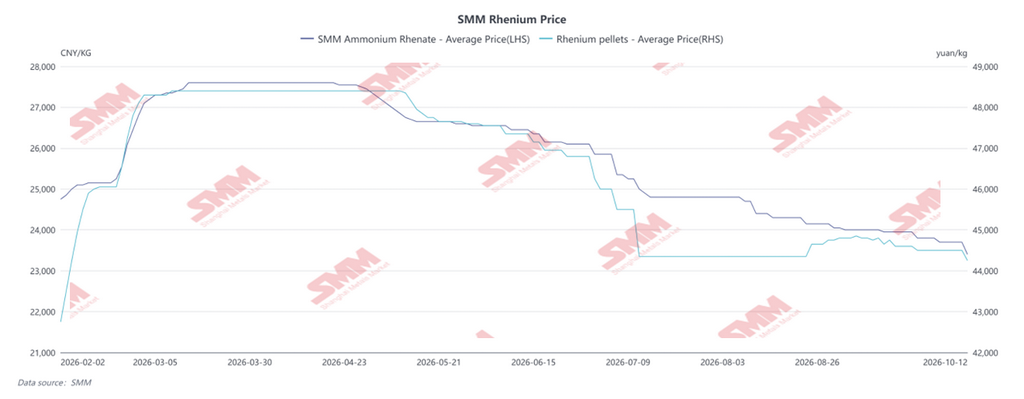
In contrast, the domestic ammonium perrhenate market is experiencing a gradual downtrend with muted trading activity. Downstream end-users such as superalloy producers demonstrate subdued purchasing appetite. Most enterprises only conduct routine restocking to meet essential production needs and place small orders on demand. No large-scale bulk procurement orders have emerged, leaving the demand side without strong momentum.
Inventory pressure among midstream players constitutes a key factor shaping the current domestic market. Many midstream companies still hold high-cost inventories built up in previous periods and maintain a cautious operating stance. On one hand, enterprises remain restrained from fresh feedstock purchases given the lack of visible improvement in downstream demand. On the other hand, they are reluctant to liquidate stocks at a discount to avoid losses. Consequently, listed market quotes stay relatively firm, creating a scenario of “firm offers but sluggish transactions”. Actual transaction prices carry room for negotiation, leading to discrepancies between listed offers and concluded deal prices.
Another noteworthy trend in the domestic market is the substantial price gap between investment-grade and industrial-grade materials. Some traders and market participants adopt toll processing of rhenium-bearing scrap to produce rhenium pellets and rhenium plates. The cost advantage of scrap feedstock versus primary ammonium perrhenate creates a marked price differential between products from this processing route and industrial quotes based on virgin materials. This diversifies supply sources and further widens price gaps across different supply channels, adding complexity to market price assessment.
Overall, domestic and overseas ammonium perrhenate markets are driven by different factors. Overseas pricing is mainly boosted by policy sentiment around critical minerals, whereas domestic market performance is constrained by genuine end-user demand. Without strong positive catalysts in the short term, the domestic market is likely to stay in a weak volatile pattern.
![[SMM Chromium Flash] Global Chrome Ore Departures Surge 32.16% WoW to 849,100 mt, Richards Bay Leads Gains](https://imgqn.smm.cn/usercenter/HBsPu20251217171723.jpeg)
![Cast aluminum midday gains 0.67%, cost support pushes ADC12 center slightly higher [ADC12 Price Daily Review]](https://imgqn.smm.cn/usercenter/teIej20251217171724.jpeg)