SMM, October 8:
In the metals market:
From October 1 to October 7, China was on its National Day holiday, with the domestic market closed and trading suspended.
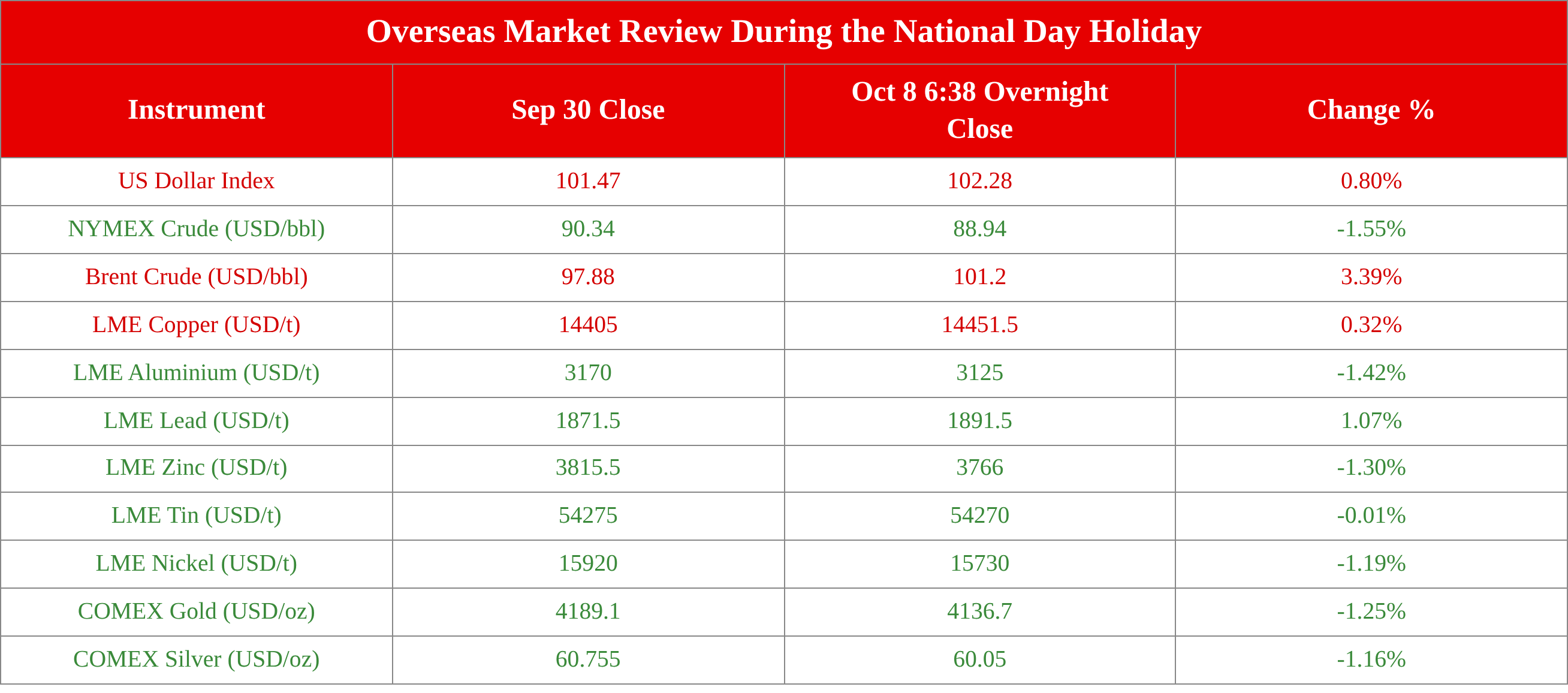
In overseas base metals, prices broadly fell during the National Day holiday, with LME copper the only gainer, up 0.32%, while all other metals declined. LME aluminum, LME lead, LME zinc, and LME nickel all fell more than 1%, with LME aluminum down 1.42%, LME lead down 1.07%, LME zinc down 1.3%, LME nickel down 1.19%, and LME tin edging down 0.01%.
Overseas precious metals fluctuated slightly overall, with COMEX gold down 1.25% and COMEX silver down 1.16% during the holiday. On Wednesday, the US dollar and Treasury yields moved higher again, putting gold prices under pressure. The World Gold Council reported that global gold ETFs attracted $10 billion of inflows in September, pushing Q3 inflows to a record $31 billion, led by funds listed in Europe and North America. Despite the decline in gold prices, global gold holdings still increased by 67 mt to a record 4,256 mt, while total assets under management fell 7% MoM to $574 billion. At the country and regional level, record Q3 inflows were led by the US, followed by strong contributions from UK-listed funds. The UK recorded its strongest quarter ever, helping Europe reach the same milestone at the regional level. (Jin10 Data APP)
According to the Financial Times, Intercontinental Exchange (ICE) has begun offering gold futures trading in London, the latest attempt to introduce precious metals derivatives in this global physical bullion trading hub. The exchange launched precious metals contracts this week linked to London's daily auction prices. In addition to gold, the company also launched contracts for silver, platinum, and palladium. London is the world's largest physical gold trading market, with daily OTC trading volume approaching $190 billion and physical gold worth about $1.4 trillion stored in its vaults. However, unlike New York, London has not offered gold futures contracts in recent years, and previous attempts have all ended in failure. (Jin10 Data APP)
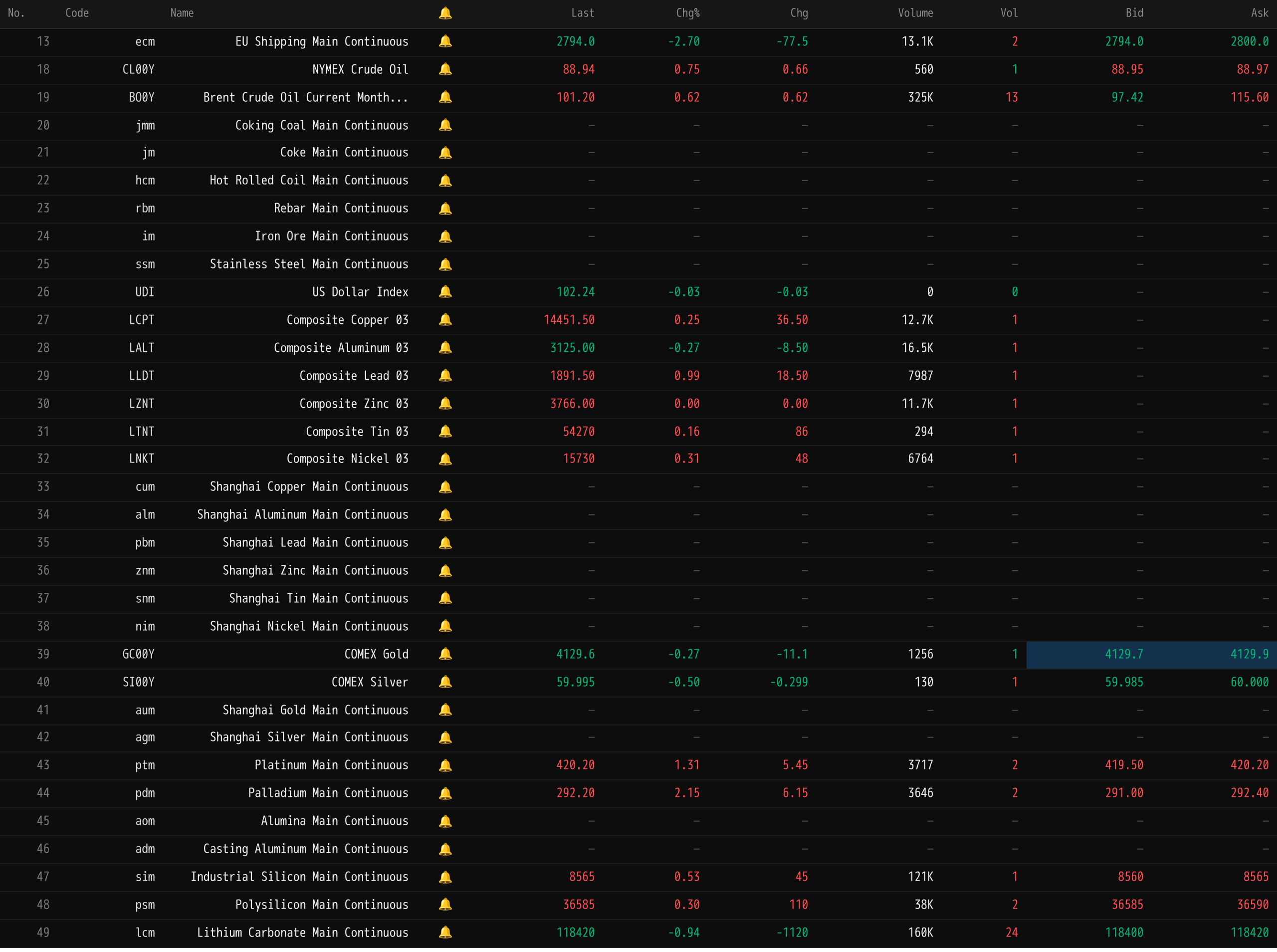
Overnight closing prices as of 6:38 on October 8:
Macro front
In China:
[Qiushi Journal publishes General Secretary Xi Jinping's important article "Strengthening Inclusive, Basic, and Bottom-line Livelihood Construction"]The 19th issue of Qiushi Journal, published on October 1, will feature an important article by Xi Jinping, General Secretary of the CPC Central Committee, President of the People's Republic of China, and Chairman of the Central Military Commission, titled "Strengthening Inclusive, Basic, and Bottom-line Livelihood Construction."The article pointed out that we must adhere to a people-centered approach, strengthen the development of inclusive, foundational, and comprehensive livelihood programs, realize, safeguard, and advance the fundamental interests of the broadest majority of the people, focus on resolving the pressing difficulties and problems that concern the people most, improve the basic public service system, raise the level of public services, enhance balance and accessibility, and steadily promote common prosperity. We must hold the bottom line, highlight key areas, improve institutions, and guide expectations, coordinate work in education, income distribution, employment, social security, healthcare, housing, and other areas, continuously make new progress in ensuring access to childcare, education, employment, medical services, elderly care, housing, and support for the vulnerable, and continuously promote social fairness and justice so that the people's sense of fulfillment, happiness, and security becomes more substantial, more secure, and more sustainable. (Jin10 Data APP)
[Cross-regional passenger flow nationwide to exceed 300 million on the sixth day of the National Day holiday] On the sixth day of the National Day holiday, return travel passenger flows across various regions stayed high. According to the Ministry of Transport, nationwide cross-regional passenger flow is expected to exceed 300 million. On that day, national railways were expected to carry 22.1 million passengers, with plans to add 2,199 additional passenger trains. On the road side, return traffic showed a dispersed release trend, with 44 expressway sections nationwide prone to congestion that day, mainly concentrated in Jiangsu, Guangdong, Hunan, Anhui, and other provinces. National civil aviation passenger volume was expected to reach 2.471 million that day, with popular routes mainly including Shenzhen-Shanghai, Beijing, Hangzhou; Shanghai-Guangzhou, Beijing, and others. On the waterway side, waterway passenger volume was expected to reach 1.39 million, up 25.3% YoY. (CCTV News) (Jin10 Data APP)
US dollar:
During the National Day holiday, the US dollar index stayed high, briefly rising to an intraday high of 102.54 on October 5, a fresh high of more than one year since April 11, 2025. Although the subsequent gains pulled back slightly, it was still markedly higher than the 101.47 level before the holiday. Despite the market's expectations for a Fed rate hike at this month-end meeting having cooled significantly, concerns over eurozone debt and the US ISM September services data released on Monday showed that cost pressure recorded the largest increase in more than four years last month, supporting the prospect of further Fed rate hikes and helping the dollar break through the 102 integer level on October 5. On a monthly basis, the US dollar index rose 2.06% in September.
Fed policymakers were divided last month on the case for rate hikes. "Some participants" believed that rate hikes were necessary to curb the impact of energy and other price shocks, while more hawkish officials argued that rate hikes were needed to guard against emerging demand-driven inflation. The US Fed voted unanimously to raise interest rates by 25 basis points at its September meeting, but officials were divided over whether the move was a precautionary measure or signalled a shift toward significantly tighter policy. This divergence, along with officials' differing assessments of current economic conditions, suggests that the October meeting could involve intense debate. The minutes stated: "Many participants stressed that, from a risk-management perspective, a path of raising the target range for the federal funds rate was prudent, providing insurance against the risk of inflation remaining above target due to stronger-than-expected demand or further adverse supply shocks." Other participants believed the rate hike was important to prevent recent energy and other shocks from having a broader impact on prices; two other participants said they supported the hike because it was in line with their judgement that estimates of the neutral interest rate had risen. The minutes stated: "Several participants indicated that they viewed the current policy rate as not restrictive, or only mildly restrictive." "Most participants judged that another increase in the target range before the end of the year would likely be appropriate." (Jin10 Data APP)
According to the minutes released today, US Fed officials expected to raise interest rates again before the end of the year to curb inflation that had remained above target for more than five consecutive years. However, the minutes did not show exactly when policymakers expected to hike, only indicating that persistently elevated prices and a stable labour market could prompt the US Fed to carry out a second rate increase this year. The minutes stated: "Regarding the outlook for monetary policy beyond this meeting, most participants judged that another increase in the target range for the federal funds rate before the end of the year would likely be appropriate." "However, participants stressed that they would approach each meeting with an open mind, and that decisions at future meetings would depend on newly available information and its implications for the economic outlook and the balance of risks." Discussion at the September meeting showed that officials saw risks of inflation continuing to display stickiness, while the labour market was "near full employment" and overall economic growth had also picked up. The minutes stated: "Many participants stressed that, from a risk-management perspective, a path of raising the target range for the federal funds rate was prudent, providing insurance against the risk of inflation remaining above target due to stronger-than-expected demand or further adverse supply shocks." (Jin10 Data APP)
According to CME "FedWatch": the probability of the US Fed keeping rates unchanged through October was 80.6%, and the probability of a cumulative 25-basis-point hike was 19.4%. The probability of the US Fed keeping rates unchanged through December was 21.7%, the probability of a cumulative 25-basis-point hike was 64.1%, and the probability of a cumulative 50-basis-point hike was 14.2%. (Jin10 Data APP)
San Francisco Fed President Daly said that chip demand driven by the AI boom may spread from high-end AI chips to the broader semiconductor market, and some enterprises have already begun locking in memory chip supply in advance, even redesigning products to reduce chip usage. She believes that the price pressure brought by this round of AI may not be a one-time shock, and the time needed for it to ease may exceed the one-to-three-year horizon the US Fed typically assumes. Daly said she fully supported the US Fed's rate hike in September, and whether further action is needed will depend on whether shocks such as AI, tariffs, and higher energy prices driven by the Middle East conflict can fade; if these factors persist longer or compound with each other, further policy tightening may be needed, but if the shocks are only temporary, there may be no need to continue raising rates. (Jin10 Data APP)
On the data front, the US September ISM services PMI fell to 54.9, but the prices index surged to 74, a four-year high, as the services expansion slowed while cost pressure rebounded; the employment report released by the US Labor Department last Friday showed that nonfarm payrolls increased by 29,000 in September, while August payrolls were revised down to an increase of 133,000. Economists noted that fluctuations caused by the government's seasonal adjustment model (used to strip out seasonal fluctuations in the data) may be the reason why September payrolls only edged up and August employment data was revised down. When the Labor Day holiday falls in the middle or at the end of the month, job growth tends to underperform, which was the case this year. There are no signs of large-scale layoffs yet. However, economists expect that mounting economic headwinds from the war between the US and Iran may begin to disrupt the US job market from the end of this year through 2027. (Jin10 Data APP)
On the macro front:
This week, China may release data including China's September M2 money supply YoY (TBD) and China's September M2 money supply YoY (TBD); the US will release data including the US 10-year Treasury auction high yield for October 7, the US 10-year Treasury auction bid-to-cover ratio for October 7, initial jobless claims for the week ending October 3, US August wholesale sales MoM, US October one-year inflation expectations preliminary, and US October University of Michigan consumer sentiment index preliminary; Japan's August trade balance, Canada's September employment change, Germany's August seasonally adjusted trade balance, and Switzerland's September consumer confidence index will also be released.
In addition, the US Fed will release its monetary policy meeting minutes, the European Central Bank will release its September monetary policy meeting minutes, and Bank of England Governor Bailey will deliver a speech. It is worth noting that on October 9, the South Korea-Seoul Stock Exchange was closed for Hangul Day, and the China-Taiwan Stock Exchange was closed for the Double Tenth Day compensatory holiday.
Crude oil:
During the National Day holiday, oil prices consolidated in both markets. Brent outperformed WTI, rising 3.27% over the holiday, while WTI fell 1.55%.
EU member states generally believe that after the G7 announced last week that it would release 100 million barrels of crude oil and diesel, EU countries do not need to release additional oil reserves as a result. According to a memorandum, at a meeting of EU member state officials held on Wednesday morning, a broad consensus was reached: any further release of oil inventories should be kept within the volumes already agreed in March. The document also showed that some countries want the International Energy Agency (IEA) to conduct an impact assessment. The memorandum noted that while early release of diesel, a key part of the G7 agreement, is feasible, the scale of release would be relatively small, and no EU country has explicitly committed to releasing within the 20-day window. France and Italy may consider releasing additional diesel beyond the volumes committed in March, but no decision has been made yet. The IEA is scheduled to hold discussions on the matter later on Wednesday (19:00 Beijing time). (Jin10 Data APP)
US Central Command: Earlier, a general of the Iranian Revolutionary Guard claimed in media reports that "the Strait of Hormuz has been closed" and that Iran "fully controls it." This is incorrect. In fact, commercial cargo and energy supplies are currently being transported through the Strait of Hormuz, including 20 million barrels of crude oil. The US and regional partners clearly control the strait. (Jin10 Data APP)
Affected by the situation in Hormuz, supply chain costs in the global tanker market have risen sharply. Data from the London-based Baltic Exchange shows that charter rates for very large crude carriers (VLCCs) shipping US crude to Asia have risen to $77 million, far above the 2025 average of $9.2 million. Based on a tanker carrying 2 million barrels of crude oil, the freight cost equates to an increase of about $38.5 per barrel in transportation costs. The war in Iran has led to changes in Middle East crude export routes and transportation methods. Although regional oil flows have partially recovered recently, the transportation process has become more complex, extending delivery times and effectively reducing the available fleet size, further driving up oil shipping costs. (Jin10 Data APP)
Sources said the International Energy Agency (IEA) and the EU discussed with diplomats and analysts on Wednesday the proposal announced last week to release crude oil and diesel inventories, with all parties expecting the plan to include the release volumes committed in March. The wars with Iran and Ukraine have damaged refineries and disrupted tanker shipping, pushing diesel prices to record highs and affecting inflation as well as industries such as trucking and agriculture. The G7 agreed last Friday to release 100 million barrels, after US President Trump warned he could ban US diesel exports if the group did not put more diesel on the market. It is unclear how much diesel and how much crude oil will be released. Diplomats said IEA member countries met on Wednesday to discuss the plan, and the EU Oil Coordination Group also held a meeting. (Jin10 Data APP)
Analyst Eamonn Sheridan said US forecasters reported that the storm forming in the Gulf of Mexico is expected to become the first Atlantic hurricane of 2026 within two days and could hit oil and gas facilities. Offshore production areas in the storm's path account for 15% of US crude oil production and 5% of natural gas production. Six refineries could also be affected. US refining capacity is about 18 million barrels per day, with Gulf Coast states accounting for roughly half, so the storm's impact on fuel supply is no less than on crude oil. For a market already facing numerous supply issues, this is an unwelcome new variable. The threat of refining disruptions is especially sensitive right now. Diesel prices are at historic highs. In terms of supply, Middle East export flows have improved. But a new round of escalation has offset the improvement in supply. On Monday evening, Saudi airports were attacked twice. Fighting between Saudi Arabia and Yemen's Iran-backed Houthi forces has escalated, with the Saudi-backed Yemeni government forces launching an offensive against the Houthis with Saudi air support. There is also little good news on the diplomatic front. For now, the balance of risks favors oil prices holding around $100 rather than pulling back, unless the storm weakens or Middle East tensions ease. (Jin10 Data APP)
October 7 news, according to the Financial Times, as Iran escalates attacks on ships, tanker captains in the Gulf are being offered the equivalent of $100,000 a month to sail through the Strait of Hormuz, plus a $50,000 bonus per voyage. According to three sources close to tanker owners and crew, as Gulf states work to maintain crude oil shipments through this critical strait, owners are offering this generous "danger pay" to persuade seafarers to stay on board. It is understood that the normal monthly salary for ordinary crew starts as low as $1,500, while captains earn about $15,000 a month; but when they sail in the southern Red Sea and the Gulf of Oman, their pay doubles. And each time they pass through the Strait of Hormuz, their pay rises further, with ordinary crew earning at least 4 to 6 times the normal rate. One of the people said, "These seafarers who risk sailing through are treated almost like mercenaries." (Jin10 Data APP)
Saudi Energy Minister Abdulaziz said at an event in Bahrain on Tuesday that as of that morning, Saudi Arabia's crude oil flows through the East-West Pipeline had reached about 5.8 million bpd. He said that after the pipeline suffered a "severe attack," Saudi Arabia restored operations on the route in just five to six days. The pipeline had been shut down on September 10 after a drone attack launched from Iraq. A person familiar with the matter said late last week that Saudi state oil company Saudi Aramco had raised the pipeline's throughput to nearly 6 million bpd, equivalent to more than 80% of its total capacity. About 4.5 million bpd of that crude can be exported through the port of Yanbu on Saudi Arabia's Red Sea coast. (Jin10 Data APP)
US Energy Information Administration (EIA): Global oil production is expected to be 101.1 million bpd in 2026, revised up from the previous forecast of 100.6 million bpd; 2027 output is expected to be 109.6 million bpd (previously 109.9 million bpd). EIA Short-Term Energy Outlook: WTI crude prices are expected to average $88.21/bbl in 2026, compared with a previous forecast of $84.65/bbl. WTI crude prices are expected to average $79.74/bbl in 2027, compared with a previous forecast of $69.74/bbl. Brent prices are expected to average $96.32/bbl in 2026, compared with a previous forecast of $91.01/bbl. Brent prices are expected to average $83.74/bbl in 2027, compared with a previous forecast of $73.74/bbl. (Jin10 Data APP)
The US Energy Information Administration (EIA) said in its latest Short-Term Energy Outlook that although Middle East oil supply will remain constrained in Q4 2026, the scale of September production outages has fallen to the lowest level since the conflict began, and Middle East oil production and exports are expected to rebound overall as escorted transits through the Strait of Hormuz, rerouting, and ship-to-ship transfers increase. The US diesel market remains relatively tight, with East Coast distillate inventories in September 32% below the five-year average for the same period, and they are expected to remain about 20% below this winter before gradually approaching the five-year average in H2 next year. The EIA expects the average spot price of natural gas at Henry Hub in 2027 to be $3.16/MMBtu, down 9% YoY; average spending for US households heating with natural gas and propane is expected to decline this winter, while spending for households using heating oil is expected to increase by 21%. This forecast has already factored in the 40 million barrels of crude oil that the US announced on September 29 to swap from the Strategic Petroleum Reserve, but it has not factored in the additional oil that may be released after the measures announced by the G7 on October 2. (Jin10 Data APP)
Recommended reading:
![Post-holiday inventory buildup limited; market mostly wait-and-see [SMM South China Spot Aluminum Daily Review]](https://imgqn.smm.cn/usercenter/nkdst20251217171652.jpg)
![Post-holiday inventory surge coupled with major traders actively cutting prices drove premiums sharply lower [SMM South China spot copper]](https://imgqn.smm.cn/usercenter/JYzFE20251217171714.jpeg)
![The most-traded SHFE tin SN2610 contract closed at 408,590 yuan/mt in the night session, and edged up 0.10% in the daytime session. LME tin 3M fell 0.47% to $54,135 [SMM Tin Morning Update]](https://imgqn.smm.cn/usercenter/WWXJU20251217171753.jpg)