SMM, October 7:
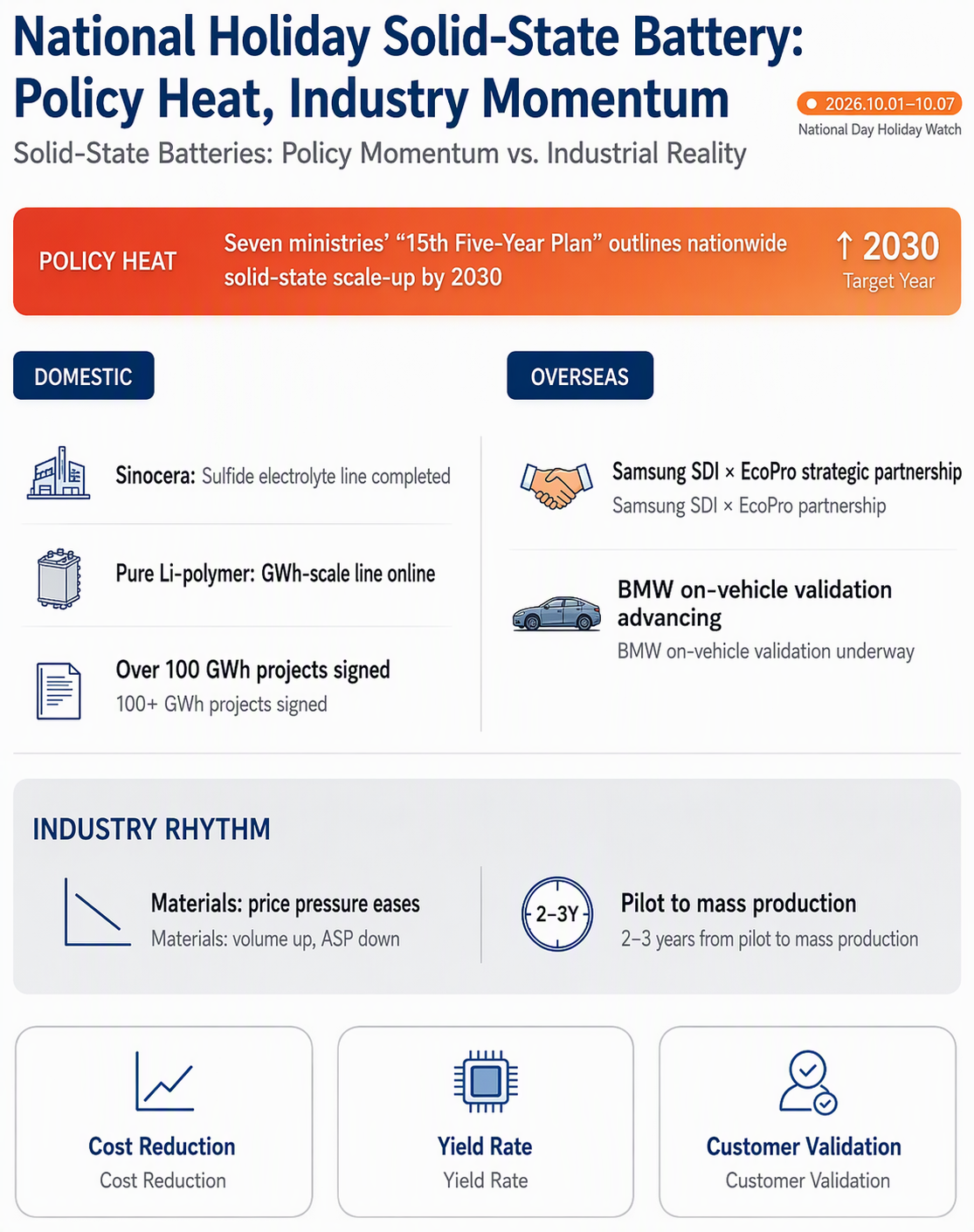
Key points: During the National Day holiday, the solid-state battery sector showed a pattern of “hot policy, slow industry.” Seven ministries’ 15th Five-Year Plan set 2030 as the target for large-scale application of all-solid-state batteries; Sinocera’s sulphide production line was completed, Chuneng’s polymer GWh-level line went into operation, and a 100 GWh project was signed. Overseas, Samsung SDI/EcoPro cooperation and BMW real-vehicle validation moved forward. However, materials are seeing “rising volumes and falling prices,” and the transition from pilot production to mass production still requires 2–3 years, with cost reduction, yield, and client validation remaining the three major hurdles.
Around the National Day holiday, the solid-state battery industry received a dual boost from “policy direction” and “industrial implementation.” Many enterprises arranged early holiday breaks, and actual industrial implementation remained slow. The Ministry of Industry and Information Technology and six other departments jointly issued the 15th Five-Year Plan for the Development of the New-Type Battery Industry, setting a 2030 timetable for the large-scale application of all-solid-state batteries for the first time in a national-level special plan. At the same time, China’s first polymer GWh-level production line went into operation, Sinocera Materials’ sulphide electrolyte production line was completed, and a project with over 100 GWh of capacity was signed. The industry is accelerating its transition from an “intensive pilot phase” to a “mass-production validation phase.” However, SMM believes there remains a clear gap between policy enthusiasm and industrial reality—the trend of “rising volumes and falling prices” on the materials side has not yet reversed, and the window from pilot production to mass production still requires 2–3 years of validation.
I. Policy side: First national-level special plan released, 2030 timetable officially set
During this holiday, the biggest variable for the solid-state battery industry came from the policy side. On September 28, the Ministry of Industry and Information Technology and six other departments jointly issued the 15th Five-Year Plan for the Development of the New-Type Battery Industry. This is China’s first national-level special plan in the battery sector, explicitly proposing that by 2030 all-solid-state batteries will achieve initial large-scale application, and top-tier players’ product defect rates will reach the PPB (1 part per billion) level.
Notably, the plan places special emphasis on key technology directions such as interface contact, high ionic conductivity, long cycle life, and engineered pressure system design, while also proposing to promote the integrated application of high-voltage cathode materials and new-type lithium metal-based anode materials. This indicates that policy orientation has shifted from “encouraging R&D” to “engineering implementation,” targeting the core bottlenecks in the industrialisation of all-solid-state batteries.
II. Materials side: Sulphide electrolytes see “rising volumes and falling prices,” capacity construction enters the “mt era”
The core highlight on the materials side during this holiday was the acceleration of capacity construction and the continued downward shift of the price center.
Sinocera Materials’ sulphide electrolyte production line completed. On October 5, Sinocera Materials disclosed that its automated sulphide solid-state electrolyte production line had been successfully completed, with initial mass-production capability established. The first line is planned to have an annual capacity of 30 mt and is expected to be completed and put into operation within 2026; the second line is planned to have an annual capacity of 100 mt and will be advanced in an orderly manner based on the industrialisation pace of downstream battery enterprises. It is worth noting that Sinocera Materials is simultaneously laying out both oxide and sulphide technology routes, but its current strategic center is focused on the sulphide route, and its product performance has been highly recognised by downstream battery enterprises.
SMM believes that sulphide electrolytes are in the typical early-industry stage of "rising volume and falling prices"—production is increasing, but capacity utilization rates remain low, and price pressure has been the dominant theme since Q3. The commissioning of 100 mt-class production lines means the industry is crossing from the "kg-class" to the "mt-class" threshold, but there is still some distance from truly meaningful large-scale supply.
III. Battery cell side: Polymer route achieves GWh-class breakthrough, "three dominant players" landscape begins to emerge
In battery cell manufacturing, the most noteworthy event this holiday is the GWh-class mass production breakthrough on the polymer route.
China's first polymer solid-state battery GWh-class production line has been commissioned. On 29 September, Chunlv New Energy's Hukou 1 GWh solid-state battery intelligent manufacturing base officially entered production, marking China's first solid-state battery mass production line using the polymer process route. The project is planned to be built in two phases, with total capacity reaching 5 GWh once fully ramped up, covering diverse scenarios including grid-side ESS, industrial and commercial ESS, passenger NEVs, drones, robots, and marine power.
The industrial significance of this event is that it breaks the long-standing "sulphide + oxide" dual-route dominance in the solid-state battery industry and validates the industrial manufacturing strength of the polymer route. The solid-state battery industry has officially entered a new competitive landscape of three dominant players: sulphide, oxide, and polymer.
From a technical and economic perspective, the differentiated advantages of the polymer route deserve attention: first, high production line compatibility allows extensive reuse of existing lithium battery coating, rolling, and hot-pressing equipment, with low line conversion costs and short construction cycles; second, the flexible nature of the electrolyte material enables better solid-solid interface contact, which helps improve production yield. However, its shortcomings are equally notable—low room-temperature ionic conductivity, limited electrochemical window, difficulty matching high-nickel high-voltage cathodes, and an energy density ceiling. SMM believes that composite systems with polymer doped with inorganic fillers are the optimal direction at this stage for balancing mass production feasibility and overall performance.
In addition, Farasis Energy disclosed during the holiday that it has completed sample delivery of sulphide all-solid-state batteries to a leading humanoid robot client and is continuing to engage with several other leading humanoid robot companies on solid-state battery demand. Emerging scenarios such as humanoid robots and eVTOL are becoming important testing grounds for solid-state batteries beyond automobiles, and this trend warrants continued tracking.
IV. Overseas developments: Korean industry chain accelerates integration, BMW validation enters critical phase
Outside China, vertical integration in South Korea's solid-state battery industry chain is accelerating.
EcoPro BM and Samsung SDI signed an MOU on all-solid-state battery materials. On 6 October, EcoPro BM announced the signing of an MOU with Samsung SDI, covering cathode materials for all-solid-state batteries, electrolytes for cathodes, and electrolytes for separators. Samsung SDI will be responsible for battery cell development and mass-production technology improvement, while EcoPro BM will be responsible for core material development, with both parties targeting the commercialisation of sulphide-based all-solid-state batteries by 2027. This cooperation model is worth referencing for China's industry chain—deep binding and simultaneous development between material enterprises and battery cell enterprises can help shorten the cycle from material validation to battery cell mass production.
The BMW-Samsung SDI-Solid Power tripartite validation has entered a new phase. BMW has installed Solid Power's large-format all-solid-state battery in a BMW i7 test vehicle and is conducting road tests in the Munich area, marking the first time all-solid-state battery technology has entered durability, thermal management, and system safety testing in a real vehicle environment. The tripartite joint evaluation framework concluded on 30 September, and the subsequent phase will shift to an independent collaboration approach. Samsung SDI plans to independently advance the commercialisation of sulphide-based all-solid-state batteries, targeting mass production in 2027. SMM believes that real-vehicle validation data from OEMs will be a key variable in determining whether the 2027-2028 window for all-solid-state battery installation in vehicles can open as scheduled.
V. Capacity side: 100 GWh-level project signed, and the risk of capacity-demand "mismatch" warrants caution
During the holiday period, domestic solid-state battery capacity planning continued to expand rapidly, but SMM remains cautious about the matching between capacity and demand.
Weihai Jinhong and Tianjin Urban Construction Group signed a 100 GWh solid-state battery industrial layout project. Before the holiday, the two parties signed a strategic cooperation agreement to build solid-state battery production sites in batches across five locations: Weihai, Dalian, Ordos, Xi'an, and Xining, with a planned total construction scale of approximately 100 GWh. Weihai Jinhong has completed construction and commenced production of a 0.5 GWh solid-state battery production line, launching multiple specifications of solid-state battery cells ranging from 35 Ah to 314 Ah, among which the 102 Ah cell has passed the full safety inspection under GB 38031—2025 by CATARC.
Enpower's 2 billion yuan solid-state battery central China base landed in Xiangtan. On 4 October, Xiangtan Economic Development Zone signed an agreement with Beijing Enpower Technology Co., Ltd., officially landing Enpower's solid-state battery central China regional headquarters and production site project, with a total investment of approximately 2 billion yuan. Enpower has deep expertise in the sulphide solid-state battery technology route and is at an industry-advanced level in key technologies such as solid-solid interface contact and lithium metal anode protection. Its products are widely used in robots, drones, high-end electric motorcycles, and other fields.
Jinyinhe plans to raise no more than 1.5 billion yuan through a private placement to expand solid-state battery equipment. The proceeds will be directed towards the industrialisation project of high-end intelligent equipment for sodium-ion batteries, consumer lithium batteries, solid-liquid batteries, and new-type ESS batteries (490 million yuan), as well as the R&D and construction project of high-end intelligent equipment for dry-process electrodes and solid-state batteries (290 million yuan).
VI. Summary
Based on the industry developments around the National Day holiday, SMM maintains the following judgements on the solid-state battery industry:
First, the policy direction has been set, and the industry has entered the "execution phase." The 15th Five-Year Plan has set the goal of initial large-scale application of all-solid-state batteries by 2030, which is a clear policy signal. However, from policy release to industrial implementation, multiple stages remain, including technological breakthroughs, pilot verification, and mass production ramp-up. SMM believes that 2026-2027 will be a critical validation window for all-solid-state batteries moving from pilot production to mass production.
Second, a "three dominant players" landscape is emerging, but technological convergence is far from complete. The polymer route has achieved GWh-level mass production breakthroughs, the sulphide route continues to lead in energy density, and the oxide route has taken the lead in releasing volume in energy storage scenarios. Each of the three routes has its own advantages and disadvantages, and no single route will dominate the market in the short term. The industry generally believes that a composite system of polymers doped with inorganic fillers may be the optimal direction at this stage for balancing mass production feasibility and overall performance.
Third, material cost reduction is the core issue. The current cost of solid-state batteries is 5 to 10 times that of traditional lithium batteries. In addition to the cost pressure brought by process technology difficulties, high raw material costs are also an important factor. Sulphide electrolytes need to drop from the 10 million yuan/mt level to the 1 million yuan/mt level, and then to the future target of the 100,000 yuan level, which requires continuous breakthroughs in synthesis processes and further expansion of capacity scale.
Fourth, the "time gap" between capacity planning and demand release warrants caution. The signing of 100 GWh-level projects is certainly encouraging, but SMM reminds that the actual conversion rate from planning to mass production of solid-state batteries, the ramp-up pace of capacity utilization rate, and the real demand release speed of downstream clients are the key indicators that determine the health of the industry. The cycle from pilot production to mass production ranges from as short as 2 to 3 years to as long as 3 to 5 years, and all industry participants need to remain patient.
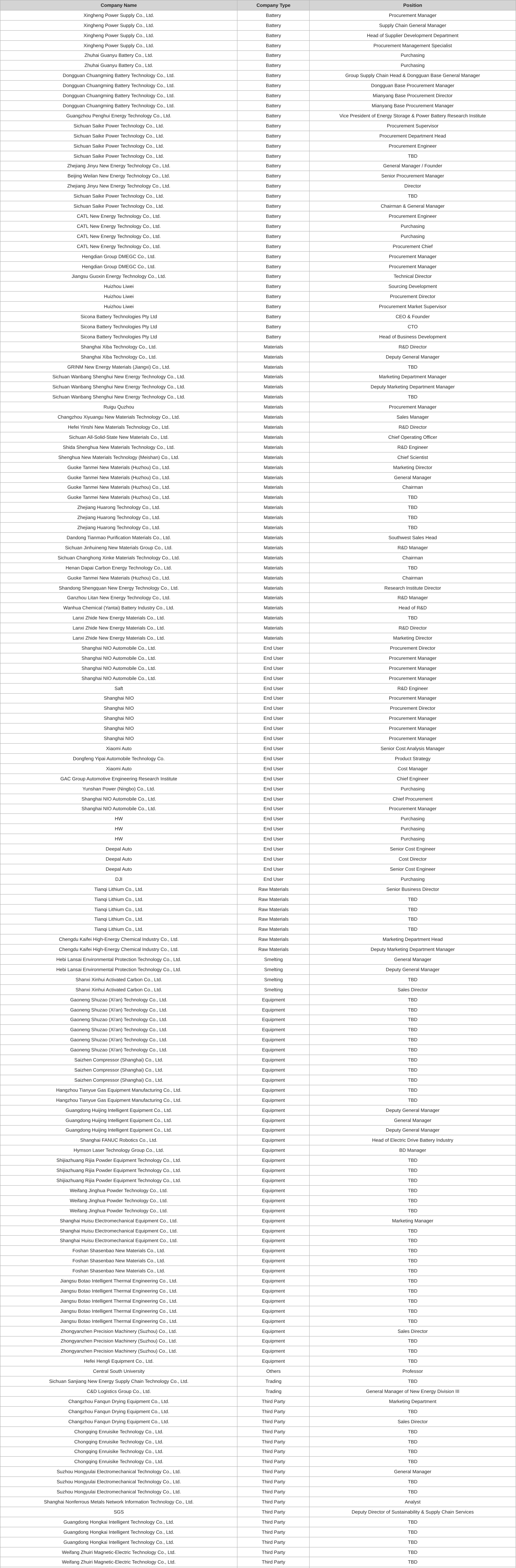
SMM Solid-State Battery Conference Attendee List (Partial)
Note: If you have any supplements regarding the details mentioned in this article or are following the development of solid-state batteries, please feel free to contact us at:
Tel: 021-20707860 (or add WeChat 13585549799) Yang Chaoxing, thank you!

Related Reading
![2026 National Day Holiday Phosphate Ore Market Review: In the Doldrums, Supply-Demand Weakness on Both Sides [SMM Analysis]](https://imgqn.smm.cn/usercenter/IpglC20251217171727.jpg)
![[SMM Analysis] Review of the FP and LFP Markets During the China's National Day Holiday](https://imgqn.smm.cn/usercenter/QBuyW20251217171726.jpg)
![[SMM Analysis] Cobalt Salts After National Day: Supply Cuts Offer Limited Support, Prices May Keep Edging Lower](https://imgqn.smm.cn/usercenter/wzbHd20251217171731.jpg)