On 18 September 2026, Indonesia's Financial Services Authority (OJK) issued POJK No. 15/2026 and POJK No. 16/2026, which together set out the regulatory framework and operating rules for the Mineral and Strategic Commodity Exchange (BMKS, referred to in the market as ICOMEX). Read alongside the rollout of Danantara Sumber Daya Indonesia (DSI) as the single window for exports, Indonesia now has a four-part structure: OJK writes the rules, ICOMEX runs the trading, DSI handles execution, and Danantara provides the capital. This note sets out where each institution's remit starts and stops, what the policy currently covers, and how title and delivery are handled, which is the part market participants care about most.
1. Institutional roles and responsibilities
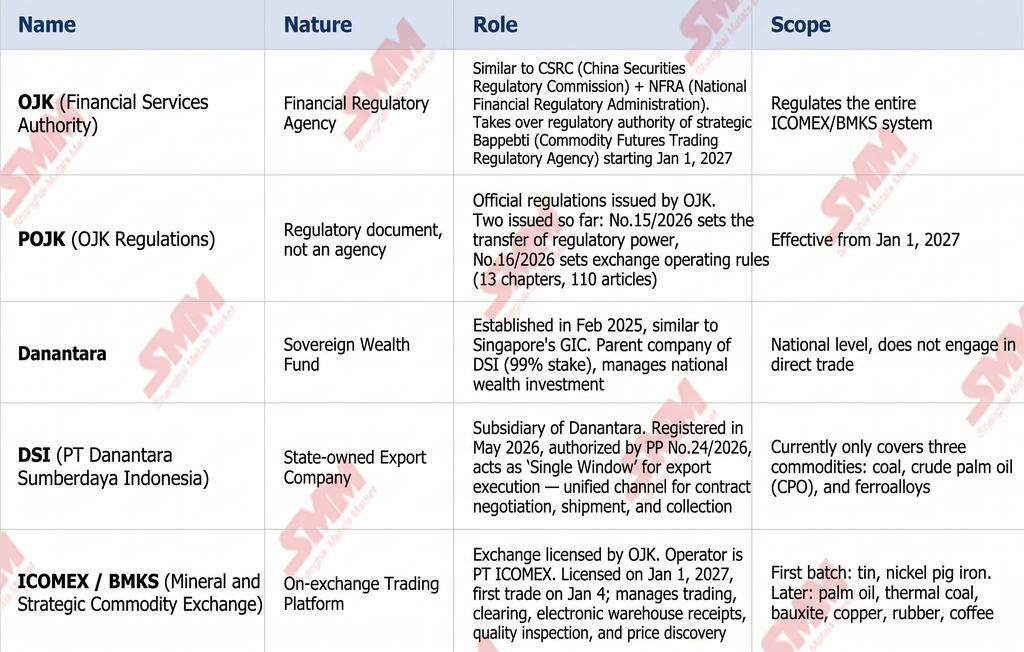
OJK is Indonesia's unified financial regulator. Starting 1 January 2027 it takes over supervision of BMKS from the Commodity Futures Trading Regulatory Agency (Bappebti). POJK 15/2026 covers the phased handover of authority, while POJK 16/2026 runs to 13 chapters and 110 articles and sets out BMKS's organisational structure, participant eligibility, the trading process, clearing and settlement, risk controls, and market integrity requirements. Both regulations take effect on 1 January 2027.
Danantara is Indonesia's sovereign wealth fund, established in February 2025. It holds 99% of DSI and operates as the country's wealth management and investment platform. It does not get involved in executing physical commodity trades.
DSI is Danantara's wholly state-owned trading company, set up under Government Regulation No. 24/2026 to serve as the single window for strategic commodity exports. Its remit currently covers three products: thermal coal, crude palm oil, and ferroalloys. Rollout happens in two stages. During the transition period from 1 June to 31 December 2026, exporters keep the right to sign their own contracts, but they must report full transaction data to DSI through Customs' CEISA 4.0 system. From 1 January 2027 the arrangement takes full effect: DSI becomes the sole exporter for these three commodities and takes over contract negotiation with overseas buyers, shipment, and foreign exchange repatriation. According to the Cabinet Secretariat, DSI has already overseen around USD 14 billion of export value during the transition period, spanning 50 ports and more than 6,000 transactions.
ICOMEX, or BMKS, is the OJK-licensed exchange venue, operated by PT ICOMEX with minimum paid-up capital of IDR 1 trillion. Tin and ferronickel are the first two contracts listed, and the pipeline for adding products runs to palm oil, thermal coal, bauxite, copper, rubber, and coffee. ICOMEX is not just a trading screen. It is a full infrastructure package covering trading, clearing, electronic warehouse receipts, quality inspection, settlement guarantees, and price discovery. Sitting underneath it are the clearing house (LK, minimum capital IDR 500 billion), the electronic depository (LKE, minimum capital IDR 500 billion), exchange-approved warehouses, and the compliance assessment body (LPK).
ICOMEX and DSI run on two separate tracks. ICOMEX is the on-exchange trading and price formation platform, while DSI is the entity that actually executes export sales. The design does try to connect them, in that an export contract is meant to be priced through an on-exchange transaction first, after which DSI coordinates the overseas sale. But right now that link only has the conditions to work on the three commodities DSI already covers.
2. Trading process and title arrangements
POJK 16/2026 divides BMKS trading into three phases: pre-trade, execution, and post-trade.
In the pre-trade phase, goods go through quality inspection and quantity verification by LPK and then move into an exchange-approved warehouse. Once they are certified as tradable, LKE issues an electronic certificate of ownership, known locally as the Bukti Kepemilikan Elektronik. In the execution phase, the exchange system matches orders and prices form through the market. Executed trades feed into the Indonesian Reference Price (Harga Acuan Indonesia, or IRP). In the post-trade phase, LK handles cash and title settlement centrally, with a default management mechanism behind it.
For tin, this process follows fairly closely what already happens on JFX and ICDX. Since 2013 Indonesia has required refined tin exports to be traded on either the Jakarta Futures Exchange (JFX) or the Indonesia Commodity and Derivatives Exchange (ICDX). Under the current setup the seller delivers tin ingots to a bonded logistics centre warehouse, the clearing house issues an electronic warehouse receipt (Transit CTD or Delivery CTD), and after the trade closes the receipt is endorsed over to the buyer, who then uses it to clear the goods for export. Once ICOMEX goes live there are three main changes. The two parallel exchanges collapse into a single ICOMEX venue, and the Minister of State Secretariat has said publicly that folding ICDX into ICOMEX is not off the table. Quality inspection moves from the exchange's own surveyor to a mandatory tradability assessment by LPK carried out before trading. And electronic warehouse receipts are registered centrally by LKE, with clearing guaranteed centrally by LK.
On title, the exchange model does not pass ownership to the state or to the exchange. The regulations state that the warehouse manager's custody obligations do not shift to the exchange or to OJK just because a trade takes place. Title moves between buyer and seller along with the electronic certificate of ownership. Take PT Timah as an example. It is expected to be one of the first liquidity providers once ICOMEX launches, but its tin stays PT Timah's property until a sale completes, at which point title passes to the buyer through the on-exchange transaction.
The DSI model works differently, and differently in a way that matters. For thermal coal, CPO, and ferroalloys, once full implementation begins on 1 January 2027, producers have to sell their goods to DSI. Title passes to DSI at the point of the domestic sale, and DSI then handles the export. That is fundamentally different from the exchange model tin currently runs on.
3. Key issues to monitor
First, the timing for bringing tin into the DSI export window. Futures Daily, citing regulators, reports that nickel and tin are "to be brought under DSI management gradually". If that goes ahead, tin's title arrangements shift from the exchange model to a DSI central purchasing model. That single variable will do more than anything else to determine the long-run shape of tin trade.
Second, how existing bilateral term contracts are treated. The POJK establishes the principle of on-exchange trading, but it does not yet say what happens to long-term supply contracts already signed. Market participants will need time to rework their systems, compliance processes, and trading workflows.
Note: this draws on OJK announcements, PT ICOMEX regulations, Indonesian media coverage, SMM, and publicly available industry research, reflecting information available as of 28 September 2026. It is for discussion only and is not investment advice. Policy details are still moving, so official Indonesian releases will govern the final trading rules, the product rollout schedule, and which commodities DSI brings in.
![SHFE tin SN2610 closed the night session at 408,560 yuan, edging up 0.28%, with the 408,000 yuan/mt level yet to be confirmed [SMM Tin Morning Brief]](https://imgqn.smm.cn/usercenter/GgYmu20251217171750.jpg)
![The most-traded SHFE tin contract fell 0.85% after the Mid-Autumn Festival, losing the 410,000 level, then edged up to 408,280 in the overnight night session [SMM Tin Morning Meeting Minutes]](https://imgqn.smm.cn/usercenter/TYKtM20251217171753.jpg)
![[SMM Tin Newsflash: Voluntary Information Disclosure Announcement Regarding Production Suspension for maintenance at the Tin Branch]](https://imgqn.smm.cn/usercenter/bYFQn20251217171752.jpg)