SMM, September 9:
In the metals market:
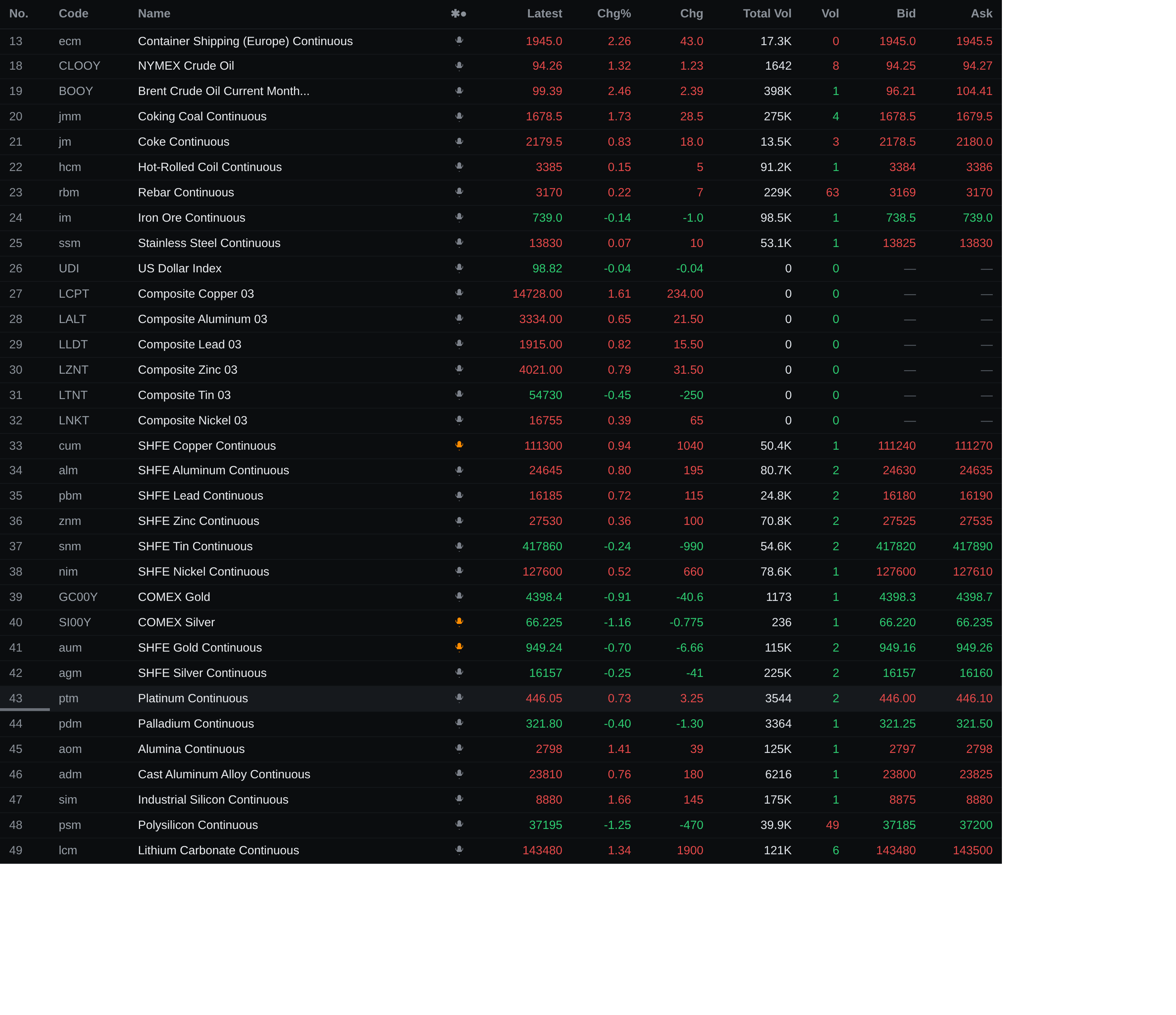
Overnight, both domestic and overseas markets broadly rose, with only LME tin and SHFE tin falling together. LME tin dropped 0.45%, SHFE tin fell 0.24%, while LME copper led the gains with a 1.61% increase, hitting an intraday high of $14,779/mt and setting a new record high since its listing. LME lead rose 0.82%, SHFE copper gained 0.94%, SHFE aluminum rose 0.8%, SHFE lead added 0.72%, and the remaining metals saw relatively small fluctuations in their percentage changes. The alumina main contract rose 1.41%, and the cast aluminum main contract gained 0.76%.
Ferrous metals broadly rose, with only iron ore falling, down 0.14%. Rebar gained 0.22%, and the remaining metals saw modest fluctuations. In coking coal and coke, coking coal rose 1.73%, and coke gained 0.83%.
Overnight in precious metals, COMEX gold fell 1.71%, and COMEX silver dropped 0.56%. Domestically, SHFE gold fell 0.7%, and SHFE silver dropped 0.25%.
As of 6:44 a.m. on September 9, overnight closing prices:
Macro front
Domestically:
[National Development and Reform Commission (NDRC) Price Cost and Certification Center conducts wire and cable industry survey in Wuxi] On September 3, Yang Dong, deputy director of the Price Cost and Certification Center, led a team to Jiangsu Yujiu Cable Technology Co., Ltd., Jiangsu Huaya Cable Co., Ltd., and Wuxi Jiangnan Cable Co., Ltd. for research, focusing on cost and price conditions in the wire and cable industry and the prominent issues currently facing the industry's development, and solicited relevant opinions and suggestions. Comrades from the Center's Comprehensive Information Division participated in the discussions and survey. (NDRC)
[Zimbabwe issues another resource control order: antimony and tungsten exports immediately banned] Zimbabwe has immediately banned the export of antimony and tungsten, one of the government's measures to push mining companies to process raw materials more locally. According to a letter from Mining Minister Thomas Ushe to the state-owned Minerals Marketing Corporation of Zimbabwe, which is responsible for selling all Zimbabwean minerals except gold and silver, shipments of ore and concentrates have also been suspended. The letter, dated July 21, has been confirmed by the country's Ministry of Mines. Like Guinea, Ghana, the DRC, and other African countries, Zimbabwe is seeking to extract more value from its natural resources. Zimbabwe suspended lithium concentrate exports in February to promote local processing of high-value-added products and curb illegal lithium shipments. The export restriction was eased in April, and the ban is currently set to take effect in early 2027. (Jin10 Data APP)
US dollar:
As of the overnight close, the US dollar index fell 0.05% to 98.87, as investors await US inflation data for more clues on the US Fed's rate decisions. The market is currently balancing two forces: strong US economic data supporting rate hikes, and geopolitical uncertainty that continues to attract safe-haven demand. Focus now shifts to the US PPI and CPI data due later this week. (Jin10 Data App)
According to CME "FedWatch": The probability of the Fed keeping rates unchanged in September is 40.6%, and the probability of a cumulative 25bp hike is 59.4%. The probability of the Fed keeping rates unchanged in October is 29.8%, the probability of a cumulative 25bp hike is 54.4%, and the probability of a cumulative 50bp hike is 15.8%. (Jin10 Data App)
US Treasury yields rose, driven by higher oil prices and increased likelihood of a rate hike next week after last week's stronger-than-expected jobs data. Analysts at Danske Bank said in a note that even if they do not expect a hike next week, they still view current pricing (with hike and hold probabilities near evenly split) as reasonable. However, Danske Bank still expects the Fed to hike twice, in December and March. But the dollar softened against a basket of currencies as the yen strengthened further. (Jin10 Data App)
Analyst Robert Howard said the US August CPI data could determine whether the Fed leans toward hiking or holding at next week's rate decision, and will influence the dollar's direction. According to the median estimate from a Reuters survey, headline CPI is expected to rise 0.4% MoM and 3.4% YoY; core CPI is expected to rise 0.2% MoM and 2.4% YoY. If the data comes in above expectations, hawkish voices will grow louder, calling for a September hike, which could boost the dollar. Conversely, if the data comes in cool, doves will argue for a sixth consecutive hold, which could weigh on the dollar. The market currently sees a 57% probability of a hike this month, after last Friday's strong non-farm payrolls data shifted expectations hawkishly. This shift came 24 hours after dovish remarks from Fed Governor Waller, which had put the dollar under pressure; and seven days earlier, hawkish guidance from Fed Chairman Warsh at Jackson Hole had lifted the dollar. (Jin10 Data App)
According to data compiled by Wells Fargo going back to 2015, the Fed has traditionally acted only when the probability of a hike or cut has risen above 69%. The bank said Friday's Consumer Price Index (CPI) data "could well determine" the central bank's decision at next week's meeting. Analysts led by Ohsung Kwon wrote in a note released Tuesday: "Since 2015, the probability of a hike or cut has never fallen within the 38%-69% range, and whenever market pricing for a meeting exceeded 69%, the Fed acted every time."Kwon noted that since 1994, the S&P 500 has fallen an average of 3% in the three months following the first rate hike of a tightening cycle. Kwon added that across these six rate-hike cycles, the index posted a gain only once. Kwon mentioned that two weeks ago, Fed Chairman Kevin Warsh's remarks at the Jackson Hole conference focusing on price issues briefly pushed rate hike expectations to around 65%. "Some dovish comments last week lowered the probability of a rate hike to 50%, but strong non-farm payrolls data pushed it back up to near the historical minimum threshold for the Fed to act." (Wall Street CN)
On the macro front:
Today will see the release of China's August CPI YoY, the weekly change in US ADP employment for the week ending August 22, France's July industrial output MoM, and other data. In addition, the US Treasury will announce the maximum amount of 10- to 20-year US Treasuries it plans to repurchase.
On the crude oil front:
As of the overnight close, oil prices rose across both benchmarks, with WTI up 3.03% and Brent up 2.46%, supported by concerns over escalating tensions in the Middle East. According to Fox News, senior US officials said the US military has struck targets near Hormuz Island and Jask. The targets included Iranian oil tankers. This is part of a broader effort to squeeze Iran economically. The strategy includes sinking and crippling Iranian crude oil tankers. (Jin10 Data APP)
According to a statement released today (September 8) by Saudi Arabia's Ministry of Energy, multiple energy facilities and utilities in the country were attacked, with fires breaking out at several locations and operations at some facilities temporarily disrupted. The Saudi Ministry of Energy said it is working to ensure the safety of facilities, the well-being of personnel, and the continuity of operations. (CCTV International)
Goldman Sachs executives said on Tuesday that refined product flows through the Strait of Hormuz are at 35% of pre-war levels, while crude oil flows are at 70%. Daan Struvyen, co-head of global commodities research at Goldman Sachs, said the impact of Middle East supply shocks is greater on refined products than on crude oil, especially heavy products such as diesel, but did not provide specific volumes. Kpler vessel-tracking data shows that last year, refined products including diesel, gasoline, jet fuel, and naphtha shipped from the Middle East through the Strait of Hormuz averaged about 2.2 million barrels per day, while crude oil averaged 14.95 million barrels per day. (Jin10 Data APP)
Bank of America raised its Brent crude oil price forecast, projecting a peak of $83 per barrel in H2 2026 and $75 per barrel in 2027. Bank of America: If the Middle East conflict persists until year-end, Brent crude could trade in a range of $95-120 per barrel. (Jin10 Data APP)
Crude oil inventories in the US Strategic Petroleum Reserve fell by about 1.2 million barrels last week to 285.4 million barrels, the lowest level since 1982. (Jin10 Data APP)

![SHFE Zinc Continues to Rise; Watch for Arrivals of Zinc Ingots Outside China [SMM Zinc Futures Briefing]](https://imgqn.smm.cn/usercenter/ipTIN20251217171755.jpg)