Key Points: Sulfide electrolyte prices continued to decline this week (LPSC fell to RMB 4,300/kg), while lithium sulfide’s decline slowed. The Zhejiang University team published in Nature Communications a kilogram‑scale liquid‑phase synthesis of sulfide electrolyte with 5.42 mS·cm⁻¹ ionic conductivity, providing technical support for scaled cost reduction. On the industrial side: Tuoyi Gu Neng’s RMB 6 billion 30 GWh project started construction; Xinjie Energy secured over USD 100 million in Series B financing; Solid Power plans a 20,000‑ton‑per‑year electrolyte base in South Korea; and the CAS Institute of Physics launched a 0.2 GWh all‑solid‑state pilot line. The inflection point for all‑solid‑state scale‑up is expected around 2028–2030.
Solid‑State Battery Material Price Analysis (August 14–20, 2026)
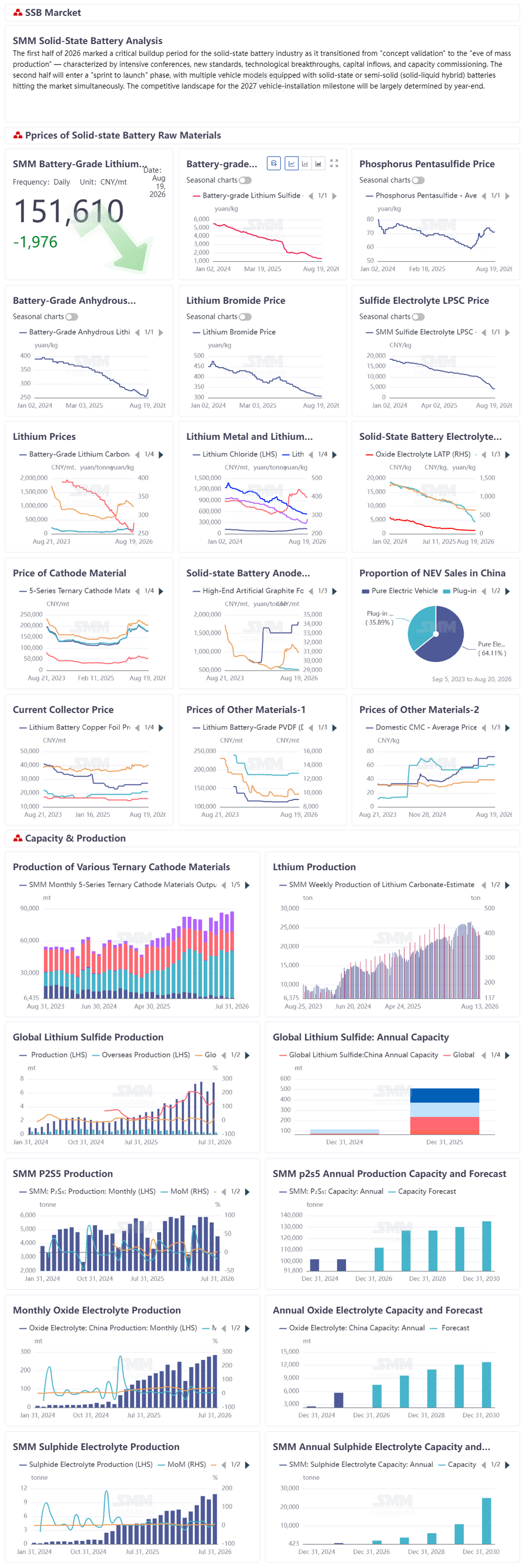
Price trends this week showed continued divergence: sulfides weakened, oxides held steady, and silicon‑carbon anodes maintained a high premium.
Sulfide system: LPSC (sulfide electrolyte) continued to edge down, with mainstream quotes falling from RMB 4,400/kg to RMB 4,300/kg, a weekly decline of ~2.27%, mainly pressured by supply‑side expansion expectations from Tianci Materials’ hundred‑ton‑scale pilot line and Tianshi Kefeng’s capacity expansion. Lithium sulfide, having fallen more than 50% over the past six months, approached RMB 1,300/kg.
Oxide system: LLZO held steady at RMB 638/kg throughout the week; LATP, due to mature processing, dropped to just over RMB 90/kg, with its cost advantage accelerating commercial adoption in semi‑solid batteries.
Anode materials: Deposition‑based (resin‑based) silicon‑carbon anodes remained at RMB 525,000/ton, roughly 2.2 times that of ball‑milled material (RMB 235,500/ton), reflecting a significant premium from process barriers.
Cathode and related materials: Ternary cathode materials saw a slight rebound, with lithium hydroxide strengthening notably. Sodium‑ion cathode NFPP edged up RMB 100/ton to RMB 28,250/ton. Electrolyte (for ternary power batteries) held steady at RMB 31,750/ton.
Overall, solid‑state battery material prices are being shaped by capacity expansion expectations: sulfides show a clear downward trend, oxides are rapidly penetrating due to cost advantages, while high‑end silicon‑carbon anodes maintain their premium.
I. Preface: Material Price Divergence Continues, Sulfides Accelerate Bottoming
This week, upstream prices in the solid‑state battery supply chain continued their structural divergence. According to SMM data, sulfide electrolyte LPSC (Li₆PS₅Cl) gradually declined from RMB 4,400/kg to RMB 4,300/kg, a weekly drop of ~2.27%. Battery‑grade lithium sulfide was quoted at about RMB 1,320/kg, down only 0.8% week‑on‑week, suggesting a slowing downtrend. Oxide electrolyte LLZO held at RMB 638/kg, while LATP remained at RMB 93/kg, having been range‑bound for several weeks. Germanium ingot was quoted at RMB 24,500/kg on August 14, up 81.48% year‑to‑date; rare earth lanthanum was quoted at RMB 21,000–22,000/ton on August 13.
The core logic of price divergence lies in differing supply rhythms: the sulfide route is on the eve of concentrated release of hundred‑ton‑scale capacity—Tianci Materials’ hundred‑ton line is expected to start production in Q3, with scale effects pushing the price centre lower. The oxide route, with higher process maturity and a more stable competitive landscape, has already bottomed out. Battery‑grade lithium carbonate rose to RMB 148,000/ton on August 12, up RMB 3,250/ton in a single day, with tight upstream lithium salt supply providing some cost support to the material side.
At the industrial level, the most prominent signal this week is that sulfide‑based all‑solid‑state batteries are shifting from “single‑point breakthroughs” to “systematic advancement.” The intensive rollout of events—Zhejiang University’s kilogram‑scale liquid‑phase synthesis breakthrough, Tuoyi Gu Neng’s RMB 6 billion 30 GWh project ground‑breaking, Xinjie Energy’s over‑USD‑100‑million financing, and Solid Power’s planned 20,000‑ton joint venture in South Korea—has significantly accelerated the pace of industrialisation.
II. Materials: Zhejiang University’s Kilogram‑Scale Synthesis Breakthrough, Accelerated Lithium Sulfide Capacity Release
Sulfide electrolyte: The most notable breakthrough this week came from the teams of Tu Jiangping and Zhong Yu at Zhejiang University. They reported in Nature Communications a kilogram‑scale liquid‑phase suspension synthesis platform based on the Li₂S‑SiS₂‑P₂S₅ ternary system, producing a series of (1−x)Li₃PS₄‑xLi₄SiS₄ (LSPSₓ) electrolytes. In the low‑doping range (0 < x ≤ 0.25), an orthorhombic phase forms, with LSPS₀.₂₅ achieving an ionic conductivity of 1.94 mS·cm⁻¹; in the high‑doping range (0.33 ≤ x ≤ 0.5), the structure transforms to a tetragonal thio‑LISICON II type, with LSPS₀.₄₅ reaching a room‑temperature conductivity as high as 5.42 mS·cm⁻¹. Theoretical simulations confirm that Si doping first increases the configurational entropy of lithium ions and eliminates anisotropic diffusion barriers; after the phase transition, fast transport channels analogous to Li₁₀GeP₂S₁₂ are formed. This achievement moves kilogram‑scale liquid‑phase synthesis of sulfide electrolytes from the laboratory to the eve of mass production.
Lithium sulfide: Qinghai Weixiang Technology completed filing for a 3,000‑ton‑per‑year lithium sulfide project, with a total investment of RMB 81.319 million, to be built in two phases (500 t/y in Phase I, 2,500 t/y in Phase II). The core technology, a “high‑temperature low‑pressure process for high‑purity lithium sulfide,” has been granted a national invention patent. This is the largest capacity‑expansion signal on the lithium sulfide supply side this week. According to SMM, actual procurement of lithium sulfide in the first half of the year was only 37 tons; with Tianci Materials, Tianhua Xinneng and others putting hundred‑ton lines into production in Q3–Q4, second‑half production is expected to reach 80–120 tons, and the full year may exceed 150 tons.
Cathode materials: Xiantao Ronbay’s 10‑ton‑per‑year solid‑state electrolyte project received its environmental impact assessment public notice, with an investment of RMB 50 million. Ronbay Technology is simultaneously advancing semi‑solid and all‑solid‑state cathode materials development, focusing on new ternary and lithium‑rich manganese‑based cathode materials, with market demand expected to approach the hundred‑ton level this year and small‑batch production in 2027. CNGR Advanced Material and Chuandong Chemical signed a letter of intent for cooperation in the phosphorus‑based industrial chain, aiming to build an integrated “phosphate ore‑fine phosphorus chemicals‑new energy battery materials” value chain. SMM data show that first‑half lithium iron phosphate production reached 2.6 million tons and ternary cathode 500,000 tons; second‑half figures are expected to reach 3.0–3.3 million tons and 550,000–600,000 tons, respectively.
Oxides and auxiliary materials: Oxide electrolyte production reached 1,380 tons in H1, and accelerated semi‑solid battery installations in H2 are expected to boost that to 2,000–2,500 tons. Auxiliary materials such as lithium bromide and lithium chloride, with new capacity coming online, are expected to decline to RMB 280–300/kg and RMB 220–250/kg, respectively, in H2.
III. Cells: Multiple All‑Solid‑State Breakthroughs, Semi‑Solid Production Accelerates
All‑solid‑state batteries: The Dalian Institute of Chemical Physics (DICP) disclosed its environmental impact assessment for a high‑performance solid‑state battery core material pilot platform, with total investment of RMB 55 million and designed capacities of 50 t/y for high‑energy‑density cathode materials, 5 t/y for high‑performance solid‑state electrolytes, and 10 t/y for high‑capacity composite anodes, expected to commence production in November 2026. The CAS Institute of Physics and Zhongke Low‑Carbon City Development (Suzhou) signed an agreement to launch a solid‑state prismatic cell pilot line in Suzhou Industrial Park, with an initial 219 mu (about 14.6 hectares) of industrial land. The project adopts an in‑situ solidification technology route, integrating five core processes—electrode integration, ionic conductor membranes, pre‑lithiation, thermal lamination, and central liquid cooling—supporting sustained 3C and peak 6C high‑rate discharge. The same production line can flexibly produce batteries ranging from 400 Wh/kg semi‑solid to 600 Wh/kg all‑solid‑state; the dry‑electrode process shortens the line by more than half and reduces energy consumption by 40% compared to traditional wet processes. The first phase includes a 0.2 GWh cell pilot line and a 4 GWh system integration line, aiming to ship products within two years, targeting electric aviation, heavy‑lift drones, new energy vehicles, and embodied intelligence.
Semi‑solid batteries: Shenan Lithium Energy’s Shaoxing intelligent manufacturing base, with a total investment of about RMB 200 million, built a 500 MWh high‑standard cell production line with a planned annual output value of RMB 1 billion. Guansheng Dongchi and CNNC Haiyang signed a strategic cooperation framework agreement to promote polymer‑based semi‑solid batteries in wind‑solar‑storage and commercial/industrial energy storage applications. Degang Energy launched its MES system project, with Yunxuntong empowering digital production for semi‑solid batteries.
IV. Projects: 60‑billion‑yuan 30 GWh Project Breaks Ground, Capacity Construction Accelerates Across the Board
The most significant capacity project this week is the official start of Tuoyi Gu Neng’s Inner Mongolia solid‑state battery project. Located in Hohhot, the project has a total investment of RMB 6 billion, covers 1,000 mu, and will be built in three phases with a total annual capacity of 30 GWh of solid‑state batteries; the first phase is designed for 10 GWh/year.
Xinjie Energy completed over USD 100 million in Series B financing and will add a 3 GWh solid‑state battery mass‑production line. Its Hangzhou 10 GWh project (Phase I 2 GWh) is already in production, Phase II plans 8 GWh, and a 600 MWh pilot line in South China continues to operate. Combining already‑commissioned, under‑construction, and planned capacity, the total exceeds 20 GWh.
Overseas capacity: US‑based Solid Power is advancing a joint venture with a major Korean conglomerate to build a sulfide electrolyte production base in South Korea. The project will adopt a “shell factory” model, with initial capacity of about 500 tons and modular expansion. The company targets announcing a partnership in 2026, entering design and construction in 2027, and supplying up to 500 tons of electrolyte to Korean and global customers by 2028. Longer‑term, as demand becomes clearer, additional 2,000‑ton production modules would bring total capacity to 20,000 t/year, matching small‑fleet mass production (SOP) demand for all‑solid‑state batteries around 2029–2030. Solid Power currently operates a 30‑ton batch line in Colorado; its continuous electrolyte line (SP2.5) is expected to be completed by end‑2026 and commissioned in early 2027, raising capacity to 75 tons.
V. Financing and Cooperation: Capital Flows In, Industrial Chain Synergies Deepen
Financing: Xinjie Energy completed over USD 100 million in Series B financing, led by Puhua Capital, mainly for lithium‑metal solid‑state battery mass production and an additional 3 GWh high‑energy‑density, high‑safety solid‑state battery production line.
Cooperation: CNGR Advanced Material and Chuandong Chemical signed a letter of intent for cooperation in the phosphorus‑based industrial chain, deepening synergy in phosphorus‑ and sodium‑based materials to build an integrated “mining‑chemicals‑materials” industrial system. Guansheng Dongchi and CNNC Haiyang signed a strategic cooperation to promote semi‑solid batteries in new energy projects.
Earnings: Several listed companies disclosed H1 2026 results this week, with solid‑state battery‑related businesses becoming growth highlights: Putailai’s H1 revenue reached RMB 10.115 billion (+42.70%), and its solid‑state battery equipment has been delivered to leading customers, with cumulative orders exceeding RMB 200 million. XTC New Energy’s H1 revenue was RMB 14.488 billion (+91.09%), with R&D investment of RMB 342 million focused on key all‑solid‑state battery materials. Tianhua Xinneng’s H1 net profit surged to RMB 2.292 billion (+2,622.89%), and its subsidiary Jiangsu Yili officially launched a solid‑state battery cathode material mass‑production line. Hesheng’s H1 net profit was RMB 88.27 million (+102.82%), with active positioning in solid‑state battery‑related structural components. SMM analysis noted that H1 results showed significant divergence among solid‑state battery chain listed companies—traditional lithium‑ion material players benefited from price recoveries with impressive net profit growth, while overseas start‑ups remained deep in the red.
VI. Overseas Progress: Solid Power’s Korean Plant, Chicago Summit Sets Industrial Tempo
North America: Solid Power plans to establish a joint venture in South Korea with a maximum 20,000‑ton‑per‑year solid‑state electrolyte production base, targeting a partnership announcement in 2026, design/construction in 2027, and supply of up to 500 tons of electrolyte to customers by 2028. Amprius Technologies posted H1 revenue of USD 62.568 million (+137.44% YoY), with Q2 revenue of USD 34.03 million—a single‑quarter record—and raised its full‑year guidance to at least USD 140 million.
Industry conferences: The 6th Global Solid‑State Battery Annual Summit was held in Chicago this week, setting the tone: oxide electrolytes will be prioritised for deployment within 2–3 years, while all‑solid‑state sulfide battery mass production is pushed back to 2028–2030. Factorial’s CEO warned that European and US automakers risk falling behind Asian competitors if they do not act immediately.
Japan and South Korea: TrendForce’s quarterly report showed that Toyota, Honda, Nissan, Samsung SDI and others are slightly ahead in small‑scale trial production, with Japanese automakers’ automotive‑grade products having been verified and confirmed on certain performance metrics.
VII. Industry Voices This Week
Chen Liquan (Academician, Chinese Academy of Engineering) said on August 11 that developing solid‑state batteries aligns with national strategic needs, as they are a critical component of “Electric China,” energy security, and the “dual carbon” goals. “How can China’s lithium battery industry stay number one? Without new thinking, it’s impossible to maintain the lead. If others make solid‑state batteries and we don’t, we certainly cannot stay number one.” He also pointed out that poor solid‑solid interfacial contact, high ionic transport resistance, and difficulties in mass production remain the core bottlenecks for all‑solid‑state batteries.
Wan Gang (Honorary Chairman, China Association for Science and Technology) responded on August 19 to the rumoured “10‑minute fast charge with 1,500 km range,” calling it a beautiful ideal and stating that solid‑state batteries can enter industrialisation around 2030.
Shi Jiayan, BloombergNEF researcher, commented that “China is the clear leader in solid‑state battery mass production,” noting that Chinese industry is currently using semi‑solid batteries as a stepping stone toward all‑solid‑state technology, and that more than 80% of the world’s commissioned solid‑state battery factories are located in China.
Debon Securities said in an August 18 research note that the inflection point for solid‑state battery industrialisation is approaching, with mass‑production inflection imminent, and emerging applications such as embodied intelligence could accelerate commercialisation.
Summary: This week, the solid‑state battery industry showed a four‑pronged pattern of “intensive technological breakthroughs, accelerated capacity construction, surging capital inflows, and intensifying overseas competition.” The continued decline in sulfide electrolyte prices confirms the industrial logic of hundred‑ton‑scale capacity release; Zhejiang University’s kilogram‑scale liquid‑phase synthesis breakthrough provides technical support for scaled cost reduction; and the RMB 6 billion 30 GWh project ground‑breaking marks the industry’s full transition from “laboratory validation” to “production line construction.” Wan Gang’s “2030 industrialisation” timeline aligns closely with the Chicago Summit’s “sulfide mass production delayed to 2028–2030” assessment. The scale‑up inflection point for all‑solid‑state batteries is expected around 2028–2030, while 2026–2027 will be a critical window for semi‑solid battery volume ramp‑up and all‑solid‑state engineering validation.
**Note:** For further details or inquiries regarding solid-state battery development, please contact:
Phone: 021-20707860 (or WeChat: 13585549799)
Contact: Chaoxing Yang. Thank you!
![Solid-State Battery Next Decade Series, Part 7 of 9: Global Competitive Landscape—The "Patent Shadow War" and Industrialisation Race Among China, Japan and South Korea [SMM Analysis]](https://imgqn.smm.cn/usercenter/MyEcZ20251217171727.jpg)
![Solid-State Battery Next Decade Series, Part 6 of 9: Ternary Route May Become Great Again [SMM Analysis]](https://imgqn.smm.cn/usercenter/JSjkr20251217171728.jpg)