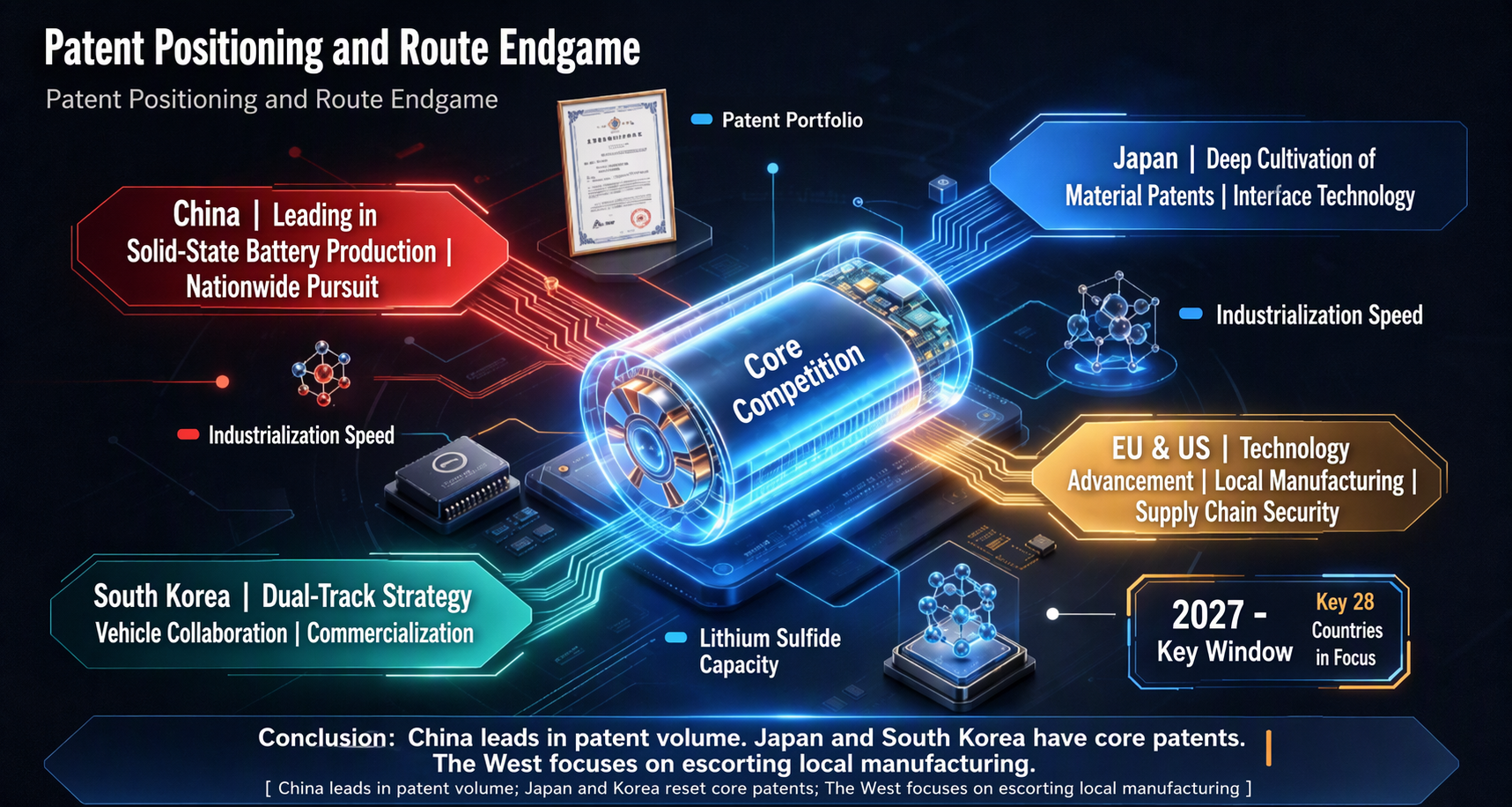
Key points: Will the development of global solid-state batteries use patents as a yardstick to determine the endpoint of each country's technology roadmap? Currently, the global competition is characterised by China leading in quantity, while Japan and South Korea hold key patent positions. China is pursuing a dual-track approach, with solid-liquid batteries already in mass production and all-solid-state batteries catching up; Japan is doubling down on sulphide, South Korea is targeting dual markets, and Europe and the US are adopting technology introduction plus local manufacturing. 2027-2028 is a critical window, with patents, industrialisation speed, and lithium sulphide capacity deciding the outcome.
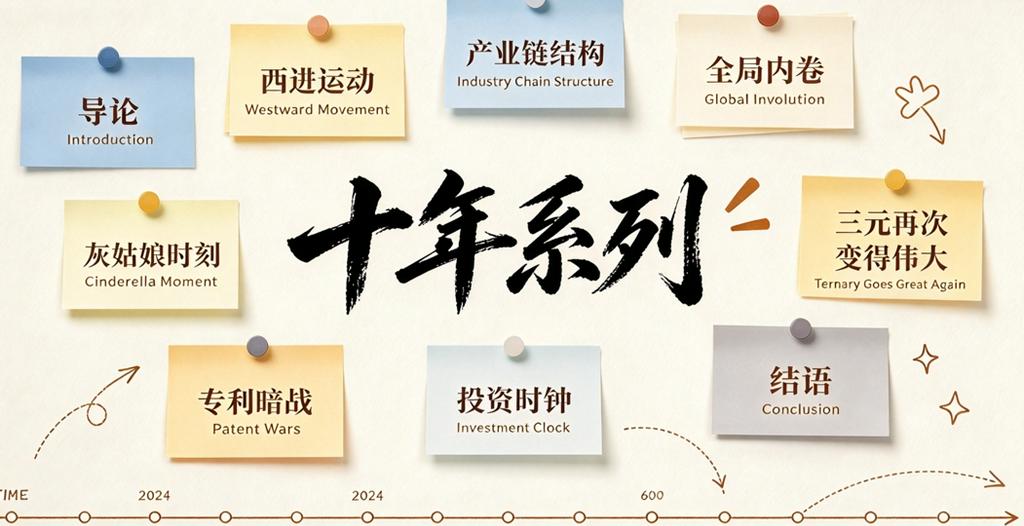
SMM has recently reviewed the future of solid-state batteries and compiled a ten-year outlook series. Using the current development of the lithium battery industry as a reference, especially the intertwined rivalry between LFP and ternary routes, which has written an epic chapter over the years. In the long history of conventional liquid lithium batteries, solid-liquid and solid-state batteries will take the stage, outlining a new generation of high-specific-energy battery world.
The ten-year series will be divided into nine parts: introduction, westward movement, industry chain structure, industry-wide involution, Cinderella moment, ternary becoming great again, patent shadow war, investment clock, and conclusion.
Introduction: Dreams will surely shine into reality: why we need to re-understand the industrial logic of solid-state batteries - the gap between ideal and reality, and the result is that dreams shine into reality
Part 1: Will it replicate the westward movement of liquid batteries: the logic of western concentration - will solid-state batteries replicate the "westward movement" of liquid lithium batteries?
Part 2: A good opportunity to correct the distorted power structure of the industry chain: power structure of the industry chain - upstream windfall profits, midstream squeezed, downstream delayed payments?
Part 3: Warning of PV-style industry-wide involution: will solid-state batteries enter PV-style industry-wide involution?
Part 4: Cinderella's comeback in technology routes: the "Cinderella moment" of solid-state batteries - which technology route will follow the comeback path of LFP?
Part 5: Ternary may become great again: can ternary batteries "become great again" with the help of solid-state batteries?
Part 6: Global competitive landscape - the "patent shadow war" and industrialisation race among China, Japan and South Korea
Part 7: Entering the market early will show you yourself ten years later: investment clock - the "five-stage model" of solid-state battery industrialisation
Conclusion: A brand-new track: solid-state batteries are not a "simple sequel" to liquid lithium batteries
This article is Part 6 of the series on the global competitive landscape of solid-state batteries - the "patent shadow war" and industrialisation race among China, Japan and South Korea, reviewing the patents of LFP, a process full of twists and turns . China broke through the overseas patent barriers of LFP with a policy package: first, it initiated patent invalidation domestically, and in 2011 declared the core patent of Hydro-Québec invalid, clearing local obstacles; overseas, it broke the deadlock through settlement, licensing and acquisition, such as Dynanonic and Wanrun New Energy obtaining licences from the LiFePO4+C alliance, and Wanxiang acquiring A123 to directly obtain core patents; at the same time, it insisted on original technology, with the team of Chen Liquan from the Chinese Academy of Sciences using sodium doping and other approaches to circumvent the original patents. Finally, it waited for the basic patents to expire in 2017 and the carbon coating patents to expire in 2022, then went global comprehensively with cost and scale advantages, ultimately dominating the global LFP market.
Review of the previous article, the sixth of nine articles in the ten-year solid-state battery series: can ternary batteries "become great again" with the help of solid-state batteries? Ternary has been structurally squeezed by LFP in the liquid lithium battery stage, and its share is unlikely to return to the mainstream. Solid-state batteries catalyse its "second positioning": high-nickel ternary and lithium-rich manganese-based materials are naturally compatible with solid-state systems, and solid-liquid batteries provide transitional growth. Scenarios such as eVTOL, humanoid robots, and high-end EVs that have rigid demand for energy density and are price-insensitive will become a solid foundation for the high-end specialised path of ternary.
Part 6: Global competitive landscape - the "patent shadow war" and industrialisation race among China, Japan and South Korea
I. Patent landscape: the quality gap behind the quantity lead
The global competition in solid-state batteries is first and foremost a patent shadow war. The most counter-intuitive feature of this shadow war is that China has already won in quantity, but is still encircled in quality.
In March 2026, Ouyang Minggao, an academician of the Chinese Academy of Sciences, disclosed at an expert and media exchange meeting of the China EV100 that China's newly published patents for all-solid-state batteries had accounted for 44% of the global total, surpassing Japan to rank first worldwide. China's patent applications in the field of solid-state lithium batteries reached 3,341, ranking alongside Japan (3,225) as the top two globally, each accounting for nearly 20%.
But the patent war has never been about who has the thicker stack of documents. On indicators that better represent the quality of technological innovation, the landscape reverses. A systematic analysis by the research team of Chen Wei at the Wuhan Library of the Chinese Academy of Sciences shows that Japan ranks first with 4,373 high-value patents (patent value score of 9-10), followed by the US (3,860) and South Korea (2,185), while China (1,471) ranks only fourth. In priority patent applicant filings, which reflect originality, the US (5,823) and Japan (4,328) are far ahead, while China (480) shows a significant gap.
This pattern of being "large but not strong" is rooted in differences in patent portfolio strategies. Japanese enterprises (such as Toyota and Panasonic) demonstrate deep accumulation and a global vision, having made extensive foundational patent deployments as early as before 2006 and actively building intellectual property barriers in multiple regions including China, the US, and Europe. South Korean giants (Samsung and LG) focus on the dual core markets of their home country and the US. In contrast, although China has six institutions among the global top 20 (such as the Chinese Academy of Sciences, CATL, and BYD), their patent portfolios are highly concentrated in the Chinese market, with over 97% of the Chinese Academy of Sciences' patents filed only in China, indicating a clear lack of global protection.
Toyota's patent moat is the key anchor for understanding this covert battle. Toyota alone holds more than 1,300 solid-state battery patents, and nearly 70% to 80% of the world's core sulphide patents are firmly in the hands of Japanese companies such as Toyota, Panasonic, and Idemitsu Kosan. These patents cover every critical period from electrolyte material formulations to stacking processes, from packaging structures to production equipment, and are mostly foundational, indispensable sulphide core patents. Any company that wants to pursue the sulphide route to make all-solid-state batteries must either pay licensing fees—industry estimates put the patent royalty at at least 5% per battery cell—or spend considerable time and resources to take a detour along peripheral routes.
From the patent landscape data, Toyota leads by a wide margin with 2,077 patent families, followed by Panasonic with 1,579, while LG Energy Solution (804), Samsung SDI (759), and Samsung Electronics (501) form the second tier. The top five applicants together account for 73% of the total patents held by leading applicants, an extremely high concentration, meaning it is difficult for new entrants to shake the existing landscape through volume alone. It is worth noting that South Korean companies are accelerating their catch-up—Samsung SDI's application rate over the past three years is 3.4 times its previous rate, and LG Energy Solution's is 3.1 times.
The direct risk of this patent landscape to Chinese solid-state battery enterprises is: mass production and sales face patent encirclement by Japanese and South Korean enterprises, and technology route choices are constrained. One industry insider's summary is quite precise: China has won the face in terms of patent quantity, while Japan has seized the substance through core patents.
China may use its experience in the LFP industry to break through patent barriers, in a uniquely Chinese way.
II. The Industrialisation Race: China's "Dual-Track Approach" and Japan and South Korea's "Route Focus"
If the patent landscape represents a static distribution of existing stock, then the industrialisation race is a dynamic contest for incremental growth. In this race, China, Japan, and South Korea have taken distinctly different paths.
Chinese producers have adopted a "dual-track approach": semi-solid batteries have achieved mass production and vehicle installation through overtaking on the curve, while all-solid-state batteries are accelerating to catch up. The rationale behind this strategy is that 90% of the process steps for semi-solid batteries can reuse existing liquid-electrolyte production lines, with costs only 20-30% higher than high-end liquid batteries, making them a "present-progressive" growth market; all-solid-state batteries, by contrast, are a "long-dated option" that will determine future competitive positioning.
In the all-solid-state field, the construction of pilot lines by top-tier Chinese players is advancing intensively. CATL's 5GWh sulphide all-solid-state pilot line is in continuous commissioning, with 500Wh/kg-class laboratory samples already validated and pilot-line yield at approximately 60%-70%; the company targets breaking through 90% yield in Q4 2026. BYD's 2GWh sulphide all-solid-state pilot line at Shenzhen Pingshan officially began production in February 2026, making it China's first automotive-grade sulphide all-solid-state battery pilot production line, with reported yield already exceeding 90% and a prototype vehicle achieving a CLTC driving range of 1,218 km. The first phase of the 20GWh mass production line at Bishan, Chongqing is expected to begin construction in Q3 2026.
BYD Chief Scientist Lian Yubo offered a pragmatic assessment of the industrialisation pace: "The industrialisation of all-solid-state batteries has entered the critical stage. Achieving widespread application within three years is relatively difficult; five years is more realistic. We have entered the phase of full-scale assault, with small-batch vehicle installation in 2027 and large-scale popularisation driven by 2030."
Japan's strategy is to concentrate resources on the sulphide route. Toyota and Idemitsu Kosan have jointly conducted R&D for over a decade, forming a complete patent chain from sulphide electrolyte base materials to mass production processes. In January 2026, Toyota's all-solid-state battery officially obtained a mass production permit jointly issued by Japan's Ministry of Economy, Trade and Industry and Ministry of Land, Infrastructure, Transport and Tourism, with an energy density of 480-500Wh/kg, 10-minute charging to 80%, and capacity retention still exceeding 90% after 2,000 cycles. Toyota plans to apply all-solid-state batteries to Lexus flagship models in 2027-2028 and reach 10GWh capacity by 2030. On the materials side, Toyota and Sumitomo Metal Mining are jointly developing high-durability cathode materials for all-solid-state batteries, with large-scale mass production planned from FY2028; lithium sulphide will be stably supplied by Idemitsu Kosan.
South Korea has adopted a "dual-market" strategy. Samsung SDI is focused on the sulphide route and has explicitly planned to achieve mass production of all-solid-state batteries in 2027, with its Q1 2026 R&D expenses up 21.8%, the highest growth rate among the three South Korean battery enterprises. LG Energy Solution, while advancing all-solid-state R&D, is directing more resources to the North American ESS market, planning to secure over 50GWh of ESS capacity in North America by the end of 2026. Both enterprises are simultaneously targeting the domestic and US markets, seeking a balance between technological leadership and commercial implementation.
Europe and the US are advancing through a combination of "US battery plants + European automakers." ProLogium Technology's 48GWh gigafactory in Dunkirk has received approximately 1.4 billion yuan in subsidies from the French government, representing Europe's typical path of entering the solid-state battery market through "technology introduction + local manufacturing."
III. Competitive Landscape Outlook: Divergence and Convergence of Three Paths
Taking into account the three dimensions of patent landscape, industrialisation strategy, and material constraints, the global competitive landscape for solid-state batteries over the next decade may unfold as follows:
China will dominate the mass production of semi-solid batteries and the oxide route. China's advantage lies in industrialisation speed and the first-mover advantage in semi-solid batteries. Semi-solid batteries have already achieved mass production and vehicle installation, generating actual shipments in scenarios such as the low-altitude economy and high-end passenger vehicles. The oxide route, due to its relatively low engineering difficulty and controllable costs, is also a direction where Chinese enterprises are concentrated. However, the window for this advantage is limited—China needs to establish sufficient cost and scale barriers before sulphide all-solid-state technology matures.
Japan and South Korea will dominate core technology patents on the sulphide route. The foundational patent layouts of Toyota, Panasonic, and Idemitsu Kosan in core areas such as sulphide electrolytes, anode and cathode materials, and interface technologies constitute intellectual property barriers that are difficult to circumvent. Even if Chinese enterprises can independently develop manufacturing processes for sulphide all-solid-state batteries, they may still face patent licensing negotiations during commercialisation. Samsung SDI and LG Energy Solution, while trailing Toyota in patent quantity, have shown a significant acceleration in application rates over the past three years, indicating they are rapidly catching up.
Europe and the US will enter the market through "technology introduction + local manufacturing." ProLogium Technology's receipt of French government subsidies to build a gigafactory in Dunkirk is a typical case of this model. Europe and the US have relatively weak reserves of foundational patents in solid-state batteries, but they hold advantages in automotive brands, market channels, and policy tools, enabling them to participate in competition by introducing Asian technology and localising manufacturing.
From a temporal perspective, 2027-2028 will be the first critical window for global solid-state battery industrialisation. The mass production timetables of top-tier players such as Toyota, Samsung SDI, CATL, and BYD are concentrated in this period. But as Zeng Yuqun pointed out at the 2026 Dalian Davos Forum, the entire industry is currently only at level 4 of technology maturity, and "going from 4 to 9" is not a matter of engineering volume, but of yield, cost, and the industry chain. In this climb from level 4 to level 9, the patent shadow war determines who is qualified to compete, industrialisation speed determines who reaches the finish line first, and lithium sulphide capacity determines how many competitors can start the race simultaneously.
The next article will discuss: Entering the field early means seeing yourself ten years later: The Investment Clock—the "Five-Stage Model" of solid-state battery industrialisation
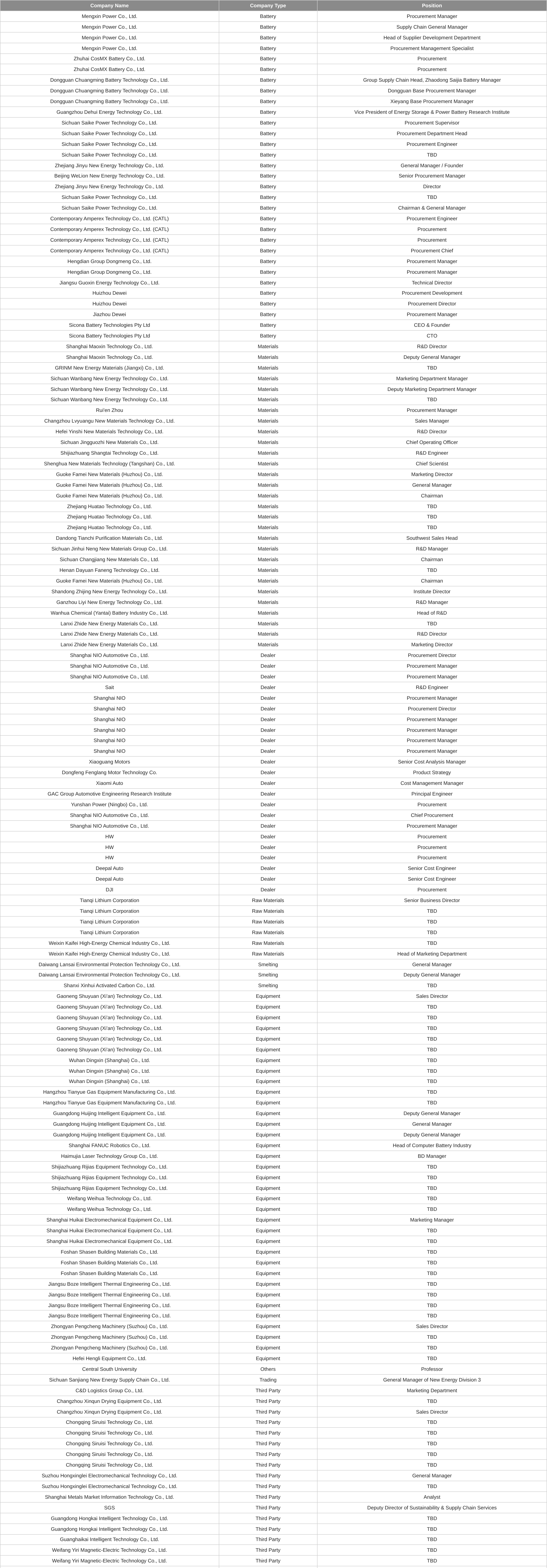
Finally, I would like to recommend SMM's premium conference. Current progress and some participating enterprises and representatives:
Tel: 021-20707860 (or add WeChat 13585549799) Yang Chaoxing, thank you!
Related Information