Key points: In the liquid-state lithium battery era, ternary has been structurally squeezed by LFP, making it difficult for its share to return to the mainstream. Solid-state batteries are catalysing its "second positioning": high-nickel ternary and lithium-rich manganese-based cathodes are naturally compatible with solid-state systems, and semi-solid batteries provide transitional growth. Scenarios such as eVTOL, humanoid robots and high-end EVs, which have rigid demand for energy density and are price-insensitive, will become a solid foundation for ternary's high-end specialised path.
SMM recently reviewed the future of solid-state batteries and compiled a ten-year series. Using the current development of the lithium battery industry as a reference, especially the intertwined love-hate relationship between the LFP and ternary routes, an epic chapter has unfolded over time. In the long river of conventional liquid-state lithium batteries, semi-solid and solid-state batteries will take the stage, outlining a new generation of high-specific-energy battery world.
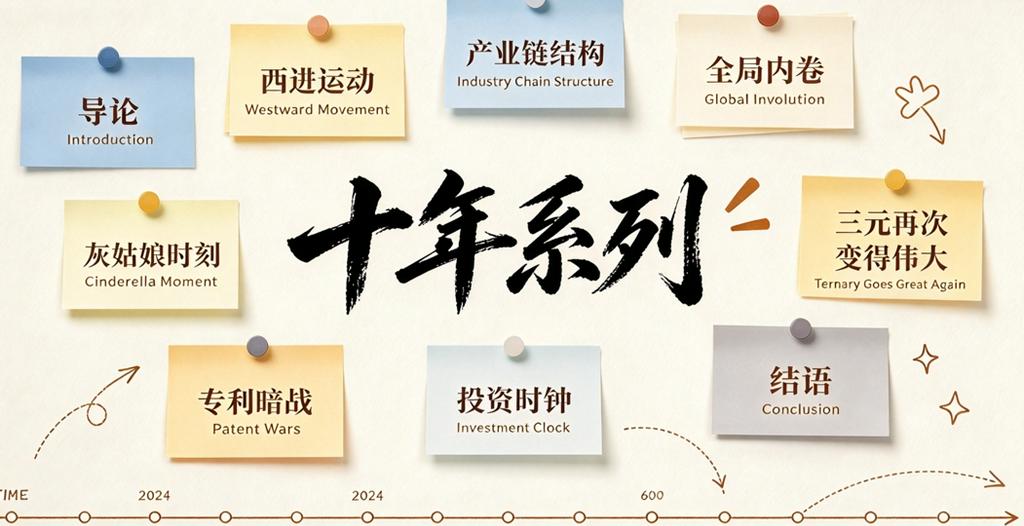
The ten-year series will be divided into nine parts: introduction, westward movement, industry chain structure, industry-wide involution, Cinderella moment, making ternary great again, patent shadow war, investment clock and conclusion.
Introduction: Dreams will surely shine into reality: why we need to re-understand the industrial logic of solid-state batteries - the gap between ideal and reality, and the result is that dreams shine into reality
Part One: Will it replicate the westward movement of liquid-state batteries: the logic of concentration in the west - will solid-state batteries replicate the "westward movement" of liquid-state lithium batteries?
Part Two: A good opportunity to reverse the distorted power structure of the industry chain: industry chain power structure - upstream windfall profits, midstream under pressure, downstream delaying payments?
Part Three: A warning of PV-style industry-wide involution: will solid-state batteries enter PV-style industry-wide involution?
Part Four: The Cinderella comeback in technology routes: the "Cinderella moment" of solid-state batteries - which technology route will follow the comeback path of LFP?
Part Five: Ternary may become great again: can ternary batteries become "great again" with the help of solid-state batteries?
Part Six: Global competitive landscape - the "patent shadow war" and industrialisation race among China, Japan and South Korea
Part Seven: Entering early will let you see yourself ten years later: investment clock - the "five-stage model" of solid-state battery industrialisation
Conclusion: A brand-new track: solid-state batteries are not a "simple sequel" to liquid-state lithium batteries
This article is Part Five: can ternary batteries become "great again" with the help of solid-state batteries? In a liquid-state lithium battery industry where the share of LFP batteries continues to rise while the market share of ternary batteries gradually declines to zero growth, the development of solid-state batteries will give ternary another opportunity to be valued. High-nickel ternary and lithium-rich manganese-based cathode materials, prized by solid-state batteries for their high energy density, may regain market share and "become great" again.
Recap of the previous article, the fifth of nine in the ten-year solid-state battery series: "Cinderella moment" - which technology route will follow the comeback path of LFP? The oxide route is most likely to replicate LFP's comeback: overlooked, easy to engineer and low-cost, it will first target commercial vehicles, energy storage and eVTOL, then counterattack into passenger vehicles. But the window is only 3-5 years, and cost and scale barriers must be established before sulphide matures; all-solid-state performance bottlenecks and profitability pressure are the main risks.
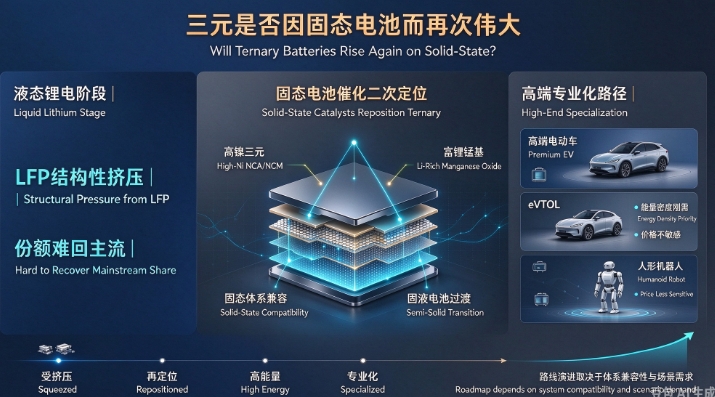
Ternary batteries' "second positioning" is a high-end specialised path catalysed by solid-state batteries!
In the liquid-state lithium battery stage, LFP squeezed ternary with its cost, safety and cycle advantages, leaving ternary with almost no growth. Solid-state batteries change the logic: solid-state electrolytes are compatible with high-voltage, high-specific-energy cathodes, suppressing interfacial side reactions and thermal runaway, allowing the energy density potential of high-nickel ternary and lithium-rich manganese-based cathodes to be truly released. High-nickel ternary improves specific capacity and driving range; lithium-rich manganese-based cathodes combine high voltage, high specific energy and low-cost manganese resources, and their cycle and safety shortcomings in liquid-state systems are expected to be alleviated in solid-state systems. As solid-state batteries are deployed in high-end EVs, eVTOL and other scenarios, the market will once again pay for high energy density, and high-nickel ternary and lithium-rich manganese-based cathodes may regain share, with the ternary system expected to "become great again".
I. A structural fact: ternary's decline is not cyclical
China's power battery data for 2025 outline a clear dividing line. Annual cumulative power battery installations reached 770 GWh, of which LFP accounted for 625 GWh, or 81%, up 53% YoY; ternary batteries accounted for 145 GWh, or 19%, up only 4% YoY. The market share gap between the two widened from the slight advantage when LFP first overtook ternary in 2021 to more than fourfold.
The deeper implication of this data set is that the decline in ternary's share is not the result of market sentiment or short-term supply-demand fluctuations, but rather a structural shift. Leveraging its cost advantages and safety performance, LFP has completed its "baseline" positioning in the mainstream passenger vehicle market. Since LFP's share surpassed ternary in July 2021, this trend has never reversed; instead, it has been further reinforced in each year's data.
Ternary's "decline" stems from a fundamental contradiction that cannot be eliminated through process improvements: high energy density requires high nickel and high cobalt, and high nickel and high cobalt mean high costs, as well as less stable material chemistry and greater safety challenges. In the mainstream passenger vehicle market, consumers' marginal demand for driving range has already been met by LFP's fast charging capability and the growing battery pack capacity, and the premium space for the "extra energy density" that ternary provides has been compressed to the extreme.
Therefore, any discussion of ternary's future must begin with acknowledging a reality:it cannot surpass LFP again in the mainstream passenger vehicle market. The cost gap is structural and will not disappear with the introduction of solid-state batteries. Ternary's path forward lies not in "reclaiming old territory," but in "opening up new battlegrounds."
II. Three Growth Opportunities That Solid-State Batteries Open Up for Ternary
2.1 Natural Compatibility of the Cathode System
The technology roadmap for all-solid-state batteries is rapidly converging. Ouyang Minggao, an academician of the Chinese Academy of Sciences, has explicitly stated: "The current technology roadmap for all-solid-state batteries should focus on sulphide electrolytes as the primary electrolyte, matched with high-nickel ternary cathodes and silicon carbon anodes." Ronbay Technology has also pointed out in institutional surveys that ultra-high-nickel and lithium-rich manganese-based materials will become the mainstream for solid-state cathodes.
This means that ternary materials have a natural compatibility with solid-state battery systems. The high specific capacity and high energy density advantages of high-nickel ternary cathode materials, combined with the high safety of solid-state electrolytes, constitute the most promising material combination for all-solid-state batteries. In contrast, LFP's compatibility in solid-state systems actually requires more R&D investment—its lower working voltage and energy density ceiling create a directional tension with the technical goal of "pursuing ultimate energy density" in solid-state batteries.
Of course, the interfacial compatibility between high-nickel ternary and solid-state electrolytes remains a technical challenge that needs to be overcome, including issues such as the space charge layer effect, interfacial side reactions, and mechanical contact failure. However, these problems are engineering-level challenges rather than fundamental incompatibility of the material system. Cathode material enterprises such as Zhenhua New Materials have explicitly stated that their high-nickel/ultra-high-nickel materials "can be directly adapted to solid-state battery systems."
2.2 The "Present Progressive" of Solid-Liquid Batteries
During the transition toward all-solid-state batteries, solid-liquid batteries are becoming a realistic growth market for ternary materials. 2026 has been defined by SVOLT as "the inaugural year of solid-liquid batteries," and its CEO Yang Hongxin predicts that solid-liquid batteries will first be applied in the low-altitude economy and high-end passenger vehicles.
CATL's Qilin condensed-state battery, released in April 2026, adopts an ultra-high-nickel cathode solution and a silicon-based anode solution, achieving an energy density of 350 Wh/kg and 760 Wh/L, with a driving range of up to 1,500 km for equipped car models. SVOLT's mass-produced prismatic mid-nickel and high-nickel solid-liquid batteries have an energy density in the range of 247–270 Wh/kg, with the core goal not being the pursuit of ultimate energy density but rather addressing the safety issues of ternary batteries. REPT Battero's solid-liquid hybrid high-nickel battery achieves an energy density of 280–400 Wh/kg and has already entered mass production.
The significance of solid-liquid batteries for ternary lies in the fact that they provide a "present progressive" incremental outlet. Cathode material enterprises have already achieved kiloton-level shipments of materials specifically for solid-liquid batteries, including mid-nickel, high-nickel, and lithium nickel manganese oxide, with related products introduced to multiple leading solid-state battery clients and successfully applied in batches in high-end EVs. This is not a "long-dated option" waiting for all-solid-state technology to mature, but rather orders and revenue that have already materialized.
2.3 Incremental scenarios: extremely sensitive to energy density, insensitive to price
The most noteworthy aspect of ternary under the catalysis of solid-state batteries is a cluster of incremental scenarios sharing common characteristics: extremely sensitive to energy density and insensitive to price.
2.3.1 The low-altitude economy (eVTOL) is the most typical scenario among them. The takeoff weight limit of eVTOL makes battery energy density a core bottleneck. At present, low-altitude aircraft batteries are predominantly high-nickel ternary, with cell energy density reaching 300–360 Wh/kg. The reason high-nickel ternary is currently the primary choice lies in its excellent balance between high energy density and high power output. The battery provided by CALB for XPeng's flying car adopts high-silicon high-nickel cells, achieving an energy density of 360 Wh/kg, approximately 1.5 times that of ordinary EV batteries. Farasis Energy has already secured designations from a leading US eVTOL client, Shanghai TCab Tech, XPeng AeroHT, Zero Gravity, and other low-altitude economy clients.
2.3.2 Humanoid robots represent another rapidly emerging incremental market.High-nickel ternary lithium batteries are currently the mainstream choice for robot batteries—the Tesla Optimus Gen 2 is equipped with a 2.3 kWh high-nickel ternary battery system, which can only sustain approximately two hours of dynamic operation. Increased battery weight directly adds load to the robot's joint motors and actuators, so the ternary system, with its higher energy density and lighter weight, offers advantages that LFP cannot replace. Farasis Energy has already engaged with multiple leading humanoid robot clients in China and overseas for sample delivery.
The common logic of these two scenarios is that they do not compete within LFP's "cost-safety" framework, but rather within ternary's "energy density-lightweighting" framework. In eVTOLs, battery weight directly determines the aircraft's payload capacity and range; in humanoid robots, battery weight directly affects joint load and motion efficiency. Under these constraints, LFP's "cost advantages" cannot be converted into value, while ternary's "energy density advantage" is directly converted into product competitiveness.
III. The Boundaries and True Meaning of the Revival
Ternary will not become "great again" to the extent of its dominance in the liquid lithium battery era. Its 19% share of domestic installations in 2025 already shows that LFP's position in China's mainstream passenger car market is difficult to shake. By 2030, the global share of LFP versus ternary power batteries is expected to increase significantly, but within this growth, most of ternary's incremental volume will come from markets outside China, high-end car models, and emerging applications, rather than China's mainstream passenger car market. Lithium-rich manganese-based materials will be the primary cathode material for future solid-state batteries, not the ternary system.
This is a shift from "commoditization" to "high-end specialization." Ternary's future lies not in recapturing market share, but in establishing irreplaceability in growth scenarios such as the low-altitude economy, humanoid robots, and high-end EVs. In these scenarios, the measure of ternary's value is not "cost per watt-hour," but "energy per gram of weight"—a dimension in which LFP cannot compete for the foreseeable future.
CATL CTO Gao Huan once said bluntly: "Choosing an LFP battery for an EV priced above 250,000 yuan is essentially a disguised downgrade." This statement reveals a key judgment: the high-end market's demand for energy density is rigid, and ternary is currently the only mainstream cathode system capable of meeting this rigid demand. The emergence of solid-liquid batteries further lowers the safety risk threshold for ternary applications in the high-end market, making the combination of "high energy density + high safety" possible.
IV. Conclusion
What ternary batteries are undergoing is not a "revival," but a repositioning. They are shifting from being "competitors in the mainstream passenger car market" to "enablers of high-end and emerging scenarios." Solid-state batteries—whether solid-liquid or all-solid-state—provide the technological infrastructure for this shift: the natural compatibility of the cathode system allows ternary to enter the solid-state system without "modification," while solid-liquid batteries offer a transitional growth market that is already materializing.
The future of ternary does not depend on whether it can once again surpass LFP, but on whether it can build a sufficiently deep moat in scenarios with rigid demand for energy density and low price sensitivity. The takeoff weight limits of eVTOL, the joint load constraints of humanoid robots, and the extreme pursuit of driving range and lightweighting in high-end EVs—these constraints form the solid foundation for ternary's "high-end specialisation" path.
The next article will discuss: the global competitive landscape—the "patent shadow war" and industrialisation race among China, Japan and South Korea, current progress and future trends.
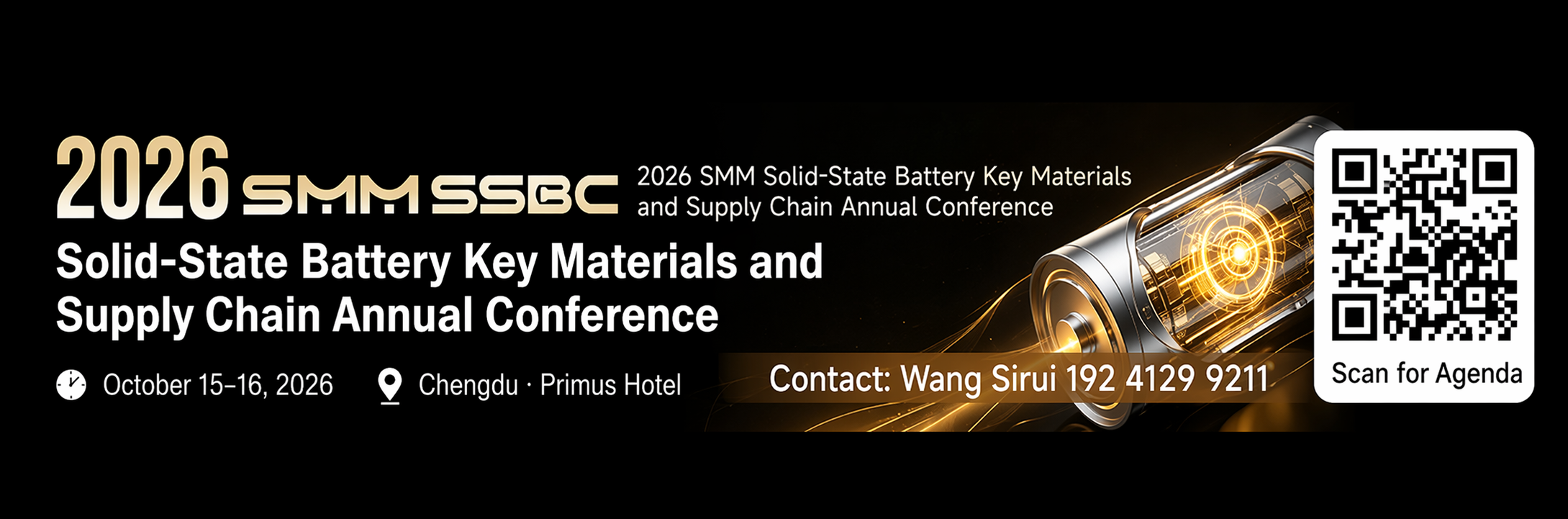
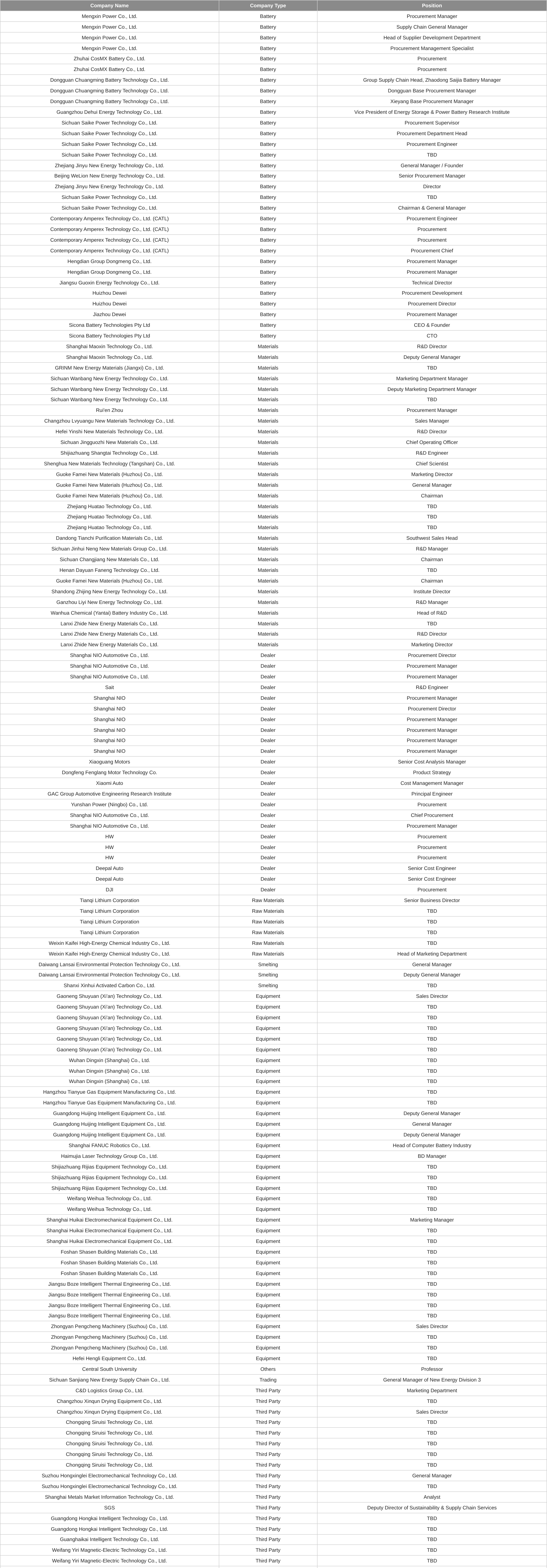
Finally, I would like to recommend SMM's premium conference, with current progress and some participating enterprises and representatives:
Tel: 021-20707860 (or add WeChat 13585549799) Yang Chaoxing, thank you!