Glencore's Attributable Chrome Ore Output Holds Near 1.65 Million Tonnes in H1 2026 Despite Ferroalloys Strain

Published: Aug 5, 2026 15:16

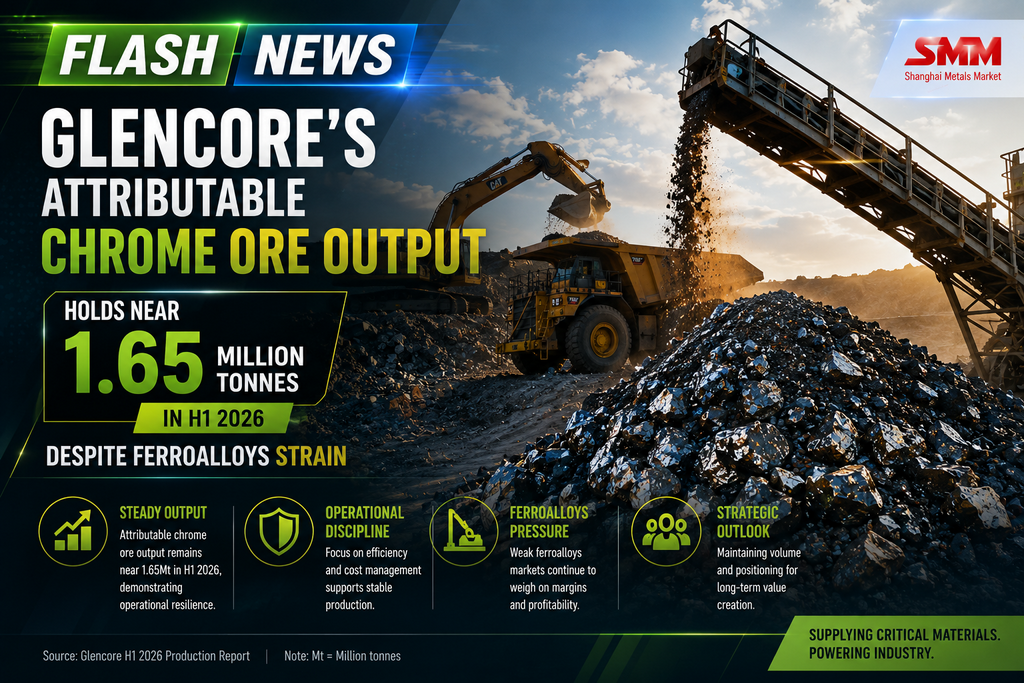
[SMM Express] Glencore's Half-Year Production Report 2026 shows attributable chrome ore production — the group's 79.5% share of the Glencore-Merafe Chrome Venture — at 1,647,000 tonnes for H1 2026, down just 4% (70,000 tonnes) from 1,717,000 tonnes in H1 2025. Glencore attributed the modest decline simply to "operating conditions over the period," a notably milder explanation than the smelter-specific language it used for ferrochrome. Quarterly data confirms this was a gradual easing rather than a sharp drop: 910kt in Q2 2025, rising to 1,037kt in Q3, before stepping down to 859kt in Q4 2025, 830kt in Q1 2026 and 817kt in Q2 2026 — a 10% year-on-year decline at the Q2-to-Q2 level.

This resilience mirrors what SMM has already tracked at Merafe Resources, Glencore's 20.5% partner in the same Venture. Merafe's own H1 2026 disclosure showed chrome ore production of 425,000 tonnes, down 4% from 443,000 tonnes — an almost identical percentage decline to Glencore's figure. With both Venture partners independently reporting the same modest ore-side softening even as ferrochrome production collapsed on their respective books, the pattern is now confirmed at the Venture level rather than being an artifact of one company's reporting: chrome ore extraction has held up far better than downstream smelting through the first half of 2026.
Data Source Statement: Except for publicly available information, all other data are processed by SMM based on publicly available information, market communication, and relying on SMM's internal database model. They are for reference only and do not constitute decision-making recommendations.

For any inquiries or for more information, please contact: lemonzhao@smm.cn
For more information on how to access our research reports, please contact:service.en@smm.cn
Related News
[SMM Chromium Flash] Alluvial Exhaustion Forces Zimbabwe's Chrome Miners Toward Costlier Hard-Rock Ore
4 hours ago
[SMM Chromium Flash] Alluvial Exhaustion Forces Zimbabwe's Chrome Miners Toward Costlier Hard-Rock Ore
Read More
[SMM Chromium Flash] Alluvial Exhaustion Forces Zimbabwe's Chrome Miners Toward Costlier Hard-Rock Ore
[SMM Chromium Flash] Alluvial Exhaustion Forces Zimbabwe's Chrome Miners Toward Costlier Hard-Rock Ore
As Zimbabwe's easily mined alluvial chrome deposits approach exhaustion, small-scale miners are being pushed toward hard-rock lumpy chrome, a shift that Chrome Miners Association of Zimbabwe chairperson Shelton Lucas says is straining the sector's economics. Unlike alluvial chrome, which could be extracted with limited capital and equipment, hard-rock ore requires drilling, blasting, crushing and heavier mechanization, pushing production costs beyond the reach of many operators. Lucas said this cost pressure is compounded by Zimbabwe's ban on raw chrome ore exports, introduced to encourage local beneficiation and smelter investment. With a limited number of domestic smelters absorbing ore, miners have fewer buyers to sell into and correspondingly weaker pricing power, leaving them, in Lucas's words, exposed to predatory pricing from Chinese-owned smelter operators even as extraction costs climb. To rebalance the market, Lucas proposed government-backed toll smelting, an arrangement under which miners would pay a processing fee while retaining ownership of their chrome, allowing them to sell the processed product rather than raw ore at prices set unilaterally by smelter operators. Zimbabwe's Ministry of Mines has pointed to investment in mining infrastructure, energy supply and operational efficiency as necessary to sustain output, though no toll-smelting facility has yet been confirmed. Whether such a mechanism materializes will be a key test of how much pricing leverage Zimbabwe's ore miners can claw back as the sector's hard-rock transition deepens.
4 hours ago
Tantalum Prices Rally Amid Supply Gaps and AI Demand, But Sustainability Uncertain
8 hours ago
Tantalum Prices Rally Amid Supply Gaps and AI Demand, But Sustainability Uncertain
Read More
Tantalum Prices Rally Amid Supply Gaps and AI Demand, But Sustainability Uncertain
In late May, driven by news stimulus and expectations for future demand, tantalum prices once rallied sharply, with tantalum ore prices surging to 240–245 US dollars per ton-unit.
8 hours ago
[SMM Chromium Flash] Zimbabwe's Q1 Chrome Output Falls 61% as Alluvial Deposits Run Dry
8 hours ago
[SMM Chromium Flash] Zimbabwe's Q1 Chrome Output Falls 61% as Alluvial Deposits Run Dry
Read More
[SMM Chromium Flash] Zimbabwe's Q1 Chrome Output Falls 61% as Alluvial Deposits Run Dry
[SMM Chromium Flash] Zimbabwe's Q1 Chrome Output Falls 61% as Alluvial Deposits Run Dry
Zimbabwe's chrome production fell 61.7% year-on-year in Q1 2026, dropping to 178,425 mt from 465,638 mt in the prior-year period, according to the country's Ministry of Mines and Mining Development. The decline ranks among the steepest recorded across Zimbabwe's major minerals for the quarter. The Chrome Miners Association of Zimbabwe attributes the contraction to the exhaustion of alluvial chrome deposits, the loose, near-surface sediment that has historically supplied the bulk of the country's output and underpinned its artisanal and small-scale mining sector. Association chairperson Shelton Lucas said replenishment of these deposits occurs only through slow sedimentary processes, leaving no near-term prospect of alluvial supply recovering to prior levels. With alluvial sources depleting, Zimbabwean miners are increasingly turning to lumpy chrome locked in hard-rock formations, a resource that demands drilling, blasting, crushing and greater mechanization to extract. That shift raises the capital and cost threshold for participation in a sector still dominated by small-scale operators, positioning the pace and terms of Zimbabwe's transition to hard-rock mining as a key swing factor for the country's chrome supply going forward.
8 hours ago