Tantalum Price Stops Falling and Stabilizes: Off-Season Ends, Can the Next Round of Market Rally Begin? [SMM Analysis]

Published: Aug 26, 2026 18:06
[SMM Tantalum Market Analysis: Tantalum Prices Stop Falling and Stabilize: Off-Season Ends, Can the Next Round of Market Movement Be Launched?] At the end of May, driven by news factors and supported by future demand expectations, tantalum prices shot up, with tantalum ore prices soaring to $240-245/mtu. However, the positive news failed to materialize, market panic sentiment intensified, and tantalum prices turned to grind lower, entering a prolonged period of consolidation at lows. As the traditional off-season of July and August comes to an end, the market is stirring at the bottom, and tantalum prices are expected to usher in a new operating cycle.

At the end of May, supported by news stimuli and future demand expectations, tantalum prices shot up, with tantalum ore prices surging to $240-245/mtu. However, the positive factors did not materialize later, market panic sentiment fermented, and tantalum prices shifted to a grind lower channel and entered a long period of consolidation at lows. As the traditional off-season in July and August comes to an end, underlying currents stir at the market bottom, and tantalum prices are expected to usher in a new operating cycle.
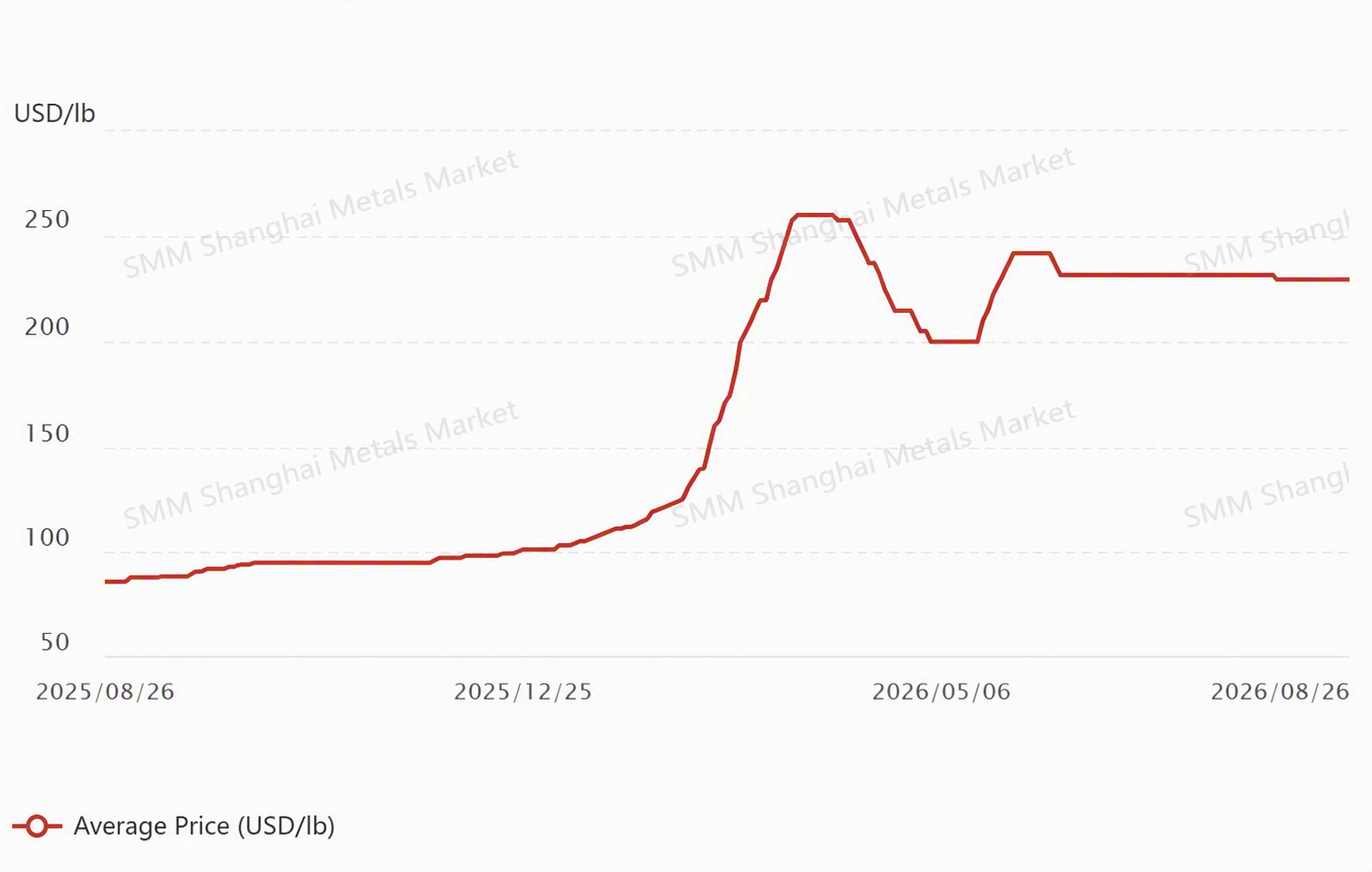
Recently, signals of price increases have emerged one after another. There are three main supporting factors: First, downstream tantalum smelters restocked in a timely manner, providing underlying support for the market, which is also the core reason for the limited overall pullback in tantalum prices earlier. Second, the annual supply gap exists naturally, and the recovery of traditional demand coupled with the release of demand in the emerging AI sector keeps demand for tantalum ore and tantalum smelting products strong. Third, speculative demand amplified the gains. As the off-season ends, some miners began to purchase and stockpile, low-priced goods in the market were quickly digested, and the bottom of tantalum prices gradually rose.

However, the sustainability of this round of increase remains uncertain. On the one hand, the sharp rise in tantalum prices creates substitution pressure on traditional demand. Long-term high prices will prompt downstream enterprises to actively seek substitutes, limiting the upside room for prices. On the other hand, the market still maintains a certain amount of raw material inventory. Combined with smelters' fear of high prices, downstream procurement shows the characteristics of "long intermittent periods and concentrated procurement," making it difficult for the demand side to form a sustained boost.

Data Source Statement: Except for publicly available information, all other data are processed by SMM based on publicly available information, market communication, and relying on SMM's internal database model. They are for reference only and do not constitute decision-making recommendations.

Images in this article contain AI-translated captions for reference only.

For any inquiries or for more information, please contact: lemonzhao@smm.cn
For more information on how to access our research reports, please contact:service.en@smm.cn
Related News
Tantalum Prices Rally Amid Supply Gaps and AI Demand, But Sustainability Uncertain
1 hour ago
Tantalum Prices Rally Amid Supply Gaps and AI Demand, But Sustainability Uncertain
Read More
Tantalum Prices Rally Amid Supply Gaps and AI Demand, But Sustainability Uncertain
In late May, driven by news stimulus and expectations for future demand, tantalum prices once rallied sharply, with tantalum ore prices surging to 240–245 US dollars per ton-unit.
1 hour ago
[SMM Chromium Flash] Zimbabwe's Q1 Chrome Output Falls 61% as Alluvial Deposits Run Dry
1 hour ago
[SMM Chromium Flash] Zimbabwe's Q1 Chrome Output Falls 61% as Alluvial Deposits Run Dry
Read More
[SMM Chromium Flash] Zimbabwe's Q1 Chrome Output Falls 61% as Alluvial Deposits Run Dry
[SMM Chromium Flash] Zimbabwe's Q1 Chrome Output Falls 61% as Alluvial Deposits Run Dry
Zimbabwe's chrome production fell 61.7% year-on-year in Q1 2026, dropping to 178,425 mt from 465,638 mt in the prior-year period, according to the country's Ministry of Mines and Mining Development. The decline ranks among the steepest recorded across Zimbabwe's major minerals for the quarter. The Chrome Miners Association of Zimbabwe attributes the contraction to the exhaustion of alluvial chrome deposits, the loose, near-surface sediment that has historically supplied the bulk of the country's output and underpinned its artisanal and small-scale mining sector. Association chairperson Shelton Lucas said replenishment of these deposits occurs only through slow sedimentary processes, leaving no near-term prospect of alluvial supply recovering to prior levels. With alluvial sources depleting, Zimbabwean miners are increasingly turning to lumpy chrome locked in hard-rock formations, a resource that demands drilling, blasting, crushing and greater mechanization to extract. That shift raises the capital and cost threshold for participation in a sector still dominated by small-scale operators, positioning the pace and terms of Zimbabwe's transition to hard-rock mining as a key swing factor for the country's chrome supply going forward.
1 hour ago
[SMM Chromium Flash] Global Chrome Ore Departures Rise 33.62% WoW to 599,300 mt, Maputo Continues to Lead
4 hours ago
[SMM Chromium Flash] Global Chrome Ore Departures Rise 33.62% WoW to 599,300 mt, Maputo Continues to Lead
Read More
[SMM Chromium Flash] Global Chrome Ore Departures Rise 33.62% WoW to 599,300 mt, Maputo Continues to Lead
[SMM Chromium Flash] Global Chrome Ore Departures Rise 33.62% WoW to 599,300 mt, Maputo Continues to Lead
Global chrome ore departures from major export ports totaled 599,300 mt in the week ended August 21, up 33.62% week-on-week, according to SMM's latest data. The rebound follows the prior week's weather-affected decline, with volumes recovering sharply as loading conditions appear to have normalized across the region's key export corridors. Maputo drove the bulk of the recovery, with departures jumping to 515,200 mt from 333,200 mt, a 54.62% increase that lifted the port's share of total departures to roughly 86%. The sharp rebound is consistent with a catch-up in loadings following the prior week's freezing temperatures, heavy rains, and strong winds, and reaffirms Maputo's position as the dominant corridor for regional chrome ore exports. Mersin also posted a strong gain, rising to 50,600 mt from 33,100 mt, though it remains a comparatively minor contributor to overall volumes. Richards Bay moved in the opposite direction, falling further to 33,500 mt from 82,200 mt, a 59.24% decline that marks a second consecutive weekly drop. The continued weakness suggests the port has yet to see the same recovery in loading activity observed at Maputo, though SMM has not confirmed whether this reflects ongoing weather disruption, vessel scheduling, or other port-side constraints. Beira again recorded no chrome ore departures, remaining inactive in the current shipping cycle. Overall, the week's data points to a broad-based recovery in seaborne chrome ore flows from Southern Africa, led by a strong rebound at Maputo, even as Richards Bay's diverging trend warrants continued monitoring in the coming weeks.
4 hours ago
Register to Continue Reading
Gain access to the latest insights in metals and new energy
Already have an account?Sign in here