July 31, 2026 –
China’s overall aluminum processing PMI for July registered 42.2%, a sharp pullback of 4.4 percentage points MoM, with all sub-sectors in contraction territory. Aluminum plate/sheet and strip (44.8%), aluminum foil (39.0%), construction extrusion (39.7%), industrial extrusion (42.1%), aluminum wire and cable (44.4%), primary alloy (43.9%), and secondary alloy (37.6%) all fell below the 50 mark, signaling a further contraction in industry sentiment. The common pressure across sub-sectors was the full-blown traditional consumption off-season in July, with synchronized weakness in end-use demand from real estate, home appliances, and general machinery. Sub-indexes for all categories broadly fell into contraction territory. Structural divergence was pronounced—civilian sheets and plates in the plate/sheet and strip sector, air-conditioner and packaging foil, real estate extrusion orders, and domestic sales and exports in the wire and cable sector all weakened across the board. Only NEV and PV-related demand in the industrial extrusion sector provided structural support. Export performance showed a sharp contrast: aluminum plate/sheet and strip, aluminum foil, and construction extrusion exports only contracted mildly, and industrial extrusion exports held at the 50 mark, while a reversal of the price spread between Chinese and overseas markets hammered new export orders for aluminum wire and cable, making it the biggest drag. Secondary alloy, additionally constrained by fiscal and tax compliance controls and a shortage of aluminum scrap raw materials, recorded the lowest reading among all processing sub-sectors.
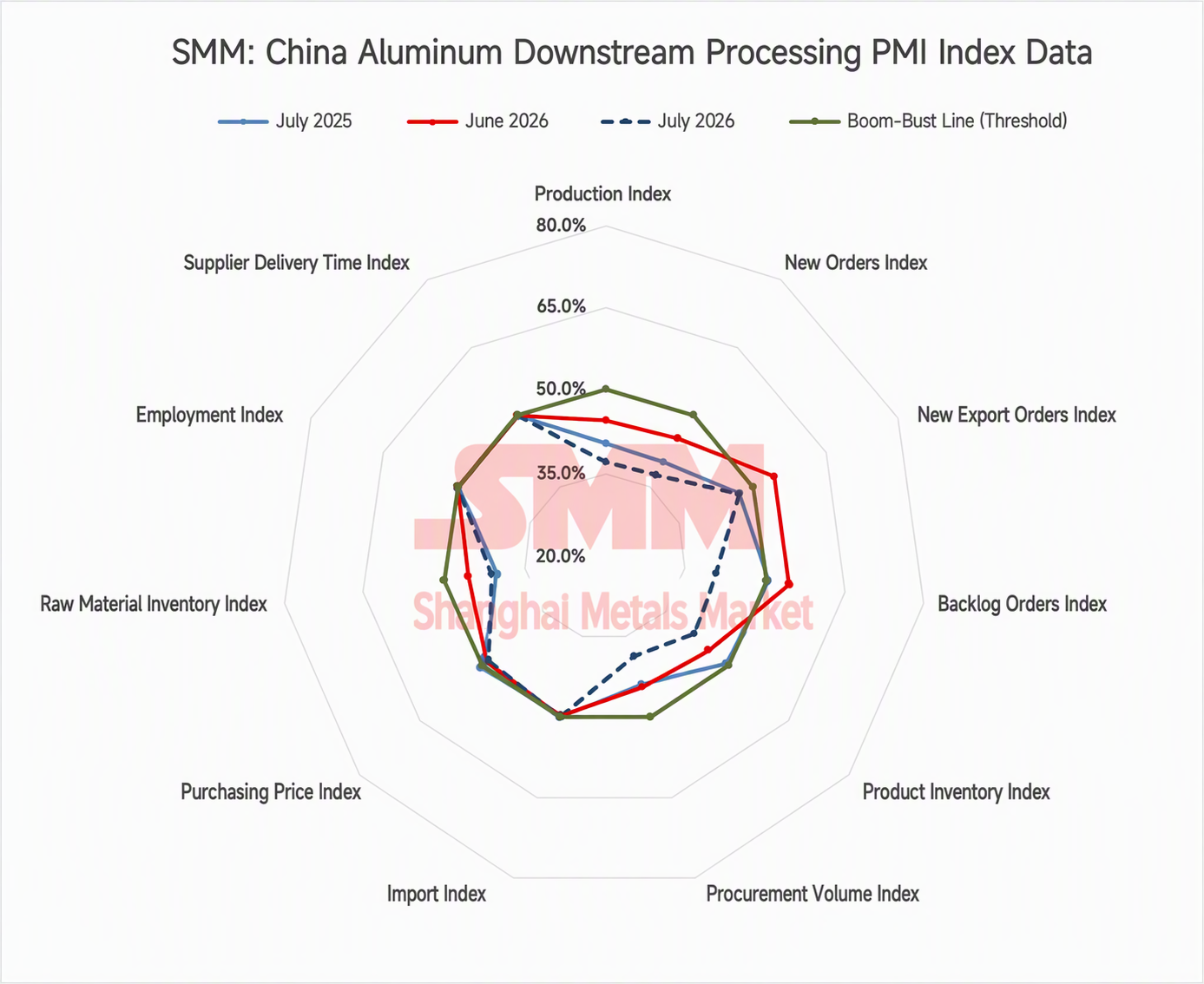
Looking at individual product categories:
Aluminum Plate/Sheet and Strip : The monthly composite PMI for aluminum plate/sheet and strip registered 44.8% in July, with all core sub-indexes broadly shifting into contraction territory. Both the production index and new orders index fell to 41.3%. As the traditional July off-season deepened, automotive sheet consumption pulled back slightly, 1000, 3000-series cast-rolling orders decreased notably, end-use demand for general-purpose plates remained persistently sluggish, and producers faced the dual headwinds of insufficient orders and elevated finished product inventories. The scale of proactive production cuts expanded significantly MoM. On the export front, the new export orders index registered 48.6%—still in contraction territory but with a relatively mild decline. Although customs data showed exceptionally stellar aluminum plate/sheet and strip export performance in June (354,000 mt, up 10.6% MoM and up 44% YoY), maintaining some resilience, domestic enterprises that had undertaken diverted orders saw a notable adjustment in production pace in July after North American leading rolling mills resumed production lines in June. Diverted orders that had previously flowed back to China were fully reclaimed. On the inventory and pricing front, the finished product inventory index fell to 45.0%, and the raw material inventory index was 47.6%, with enterprises adopting proactive production cuts and aggressive destocking strategies during the off-season. Overall, multiple pressures—the loss of can stock transfer orders, marginal weakening of export support, and deepening traditional off-season effects—are intertwined. The aluminum plate/sheet and strip PMI is expected to remain below the 50 mark in August.
Aluminum Foil : The monthly composite PMI for aluminum foil fell to 39.0% in July. By sub-index, the production index and new orders index both plummeted to 31.8%. The traditional off-season effect deepened July–August, downstream clients lacked incentive to stockpile, and production and sales fell 10%–20% MoM. The air-conditioner foil segment was the core drag—some producers reported that air-conditioner foil production schedules were sharply cut by 25%–30% MoM, with operating rates plunging. Exports provided a partial offset temporarily; some enterprises’ export order production schedules have been extended to September, but uncertainty around new orders for October is high after the narrowing of the price spread between Chinese and overseas markets. On inventory management, the finished product inventory index registered 48.9% and the raw material inventory index registered 30.5%. Fear of falling prices currently remains the dominant sentiment, with processors widely adopting "controlled production runs, prioritizing inventory reduction" as their primary strategy. Amid deep weakness in air-conditioner foil and off-season packaging sector effects, existing battery foil consumption support is insufficient to reverse the overall trend. Judging comprehensively, the aluminum foil industry was mired in a structural deep freeze in July. The aluminum foil PMI is expected to remain deeply depressed in August.
Construction Extrusion : The composite PMI for the construction aluminum extrusion industry registered 39.7% in July, remaining below the 50 mark. The production index registered 33.7%, the new orders index registered 32.2%, and the procurement volume index registered 39.9% this month, signaling an intensifying industry contraction. The off-season for real estate building materials deepened in July, with end-use new order volumes for construction extrusion contracting further. Small and medium-sized extrusion plants reported downstream purchases were mostly rigid demand-based rush orders, while the drift higher in aluminum prices at month-end heightened end-user cost concerns, further suppressing the pace of construction extrusion order finalization. Some small and medium-sized construction extrusion enterprises in the Hebei region began taking phased holidays due to order deficits, with industry sentiment weakening significantly MoM. The new export orders index registered 49.8% this month. Although strong growth in extrusion exports materialized in June, enterprises reported that recurring overseas geopolitical conflicts and a repair of the aluminum price spread between Chinese and overseas markets shifted export orders into a mild contraction territory in July. On the inventory side, the finished product inventory index registered 41.5% and the raw material inventory index registered 40.2%. Enterprises broadly implemented proactive destocking strategies amid sluggish off-season demand, strictly purchasing raw materials as needed. Looking ahead to August, traditional off-season pressure is expected to magnify further. Producers are cautious in their order expectations for the coming period. The composite PMI for construction extrusion is expected to remain below the 50 mark in August.
Industrial Extrusion : The composite PMI for the industrial extrusion industry registered 42.1% in July, remaining below the 50 mark, with overall industry sentiment staying in a weak contraction zone. This month’s sub-indexes show a production index of 38.5% and a new orders index of 40.0%. Sector demand exhibited a clear structural divergence: NEV-related extrusions provided rigid support for the industry, while demand for energy-storage aluminum extrusions sustained high momentum, offering marginal support to overall operating rates. Orders for PV modules and NEV lightweight structural extrusions were broadly stable, with no clear signals of weakening demand yet. Hammered by the traditional consumption off-season, end-use orders for general-purpose tubes, pipes, and bars contracted notably, dragging the industry's overall operating load lower. This was compounded by extreme high temperatures in Sichuan in mid-July that caused local extrusion processors to suspend operations in the afternoon, further compressing monthly output. The new export orders index held flat at the 50 mark this month. Order volumes from long-term overseas cooperation clients remained stable, with no feedback of notable reductions in export orders yet. On the inventory side, the finished product inventory index registered 26.9% and the raw material inventory index registered 32.7%. Enterprises broadly implemented proactive destocking strategies amid sluggish off-season demand, while simultaneously tightening deadlines for downstream cargo pick-up to ensure stable operating cash flow. Comprehensively, the industrial extrusion PMI is expected to remain below the 50 mark in August. PV frame profiles are expected to show resilience based on stable downstream module production schedule expectations. The key variables to track going forward will be the pace of recovery in China’s end-use auto consumption and whether high sentiment demand for energy-storage aluminum extrusions sustains.
Aluminum Wire and Cable : The PMI for China’s domestic aluminum wire and cable industry registered 44.4% in July, down 9.1 percentage points MoM, plunging from expansion territory into contraction territory and signaling a sharp deterioration in industry health. Looking at sub-sectors, the production index registered 36.4%, down 21.1 percentage points from June’s 57.5%. The closure of the export window led to an order gap that transmitted to operating rates, causing enterprises’ operating rates to brake sharply. The new orders index registered 45.3%, down 10.4 percentage points from June’s 55.6%, as slowing orders from State Grid combined with plunging export demand to severely squeeze new orders. The new export orders index registered 23.2%, down 23.8 percentage points from June’s 47.0%. The erosion of the price spread advantage between Chinese and overseas markets shuttered the export window, making the export front the most violently hit. The backlog orders index registered 30.2%, down 21.4 percentage points from June’s 51.6%. Previously accumulated backlog orders were largely digested, and combined with the impact of export order cancellations, existing order volumes were significantly affected. The procurement volume index registered 38.4%, down 20.7 percentage points from June’s 59.1%, with enterprises’ restocking willingness plunging sharply. The raw material inventory index registered 45.80%. In sum, the aluminum wire and cable industry was hit by the dual shock of an export window closure and a domestic order gap in July, with production, orders, and procurement collapsing across the board. The industry PMI is expected to remain weak in August.
Primary Alloy : The PMI for the primary aluminum alloy industry registered 43.9% in July, staying below the 50 mark for a second consecutive month and slipping further from June, indicating that sentiment remains in contraction territory under the dual pressures of the traditional off-season and insufficient demand. Examining sub-indexes, the production index was 39.0%, the new orders index was 42.0%, the finished product inventory index was 38.9%, the procurement volume index was 42.0%, the raw material inventory index was 42.0%, and the purchase price index was 48.6%, with all indexes pulling back to varying degrees MoM, reflecting broadly weak industry operations. Looking at enterprise operations, the vast majority currently still mainly fulfill previously signed long-term contracts, with relatively stable production arrangements, but new orders are notably insufficient. Hampered by the seasonal off-season, demand release in downstream consumption sectors lacked momentum, with order volumes all weakening sequentially, exerting pressure on producers’ production schedules. In the trader segment, although overall aluminum prices were relatively low in July, attracting more cautious inquiries from some traders on price dips, actual transactions did not increase proportionally. The majority remained in a wait-and-see posture, with sluggish trading sentiment and no tangible improvement in spot circulation pace. Affected by persistently weak demand, some enterprises began proactively adjusting their production pace and moderately lowering output levels to avoid inventory accumulation and capital lock-up. Correspondingly, raw material procurement also turned more cautious, with the procurement volume and raw material inventory indexes declining concurrently. Meanwhile, due to reduced orders and contracted production, finished product inventories also underwent relatively pronounced destocking. Enterprises’ overall operating strategies leaned increasingly conservative and defensive. Overall, the industry’s July performance was characterized by weak supply and demand and heavy wait-and-see sentiment, with no clear near-term improvement anticipated. August is expected to sustain off-season characteristics, with the PMI most likely staying below the 50 mark, registering around 45.7%.
Secondary Alloy : The PMI for the secondary aluminum industry registered 37.6% in July, a marginal rebound of 0.6 percentage points MoM, but still operating below the 50 mark for a fourth-straight months. On the supply side, tightened fiscal and tax compliance controls continued to make it difficult for enterprises to obtain input invoices, while compliant aluminum scrap circulation remained tight and arrivals of imported scrap decreased due to losses between Chinese and overseas market prices. Raw material supply remained constrained, extending the decline in industry operating rates. During the sharp drop in aluminum prices in early July, some enterprises moderately increased their ratio of A00 ingot to alleviate production pressure from difficulties in procuring compliant scrap and insufficient tax invoices. After mid-to-late July, the traditional consumption off-season deepened further, with hot weather prompting some downstream enterprises to successively enter 1–2-week summer breaks. Orders contracted notably, and secondary aluminum producers concurrently slowed their production and order-taking pace. Insufficient demand further exacerbated the industry health downturn. Regarding inventories, constrained by tax invoice issues and tight compliant raw material supply, enterprises’ raw material inventories remained persistently low. Concurrently, the decline in industry operating rates drove finished product supply contraction, while buybacks by producers and limited spot circulation resources jointly pushed cast aluminum alloy social inventories to destock for a ninth consecutive week. However, with weakening end-use demand, the pace of inventory decline has recently narrowed notably, reflecting some weakening destocking momentum. Looking ahead to August, the traditional consumption off-season is not yet over, and summer holidays will continue to affect downstream operating rates and procurement pace to some degree; end-use demand is hardly expected to show marked improvement. Simultaneously, tax invoice constraints will remain difficult to alleviate in the near term, continuing to curb industry production incentive. Overall, the secondary aluminum industry PMI is expected to stay below the 50 mark in August, with meaningful improvement in overall industry sentiment unlikely. Close attention should be paid to the pace of end-use demand recovery and relevant policy changes in late August.
Brief Comment:
Overall, the aluminum processing industry in July exhibited an off-season weakening across all sub-sectors with structural divergence within each. Only the new energy sector displayed demand resilience, while domestic demand in other sectors broadly contracted sharply. Export performance was uneven, with aluminum wire and cable exports plunging off a cliff to drag on the industry. Compounded by raw material constraints, heat-driven production restrictions, and price spread repair disturbances, overall industry sentiment was mired in contraction territory, with insufficient near-term recovery momentum.
(SMM Aluminum Team)